Tanzania Contactless Payment Market Size & Growth Rate (2026-2032)
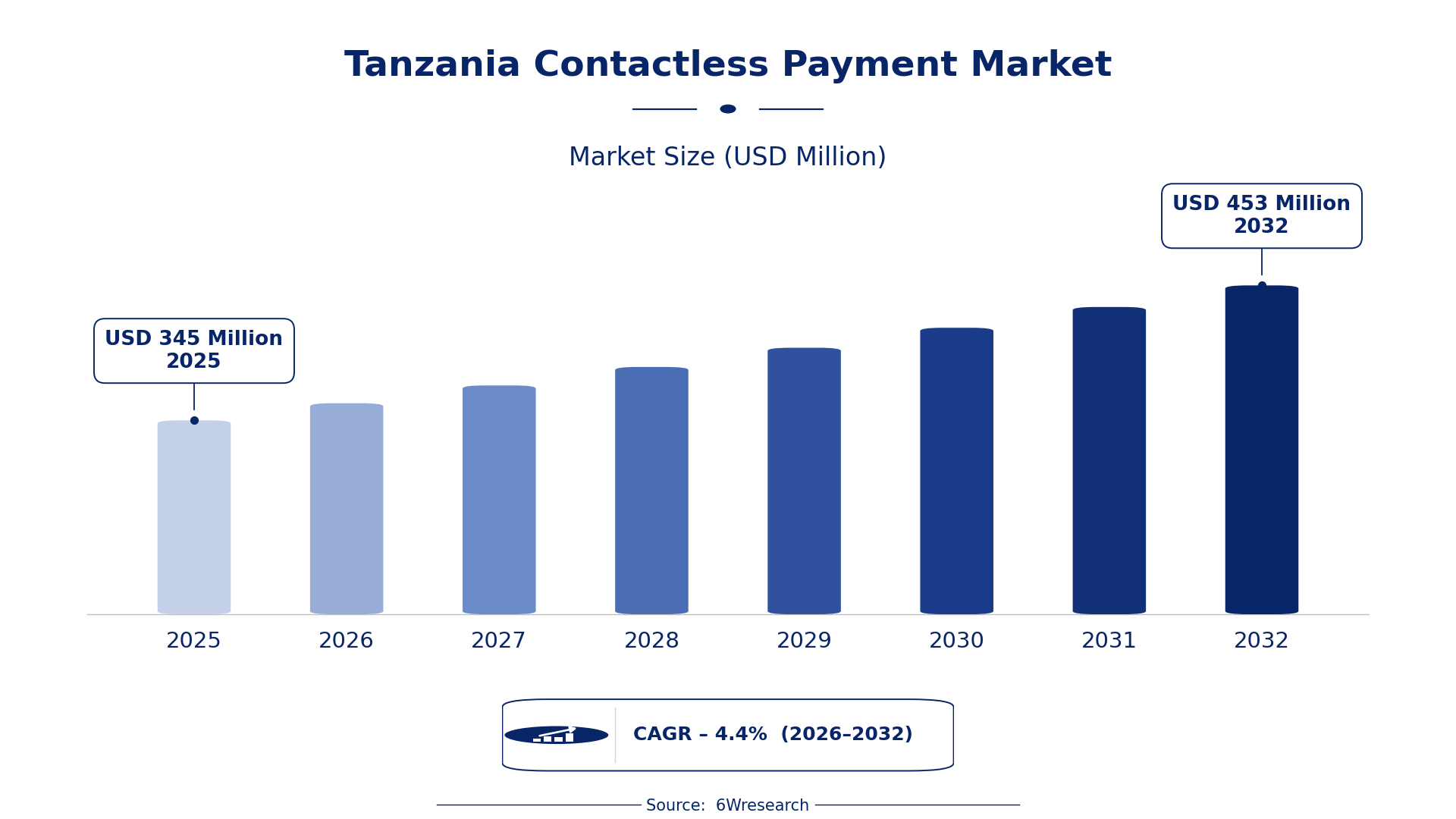
The Tanzania Contactless Payment Market was estimated at USD 345 Million in 2025 and is projected to reach USD 453 Million by 2032, growing at a CAGR of 4.4% from 2026 to 2032.
Tanzania Contactless Payment Market Synopsis
The demand for contactless payment solutions in Tanzania is being significantly bolstered by the rising smartphone penetration and the widespread adoption of mobile money services like M-Pesa. This shift is a direct response to consumers' growing preference for quick and secure payment methods, especially in urban areas.
As businesses increasingly adopt digital payment infrastructures, the government’s initiatives to enhance financial inclusion and the proliferation of e-commerce platforms are paving the way for contactless payments to become a norm rather than an exception. This evolving scenario presents a fertile ground for both local and foreign investments.
Tanzania Contactless Payment Market Year-wise Growth Rate and Key Drivers
This graph illustrates the annual growth rates of the Tanzania Contactless Payment Market from 2021 to 2032, highlighting a steady upward trajectory and projected expansion over the forecast period.
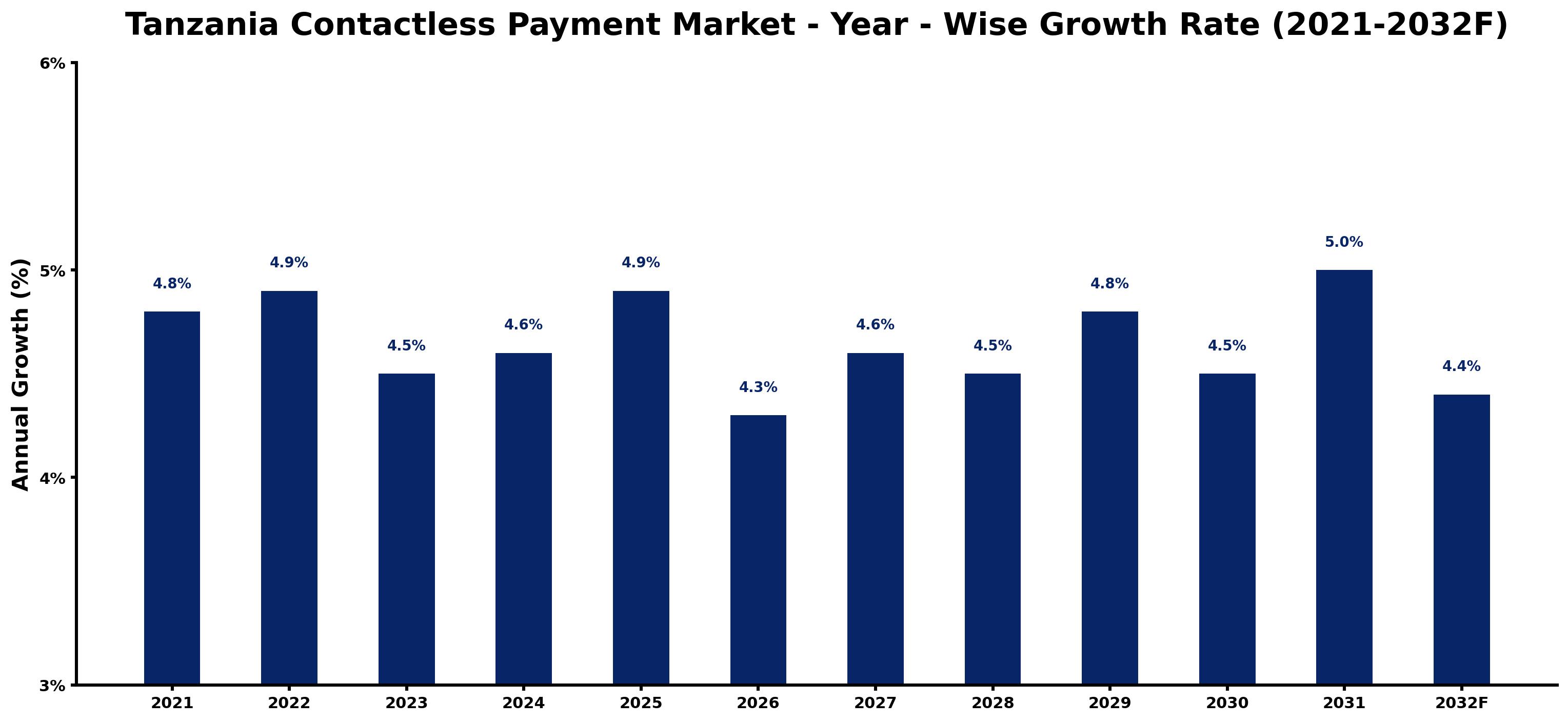
The table below presents the year‑wise growth rates along with the key drivers influencing the market
| Year | Growth Rate | Major Drivers |
| 2021 | 4.8% | Tanzania's digital payment regulations encouraging financial inclusion. |
| 2022 | 4.9% | Increased smartphone adoption facilitating contactless payment options. |
| 2023 | 4.5% | Central Bank's promotion of cashless transactions via campaigns. |
| 2024 | 4.6% | Growing merchant acceptance of digital wallets in urban areas. |
| 2025 | 4.9% | COVID-19 accelerated demand for hygienic payment solutions. |
| 2026 | 4.3% | Rising urban population driving demand for efficient transactions. |
| 2027 | 4.6% | Emerging partnerships between banks and mobile operators. |
| 2028 | 4.5% | Investment in mobile network infrastructure enhancing payment access. |
| 2029 | 4.8% | Consumer preference shifts towards secure digital payment methods. |
| 2030 | 4.5% | Government initiatives advocating for reduced cash dependency. |
| 2031 | 5.0% | Increased international tourism boosting contactless payment adoption. |
| 2032 | 4.4% | Enhanced cybersecurity measures improving consumer trust in payments. |
Note: Market size estimations and growth projections presented in this report are based on 6Wresearch's proprietary forecasting methodology, utilizing the latest available industry data, government publications, and primary research inputs.
Tanzania Contactless Payment Market Key Takeaways
Below are some of the specific key takeaways from the market, including:
- The market is anticipated to expand as consumer demand for cashless transactions continues to grow.
- Mobile payment platforms are driving the adoption of contactless solutions throughout the country.
- Government policies aimed at promoting digital financial services are crucial for market development.
- Investment opportunities are plentiful, particularly in fintech and innovative payment solutions.
- Infrastructure improvements are essential to address connectivity issues in remote areas.
Evaluation of Restraints in Tanzania Contactless Payment Market
Despite the promising growth trajectory, the Tanzania contactless payment market faces notable challenges. A significant number of merchants still lack the necessary infrastructure to accept contactless payments, which hampers widespread adoption. on top of that, low consumer awareness and trust in the technology slow down its uptake.
Infrastructure limitations, particularly in rural areas, pose hurdles to the seamless operation of contactless payment systems. Additionally, regulatory barriers around data security and privacy remain a concern that needs to be addressed to foster a more supportive environment for these payment solutions.
Tanzania Contactless Payment Market Trends
The trends shaping the Tanzania contactless payment market are heavily influenced by the increasing demand for digital payment solutions. The pandemic has accelerated the shift towards cashless transactions, with mobile wallets and NFC-enabled cards gaining traction as preferred payment methods. Consumers are seeking faster, safer, and more convenient ways to transact.
E-commerce is also on the rise, creating a stronger demand for contactless payments as businesses strive to enhance customer experience. The government’s push for digital financial inclusion continues to play a critical role in this market's evolution.
Tanzania Contactless Payment Market Opportunities
Investment opportunities in the Tanzania contactless payment market are ripe for exploitation. As the demand for cashless solutions rises, there is a pressing need for innovative payment technologies that cater to the diverse needs of consumers. The unbanked population represents a significant market segment that can benefit from accessible digital payment options.
Partnerships with financial institutions to expand payment networks are also a promising avenue for growth. Additionally, the government's ongoing initiatives to build a cashless economy create a conducive environment for startups and established players alike to invest in fintech innovations.
Government Initiatives in the Tanzania Contactless Payment Market
The Tanzanian government is actively fostering an environment conducive to the growth of contactless payments. By regulating and supervising electronic payment systems through the Bank of Tanzania, the government aims to enhance the security and efficiency of transactions. These initiatives are essential for ensuring that consumers feel safe and supported as they transition to digital financial solutions.
- A recently completed initiative involved the introduction of new guidelines to regulate electronic payment systems, enhancing transaction security.
- A current initiative focuses on the rollout of a national financial inclusion framework aimed at increasing access to financial services for all citizens.
- Planned for the next few years is a comprehensive public-private partnership to upgrade digital infrastructure across remote regions.
- Ongoing efforts to educate consumers about digital payment options are crucial for building trust in contactless technologies.
- A regulatory framework is expected to be introduced to promote transparency in transaction billing and data security by 2026.
Future Insights of the Tanzania Contactless Payment Market
Looking ahead, the Tanzania contactless payment market is set for significant transformation. With advancements in technology and infrastructure improvements, the landscape for digital payments will become increasingly competitive. As consumers become more accustomed to cashless transactions, the integration of contactless payment options into everyday commerce is inevitable.
The government's commitment to promoting financial inclusion will further drive the market's expansion, creating a solid foundation for sustainable growth. Expect to see a surge in partnerships and innovations that enhance user experience, as both local and international players recognize the potential of this evolving market.
Tanzania Contactless Payment Market Latest Developments
In the last year, the Tanzania contactless payment market has seen a flurry of activity as stakeholders respond to the increasing demand for digital payment solutions. The emphasis on convenience and security has led to a number of noteworthy developments, setting the stage for future advancements in the sector.
- A major technology vendor announced a partnership in early 2025 aimed at rolling out NFC-enabled payment terminals across urban areas.
- An ongoing initiative focuses on enhancing mobile wallet functionalities, which began in Q3 2025 and is expected to continue through 2026.
- A leading financial institution is currently piloting a contactless payment solution for small businesses, which is expected to launch by mid-2026.
- Recent investments in digital infrastructure upgrades are underway, aimed at improving connectivity in underserved regions.
- A rollout of a nationwide awareness campaign about contactless payment security is planned for late 2025 to bolster consumer trust.
Tanzania Contactless Payment Market - Key Attractiveness of the Report
- 10 Years of Market Numbers
- Historical Data Starting from 2022 to 2025
- Base Year: 2025
- Forecast Data until 2032
- Key Performance Indicators Impacting the Market
- Major Upcoming Developments and Projects
Key Highlights of the Report:
- Tanzania Contactless Payment Market Outlook
- Market Size of Tanzania Contactless Payment Market, 2025
- Forecast of Tanzania Contactless Payment Market, 2032
- Historical Data and Forecast of Tanzania Contactless Payment Revenues & Volume for the Period 2022-2032F
- Tanzania Contactless Payment Market Trend Evolution
- Tanzania Contactless Payment Market Drivers and Challenges
- Tanzania Contactless Payment Price Trends
- Tanzania Contactless Payment Porter's Five Forces
- Tanzania Contactless Payment Industry Life Cycle
- Historical Data and Forecast of Tanzania Contactless Payment Market Revenues & Volume By Component for the Period 2022-2032F
- Historical Data and Forecast of Tanzania Contactless Payment Market Revenues & Volume By Hardware for the Period 2022-2032F
- Historical Data and Forecast of Tanzania Contactless Payment Market Revenues & Volume By Solutions for the Period 2022-2032F
- Historical Data and Forecast of Tanzania Contactless Payment Market Revenues & Volume By Services for the Period 2022-2032F
- Historical Data and Forecast of Tanzania Contactless Payment Market Revenues & Volume By Vertical for the Period 2022-2032F
- Historical Data and Forecast of Tanzania Contactless Payment Market Revenues & Volume By Retail for the Period 2022-2032F
- Historical Data and Forecast of Tanzania Contactless Payment Market Revenues & Volume By Hospitality for the Period 2022-2032F
- Historical Data and Forecast of Tanzania Contactless Payment Market Revenues & Volume By Healthcare for the Period 2022-2032F
- Historical Data and Forecast of Tanzania Contactless Payment Market Revenues & Volume By Energy and Utilities for the Period 2022-2032F
- Historical Data and Forecast of Tanzania Contactless Payment Market Revenues & Volume By Transportation and Logistics for the Period 2022-2032F
- Historical Data and Forecast of Tanzania Contactless Payment Market Revenues & Volume By BFSI for the Period 2022-2032F
- Historical Data and Forecast of Tanzania Contactless Payment Market Revenues & Volume By Others (Government, telecommunications, and education) for the Period 2022-2032F
- Tanzania Contactless Payment Import Export Trade Statistics
- Market Opportunity Assessment By Component
- Market Opportunity Assessment By Vertical
- Tanzania Contactless Payment Top Companies Market Share
- Tanzania Contactless Payment Competitive Benchmarking By Technical and Operational Parameters
- Tanzania Contactless Payment Company Profiles
- Tanzania Contactless Payment Key Strategic Recommendations






































