Tanzania Ice Maker Market: Top 5 Importing Countries and Market Competition (HHI) Analysis
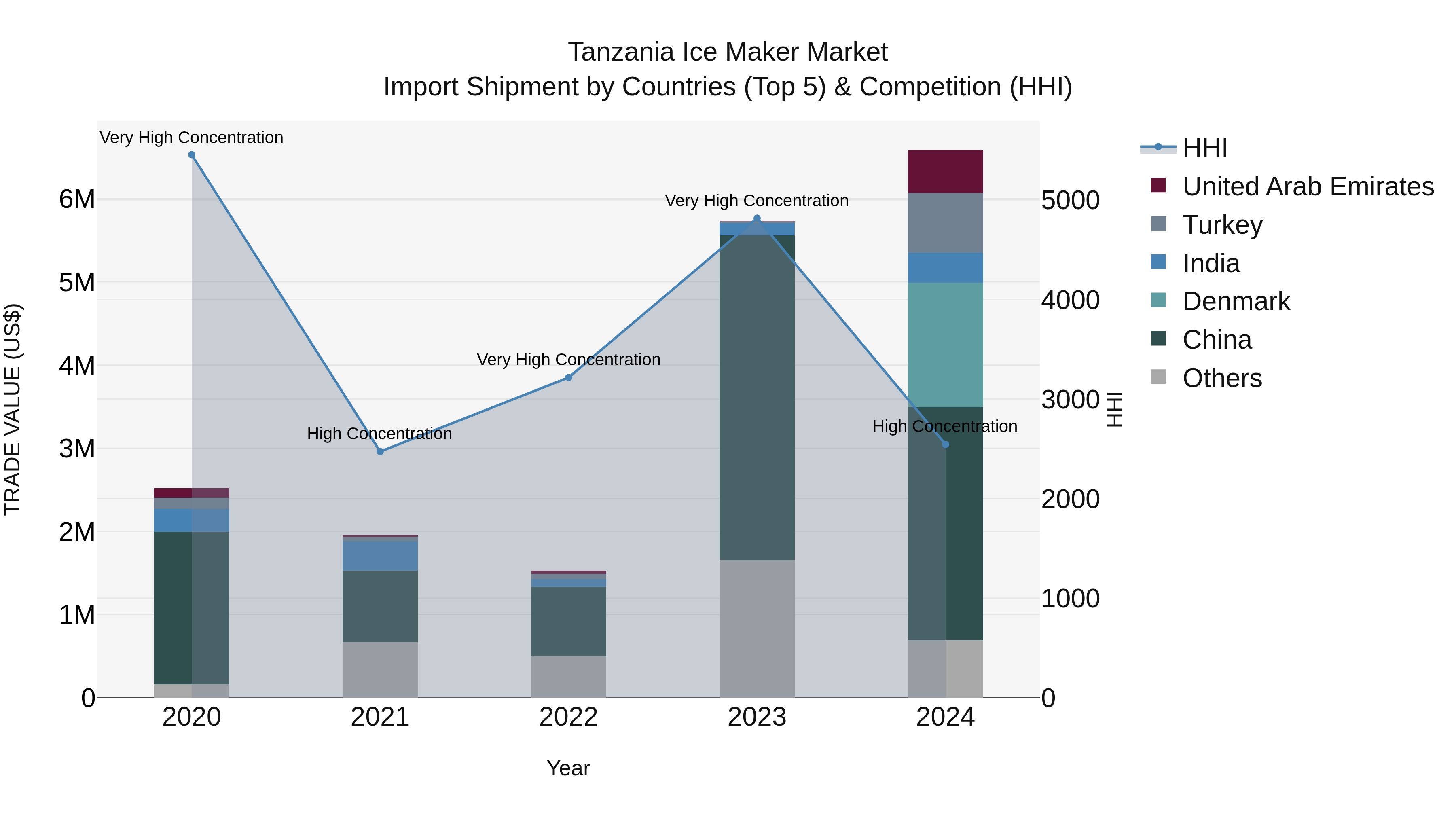
The ice maker import market in Tanzania continued to show strong growth in 2024, with the top exporting countries being China, Denmark, Turkey, United Arab Emirates, and India. The high concentration of the market in terms of the Herfindahl-Hirschman Index (HHI) remained a notable trend from 2023 to 2024. The impressive compound annual growth rate (CAGR) of 27.17% from 2020 to 2024 indicates a thriving market, while the growth rate of 14.86% from 2023 to 2024 highlights sustained momentum. Tanzania`s demand for ice makers is evidently on the rise, attracting suppliers from diverse regions.
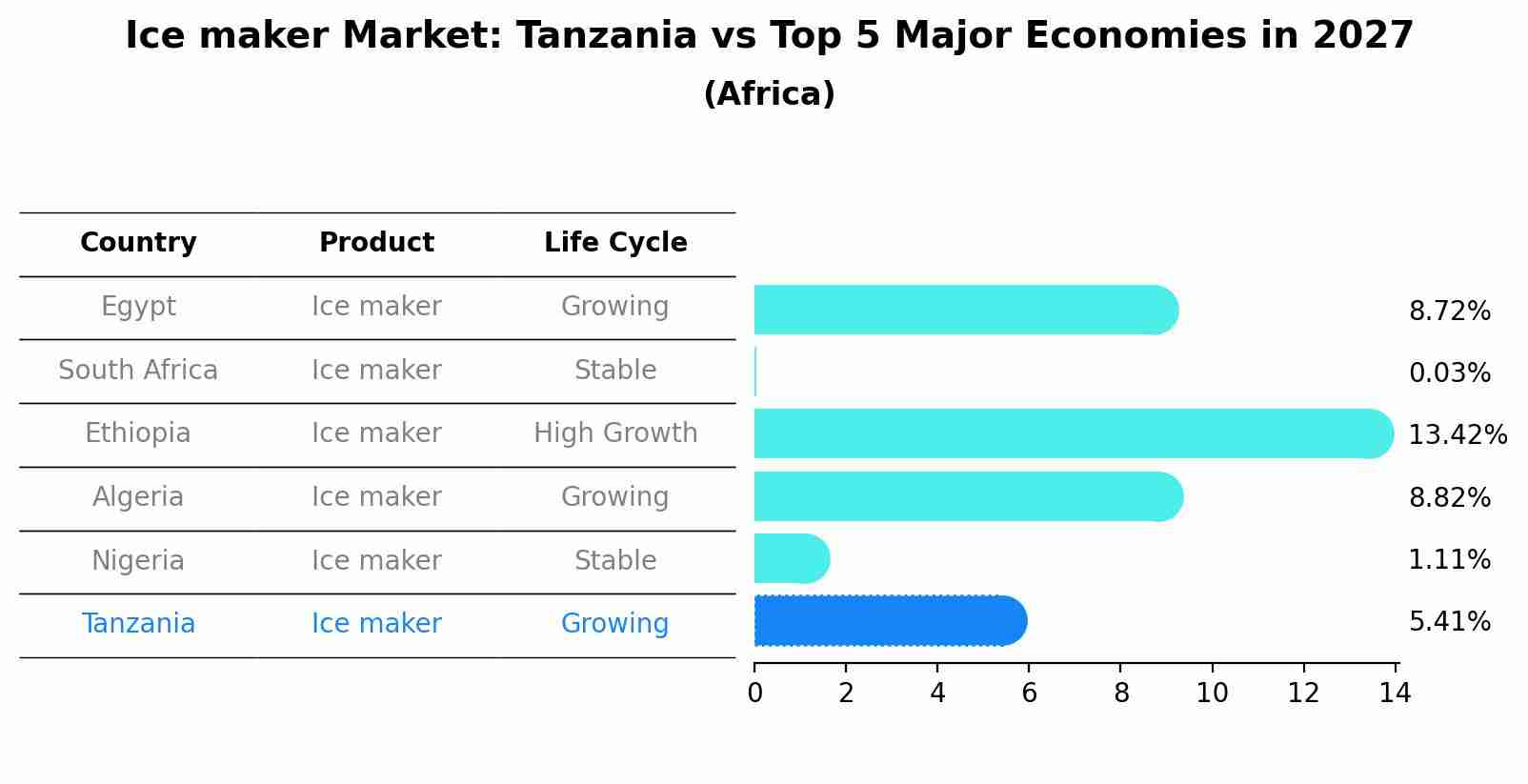
Ice maker Market: Tanzania vs Top 5 Major Economies in 2027 (Africa)
By 2027, the Ice maker market in Tanzania is anticipated to reach a growth rate of 5.41%, as part of an increasingly competitive Africa region, where Egypt remains at the forefront, supported by South Africa, Ethiopia, Algeria and Nigeria, driving innovations and market adoption across sectors.
Tanzania Ice maker Market Overview
The Tanzania ice maker market is witnessing steady growth driven by the increasing demand for ice across various sectors such as hospitality, healthcare, and retail. The market is characterized by a rising number of small to medium-sized enterprises offering a range of ice making solutions including ice cube machines, ice flake machines, and ice block machines. These solutions cater to diverse requirements in terms of ice production capacity and efficiency. Key factors influencing the market include improving infrastructure, expanding tourism industry, and growing food and beverage sector. Additionally, technological advancements in ice making equipment and a focus on energy efficiency are shaping the market landscape. With a competitive market environment, players are focusing on product innovation, distribution network expansion, and strategic partnerships to strengthen their market presence and gain a competitive edge.
Tanzania Ice maker Market Trends
The Tanzania ice maker market is experiencing a growing demand for portable and compact ice makers due to their convenience and suitability for small-scale businesses and personal use. Consumers are also showing interest in energy-efficient models to reduce operating costs and environmental impact. Additionally, there is a trend towards ice makers with faster production rates and larger storage capacities to meet the needs of commercial establishments such as restaurants, bars, and hotels. Manufacturers are focusing on incorporating advanced technologies such as automatic cleaning functions and smart connectivity features to enhance user experience. Overall, the Tanzania ice maker market is witnessing a shift towards more efficient, versatile, and user-friendly products to cater to the evolving needs of consumers and businesses alike.
Tanzania Ice maker Market Challenges
In the Tanzania ice maker market, some of the key challenges include unreliable electricity supply, which can hinder the consistent operation of ice making equipment. Additionally, the high initial investment costs for purchasing ice makers and the ongoing maintenance expenses pose barriers for small businesses looking to enter the market. Limited access to financing options further complicates the situation for entrepreneurs seeking to invest in ice making machinery. Furthermore, competition from informal ice sellers who may offer lower prices due to lower operating costs can squeeze profit margins for formal ice maker businesses. Lastly, inadequate infrastructure for transporting and storing ice in some regions of Tanzania can also impact the distribution and availability of ice to customers, especially in remote areas.
Tanzania Ice maker Market Investment Opportunities
The Tanzania ice maker market presents promising investment opportunities due to the country`s growing hospitality industry, increasing demand for cold storage solutions in the food and beverage sector, and improving infrastructure supporting cold chain logistics. Investing in modern, energy-efficient ice making equipment to cater to hotels, restaurants, and supermarkets can be lucrative. Additionally, targeting remote areas and small-scale businesses with portable ice makers can tap into underserved markets. Providing maintenance and repair services for existing ice maker units can also be a profitable venture. Overall, the Tanzania ice maker market offers potential for growth and diversification, especially with the rising awareness of food safety and quality standards driving the need for reliable ice production solutions.
Tanzania Ice maker Market Government Policy
The Tanzanian government has implemented various policies related to the ice maker market to promote local production and ensure quality standards. These policies include import restrictions to protect the domestic ice maker industry, tax incentives for manufacturers to encourage investment and growth, and regulations on product quality and safety to safeguard consumer interests. Additionally, the government has implemented initiatives to support small and medium enterprises in the ice maker sector through capacity building programs and access to financing. Overall, these policies aim to promote the development of the ice maker market in Tanzania, boost local production capabilities, and ensure that consumers have access to high-quality and safe products.
Tanzania Ice maker Market Future Outlook
The Tanzania ice maker market is poised for steady growth in the coming years, driven by increasing demand from various sectors such as hospitality, healthcare, and food and beverage. The market is expected to benefit from the rising number of restaurants, bars, and hotels in the country, as well as the growing popularity of cold beverages and frozen foods. Additionally, improvements in technology and the availability of energy-efficient ice making solutions are likely to fuel market expansion. With a focus on enhancing food safety standards and the need for reliable ice production equipment, the Tanzania ice maker market is expected to see a positive trajectory in the foreseeable future.
Key Highlights of the Report:
- Tanzania Ice maker Market Outlook
- Market Size of Tanzania Ice maker Market, 2021
- Forecast of Tanzania Ice maker Market, 2027
- Historical Data and Forecast of Tanzania Ice maker Revenues & Volume for the Period 2018 - 2027
- Tanzania Ice maker Market Trend Evolution
- Tanzania Ice maker Market Drivers and Challenges
- Tanzania Ice maker Price Trends
- Tanzania Ice maker Porter's Five Forces
- Tanzania Ice maker Industry Life Cycle
- Historical Data and Forecast of Tanzania Ice maker Market Revenues & Volume By Product type for the Period 2018 - 2027
- Historical Data and Forecast of Tanzania Ice maker Market Revenues & Volume By Ice Cube Maker for the Period 2018 - 2027
- Historical Data and Forecast of Tanzania Ice maker Market Revenues & Volume By Ice Flake Maker for the Period 2018 - 2027
- Historical Data and Forecast of Tanzania Ice maker Market Revenues & Volume By Ice Nugget Maker for the Period 2018 - 2027
- Historical Data and Forecast of Tanzania Ice maker Market Revenues & Volume By Others for the Period 2018 - 2027
- Historical Data and Forecast of Tanzania Ice maker Market Revenues & Volume By Component for the Period 2018 - 2027
- Historical Data and Forecast of Tanzania Ice maker Market Revenues & Volume By Condenser for the Period 2018 - 2027
- Historical Data and Forecast of Tanzania Ice maker Market Revenues & Volume By Evaporator for the Period 2018 - 2027
- Historical Data and Forecast of Tanzania Ice maker Market Revenues & Volume By Throttle Valve for the Period 2018 - 2027
- Historical Data and Forecast of Tanzania Ice maker Market Revenues & Volume By Compressor for the Period 2018 - 2027
- Historical Data and Forecast of Tanzania Ice maker Market Revenues & Volume By Motors for the Period 2018 - 2027
- Historical Data and Forecast of Tanzania Ice maker Market Revenues & Volume By Heating Elements for the Period 2018 - 2027
- Historical Data and Forecast of Tanzania Ice maker Market Revenues & Volume By Application for the Period 2018 - 2027
- Historical Data and Forecast of Tanzania Ice maker Market Revenues & Volume By Residential for the Period 2018 - 2027
- Historical Data and Forecast of Tanzania Ice maker Market Revenues & Volume By Commercial for the Period 2018 - 2027
- Tanzania Ice maker Import Export Trade Statistics
- Market Opportunity Assessment By Product type
- Market Opportunity Assessment By Component
- Market Opportunity Assessment By Application
- Tanzania Ice maker Top Companies Market Share
- Tanzania Ice maker Competitive Benchmarking By Technical and Operational Parameters
- Tanzania Ice maker Company Profiles
- Tanzania Ice maker Key Strategic Recommendations






































