Tanzania Smart Locks Market Size, Share & Growth Rate
The Tanzania Smart Locks Market was estimated at USD 908 Million in 2025 and is projected to reach USD 1652 Million by 2032, growing at a CAGR of 8.9% from 2026 to 2032. This trajectory is driven by an increasing urban population, as well as a growing consumer awareness of smart home technologies that prioritize security and convenience. As disposable incomes rise, more households and businesses are turning to advanced security solutions, making smart locks an attractive option for modern security needs.
Tanzania Smart Locks Market Year-wise Growth Rate and Key Drivers
This graph highlights how the Tanzania Smart Locks Market has steadily grown over the years, supported by major growth factors.
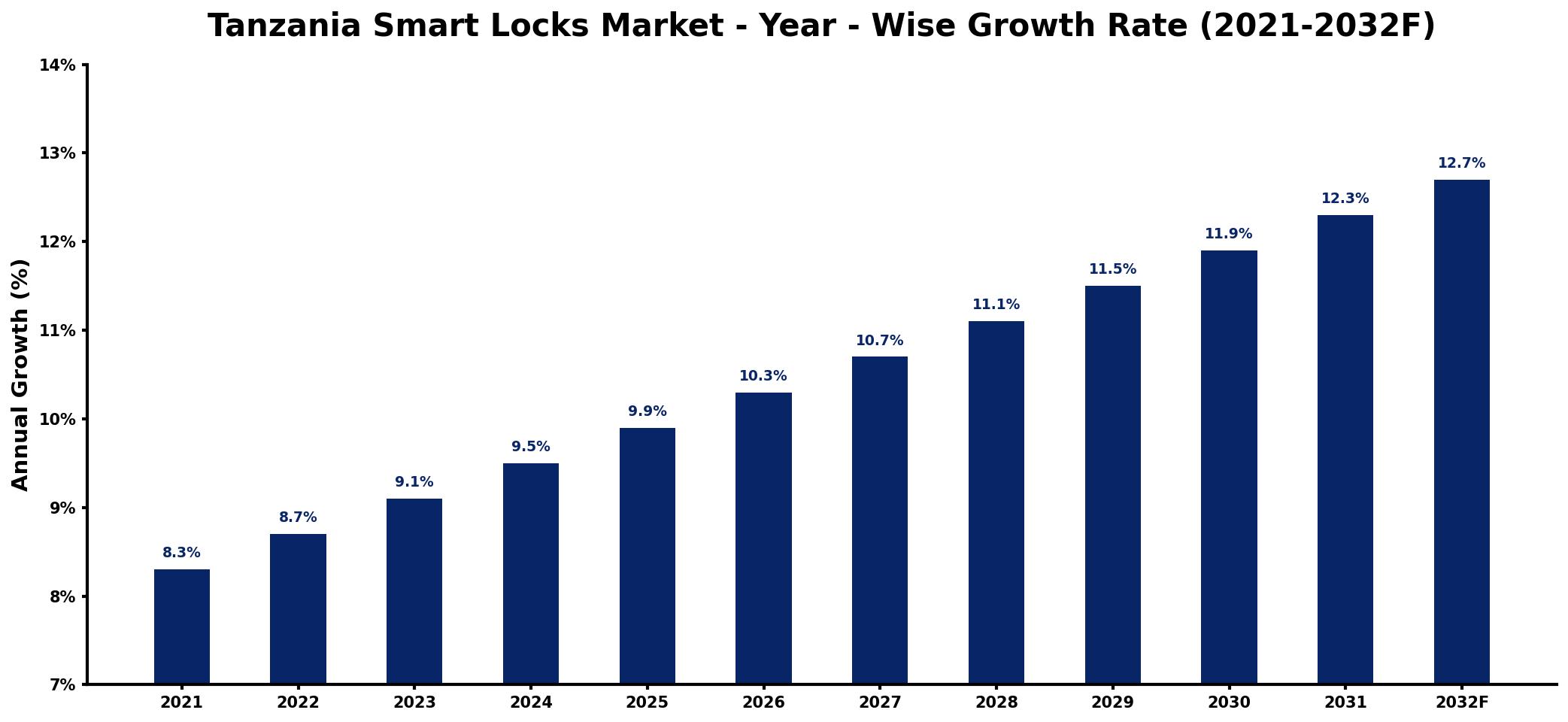
The table below presents the year‑wise growth rates along with the key drivers influencing the market
| Year | Growth Rate | Major Drivers |
| 2021 | 8.3% | Rising urbanization and infrastructure development |
| 2022 | 8.7% | Growing interest in home automation |
| 2023 | 9.1% | Increased consumer awareness of security |
| 2024 | 9.5% | Expansion of e-commerce platforms |
| 2025 | 9.9% | Technological advancements in security features |
| 2026 | 10.3% | Surge in residential construction projects |
| 2027 | 10.7% | Higher disposable income among consumers |
| 2028 | 11.1% | improved processing technologies adoption |
| 2029 | 11.5% | Rise in investment from startups |
| 2030 | 11.9% | Growing demand for convenience solutions |
| 2031 | 12.3% | Increased focus on energy efficiency |
| 2032 | 12.7% | growing downstream application demand |
Note: Market size estimations and growth projections presented in this report are based on 6Wresearch's proprietary forecasting methodology, utilizing the latest available industry data, government publications, and primary research inputs.
Tanzania Smart Locks Market Synopsis
The Tanzania Smart Locks Market is currently witnessing a transformation as consumers embrace the benefits of innovative security technologies. Increased demand for smart locks reflects a larger trend toward home automation, with many consumers seeking enhanced control over their security systems.
As urbanization accelerates and disposable incomes grow, both residential and commercial users are increasingly investing in smart lock solutions. These devices not only provide robust security features, such as remote access and activity monitoring, but also integrate seamlessly with other smart home systems, further driving their popularity.
Tanzania Smart Locks Market Key Takeaways
- Consumer interest in smart home technologies is fueling demand for advanced security solutions.
- Smart locks offer a unique blend of convenience, security, and integration, appealing to diverse user segments.
- Technological advancements, including biometric authentication and remote access, are shaping product offerings.
- Government policies are fostering growth by promoting innovation in the security sector.
- The market presents lucrative investment opportunities for businesses in manufacturing and installation services.
Evaluation of Restraints in Tanzania Smart Locks Market
Despite the positive growth trajectory, the Tanzania Smart Locks Market faces several challenges. Limited consumer awareness and understanding of smart lock technology hinder broader adoption, as many potential users remain unaware of the benefits these devices offer. The initial cost remains a barrier, as smart locks are often priced higher than traditional locking systems. Additionally, compatibility with existing door hardware poses a challenge, as do concerns surrounding cybersecurity and potential hacking incidents. Furthermore, the inconsistent internet connectivity in various regions of Tanzania limits the functionality of many smart lock systems, particularly in rural areas, which complicates their deployment and user trust.
Tanzania Smart Locks Market Trends
Emerging trends in the Tanzania Smart Locks Market are significantly shaping its landscape. The current emphasis on home automation and enhanced security has sparked an increase in smart lock adoption among consumers. Features such as biometric authentication, keyless entry, and remote monitoring are becoming standard as consumers seek higher levels of control and flexibility. Furthermore, smart locks are increasingly being integrated into comprehensive smart home ecosystems, creating a seamless user experience and ensuring that security technologies meet the evolving needs of the market.
Tanzania Smart Locks Market Opportunities
The Tanzania Smart Locks Market offers numerous opportunities for growth and investment. As security concerns mount, both residential and commercial sectors are eager to adopt advanced locking solutions that provide enhanced safety and convenience. Potential avenues for investors include partnerships with manufacturers to introduce localized products tailored to Tanzanian consumer preferences. Additionally, establishing installation and maintenance services for smart locks can provide a competitive edge, capturing a share of the growing market driven by increasing consumer demand for reliable and sophisticated security solutions.
Government Initiatives in the Tanzania Smart Locks Market
The Tanzanian government is actively supporting the growth of the Smart Locks Market through various initiatives aimed at fostering innovation in the security sector. Policies promoting technological advancement include offering incentives such as tax breaks and subsidies for businesses investing in smart lock technologies. Furthermore, regulatory measures are in place to ensure that smart lock products adhere to safety and quality standards, thereby bolstering consumer confidence. By prioritizing security and technological development, the government is creating a conducive environment for local and foreign companies to thrive in this emerging market.
Future Insights of the Tanzania Smart Locks Market
Looking ahead to the 2026-2032 period, the Tanzania Smart Locks Market is expected to experience substantial expansion. The dual drivers of urbanization and a greater emphasis on security will increase consumer demand for smart lock solutions. As IoT technology advances and smartphone penetration increases, the integration of smart locks into broader smart home systems will further enhance their appeal. Key players are likely to innovate continuously, focusing on features that cater to evolving consumer needs, such as improved connectivity and enhanced security functionalities. Overall, a bright outlook is projected for the market as it aligns with global trends toward smarter, more secure living environments.
Tanzania Smart Locks Market Latest Developments (2025 - 2026)
In the recent months, the Tanzania Smart Locks Market has seen a surge in product launches, emphasizing technological advancements and user-centric features. Companies are increasingly focusing on integrating biometric technologies and robust cybersecurity measures to build consumer trust. Additionally, there has been a notable increase in marketing campaigns aimed at educating consumers about the benefits of smart locks, addressing misconceptions, and emphasizing their role in enhancing security. As competition intensifies, businesses are exploring strategic partnerships to broaden distribution networks and improve service delivery.
Tanzania Smart Locks Market - Key Attractiveness of the Report
- 10 Years of Market Numbers
- Historical Data Starting from 2022 to 2025
- Base Year: 2025
- Forecast Data until 2032
- Key Performance Indicators Impacting the Market
- Major Upcoming Developments and Projects
Key Highlights of the Report:
- Tanzania Smart Locks Market Outlook
- Market Size of Tanzania Smart Locks Market, 2025
- Forecast of Tanzania Smart Locks Market, 2032
- Historical Data and Forecast of Tanzania Smart Locks Revenues & Volume for the Period 2022-2032F
- Tanzania Smart Locks Market Trend Evolution
- Tanzania Smart Locks Market Drivers and Challenges
- Tanzania Smart Locks Price Trends
- Tanzania Smart Locks Porter's Five Forces
- Tanzania Smart Locks Industry Life Cycle
- Historical Data and Forecast of Tanzania Smart Locks Market Revenues & Volume By Product for the Period 2022-2032F
- Historical Data and Forecast of Tanzania Smart Locks Market Revenues & Volume By Deadbolts for the Period 2022-2032F
- Historical Data and Forecast of Tanzania Smart Locks Market Revenues & Volume By Lever Handles for the Period 2022-2032F
- Historical Data and Forecast of Tanzania Smart Locks Market Revenues & Volume By Padlocks for the Period 2022-2032F
- Historical Data and Forecast of Tanzania Smart Locks Market Revenues & Volume By Others for the Period 2022-2032F
- Historical Data and Forecast of Tanzania Smart Locks Market Revenues & Volume By Technology for the Period 2022-2032F
- Historical Data and Forecast of Tanzania Smart Locks Market Revenues & Volume By Bluetooth for the Period 2022-2032F
- Historical Data and Forecast of Tanzania Smart Locks Market Revenues & Volume By Wi-Fi for the Period 2022-2032F
- Historical Data and Forecast of Tanzania Smart Locks Market Revenues & Volume By End User for the Period 2022-2032F
- Historical Data and Forecast of Tanzania Smart Locks Market Revenues & Volume By Residential for the Period 2022-2032F
- Historical Data and Forecast of Tanzania Smart Locks Market Revenues & Volume By Commercial for the Period 2022-2032F
- Tanzania Smart Locks Import Export Trade Statistics
- Market Opportunity Assessment By Product
- Market Opportunity Assessment By Technology
- Market Opportunity Assessment By End User
- Tanzania Smart Locks Top Companies Market Share
- Tanzania Smart Locks Competitive Benchmarking By Technical and Operational Parameters
- Tanzania Smart Locks Company Profiles
- Tanzania Smart Locks Key Strategic Recommendations






































