Thailand Ammonium Bisulfite Market Size, Share & Growth Rate
The Thailand Ammonium Bisulfite Market was estimated at USD 193 Million in 2025 and is projected to reach USD 220 Million by 2032, growing at a CAGR of 1.9% from 2026 to 2032. This steady growth trajectory is underpinned by the increasing demand for ammonium bisulfite in vital sectors such as water treatment and the pulp and paper industry. As environmental regulations tighten, the need for effective chemical solutions that enhance water quality and support sustainable practices becomes paramount.
Thailand Ammonium Bisulfite Market Year-wise Growth Rate and Key Drivers
This graph highlights how the Thailand Ammonium Bisulfite Market has steadily grown over the years, supported by major growth factors.
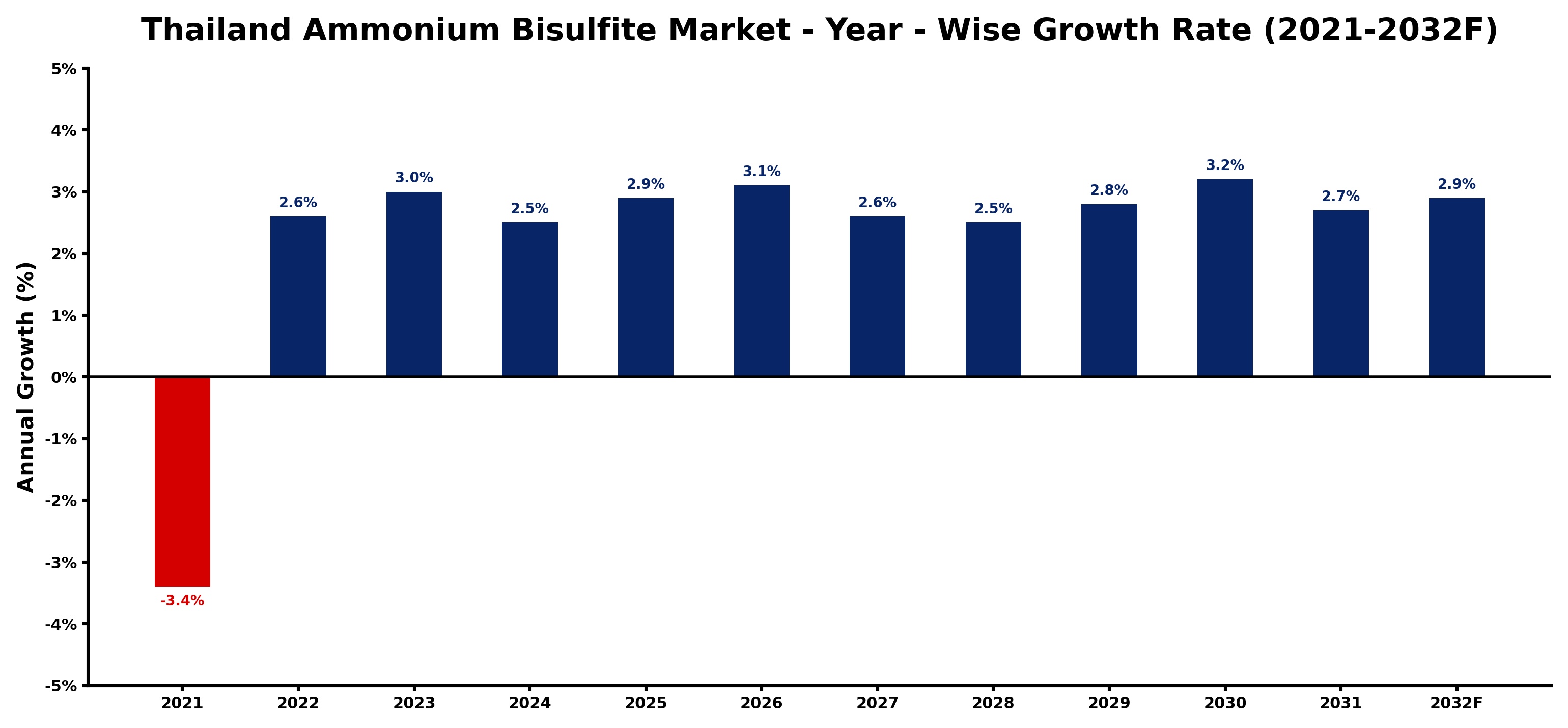
The table below presents the year‑wise growth rates along with the key drivers influencing the market
| Year | Growth Rate | Major Drivers |
| 2021 | -3.4% | Supply chain disruptions limited availability |
| 2022 | 2.6% | Industrial applications expanded significantly |
| 2023 | 3.0% | Sustainability initiatives drove demand |
| 2024 | 2.5% | Chemical manufacturing increased production |
| 2025 | 2.9% | Export opportunities enhanced market reach |
| 2026 | 3.1% | Regulatory support fostered innovation |
| 2027 | 2.6% | Technological advancements improved efficiency |
| 2028 | 2.5% | Consumer awareness heightened product usage |
| 2029 | 2.8% | Partnerships strengthened distribution networks |
| 2030 | 3.2% | Investment in infrastructure increased capacity |
| 2031 | 2.7% | Market diversification attracted new players |
| 2032 | 2.9% | Research and development fueled growth |
Note - Market size estimations and growth projections presented in this report are based on 6Wresearch’s advanced forecasting approach, validated with industry datasets as of June 2026.
Thailand Ammonium Bisulfite Market Synopsis
Currently, the ammonium bisulfite market in Thailand is characterized by a significant dependency on imports, which make up over 73% of the total market volume. With a total consumption of approximately 4 thousand metric tons, the market value is approximately USD 3 million, reflecting the chemical's essential role in various applications.
The chemical's prominence is particularly notable in the pulp and paper industry, where it is utilized as a reducing agent. Additionally, increasing awareness of water pollution and treatment efficacy continues to drive demand, making ammonium bisulfite a critical component for both industrial and environmental applications.
Thailand Ammonium Bisulfite Market Key Takeaways
- The market is heavily reliant on imports, with major suppliers from India, Germany, and the UK.
- Domestic production contributes significantly but remains dwarfed by import volumes.
- Key applications include water treatment and the pulp and paper industry, underscoring the chemical's versatility.
- Heightened environmental regulations are driving a more strategic focus on quality and compliance among manufacturers.
- Recovery in sectors impacted by the COVID-19 pandemic could lead to a resurgence in ammonium bisulfite demand.
Evaluation of Restraints in Thailand Ammonium Bisulfite Market
Despite the optimistic growth outlook, the Thailand ammonium bisulfite market encounters several restraints. One significant challenge lies in maintaining consistent product quality, largely influenced by fluctuations in raw material sources and production processes. Furthermore, stringent regulatory frameworks concerning the safe handling and disposal of chemicals impose additional operational costs, which may deter smaller manufacturers from competing effectively. These elements could potentially inhibit market expansion if not adequately addressed by stakeholders.
Thailand Ammonium Bisulfite Market Trends
Emerging trends in the Thai ammonium bisulfite market indicate a growing shift towards eco-friendly and sustainable production processes. As companies prioritize environmental responsibility, innovations aimed at reducing waste and enhancing product safety are becoming more prominent. Additionally, advancements in water treatment technologies that incorporate ammonium bisulfite are gaining traction, fostering an environment where efficiency and sustainability are paramount.
Thailand Ammonium Bisulfite Market Opportunities
The evolving landscape presents several lucrative opportunities for investment in the Thailand ammonium bisulfite market. The burgeoning demand for water treatment solutions, driven by increased urbanization and industrial activity, opens avenues for companies to enhance their product offerings. Moreover, collaborations with environmental agencies can facilitate the development of more sophisticated applications, fostering market growth. The emphasis on sustainable practices will also create openings for those willing to innovate and meet changing consumer demands.
Government Initiatives in the Thailand Ammonium Bisulfite Market
The Thai government has initiated various policies to encourage sustainable practices in chemical production, particularly in sectors impacting public health and the environment. Public funding aimed at enhancing water quality infrastructure and promoting compliance with international standards reflects a commitment to better environmental management. Furthermore, incentives for companies adopting eco-friendly technologies may spur further growth in the ammonium bisulfite market.
Future Insights of the Thailand Ammonium Bisulfite Market
Looking ahead to 2026-2032, the Thailand ammonium bisulfite market is poised for steady expansion, driven by both domestic production enhancements and increased import capacity. The anticipated growth of the pulp and paper industry, coupled with rising environmental concerns, positions ammonium bisulfite as a vital component for both industrial processes and ecological sustainability. Stakeholders that prioritize quality and compliance will likely benefit from market opportunities as demand continues to rise.
Thailand Ammonium Bisulfite Market Latest Developments (May 2025 - June 2026)
Recent trends indicate a heightened focus on product innovation, with various initiatives aimed at improving the effectiveness of ammonium bisulfite in water treatment applications. The industry is also witnessing an uptick in strategic partnerships between manufacturers and research institutions, aiming to enhance production processes while adhering to stricter environmental standards. Additionally, a shift in consumer preferences toward sustainable products is influencing manufacturers to diversify their chemical offerings.
Thailand Ammonium Bisulfite Market - Key Attractiveness of the Report
- 10 Years of Market Numbers
- Historical Data Starting from 2022 to 2025
- Base Year: 2025
- Forecast Data until 2032
- Key Performance Indicators Impacting the Market
- Major Upcoming Developments and Projects
Key Highlights of the Report:
- Thailand Ammonium Bisulfite Market Outlook
- Market Size of Thailand Ammonium Bisulfite Market, 2025
- Forecast of Thailand Ammonium Bisulfite Market, 2032
- Historical Data and Forecast of Thailand Ammonium Bisulfite Revenues & Volume for the Period 2022-2032F
- Thailand Ammonium Bisulfite Market Trend Evolution
- Thailand Ammonium Bisulfite Market Drivers and Challenges
- Thailand Ammonium Bisulfite Price Trends
- Thailand Ammonium Bisulfite Porter's Five Forces
- Thailand Ammonium Bisulfite Industry Life Cycle
- Historical Data and Forecast of Thailand Ammonium Bisulfite Market Revenues & Volume By Type for the Period 2022-2032F
- Historical Data and Forecast of Thailand Ammonium Bisulfite Market Revenues & Volume By Pharmaceutical Grade for the Period 2022-2032F
- Historical Data and Forecast of Thailand Ammonium Bisulfite Market Revenues & Volume By Chemical Grade for the Period 2022-2032F
- Historical Data and Forecast of Thailand Ammonium Bisulfite Market Revenues & Volume By Application for the Period 2022-2032F
- Historical Data and Forecast of Thailand Ammonium Bisulfite Market Revenues & Volume By Reducing Agent for the Period 2022-2032F
- Historical Data and Forecast of Thailand Ammonium Bisulfite Market Revenues & Volume By Medicine for the Period 2022-2032F
- Historical Data and Forecast of Thailand Ammonium Bisulfite Market Revenues & Volume By Dye Intermediates for the Period 2022-2032F
- Historical Data and Forecast of Thailand Ammonium Bisulfite Market Revenues & Volume By Other for the Period 2022-2032F
- Thailand Ammonium Bisulfite Import Export Trade Statistics
- Market Opportunity Assessment By Type
- Market Opportunity Assessment By Application
- Thailand Ammonium Bisulfite Top Companies Market Share
- Thailand Ammonium Bisulfite Competitive Benchmarking By Technical and Operational Parameters
- Thailand Ammonium Bisulfite Company Profiles
- Thailand Ammonium Bisulfite Key Strategic Recommendations






































