Thailand Aromatic Compounds Market: Import Trend Analysis
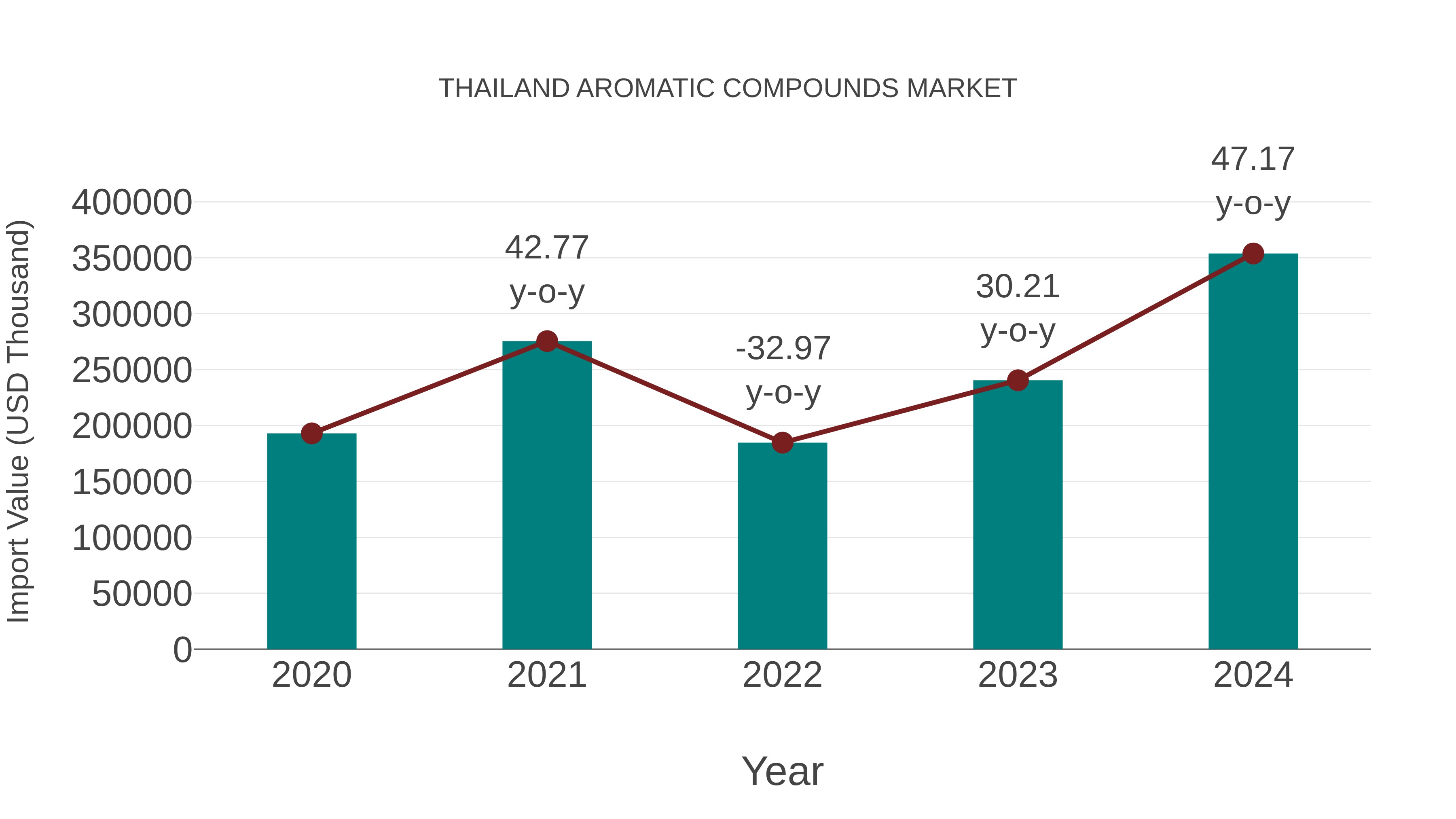
Thailand import momentum for aromatic compounds in 2024 surged with a growth rate of 47.17%, marking a notable increase from the 16.37% compound annual growth rate observed from 2020 to 2023. This substantial uptick in imports can be attributed to a significant shift in demand dynamics within the market, likely driven by evolving consumer preferences or changes in industrial applications.
Thailand Aromatic Compounds Market Synopsis
The aromatic compounds market in Thailand is a significant part of the petrochemical industry. Aromatic compounds like benzene, toluene, and xylene are used as raw materials for the production of various chemicals, plastics, and synthetic fibers. The demand for aromatic compounds is closely tied to the overall performance of the petrochemical and manufacturing sectors in Thailand.
Drivers of the Market
Aromatic compounds are integral to the petrochemical and chemical industries in Thailand. The market is driven by the country`s industrial growth, particularly in the production of plastics, resins, and chemicals. Technological advancements and innovations in chemical processes also impact the market. Furthermore, international demand for aromatic compounds, trade agreements, and competition with other chemical-producing nations are driving factors.
Challenges of the Market
The aromatic compounds market in Thailand faces several challenges. Firstly, the market is closely tied to the petrochemical industry, making it susceptible to fluctuations in crude oil prices and supply disruptions. Maintaining a stable supply chain is essential. Secondly, environmental concerns and regulatory changes regarding emissions and waste disposal are increasing production costs and necessitating cleaner production processes. Thirdly, competition from other regions and countries with lower production costs can affect market share. Companies must focus on product quality and innovation to remain competitive. Finally, market demand can be influenced by shifts in consumer preferences and the broader economy, requiring adaptability and market diversification.
COVID-19 Impact on the Market
The Thailand aromatic compounds market faced challenges during the COVID-19 pandemic due to reduced demand from various industries, including automotive and textiles. Aromatic compounds are widely used in the production of plastics, chemicals, and textiles, and disruptions in these sectors led to decreased demand. As economic activities recover, the market is expected to gradually regain its footing.
Key Players in the Market
In the realm of chemicals, the aromatic compounds market features companies like Indorama Ventures Public Company Limited. Indorama is a global player in the petrochemical industry and is involved in the production of a wide range of chemicals, including aromatic compounds.
Key Highlights of the Report:
- Thailand Aromatic Compounds Market Outlook
- Market Size of Thailand Aromatic Compounds Market, 2025
- Forecast of Thailand Aromatic Compounds Market, 2032
- Historical Data and Forecast of Thailand Aromatic Compounds Revenues & Volume for the Period 2022-2032F
- Thailand Aromatic Compounds Market Trend Evolution
- Thailand Aromatic Compounds Market Drivers and Challenges
- Thailand Aromatic Compounds Price Trends
- Thailand Aromatic Compounds Porter's Five Forces
- Thailand Aromatic Compounds Industry Life Cycle
- Historical Data and Forecast of Thailand Aromatic Compounds Market Revenues & Volume By Type for the Period 2022-2032F
- Historical Data and Forecast of Thailand Aromatic Compounds Market Revenues & Volume By Benzene for the Period 2022-2032F
- Historical Data and Forecast of Thailand Aromatic Compounds Market Revenues & Volume By Xylene for the Period 2022-2032F
- Historical Data and Forecast of Thailand Aromatic Compounds Market Revenues & Volume By Toluene for the Period 2022-2032F
- Historical Data and Forecast of Thailand Aromatic Compounds Market Revenues & Volume By Application for the Period 2022-2032F
- Historical Data and Forecast of Thailand Aromatic Compounds Market Revenues & Volume By Solvent for the Period 2022-2032F
- Historical Data and Forecast of Thailand Aromatic Compounds Market Revenues & Volume By Additive for the Period 2022-2032F
- Historical Data and Forecast of Thailand Aromatic Compounds Market Revenues & Volume By End-use for the Period 2022-2032F
- Historical Data and Forecast of Thailand Aromatic Compounds Market Revenues & Volume By Packaging for the Period 2022-2032F
- Historical Data and Forecast of Thailand Aromatic Compounds Market Revenues & Volume By Detergent And Dyes for the Period 2022-2032F
- Historical Data and Forecast of Thailand Aromatic Compounds Market Revenues & Volume By Automobile for the Period 2022-2032F
- Historical Data and Forecast of Thailand Aromatic Compounds Market Revenues & Volume By Electronic Devices for the Period 2022-2032F
- Historical Data and Forecast of Thailand Aromatic Compounds Market Revenues & Volume By Medical Devices for the Period 2022-2032F
- Historical Data and Forecast of Thailand Aromatic Compounds Market Revenues & Volume By Pharmaceuticals for the Period 2022-2032F
- Historical Data and Forecast of Thailand Aromatic Compounds Market Revenues & Volume By Gasoline for the Period 2022-2032F
- Historical Data and Forecast of Thailand Aromatic Compounds Market Revenues & Volume By Tire for the Period 2022-2032F
- Thailand Aromatic Compounds Import Export Trade Statistics
- Market Opportunity Assessment By Type
- Market Opportunity Assessment By Application
- Market Opportunity Assessment By End-use
- Thailand Aromatic Compounds Top Companies Market Share
- Thailand Aromatic Compounds Competitive Benchmarking By Technical and Operational Parameters
- Thailand Aromatic Compounds Company Profiles
- Thailand Aromatic Compounds Key Strategic Recommendations






































