Thailand Automotive Ceramics Market: Import Trend Analysis
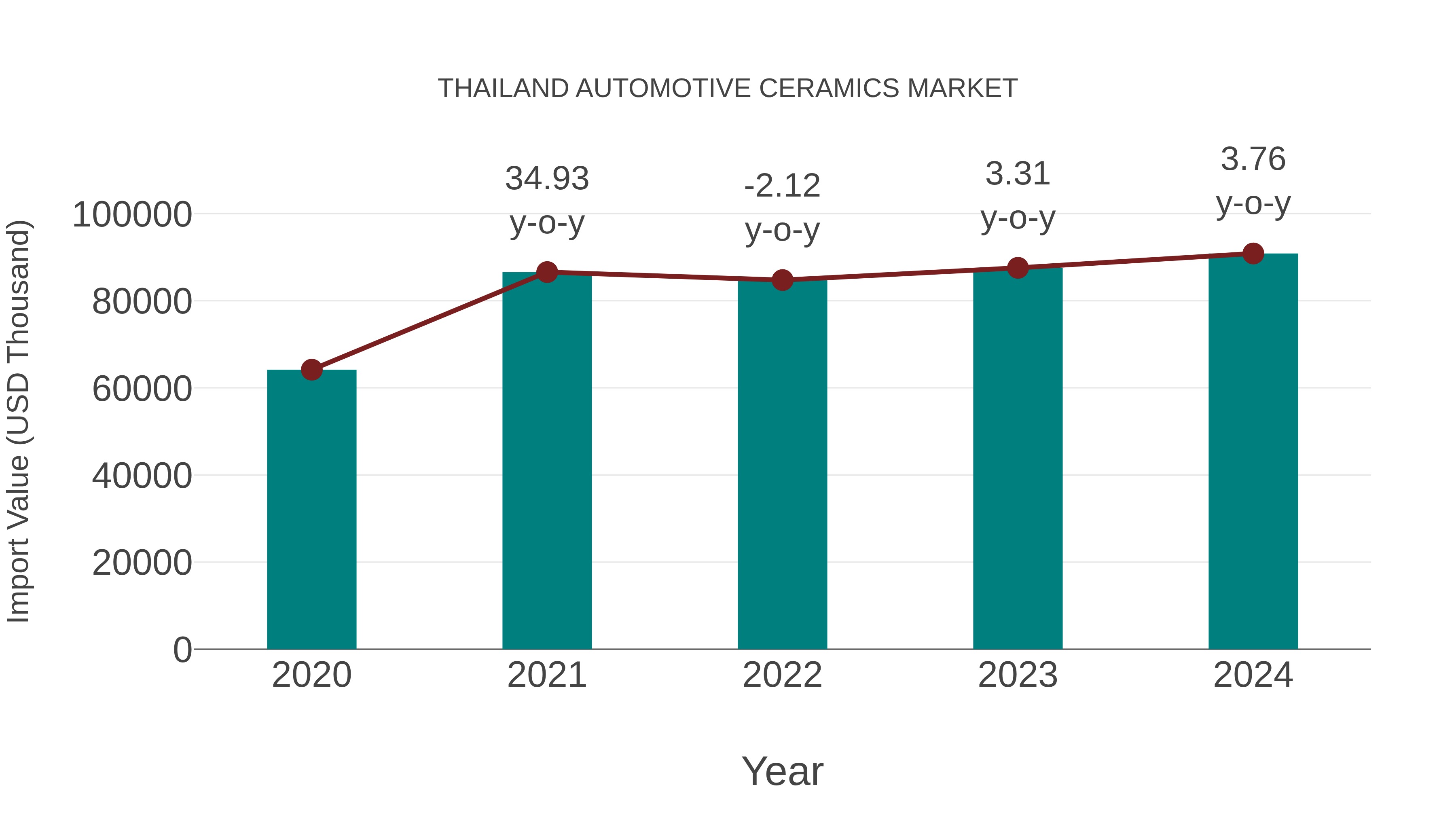
Thailand import trend in the automotive ceramics market showed a growth rate of 3.76% from 2023 to 2024, with a compound annual growth rate (CAGR) of 9.08% for the period 2020-2024. This increase can be attributed to a steady demand shift towards higher-quality automotive ceramics, reflecting market stability and evolving consumer preferences.
Thailand Automotive Ceramics Market Synopsis
The Thailand Automotive Ceramics Market supports the automotive industry with ceramics used in various components like catalytic converters, sensors, and spark plug insulators. These ceramics offer excellent heat resistance and durability, contributing to improved vehicle performance and emissions control.
Drivers of the Market
The Automotive Ceramics market in Thailand is witnessing significant growth, driven by the increasing demand for lightweight and high-performance materials in the automotive manufacturing sector. Automotive ceramics, including components such as engine parts, sensors, and catalytic converters, are gaining prominence for their durability and thermal resistance. The growth of the automotive industry, the emphasis on fuel efficiency and emissions reduction, and the need for advanced materials in Thailand are contributing to the adoption of automotive ceramics. Moreover, the focus on electric and hybrid vehicle technologies and the innovations in ceramic materials for automotive applications are further fueling the positive trajectory of the automotive ceramics market.
Challenges of the Market
The automotive ceramics market in Thailand confronts challenges related to the cyclical nature of the automotive industry, cost constraints in mass production, and the demand for lightweight and durable materials. Regulatory requirements for emissions and safety standards also impact the adoption of ceramic components in vehicles.
COVID-19 Impact on the Market
The Thailand Automotive Ceramics market faced challenges during the COVID-19 pandemic, with disruptions in automotive manufacturing and supply chains. The market is recovering as the automotive sector rebounds, and there is a growing demand for ceramics in exhaust systems, sensors, and engine components. Manufacturers are focusing on providing automotive ceramics for improved performance, durability, and emissions control in the post-pandemic landscape.
Key Players in the Market
AutoCera Dynamics Ltd. is a notable player in the Thailand Automotive Ceramics market. Renowned for its expertise in manufacturing ceramics for automotive applications, including catalytic converters, sensors, and engine components, AutoCera Dynamics Ltd. contributes to providing durable and high-performance solutions for the automotive industry. The company automotive ceramics play a crucial role in optimizing engine efficiency, emissions control, and overall vehicle performance in the Thai market.
Key Highlights of the Report:
- Thailand Automotive Ceramics Market Outlook
- Market Size of Thailand Automotive Ceramics Market, 2025
- Forecast of Thailand Automotive Ceramics Market, 2032
- Historical Data and Forecast of Thailand Automotive Ceramics Revenues & Volume for the Period 2022-2032F
- Thailand Automotive Ceramics Market Trend Evolution
- Thailand Automotive Ceramics Market Drivers and Challenges
- Thailand Automotive Ceramics Price Trends
- Thailand Automotive Ceramics Porter's Five Forces
- Thailand Automotive Ceramics Industry Life Cycle
- Historical Data and Forecast of Thailand Automotive Ceramics Market Revenues & Volume By Material for the Period 2022-2032F
- Historical Data and Forecast of Thailand Automotive Ceramics Market Revenues & Volume By Alumina Oxide Ceramic for the Period 2022-2032F
- Historical Data and Forecast of Thailand Automotive Ceramics Market Revenues & Volume By Titanate Oxide Ceramic for the Period 2022-2032F
- Historical Data and Forecast of Thailand Automotive Ceramics Market Revenues & Volume By Zirconia Oxide Ceramic for the Period 2022-2032F
- Historical Data and Forecast of Thailand Automotive Ceramics Market Revenues & Volume By Application for the Period 2022-2032F
- Historical Data and Forecast of Thailand Automotive Ceramics Market Revenues & Volume By Automotive Engine Parts for the Period 2022-2032F
- Historical Data and Forecast of Thailand Automotive Ceramics Market Revenues & Volume By Automotive Exhaust Systems for the Period 2022-2032F
- Historical Data and Forecast of Thailand Automotive Ceramics Market Revenues & Volume By Automotive Electronics for the Period 2022-2032F
- Thailand Automotive Ceramics Import Export Trade Statistics
- Market Opportunity Assessment By Material
- Market Opportunity Assessment By Application
- Thailand Automotive Ceramics Top Companies Market Share
- Thailand Automotive Ceramics Competitive Benchmarking By Technical and Operational Parameters
- Thailand Automotive Ceramics Company Profiles
- Thailand Automotive Ceramics Key Strategic Recommendations






































