Thailand Bisphenol a Market: Import Trend Analysis
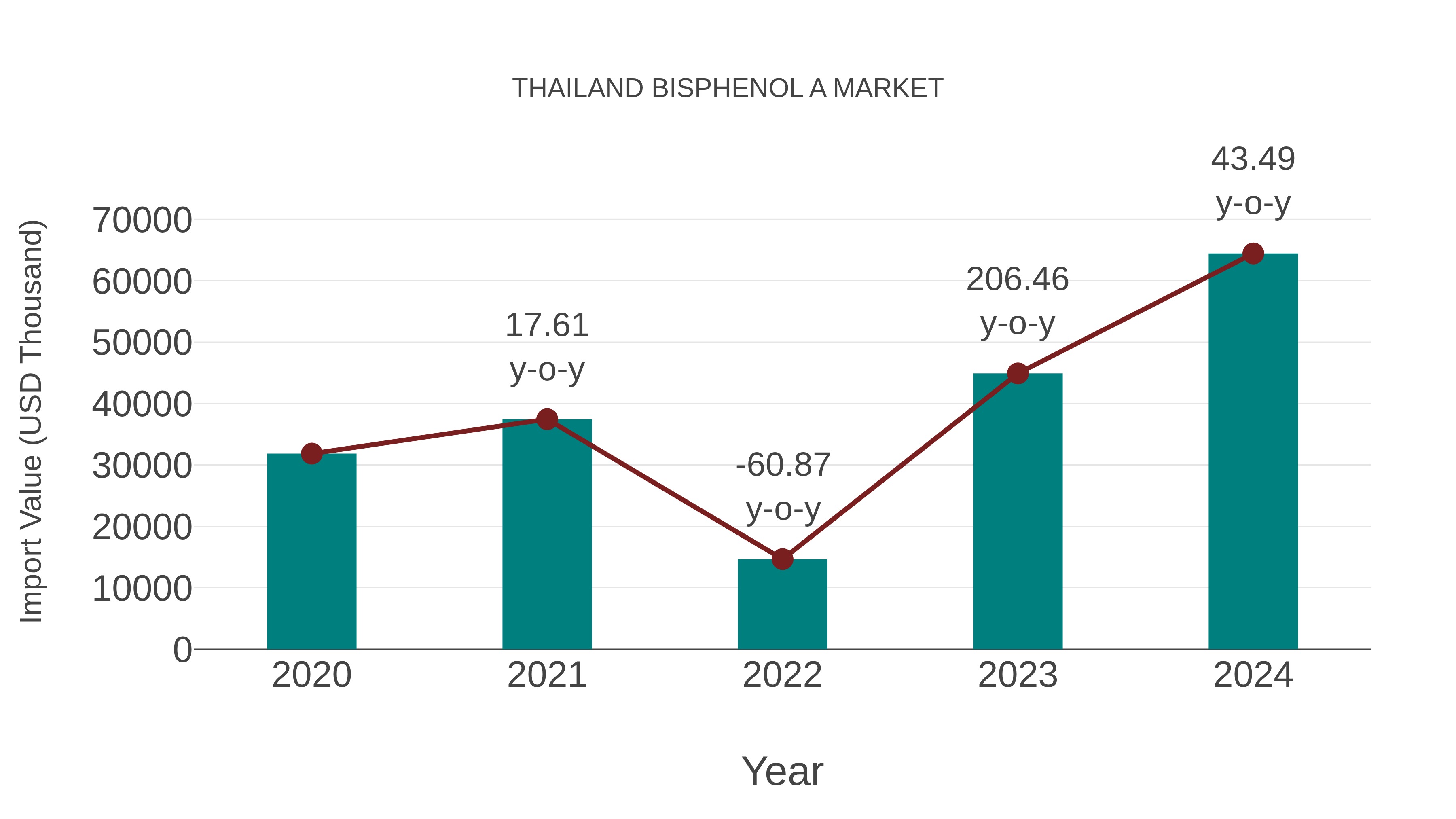
Thailand import trend for the bisphenol A market saw a significant growth rate of 43.49% from 2023 to 2024, with a compound annual growth rate (CAGR) of 19.27% from 2020 to 2024. This surge in imports could be attributed to a notable shift in consumer demand for bisphenol A products or changes in trade policies impacting market dynamics.
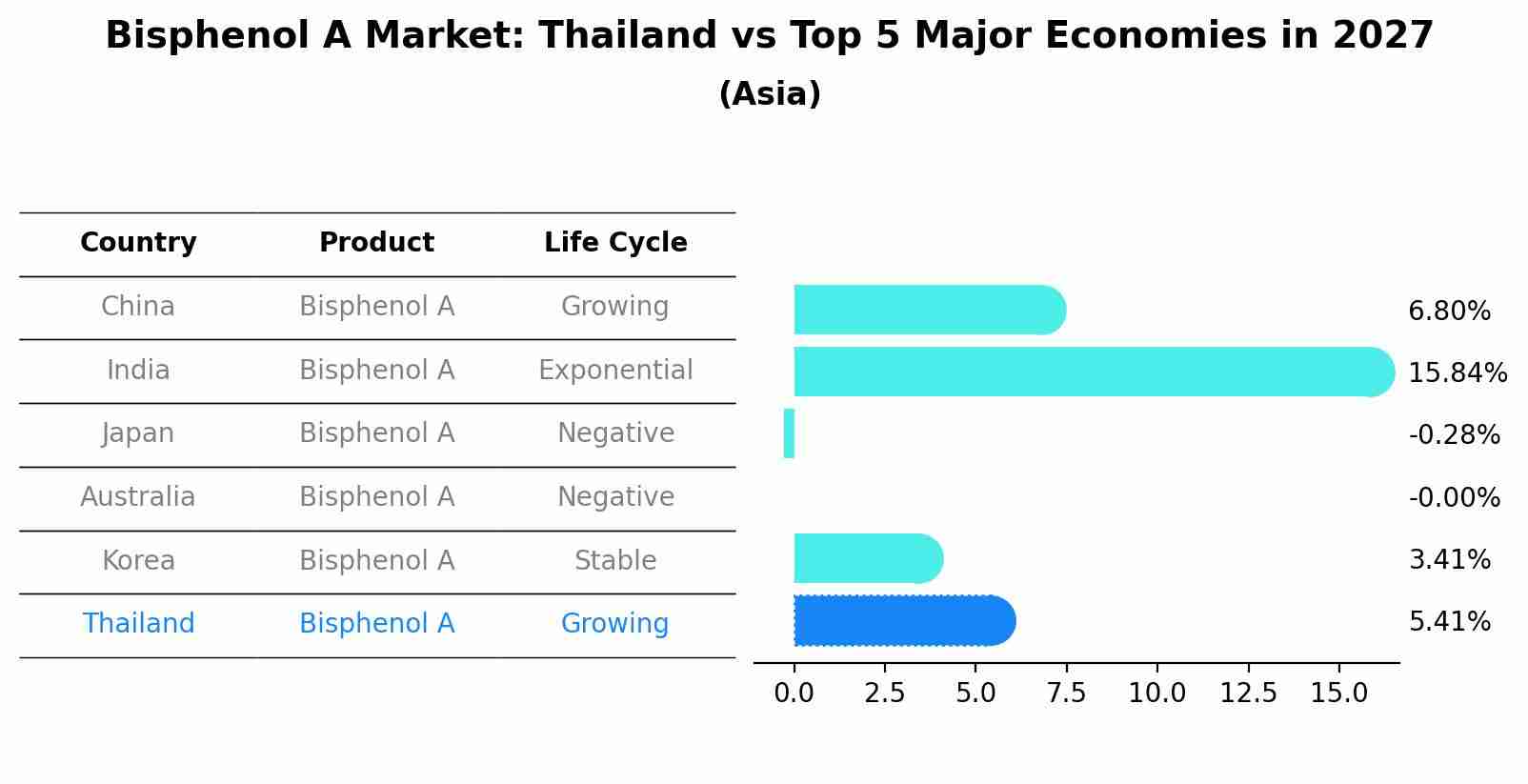
Bisphenol A Market: Thailand vs Top 5 Major Economies in 2027 (Asia)
By 2027, the Bisphenol A market in Thailand is anticipated to reach a growth rate of 5.41%, as part of an increasingly competitive Asia region, where China remains at the forefront, supported by India, Japan, Australia and South Korea, driving innovations and market adoption across sectors.
Thailand Bisphenol a Market Synopsis
The Thailand bisphenol A market size was valued at USD 38.1 million in 2025 and is projected to reach USD 46.6 million, registering a CAGR of 3.7%. The major driving factor for the growth of this market is the increased demand from various end-use industries such as electrical & electronics, automotive, and medical devices among others. Moreover, increasing use of bisphenol A derivatives due to their superior properties such as high heat resistance has further driven its demand over the years thus creating lucrative opportunities for industry players based in Thailand.
Drivers of the Market
In the Thailand bisphenol A market, drivers are driven by its importance in the production of polycarbonate plastics and epoxy resins. These materials are used in a wide range of industries, including automotive, electronics, and construction. The growth of these sectors, coupled with the increasing demand for durable and lightweight materials, has led to sustained demand for bisphenol A. Additionally, its applications in consumer goods and packaging have further contributed to the market`s growth.
Challenges of the Market
In the Thailand bisphenol A market, challenges arise from growing awareness of its potential health and environmental impacts. Bisphenol A is commonly used in the production of plastics and resins, but concerns about its endocrine-disrupting properties and its presence in food packaging have led to regulatory scrutiny and shifts in consumer preferences. Adapting to changing regulations and consumer demands for safer alternatives while ensuring product functionality and cost-effectiveness presents a challenge to businesses in this market.
COVID-19 Impact on the Market
In the Thailand bisphenol A market, reduced consumer spending on non-essential items led to decreased demand for products containing bisphenol A, such as plastics and coatings. Industries faced interruptions in production due to lockdowns, affecting the supply chain. Gradually, as markets stabilized and industries adapted, the demand for bisphenol A began to recover, although at a moderate pace.
Key Players in the Market
In the Thailand bisphenol A market, noteworthy participants like BPAChem Industries, ThaiPolymers Corporation, and SynthBisphenol Innovations have made their mark. These businesses have been involved in producing bisphenol A, a key component in the production of polycarbonate plastics and epoxy resins. Their role in supporting industries like electronics, automotive, and construction underscores their significance in modern manufacturing.
Key Highlights of the Report:
- Thailand Bisphenol A Market Outlook
- Market Size of Thailand Bisphenol A Market, 2025
- Forecast of Thailand Bisphenol A Market, 2032
- Historical Data and Forecast of Thailand Bisphenol A Revenues & Volume for the Period 2022-2032F
- Thailand Bisphenol A Market Trend Evolution
- Thailand Bisphenol A Market Drivers and Challenges
- Thailand Bisphenol A Price Trends
- Thailand Bisphenol A Porter's Five Forces
- Thailand Bisphenol A Industry Life Cycle
- Historical Data and Forecast of Thailand Bisphenol A Market Revenues & Volume By Application for the Period 2022-2032F
- Historical Data and Forecast of Thailand Bisphenol A Market Revenues & Volume By Polycarbonate Resin for the Period 2022-2032F
- Historical Data and Forecast of Thailand Bisphenol A Market Revenues & Volume By Epoxy Resin for the Period 2022-2032F
- Historical Data and Forecast of Thailand Bisphenol A Market Revenues & Volume By Unsaturated Polyester Resins for the Period 2022-2032F
- Historical Data and Forecast of Thailand Bisphenol A Market Revenues & Volume By Flame Retardants for the Period 2022-2032F
- Historical Data and Forecast of Thailand Bisphenol A Market Revenues & Volume By Others for the Period 2022-2032F
- Historical Data and Forecast of Thailand Bisphenol A Market Revenues & Volume By End-use for the Period 2022-2032F
- Historical Data and Forecast of Thailand Bisphenol A Market Revenues & Volume By Eye wear for the Period 2022-2032F
- Historical Data and Forecast of Thailand Bisphenol A Market Revenues & Volume By Automotive component for the Period 2022-2032F
- Historical Data and Forecast of Thailand Bisphenol A Market Revenues & Volume By Electronics for the Period 2022-2032F
- Historical Data and Forecast of Thailand Bisphenol A Market Revenues & Volume By Wind Energy Composites for the Period 2022-2032F
- Historical Data and Forecast of Thailand Bisphenol A Market Revenues & Volume By Paint and Coating for the Period 2022-2032F
- Historical Data and Forecast of Thailand Bisphenol A Market Revenues & Volume By Green House for the Period 2022-2032F
- Historical Data and Forecast of Thailand Bisphenol A Market Revenues & Volume By Others for the Period 2022-2032F
- Thailand Bisphenol A Import Export Trade Statistics
- Market Opportunity Assessment By Application
- Market Opportunity Assessment By End-use
- Thailand Bisphenol A Top Companies Market Share
- Thailand Bisphenol A Competitive Benchmarking By Technical and Operational Parameters
- Thailand Bisphenol A Company Profiles
- Thailand Bisphenol A Key Strategic Recommendations






































