Thailand Cloud POS Market Size & Growth Rate (2026-2032)
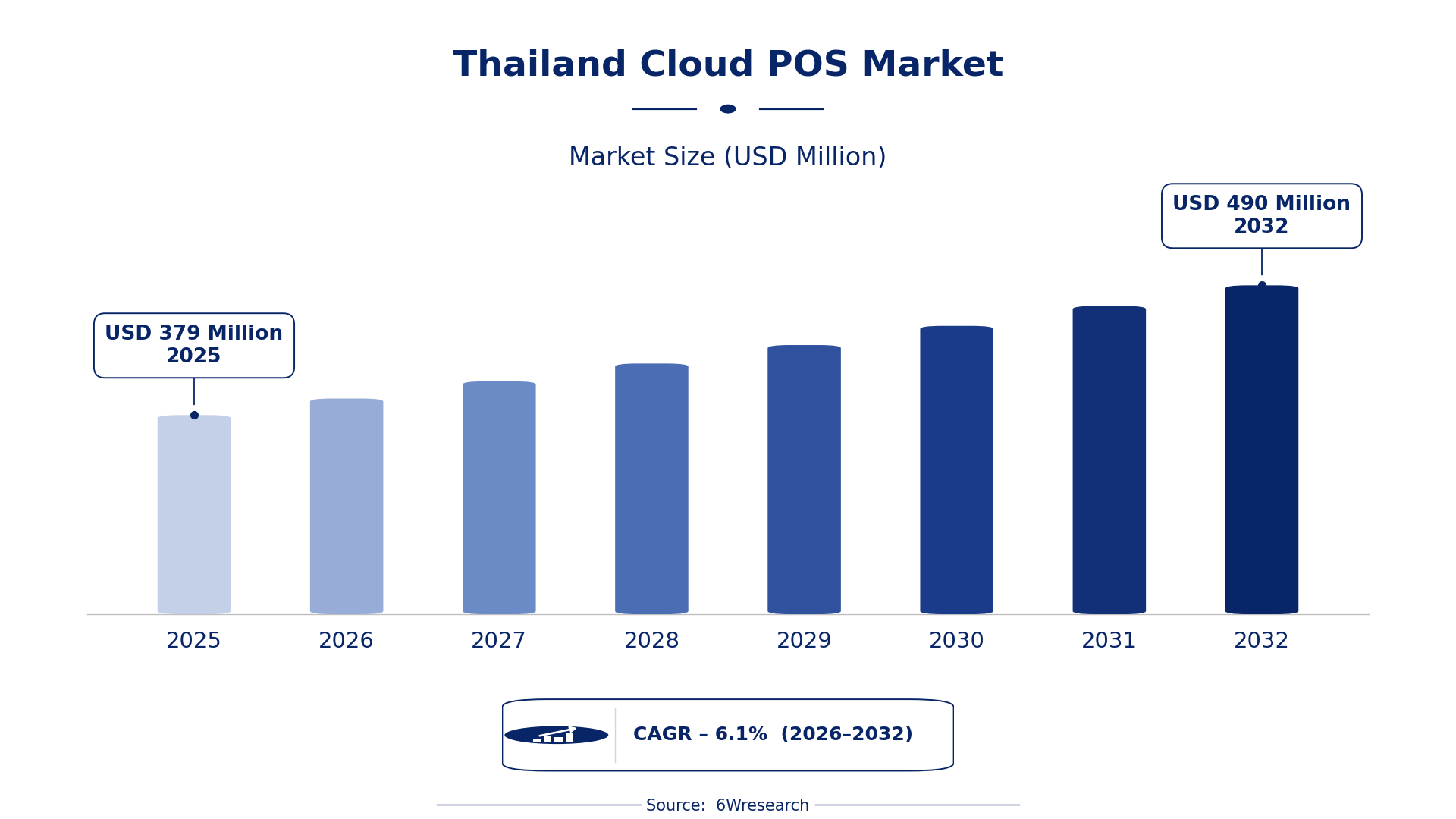
The Thailand Cloud POS Market was estimated at USD 379 Million in 2025 and is projected to reach USD 490 Million by 2032, growing at a CAGR of 6.1% from 2026 to 2032.
Thailand Cloud POS Market Synopsis
The Thailand Cloud POS Market has rapidly gained traction, especially within the retail and hospitality sectors. Businesses are recognizing the shift from traditional systems to cloud-based solutions that enhance operational efficiency and customer interaction. As companies embrace technology, the demand for feature-rich, scalable POS systems continues to rise.
Looking ahead, the market is expected to evolve significantly. A growing emphasis on digital transformation and omnichannel strategies indicates that cloud POS systems will become indispensable for businesses aiming to adapt to changing consumer expectations. This evolution promises not only to enhance transaction management but also to redefine customer engagement.
Thailand Cloud POS Market Year-wise Growth Rate and Key Drivers
This graph illustrates the annual growth rates of the Thailand Cloud POS Market from 2021 to 2032, highlighting a steady upward trajectory and projected expansion over the forecast period.
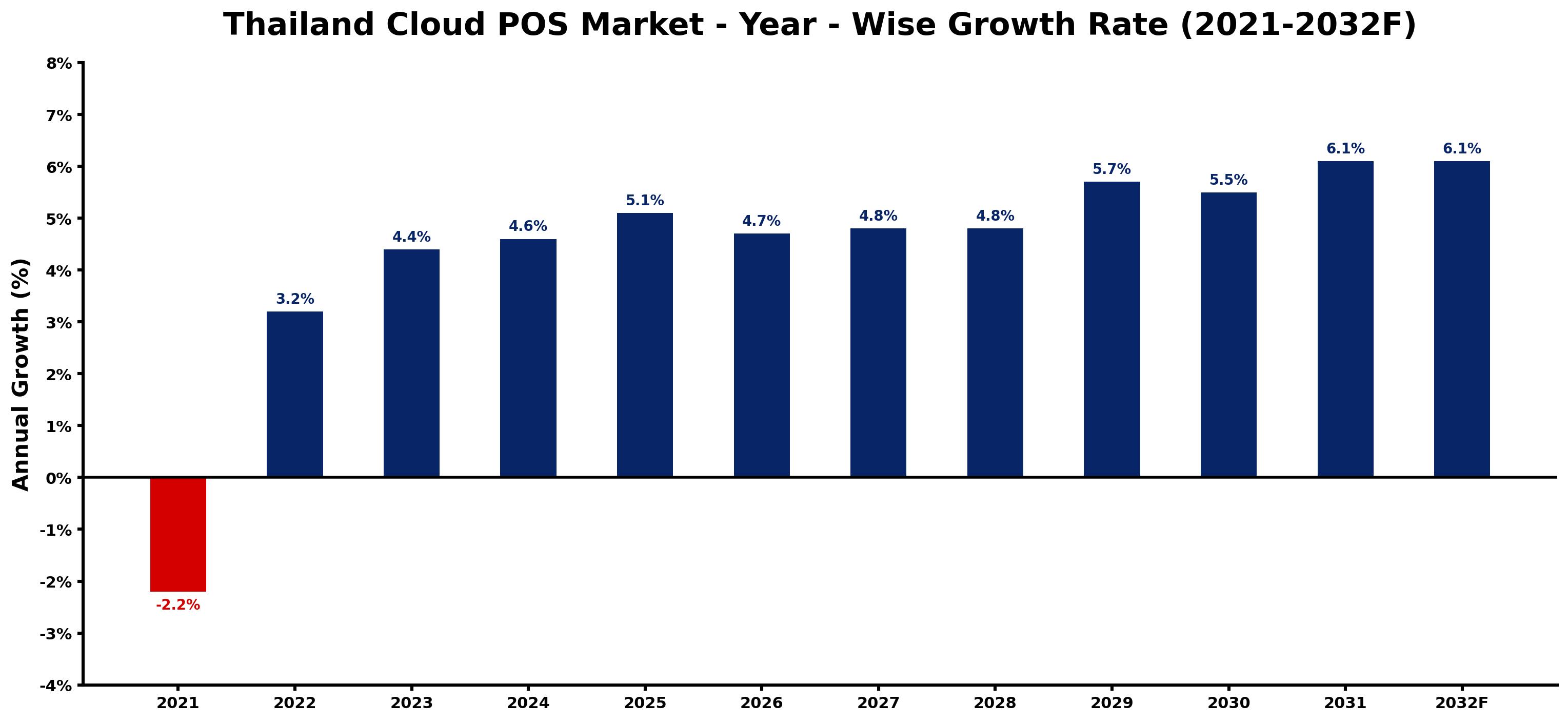
The table below presents the year‑wise growth rates along with the key drivers influencing the market
| Year | Growth Rate | Major Drivers |
| 2021 | -2.2% | Stringent regulations from Thailand's Ministry of Digital Economy. |
| 2022 | 3.2% | Tourism rebound increasing retail Cloud POS adoption. |
| 2023 | 4.4% | Government's Thailand 4.0 initiative boosting digital payment systems. |
| 2024 | 4.6% | Growing fintech partnerships enhancing Cloud POS features. |
| 2025 | 5.1% | Increasing smartphone penetration elevating mobile Cloud POS usage. |
| 2026 | 4.7% | Rising interest in small business digital transformation. |
| 2027 | 4.8% | Urbanization driving demand for advanced retail solutions. |
| 2028 | 4.8% | Local startup growth fostering innovative Cloud POS technologies. |
| 2029 | 5.7% | Regulatory support for digital financial services enhancement. |
| 2030 | 5.5% | Increased focus on data security in retail transactions. |
| 2031 | 6.1% | Demand for seamless omnichannel retail experiences rising. |
| 2032 | 6.1% | Rising adoption of interactive kiosks utilizing Cloud POS. |
Note: Market size estimations and growth projections presented in this report are based on 6Wresearch's proprietary forecasting methodology, utilizing the latest available industry data, government publications, and primary research inputs.
Thailand Cloud POS Market Key Takeaways
Below are some of the specific key takeaways from the market, including:
- Cloud POS systems are becoming essential for retailers seeking improved operational flexibility and real-time data access.
- The ongoing digital transformation in the hospitality industry is accelerating the adoption of cloud-based solutions.
- Security concerns regarding data privacy remain a critical barrier to wider cloud POS adoption.
- The COVID-19 pandemic has expedited the need for technology-driven transaction solutions.
- Leading players in the market are focusing on innovation and integration to enhance user experience.
Evaluation of Restraints in Thailand Cloud POS Market
Several restraints are affecting the Thailand Cloud POS Market, particularly concerning data security and privacy. Businesses often hesitate to migrate from traditional systems due to fears surrounding the protection of sensitive customer and transaction data. These concerns need to be addressed effectively to foster trust among potential adopters. Without comprehensive security measures and transparent data handling practices, many companies may remain reluctant to embrace the cloud. The challenge lies in educating stakeholders about the safety and reliability of cloud-based solutions while showcasing the benefits they offer.
Thailand Cloud POS Market Trends
A few trends are currently shaping the Thailand Cloud POS Market. Firstly, the push for omnichannel retail experiences is driving businesses to adopt cloud solutions that facilitate seamless transaction management across various channels. Secondly, mobile POS systems are gaining popularity, enabling businesses to engage customers directly at the point of service. Finally, the integration of advanced analytics and AI into cloud POS systems is allowing retailers to gain deeper insights into customer behavior, enhancing service delivery and inventory management.
Thailand Cloud POS Market Opportunities
The Thailand Cloud POS Market presents several growth opportunities for businesses willing to invest in technology. Retailers can capitalize on the increasing demand for integrated solutions that simplify operations and improve customer experiences. on top of that, as the hospitality sector continues to recover post-pandemic, there is a significant opportunity to offer tailored POS solutions that cater to specific industry needs. Companies that focus on enhancing data security features while providing scalable solutions will likely gain a competitive edge in this evolving market.
Government Initiatives in the Thailand Cloud POS Market
Government policy in Thailand is increasingly focused on promoting digital transformation across various sectors, including retail and hospitality. The regulatory environment is evolving to support cloud adoption, emphasizing the importance of data security and infrastructure upgrades. These policies are vital for ensuring that businesses can confidently transition to cloud-based solutions without compromising data integrity.
- A recent initiative launched in early 2025 focuses on enhancing digital infrastructure to support cloud technologies in retail and hospitality.
- Currently underway is a public-private partnership aimed at developing secure payment gateways, which will bolster consumer trust in cloud POS systems.
- Planned for late 2026 is a regulatory framework that will mandate transparency in billing processes across all digital transactions.
- A national awareness campaign to educate businesses about the benefits and security of cloud solutions is expected to commence in mid-2025.
- By 2028, the government aims to implement standards for cloud service providers to enhance overall data protection measures.
Future Insights of the Thailand Cloud POS Market
Between 2026 and 2032, the Thailand Cloud POS Market is set to witness substantial growth driven by ongoing technological advancements and heightened consumer expectations. As businesses increasingly prioritize digital solutions for operational efficiency, the demand for cloud-based POS systems will expand. The emphasis on data analytics and customer insights will further fuel innovations in POS technologies, enabling companies to tailor services to their clientele. By embracing these trends, businesses can position themselves at the forefront of this evolving market.
Thailand Cloud POS Market Latest Developments
Over the past 12-14 months, the Thailand Cloud POS Market has seen dynamic developments, primarily spurred by the pandemic's impact on consumer behavior. Businesses are increasingly adopting cloud solutions as they adapt to new retail environments and customer expectations. This shift is prompting major technology vendors to innovate and enhance their offerings.
- A major technology vendor launched an updated cloud POS system in early 2025, integrating AI capabilities for improved customer insights.
- An initiative that began in late 2025 is focused on enhancing user training programs for businesses transitioning to cloud-based systems.
- A leading regional operator is currently expanding its cloud POS services to rural areas, aiming to improve access for small businesses.
- By mid-2026, a rollout of new security features aimed at protecting customer data is expected to be implemented across various platforms.
- A collaborative project is planned to start in early 2026, aiming to create standardized protocols for cloud POS transactions across the industry.
Thailand Cloud POS Market - Key Attractiveness of the Report
- 10 Years of Market Numbers
- Historical Data Starting from 2022 to 2025
- Base Year: 2025
- Forecast Data until 2032
- Key Performance Indicators Impacting the Market
- Major Upcoming Developments and Projects
Key Highlights of the Report:
- Thailand Cloud POS Market Outlook
- Market Size of Thailand Cloud POS Market, 2025
- Forecast of Thailand Cloud POS Market, 2032
- Historical Data and Forecast of Thailand Cloud POS Revenues & Volume for the Period 2022-2032F
- Thailand Cloud POS Market Trend Evolution
- Thailand Cloud POS Market Drivers and Challenges
- Thailand Cloud POS Price Trends
- Thailand Cloud POS Porter's Five Forces
- Thailand Cloud POS Industry Life Cycle
- Historical Data and Forecast of Thailand Cloud POS Market Revenues & Volume By Application Areas for the Period 2022-2032F
- Historical Data and Forecast of Thailand Cloud POS Market Revenues & Volume By Retail and Consumer Goods for the Period 2022-2032F
- Historical Data and Forecast of Thailand Cloud POS Market Revenues & Volume By Travel and Hospitality for the Period 2022-2032F
- Historical Data and Forecast of Thailand Cloud POS Market Revenues & Volume By Media and Entertainment for the Period 2022-2032F
- Historical Data and Forecast of Thailand Cloud POS Market Revenues & Volume By Transport and Logistics for the Period 2022-2032F
- Historical Data and Forecast of Thailand Cloud POS Market Revenues & Volume By Healthcare for the Period 2022-2032F
- Historical Data and Forecast of Thailand Cloud POS Market Revenues & Volume By Component for the Period 2022-2032F
- Historical Data and Forecast of Thailand Cloud POS Market Revenues & Volume By Solution for the Period 2022-2032F
- Historical Data and Forecast of Thailand Cloud POS Market Revenues & Volume By Services for the Period 2022-2032F
- Historical Data and Forecast of Thailand Cloud POS Market Revenues & Volume By Service for the Period 2022-2032F
- Historical Data and Forecast of Thailand Cloud POS Market Revenues & Volume By Training, Consulting, and Integration for the Period 2022-2032F
- Historical Data and Forecast of Thailand Cloud POS Market Revenues & Volume By Support and Maintenance for the Period 2022-2032F
- Historical Data and Forecast of Thailand Cloud POS Market Revenues & Volume By Organization Size for the Period 2022-2032F
- Historical Data and Forecast of Thailand Cloud POS Market Revenues & Volume By SMEs for the Period 2022-2032F
- Historical Data and Forecast of Thailand Cloud POS Market Revenues & Volume By Large Enterprises for the Period 2022-2032F
- Thailand Cloud POS Import Export Trade Statistics
- Market Opportunity Assessment By Application Areas
- Market Opportunity Assessment By Component
- Market Opportunity Assessment By Service
- Market Opportunity Assessment By Organization Size
- Thailand Cloud POS Top Companies Market Share
- Thailand Cloud POS Competitive Benchmarking By Technical and Operational Parameters
- Thailand Cloud POS Company Profiles
- Thailand Cloud POS Key Strategic Recommendations






































