Thailand Cocoa Powder Market (2026-2032) | Analysis, Industry, Forecast, Revenue, Value, Size, Growth, Companies, Trends & Share
Market Forecast By Product Type (Black Cocoa, Double-Dutch Cocoa Blend, Triple Cocoa Blend, Bensdorp Dutch-Process Cocoa, Cocoa Rouge, Natural Cocoa), By End-Use Industry (Chocolate & Confectionery, Beverages, Bakery, Functional Food, Cosmetics, Pharmaceuticals), By Cocoa Variety (Forastero, Criollo, Trinitario, Other Cocoa Varieties), By Distribution Channel (Modern Trade, Speciality Stores, Convenience Stores, Traditional Grocery Stores, Online store, Other Distribution Channels) And Competitive Landscape
| Product Code: ETC126697 | Publication Date: Jul 2023 | Updated Date: Apr 2026 | Product Type: Report | |
| Publisher: 6Wresearch | Author: Ravi Bhandari | No. of Pages: 70 | No. of Figures: 35 | No. of Tables: 5 |
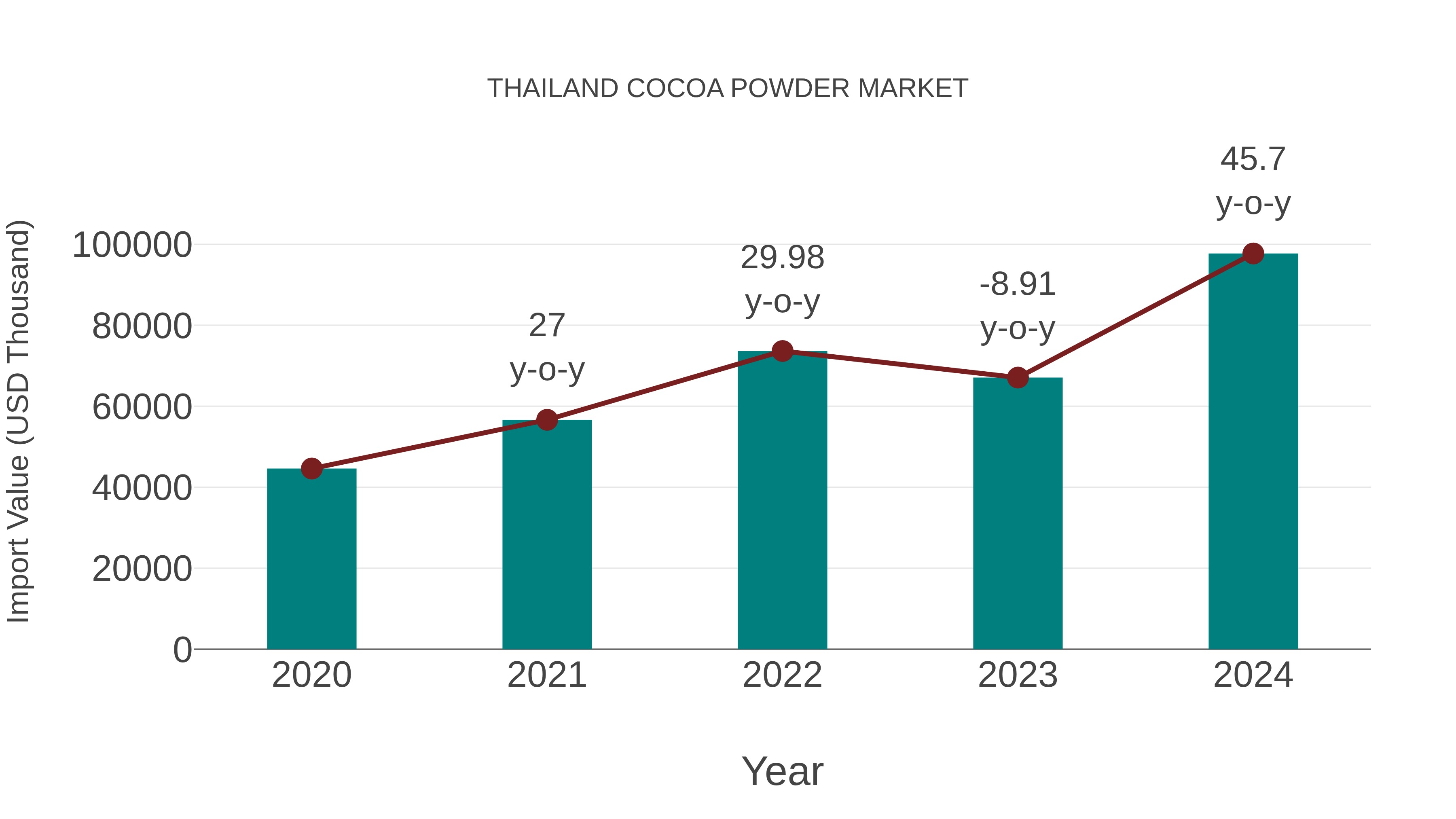
Thailand Cocoa Powder Market: Import Trend Analysis
Thailand import trend for cocoa powder in 2024 saw a notable growth rate of 45.7% compared to the previous year, with a compound annual growth rate (CAGR) of 21.66% from 2020 to 2024. This surge in imports could be attributed to a significant demand shift towards premium cocoa products in the market, driving import momentum and indicating a stable market for cocoa powder in Thailand during the period analyzed.
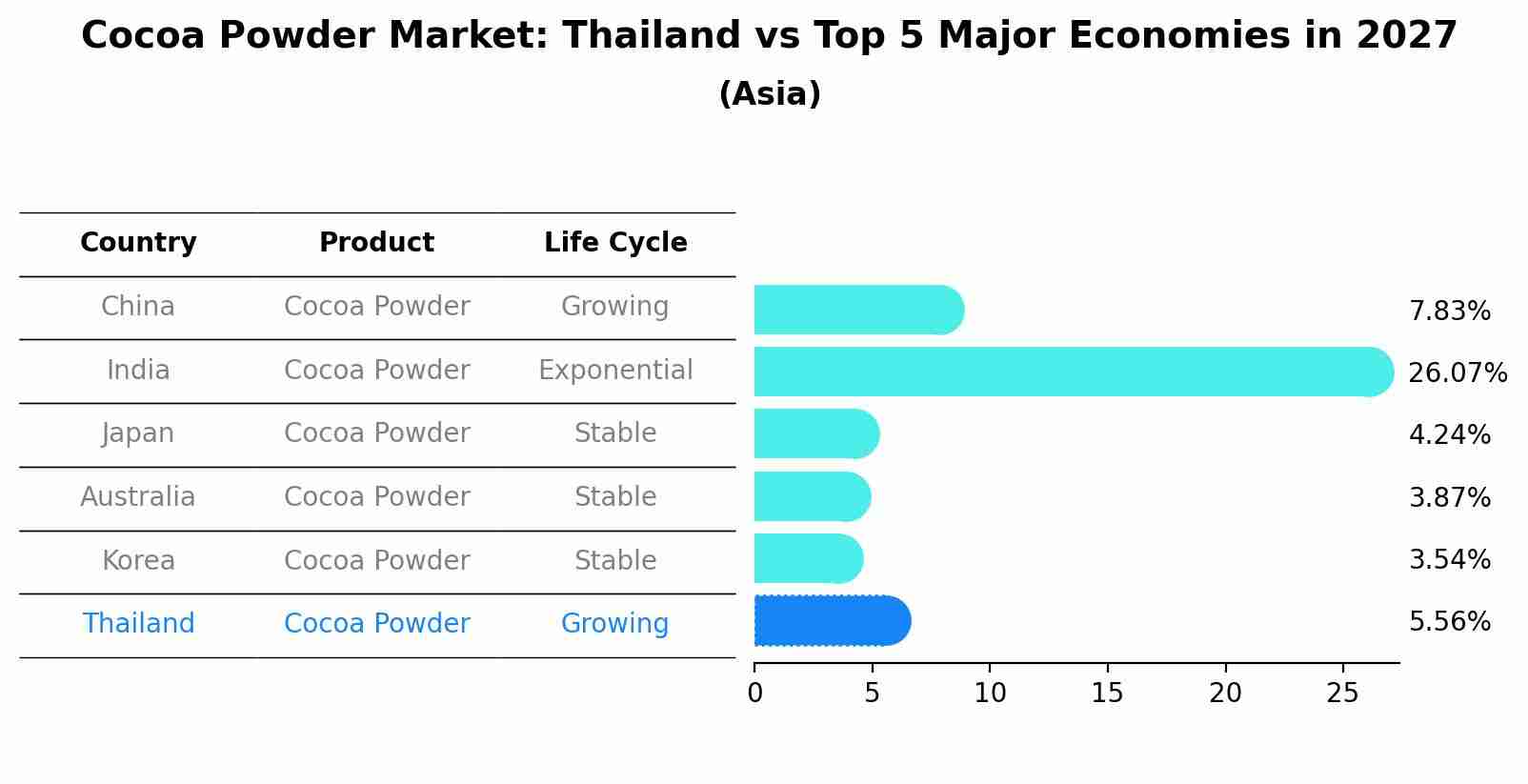
Cocoa Powder Market: Thailand vs Top 5 Major Economies in 2027 (Asia)
By 2027, Thailand's Cocoa Powder market is forecasted to achieve a growing growth rate of 5.56%, with China leading the Asia region, followed by India, Japan, Australia and South Korea.
Thailand Cocoa Powder Market Growth Rate
According to 6Wresearch internal database and industry insights, the Thailand Cocoa Powder Market is projected to grow at a compound annual growth rate (CAGR) of 7.4% during the forecast period 2026–2032.
Topics Covered in the Thailand Cocoa Powder Market Report
The Thailand Cocoa Powder Market report thoroughly covers the market by product type, end-use industry, cocoa variety, and distribution channel. It provides an unbiased and detailed analysis of ongoing market trends, opportunities, challenges, and market drivers, helping stakeholders align their strategies with current and future market dynamics.
Thailand Cocoa Powder Market Highlights
| Report Name |
Thailand Cocoa Powder Market |
| Forecast period | 2026-2032 |
| CAGR | 7.4% |
| Growing Sector | Food & Beverage, Health & Wellness |
Thailand Cocoa Powder Market Synopsis
The Thailand Cocoa Powder Market is expected to experience steady growth. This growth is driven by the increasing demand for cocoa powder in premium confectionery and beverages, growing use in functional food products, and expanding availability of high-quality cocoa. Government initiatives to support cocoa cultivation in Thailand and increasing exports of Thai cocoa-based products are predicted to further spur market expansion. The market is also getting benefit from technological advancements in cocoa processing, which are augmenting product quality and rising production efficiency.
Evaluation of Growth Drivers in the Thailand Cocoa Powder Market
Below mentioned are some prominent drivers and their influence on the Thailand Cocoa Powder Market dynamics:
| Drivers | Primary Segment Affected | Why It Matters (Evidence) |
| Premium Confectionery Demand | Chocolate & Confectionery | Consumers' growing preference for high-quality, premium chocolate. |
| Health & Wellness Trend | Functional Food | Increasing health-conscious consumers prefer cocoa for its health benefits. |
| Quality Cocoa Cultivation | Cocoa Variety | Improvements in the local cocoa industry raise the availability of quality cocoa beans. |
| Export Demand | Cocoa Powder Distribution | Growing demand for Thai cocoa powder in regional markets drives exports. |
| Growing Health Consciousness | Functional Food | Rising awareness about cocoa’s antioxidant properties and health benefits increases demand for cocoa-based functional foods. |
The Thailand Cocoa Powder Market is projected to grow at a CAGR of 7.4% from 2026 to 2032. Growth is driven by the rising demand for premium cocoa products in the chocolate & confectionery, beverages, and functional food sectors, alongside the growing awareness of cocoa's health benefits. Government initiatives aimed at enhancing domestic cocoa cultivation and supporting sustainable practices in the cocoa supply chain are expected to further propel market growth. Technological advancements in cocoa processing is predicted to strengthen the market's expansion.
Evaluation of Restraints in the Thailand Cocoa Powder Market
elow mentioned are some major restraints and their influence on the Thailand Cocoa Powder Market dynamics:
| Restraints | Primary Segment Affected | What This Means (Evidence) |
| Cocoa Price Volatility | Cocoa Powder | Fluctuating cocoa prices can lead to inconsistent product costs. |
| Limited Domestic Supply | Cocoa Powder Production | Thailand’s cocoa cultivation is still developing and may not meet the growing demand. |
| Competition from Imported Cocoa | Cocoa Powder | Imported cocoa may affect the market share of domestic cocoa producers. |
| Shift Toward Local Ingredients | Cocoa Powder | An inclination for locally sourced ingredients over imported cocoa could decreases the need for cocoa powder in certain regions. |
| Economic Downturns | All Segments | Economic recessions could affect consumer expenditure. |
Thailand Cocoa Powder Market Challenges
The Thailand Cocoa Powder Industry faces several challenges. These consist of fluctuating cocoa prices, shortage in local production, competition from imported cocoa, and quality problems in cocoa beans. Shortage of awareness about cocoa's health benefits in some regions may hamper market penetration and regulatory complexities and environmental concerns also pose significant barriers. These challenges consist of inconsistent supply chains owing to logistical bottlenecks, reliability on favourable weather conditions, and increasing labour prices that affect the overall production cost.
Thailand Cocoa Powder Market Trends
Several notable trends are shaping the Thailand Cocoa Powder Market dynamics:
- Increased Demand for Premium Products: Brands are introducing innovative cocoa-based offerings owing to consumers inclining toward premium chocolate and cocoa products with distinct flavours.
- Focus on Functional Foods: There is a rising emphasis on functional foods, such as protein-enriched beverages and snacks, which are made by making use of cocoa powder owing to its health benefits.
- Expansion of Vegan and Plant-Based Options: the need for cocoa powder as a major ingredient in substitute chocolate products and beverages is spurring owing to increase in plant-based and vegan diets.
- Technological Advancements in Cocoa Processing: Modern cocoa processing techniques are proliferating product quality and consistency, and they include such as Dutch-processed cocoa.
Investment Opportunities in the Thailand Cocoa Powder Industry
Some notable investment opportunities in the Thailand Cocoa Powder Market include:
- Cocoa Research & Development: Lucrative growth opportunities are provided through fund allocation in R&D to augment the quality of cocoa powder.
- Expansion of Cocoa Processing Plants: The local supply of high-quality cocoa powder can spur owing to money allocation in advanced cocoa processing facilities.
- Development of Sustainable Cocoa Cultivation Projects: Money allocation in organic and eco-friendly cocoa cultivation will meet with global trends as sustainable farming practices are getting importance.
Top 5 Leading Players in the Thailand Cocoa Powder Market
elow is the list of prominent companies leading in the Thailand Cocoa Powder Market:
1. Barry Callebaut
| Company Name | Barry Callebaut (Thailand) |
|---|---|
| Established Year | 1996 |
| Headquarters | Bangkok, Thailand |
| Official Website | Click Here |
As a worldwide leader in chocolate and cocoa, Barry Callebaut holds a significant position in the Thai market, supplying industrial cocoa powder to various food manufacturers.
2. Cargill
| Company Name | Cargill (Thailand) |
|---|---|
| Established Year | 1947 |
| Headquarters | Bangkok, Thailand |
| Official Website | Click Here |
A leading global player in agricultural commodities, Cargill is a dominant supplier of cocoa powder in Southeast Asia, including Thailand.
3. Olam Food Ingredients
| Company Name | Olam Food Ingredients (OFI) |
|---|---|
| Established Year | 2000 |
| Headquarters | Singapore |
| Official Website | Click Here |
A leading international processor of cocoa ingredients, Olam has a strong presence in the region. They provide high-quality cocoa powder for various food and beverage applications, focusing on sustainability and ethical sourcing.
4. Freyabadi Indotama
| Company Name | Freyabadi Indotama |
|---|---|
| Established Year | 1992 |
| Headquarters | Rayong, Thailand |
| Official Website | Click Here |
Established in Rayong, Thailand, Freyabadi Indotama is a major producer of chocolate and cocoa ingredients for the Southeast Asian market, providing to the growing demand for high-quality cocoa products in the region.
5. Chocolasia Company Limited
| Company Name | Chocolasia Company Limited |
|---|---|
| Established Year | 2004 |
| Headquarters | Bangkok, Thailand |
| Official Website | Click Here |
A leading local specialist offering a comprehensive range of cocoa powder and bean-to-bar products, Chocolasia is renowned for both manufacturing and importing high-quality ingredients for the food and beverage industry in Thailand.
Government Regulations Introduced in the Thailand Cocoa Powder Market
According to Thailand’s government data, cocoa production and usage are regulated through policies aimed at boosting the agricultural sector and encouraging local cocoa production. Thailand’s government has launched several initiatives to support cocoa cultivation, consisting of tax incentives for farmers, funding for research into better cultivation techniques, and subsidies for cocoa producers. The government also encourages fair trade and organic certifications to make sure sustainable practices in the cocoa industry and the government has implemented measures to improve the quality of cocoa production.
Future Insights of the Thailand Cocoa Powder Market
The Thailand Cocoa Powder Market Growth is expected to increase steadily. It is propelled by the growing demand for high-quality cocoa products, increasing consumer preference for health-conscious options, and government support for cocoa farming and the growing demand from the chocolate, bakery, and beverage sectors will further bolster market growth. Technological advancements in cocoa processing is likely to open new avenues for market expansion, and the growth of plant-based and vegan diets is estimated to make additional demand for cocoa powder.
Market Segmentation Analysis
The report offers a comprehensive study of the following market segments and their leading categories:
By Product Type – Black Cocoa Dominates the Market:
According to Mansi Ahuja, Senior Research Analyst at 6Wresearch, Black cocoa powder is expected to dominate the market due to its rich flavour and deep colour, which is highly favoured in premium chocolate and confectionery products.
By End-Use Industry – Chocolate & Confectionery Dominates the Market:
The chocolate and confectionery sector is predicted to lead the Indonesia Ethanol Market Share. This is owing to cocoa powder being a major ingredient in chocolate production and the rising need for high-quality chocolates is also spurring this segment's growth.
By Distribution Channel – Modern Trade Dominates the Market:
Modern trade channels, consisting of supermarkets and hypermarkets, are predicted to lead the cocoa powder market. This is owing to them providing a broad variety of cocoa powder products to consumers.
By Cocoa Variety – Forastero Dominates the Market:
Forastero cocoa, renowned for its high yield and robust flavour, is estimated to dominate the Indonesia Ethanol Market. This is owing to its obtainability and suitability for large-scale production.
Key Attractiveness of the Report
- 10 Years of Market Numbers.
- Historical Data Starting from 2022 to 2025.
- Base Year: 2025.
- Forecast Data until 2032.
- Key Performance Indicators Impacting the Market.
- Major Upcoming Developments and Projects.
Key Highlights of the Report:
- Thailand Cocoa Powder Market Outlook
- Market Size of Thailand Cocoa Powder Market, 2025
- Forecast of Thailand Cocoa Powder Market, 2032
- Historical Data and Forecast of Thailand Cocoa Powder Revenues & Volume for the Period 2022-2032
- Thailand Cocoa Powder Market Trend Evolution
- Thailand Cocoa Powder Market Drivers and Challenges
- Thailand Cocoa Powder Price Trends
- Thailand Cocoa Powder Porter's Five Forces
- Thailand Cocoa Powder Industry Life Cycle
- Historical Data and Forecast of Thailand Cocoa Powder Market Revenues & Volume By Product Type for the Period 2022-2032
- Historical Data and Forecast of Thailand Cocoa Powder Market Revenues & Volume By Black Cocoa for the Period 2022-2032
- Historical Data and Forecast of Thailand Cocoa Powder Market Revenues & Volume By Double-Dutch Cocoa Blend for the Period 2022-2032
- Historical Data and Forecast of Thailand Cocoa Powder Market Revenues & Volume By Triple Cocoa Blend for the Period 2022-2032
- Historical Data and Forecast of Thailand Cocoa Powder Market Revenues & Volume By Bensdorp Dutch-Process Cocoa for the Period 2022-2032
- Historical Data and Forecast of Thailand Cocoa Powder Market Revenues & Volume By Cocoa Rouge for the Period 2022-2032
- Historical Data and Forecast of Thailand Cocoa Powder Market Revenues & Volume By Natural Cocoa for the Period 2022-2032
- Historical Data and Forecast of Thailand Cocoa Powder Market Revenues & Volume By End-Use Industry for the Period 2022-2032
- Historical Data and Forecast of Thailand Cocoa Powder Market Revenues & Volume By Chocolate & Confectionery for the Period 2022-2032
- Historical Data and Forecast of Thailand Cocoa Powder Market Revenues & Volume By Beverages for the Period 2022-2032
- Historical Data and Forecast of Thailand Cocoa Powder Market Revenues & Volume By Bakery for the Period 2022-2032
- Historical Data and Forecast of Thailand Cocoa Powder Market Revenues & Volume By Functional Food for the Period 2022-2032
- Historical Data and Forecast of Thailand Cocoa Powder Market Revenues & Volume By Cosmetics for the Period 2022-2032
- Historical Data and Forecast of Thailand Cocoa Powder Market Revenues & Volume By Pharmaceuticals for the Period 2022-2032
- Historical Data and Forecast of Thailand Cocoa Powder Market Revenues & Volume By Cocoa Variety for the Period 2022-2032
- Historical Data and Forecast of Thailand Cocoa Powder Market Revenues & Volume By Forastero for the Period 2022-2032
- Historical Data and Forecast of Thailand Cocoa Powder Market Revenues & Volume By Criollo for the Period 2022-2032
- Historical Data and Forecast of Thailand Cocoa Powder Market Revenues & Volume By Trinitario for the Period 2022-2032
- Historical Data and Forecast of Thailand Cocoa Powder Market Revenues & Volume By Other Cocoa Varieties for the Period 2022-2032
- Historical Data and Forecast of Thailand Cocoa Powder Market Revenues & Volume By Distribution Channel for the Period 2022-2032
- Historical Data and Forecast of Thailand Cocoa Powder Market Revenues & Volume By Modern Trade for the Period 2022-2032
- Historical Data and Forecast of Thailand Cocoa Powder Market Revenues & Volume By Speciality Stores for the Period 2022-2032
- Historical Data and Forecast of Thailand Cocoa Powder Market Revenues & Volume By Convenience Stores for the Period 2022-2032
- Historical Data and Forecast of Thailand Cocoa Powder Market Revenues & Volume By Traditional Grocery Stores for the Period 2022-2032
- Historical Data and Forecast of Thailand Cocoa Powder Market Revenues & Volume By Online store for the Period 2022-2032
- Historical Data and Forecast of Thailand Cocoa Powder Market Revenues & Volume By Other Distribution Channels for the Period 2022-2032
- Thailand Cocoa Powder Import Export Trade Statistics
- Market Opportunity Assessment By Product Type
- Market Opportunity Assessment By End-Use Industry
- Market Opportunity Assessment By Cocoa Variety
- Market Opportunity Assessment By Distribution Channel
- Thailand Cocoa Powder Top Companies Market Share
- Thailand Cocoa Powder Competitive Benchmarking By Technical and Operational Parameters
- Thailand Cocoa Powder Company Profiles
- Thailand Cocoa Powder Key Strategic Recommendations
Market Covered
The report offers a comprehensive study of the following segments:
By Type:
- Black Cocoa
- Double-Dutch Cocoa Blend
- Triple Cocoa Blend
- Bensdorp Dutch-Process Cocoa
- Cocoa Rouge
- Natural Cocoa
By End-Use Industry:
- Chocolate & Confectionery
- Beverages
- Bakery
- Functional Food
- Cosmetics
- Pharmaceuticals
By Cocoa Variety:
- Forastero
- Criollo
- Trinitario
- Other Cocoa Varieties
By Distribution Channel:
- Modern Trade
- Specialty Stores
- Convenience Stores
- Traditional Grocery Stores
- Online Stores
- Other Distribution Channels
Thailand Cocoa Powder Market (2026-2032): FAQs
The Thailand Cocoa Powder Market is expected to grow at a CAGR of 7.4% during the forecast period.
Key trends include growing demand for premium cocoa products and increased focus on sustainable cocoa sourcing.
Government incentives, consumer demand for premium chocolates, and rising cocoa exports support the development of this sector.
The government provides many initiatives to support the industry, such as tax incentives for cocoa farmers and funding for research into better cultivation techniques.
6Wresearch actively monitors the Thailand Cocoa Powder Market and publishes its comprehensive annual report, highlighting emerging trends, growth drivers, revenue analysis, and forecast outlook. Our insights help businesses to make data-backed strategic decisions with ongoing market dynamics. Our analysts track relevent industries related to the Thailand Cocoa Powder Market, allowing our clients with actionable intelligence and reliable forecasts tailored to emerging regional needs.
Yes, we provide customisation as per your requirements. To learn more, feel free to contact us on sales@6wresearch.com
| Thailand Cocoa Powder |
| 1 Executive Summary |
| 2 Introduction |
| 2.1 Key Highlights of the Report |
| 2.2 Report Description |
| 2.3 Market Scope & Segmentation |
| 2.4 Research Methodology |
| 2.5 Assumptions |
| 3 Thailand Cocoa Powder Market Overview |
| 3.1 Thailand Country Macro Economic Indicators |
| 3.2 Thailand Cocoa Powder Market Revenues & Volume, 2022 & 2032F |
| 3.3 Thailand Cocoa Powder Market - Industry Life Cycle |
| 3.4 Thailand Cocoa Powder Market - Porter's Five Forces |
| 3.5 Thailand Cocoa Powder Market Revenues & Volume Share, By Product Type, 2022 & 2032F |
| 3.6 Thailand Cocoa Powder Market Revenues & Volume Share, By End-Use Industry, 2022 & 2032F |
| 3.7 Thailand Cocoa Powder Market Revenues & Volume Share, By Cocoa Variety, 2022 & 2032F |
| 3.8 Thailand Cocoa Powder Market Revenues & Volume Share, By Distribution Channel, 2022 & 2032F |
| 4 Thailand Cocoa Powder Market Dynamics |
| 4.1 Impact Analysis |
| 4.2 Market Drivers |
| 4.3 Market Restraints |
| 5 Thailand Cocoa Powder Market Trends |
| 6 Thailand Cocoa Powder Market, By Types |
| 6.1 Thailand Cocoa Powder Market, By Product Type |
| 6.1.1 Overview and Analysis |
| 6.1.2 Thailand Cocoa Powder Market Revenues & Volume, By Product Type, 2022-2032F |
| 6.1.3 Thailand Cocoa Powder Market Revenues & Volume, By Black Cocoa, 2022-2032F |
| 6.1.4 Thailand Cocoa Powder Market Revenues & Volume, By Double-Dutch Cocoa Blend, 2022-2032F |
| 6.1.5 Thailand Cocoa Powder Market Revenues & Volume, By Triple Cocoa Blend, 2022-2032F |
| 6.1.6 Thailand Cocoa Powder Market Revenues & Volume, By Bensdorp Dutch-Process Cocoa, 2022-2032F |
| 6.1.7 Thailand Cocoa Powder Market Revenues & Volume, By Cocoa Rouge, 2022-2032F |
| 6.1.8 Thailand Cocoa Powder Market Revenues & Volume, By Natural Cocoa, 2022-2032F |
| 6.2 Thailand Cocoa Powder Market, By End-Use Industry |
| 6.2.1 Overview and Analysis |
| 6.2.2 Thailand Cocoa Powder Market Revenues & Volume, By Chocolate & Confectionery, 2022-2032F |
| 6.2.3 Thailand Cocoa Powder Market Revenues & Volume, By Beverages, 2022-2032F |
| 6.2.4 Thailand Cocoa Powder Market Revenues & Volume, By Bakery, 2022-2032F |
| 6.2.5 Thailand Cocoa Powder Market Revenues & Volume, By Functional Food, 2022-2032F |
| 6.2.6 Thailand Cocoa Powder Market Revenues & Volume, By Cosmetics, 2022-2032F |
| 6.2.7 Thailand Cocoa Powder Market Revenues & Volume, By Pharmaceuticals, 2022-2032F |
| 6.3 Thailand Cocoa Powder Market, By Cocoa Variety |
| 6.3.1 Overview and Analysis |
| 6.3.2 Thailand Cocoa Powder Market Revenues & Volume, By Forastero, 2022-2032F |
| 6.3.3 Thailand Cocoa Powder Market Revenues & Volume, By Criollo, 2022-2032F |
| 6.3.4 Thailand Cocoa Powder Market Revenues & Volume, By Trinitario, 2022-2032F |
| 6.3.5 Thailand Cocoa Powder Market Revenues & Volume, By Other Cocoa Varieties, 2022-2032F |
| 6.4 Thailand Cocoa Powder Market, By Distribution Channel |
| 6.4.1 Overview and Analysis |
| 6.4.2 Thailand Cocoa Powder Market Revenues & Volume, By Modern Trade, 2022-2032F |
| 6.4.3 Thailand Cocoa Powder Market Revenues & Volume, By Speciality Stores, 2022-2032F |
| 6.4.4 Thailand Cocoa Powder Market Revenues & Volume, By Convenience Stores, 2022-2032F |
| 6.4.5 Thailand Cocoa Powder Market Revenues & Volume, By Traditional Grocery Stores, 2022-2032F |
| 6.4.6 Thailand Cocoa Powder Market Revenues & Volume, By Online store, 2022-2032F |
| 6.4.7 Thailand Cocoa Powder Market Revenues & Volume, By Other Distribution Channels, 2022-2032F |
| 7 Thailand Cocoa Powder Market Import-Export Trade Statistics |
| 7.1 Thailand Cocoa Powder Market Export to Major Countries |
| 7.2 Thailand Cocoa Powder Market Imports from Major Countries |
| 8 Thailand Cocoa Powder Market Key Performance Indicators |
| 9 Thailand Cocoa Powder Market - Opportunity Assessment |
| 9.1 Thailand Cocoa Powder Market Opportunity Assessment, By Product Type, 2022 & 2032F |
| 9.2 Thailand Cocoa Powder Market Opportunity Assessment, By End-Use Industry, 2022 & 2032F |
| 9.3 Thailand Cocoa Powder Market Opportunity Assessment, By Cocoa Variety, 2022 & 2032F |
| 9.4 Thailand Cocoa Powder Market Opportunity Assessment, By Distribution Channel, 2022 & 2032F |
| 10 Thailand Cocoa Powder Market - Competitive Landscape |
| 10.1 Thailand Cocoa Powder Market Revenue Share, By Companies, 2025 |
| 10.2 Thailand Cocoa Powder Market Competitive Benchmarking, By Operating and Technical Parameters |
| 11 Company Profiles |
| 12 Recommendations |
| 13 Disclaimer |
Global Go To Market Strategy - 2030
Export potential enables firms to identify high-growth global markets with greater confidence by combining advanced trade intelligence with a structured quantitative methodology. The framework analyzes emerging demand trends and country-level import patterns while integrating macroeconomic and trade datasets such as GDP and population forecasts, bilateral import–export flows, tariff structures, elasticity differentials between developed and developing economies, geographic distance, and import demand projections. Using weighted trade values from 2020–2024 as the base period to project country-to-country export potential for 2030, these inputs are operationalized through calculated drivers such as gravity model parameters, tariff impact factors, and projected GDP per-capita growth. Through an analysis of hidden potentials, demand hotspots, and market conditions that are most favorable to success, this method enables firms to focus on target countries, maximize returns, and global expansion with data, backed by accuracy.
By factoring in the projected importer demand gap that is currently unmet and could be potential opportunity, it identifies the potential for the Exporter (Country) among 190 countries, against the general trade analysis, which identifies the biggest importer or exporter.
To discover high-growth global markets and optimize your business strategy:
Click Here
Pricing
- Single User License$ 1,995
- Department License$ 2,400
- Site License$ 3,120
- Global License$ 3,795

Leadership Perspectives from Industry Events
Search
Thought Leadership and Analyst Meet





Our Clients








6WResearch In News
- India Air Conditioner Market Set for Strong Rebound in 2026 After Weather-Led Correction and GST-Driven Recovery: 6Wresearch
- ADAS in India: How Automatic Emergency Braking, Blind Spot Detection & Driver Monitoring are Transforming Road Safety
- Doha a strategic location for EV manufacturing hub: IPA Qatar
- Demand for luxury TVs surging in the GCC, says Samsung
- Empowering Growth: The Thriving Journey of Bangladesh’s Cable Industry
- Demand for luxury TVs surging in the GCC, says Samsung
Latest Reports
- Nicaragua RPG Gaming Market (2026-2032)
- New Zealand RPG Gaming Market (2026-2032)
- Netherlands RPG Gaming Market (2026-2032)
- Nauru RPG Gaming Market (2026-2032)
- Namibia RPG Gaming Market (2026-2032)
- Mozambique RPG Gaming Market (2026-2032)
- Montenegro RPG Gaming Market (2026-2032)
- Mongolia RPG Gaming Market (2026-2032)
- Monaco RPG Gaming Market (2026-2032)
- Micronesia RPG Gaming Market (2026-2032)
Industry Events and Analyst Meet

HIMTEX 2026

India Refining Summit 2026

India EV Show 2026

EV tech India Expo 2026

Auto Tech Asia 2026
Whitepaper
- Middle East & Africa Commercial Security Market Click here to view more.
- Middle East & Africa Fire Safety Systems & Equipment Market Click here to view more.
- GCC Drone Market Click here to view more.
- Middle East Lighting Fixture Market Click here to view more.
- GCC Physical & Perimeter Security Market Click here to view more.


