Thailand Fabric Softener Market: Import Trend Analysis
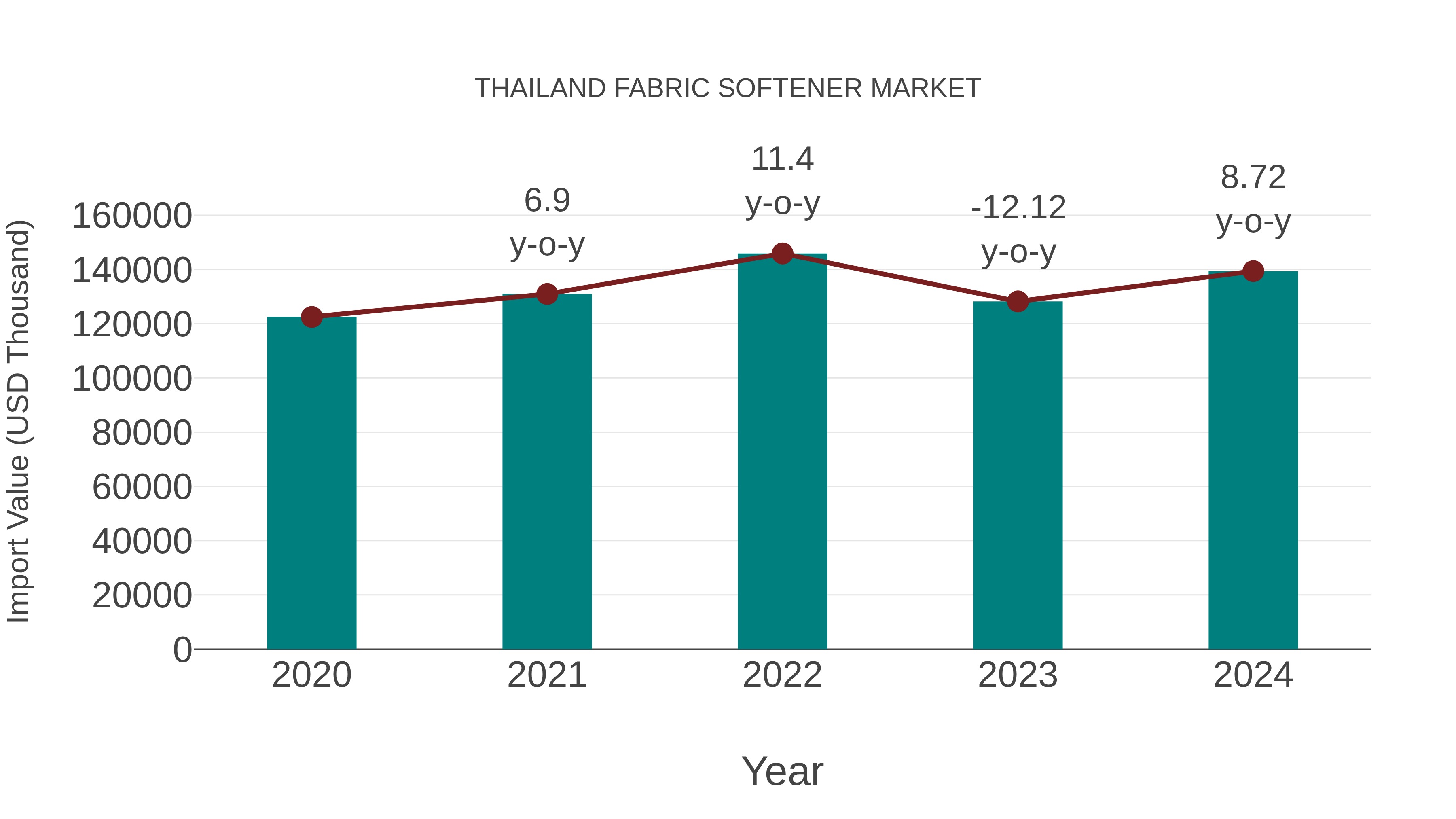
Thailand import trend in the fabric softener market showed a notable growth rate from 2023 to 2024 at 8.72%, with a compound annual growth rate (CAGR) of 3.28% for the period 2020-2024. This import momentum can be attributed to increasing consumer demand for quality fabric care products, indicating a positive shift in market stability and consumer preferences.
Fabric Softener Market: Thailand vs Top 5 Major Economies in 2027 (Asia)
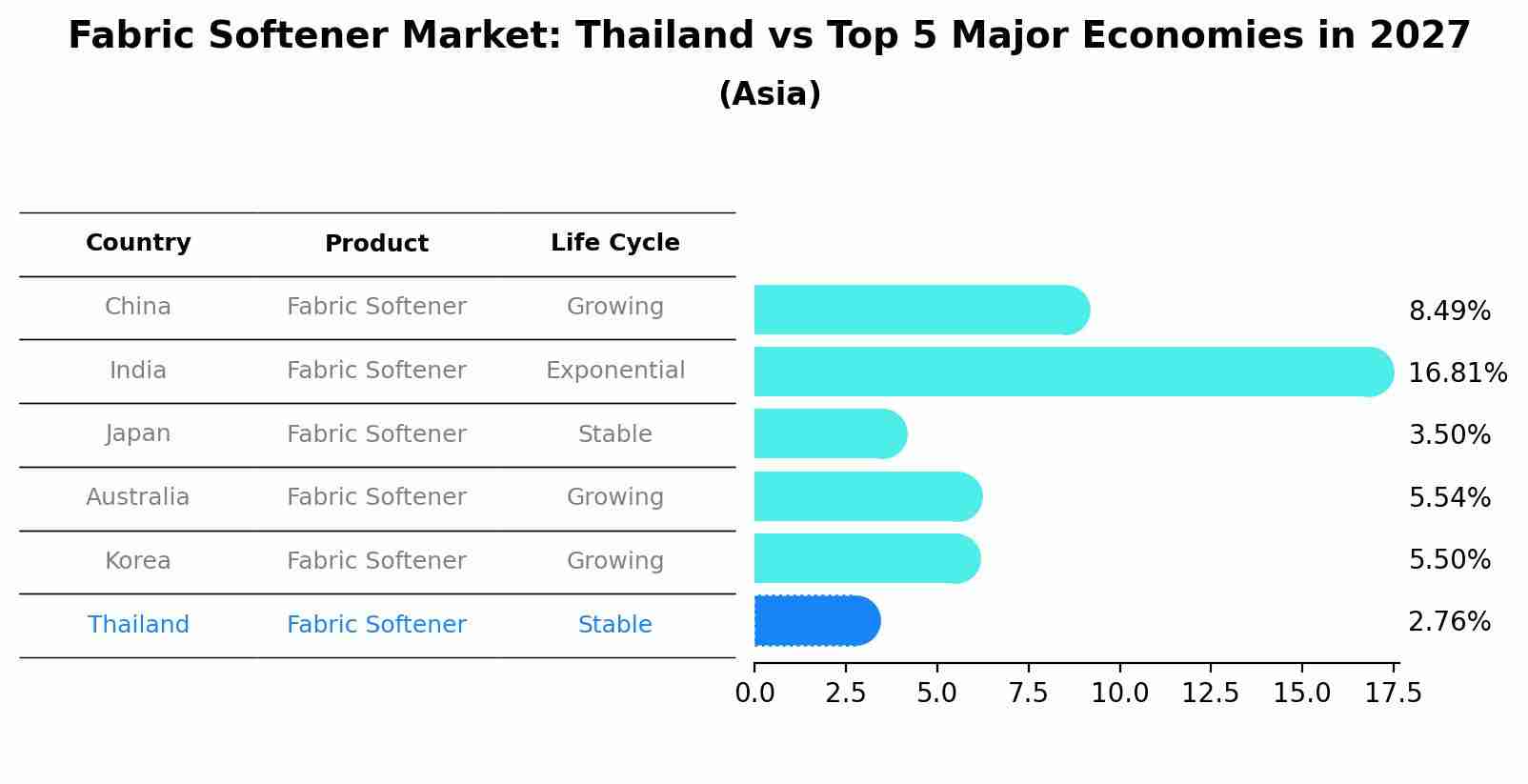
By 2027, Thailand's Fabric Softener market is forecasted to achieve a stable growth rate of 2.76%, with China leading the Asia region, followed by India, Japan, Australia and South Korea.
Thailand Fabric Softener Market Growth Rate
According to 6Wresearch internal database and industry insights, the Thailand Fabric Softener Market is projected to grow at a compound annual growth rate (CAGR) of 6.45% during the forecast period (2026-2032).
Five-Year Growth Trajectory of the Thailand Fabric Softener Market with Core Drivers
Below is an evaluation of the year-wise growth rate along with key drivers:
| Years | Estimated Annual Growth (%) | Growth Drivers |
| 2021 | 3.8% | Rising hygiene consciousness and focus on garment longevity. |
| 2022 | 4.5% | Recovery of the tourism sector driving hospitality laundry demand. |
| 2023 | 5.2% | Surge in demand for concentrated liquid refills in urban centers. |
| 2024 | 5.8% | Rise of self-service laundromats in Tier 1 and Tier 2 cities. |
| 2025 | 6% | Integration of "anti-pollution" and "anti-bacterial" claims in premium segments. |
Topics Covered in the Thailand Fabric Softener Market Report
The Thailand Fabric Softener Market report thoroughly covers the market by product type, end use, and sales channel. The report provides a detailed analysis of ongoing market trends, opportunities/high-growth areas, and market drivers that will help stakeholders align strategies based on current and future market dynamics.
Thailand Fabric Softener Market Highlights
| Report Name | Thailand Fabric Softener Market |
| Forecast period | 2026–2032 |
| CAGR | 6.45% |
| Growing Sector | Hospitality and Residential (Household) |
Thailand Fabric Softener Market Synopsis
Thailand Fabric Softener Market is projected to attain significant expansion in the coming years on the back of a major transition in consumer habits from basic cleaning to professional-grade fabric maintenance at home. The growth is primarily bolstered by the "Thailand 4.0" economic model and the "Bio-Circular-Green" (BCG) initiative, which have incentivized local manufacturers to develop sustainable, palm-oil-based surfactants that are biodegradable and eco-friendly.
Evaluation of Growth Drivers in Thailand Fabric Softener Market
Below are some prominent drivers and their influence on the market dynamics:
| Drivers | Primary Segments Affected | Why It Matters |
| Laundromat Proliferation | By End Use (Laundry Services) | Automated dispensers in 24/7 shops increase high-frequency product consumption. |
| Premiumization | By Product Type (Liquid, Sprays) | Consumers are willing to pay more for "Fine Fragrance" and "Odor-Neutralizing" tech. |
| BCG Economic Model | By Product Type (Organic/Liquid) | Government support for bio-based chemicals lowers the cost of sustainable innovation. |
| Tourism Rebound | By End Use (Hospitality) | Massive linen volume in hotels requires industrial-strength softening agents. |
| Urbanization | By Sales Channel (Online/Hypermarkets) | Busy urban lifestyles favor subscription models and bulk-buy e-commerce deals. |
Thailand Fabric Softener Market is projected to experience steady growth, registering a CAGR of 6.45% throughout the forecast period (2026-2032). The increasing consumer awareness about fabric care and the growing demand for high-quality and fragrant fabric softeners are expected to drive market growth. Apart from this, the rise of the "Scent-as-a-Signature" trend—where Thai consumers prioritize long-lasting fragrance over traditional perfume—has turned fabric softeners into a lifestyle product. Furthermore, the rapid modernization of transit hubs and residential condominiums in Bangkok and surrounding provinces has led to an explosion of 24-hour self-service laundromats, creating a massive captive audience for single-use softener pods and liquid dispensers.
Evaluation of Restraints in Thailand Fabric Softener Market
Below are some major restraints and their influence on the market dynamics:
| Restraints | Primary Segments Affected | What This Means |
| Presence of Fake Products | By Sales Channel (Independent Retailers) | Low-quality, unbranded bulk softeners in rural markets destabilize established brands. |
| Water Scarcity | By End Use (Laundry Services) | Droughts during certain seasons may impact the laundry cycle. |
| Raw Material Precariousness | By Product Type (Liquid) | Instabilities in petrochemical and palm oil prices affect overall product margins. |
| Micro-plastic Concerns | By Product Type (Tablets/Pods) | Stringent rules on micro-plastics used in the scent of the product. |
| Fragrance Sensitivity | By End Use (Household/Others) | A segment of the population avoids softeners due to respiratory or skin allergies. |
Thailand Fabric Softener Market Challenges
Thailand Fabric Softener Industry is expected to witness unprecedented growth in the years to come. Although the government is promoting green products, it is still challenging for local SMEs to compete with multinational companies due to the high price of organic surfactants compared to synthetic ones. On the other hand, issues regarding the "Thai Green Label" certification can be considered costly and time-consuming.
Thailand Fabric Softener Market Trends
It is anticipated that several new trends will influence the direction of the Thailand Fabric Softener Industry such as:
- Pollution & PM2.5 Protection: Many brands are offering softeners that supposedly lay down a "coating" of protection over individual fibres to prevent tiny particles of dust and other pollutants from clinging to clothes, which is an important unique selling point in smoggy areas like Bangkok.
- Fabric Refreshing Sprays (Waterless Maintenance): An abundance of "between wash" spray products allows consumers to refresh blazers and denim with no washing required, enabling further development of the "easy economy" trend and helping to conserve water.
- Subscription-Based E-Commerce: Platforms like TikTok Shop and Shopee Mall enable brands to offer "Subscribe and Save" options, enabling brands to create recurring revenue streams and access valuable consumer data directly.
Investment Opportunities in the Thailand Fabric Softener Market
Here is a list of significant investment opportunities in the Thailand Fabric Softener Market:
- Eco-Friendly Refill Kiosks - "Refill Stations" in high-rise condos to eliminate packaging waste and accommodate the "Zero-Waste" movement.
- AI-Driven Scent Personalization - Tech-enabled dispensers which enable consumers to personalize their choice of fragrance intensity and "mood" of their favorite fragrance prior to wash cycle start via a smartphone app.
- Specialized "Silver Economy" Fabric Softeners - Fabric softeners designed to specifically address odor neutralization within geriatric care and extreme skin sensitivity within seniors.
Top 5 Leading Players in the Thailand Fabric Softener Market
Below is a comprehensive list of major companies operating in the Thailand Fabric Softener Market:
1. Unilever Thai Trading Ltd.
| Company Name | Unilever Thai Trading Ltd. |
| Established Year | 1932 (Thailand) |
| Headquarters | Bangkok |
| Official Website | Click Here |
The market leader with its "Comfort" brand, Unilever focuses on "Ultra" concentrated technology and high-impact perfume partnerships to maintain its dominant market share.
2. I.P. One Co., Ltd.
| Company Name | I.P. One Co., Ltd. |
| Established Year | 1972 |
| Headquarters | Bangkok |
| Official Website | - |
A local giant behind the "Hygiene" brand, they are pioneers in "Life Scent" technology, capturing fragrances from living flowers to offer a superior sensory experience.
3. Lion Corporation Ltd.
| Company Name | Lion Corporation Ltd. |
| Established Year | 1967 |
| Headquarters | Bangkok |
| Official Website | - |
Known for the "Hi Class" and "Pao" brands, Lion focuses on affordable premiumization and specialized formulas for the hospitality and industrial laundry sectors.
4. NEO Corporate Public Company Limited
| Company Name | NEO Corporate Public Company Limited |
| Established Year | 1989 |
| Headquarters | Bangkok |
| Official Website | Click Here |
A rapidly growing Thai firm with the "Fineline" brand, specializing in concentrated softeners that provide high performance in anti-odor and anti-bacterial protection.
5. Kao Industrial Co., Ltd.
| Company Name | Kao Industrial Co., Ltd. |
| Established Year | 1964 |
| Headquarters | Bangkok |
| Official Website | - |
Leveraging Japanese R&D, Kao’s "Flair" and "Attack" brands focus on fiber protection and easy-ironing benefits, appealing to the professional working class.
Government Regulations in the Thailand Fabric Softener Market
According to Thai Government Data, they have also played an important role through their "Thai Green Label Scheme," which helps consumers choose products with minimum environmental impact. Other than this, the Ministry of Natural Resources and Environment has implemented the "Thailand Plastic Waste Management Roadmap," which increases the usage of refill pouches instead of rigid plastic bottles. Furthermore, the Department of Internal Trade (DIT) closely observes the prices of essential commodities, including fabric softeners, to ensure affordability in times of inflation.
Future Insights of the Thailand Fabric Softener Market
In the future years, Thailand Fabric Softener Market is expected to grow further with increasing demand for eco-friendly and high-performance products. In general, consumers are moving towards convenience and sustainability, and this is creating pressure on brands to innovate and develop products that meet this demand. Apart from this, the continued urbanization of Thailand’s population and the increasing presence of retail and e-commerce channels are also contributing to the Thailand Fabric Softener Market growth.
Market Segmentation Analysis
The report offers a comprehensive study of the following market segments and their leading categories:
By Product Type – Liquid to Lead the Market
According to Saurabh, Senior Research Analyst, 6Wresearch, Liquid segment is anticipated to lead the market due to its high solubility in the tropical climate and its seamless integration with the automated dispensing trays of modern front-load washing machines. In Thailand, concentrated liquid pouches (refills) dominate the shelf space because they offer an "eco-refill" value proposition that appeals to price-sensitive yet environmentally conscious consumers.
By End Use – Household to Lead the Market
Household segment is expected to lead the Thailand Fabric Softener Market share in the upcoming years, backed by the cultural emphasis on personal grooming and the high social value placed on "scent-identity." Thai families typically use fabric softeners in every wash cycle to combat the humidity-induced musty smells common in Southeast Asia
Key Attractiveness of the Report
- 10 Years of Market Numbers.
- Historical Data Starting from 2022 to 2025.
- Base Year: 2025.
- Forecast Data until 2032.
- Key Performance Indicators Impacting the Market.
- Major Upcoming Developments and Projects.
Key Highlights of the Report:
- Thailand Fabric Softener Market Outlook
- Market Size of Thailand Fabric Softener Market, 2025
- Forecast of Thailand Fabric Softener Market, 2032
- Historical Data and Forecast of Thailand Fabric Softener Revenues & Volume for the Period 2022-2032
- Thailand Fabric Softener Market Trend Evolution
- Thailand Fabric Softener Market Drivers and Challenges
- Thailand Fabric Softener Price Trends
- Thailand Fabric Softener Porter's Five Forces
- Thailand Fabric Softener Industry Life Cycle
- Historical Data and Forecast of Thailand Fabric Softener Market Revenues & Volume By Product Type for the Period 2022-2032
- Historical Data and Forecast of Thailand Fabric Softener Market Revenues & Volume By Liquid for the Period 2022-2032
- Historical Data and Forecast of Thailand Fabric Softener Market Revenues & Volume By Sheets for the Period 2022-2032
- Historical Data and Forecast of Thailand Fabric Softener Market Revenues & Volume By Sprays for the Period 2022-2032
- Historical Data and Forecast of Thailand Fabric Softener Market Revenues & Volume By Tablets for the Period 2022-2032
- Historical Data and Forecast of Thailand Fabric Softener Market Revenues & Volume By Dryer Bars for the Period 2022-2032
- Historical Data and Forecast of Thailand Fabric Softener Market Revenues & Volume By End Use for the Period 2022-2032
- Historical Data and Forecast of Thailand Fabric Softener Market Revenues & Volume By Laundry Services for the Period 2022-2032
- Historical Data and Forecast of Thailand Fabric Softener Market Revenues & Volume By Textile Industry for the Period 2022-2032
- Historical Data and Forecast of Thailand Fabric Softener Market Revenues & Volume By Household for the Period 2022-2032
- Historical Data and Forecast of Thailand Fabric Softener Market Revenues & Volume By Hospitality Industry for the Period 2022-2032
- Historical Data and Forecast of Thailand Fabric Softener Market Revenues & Volume By Others for the Period 2022-2032
- Historical Data and Forecast of Thailand Fabric Softener Market Revenues & Volume By Sales Channel for the Period 2022-2032
- Historical Data and Forecast of Thailand Fabric Softener Market Revenues & Volume By Independent Retailers for the Period 2022-2032
- Historical Data and Forecast of Thailand Fabric Softener Market Revenues & Volume By Hypermarkets for the Period 2022-2032
- Historical Data and Forecast of Thailand Fabric Softener Market Revenues & Volume By Multi Brand Stores for the Period 2022-2032
- Historical Data and Forecast of Thailand Fabric Softener Market Revenues & Volume By Supermarkets for the Period 2022-2032
- Historical Data and Forecast of Thailand Fabric Softener Market Revenues & Volume By Specialty Retail Stores for the Period 2022-2032
- Historical Data and Forecast of Thailand Fabric Softener Market Revenues & Volume By Online Sales for the Period 2022-2032
- Historical Data and Forecast of Thailand Fabric Softener Market Revenues & Volume By Company Website for the Period 2022-2032
- Historical Data and Forecast of Thailand Fabric Softener Market Revenues & Volume By 3rdParty Online Sales for the Period 2022-2032
- Thailand Fabric Softener Import Export Trade Statistics
- Market Opportunity Assessment By Product Type
- Market Opportunity Assessment By End Use
- Market Opportunity Assessment By Sales Channel
- Thailand Fabric Softener Top Companies Market Share
- Thailand Fabric Softener Competitive Benchmarking By Technical and Operational Parameters
- Thailand Fabric Softener Company Profiles
- Thailand Fabric Softener Key Strategic Recommendations
Market Segmentations:
The Market report covers a detailed analysis of the following market segments:
By Product Type
- Liquid
- Sheets
- Sprays
- Tablets
- Dryer Bars
By End Use
- Laundry Services
- Textile Industry
- Household
- Hospitality Industry
- Others
By Sales Channel
- Independent Retailers
- Hypermarkets
- Multi Brand Stores
- Supermarkets
- Specialty Retail Stores
- Online Sales
- Company Website
- 3rd Party Online Sales






































