Thailand HR Analytics Market Size & Growth Rate (2026-2032)
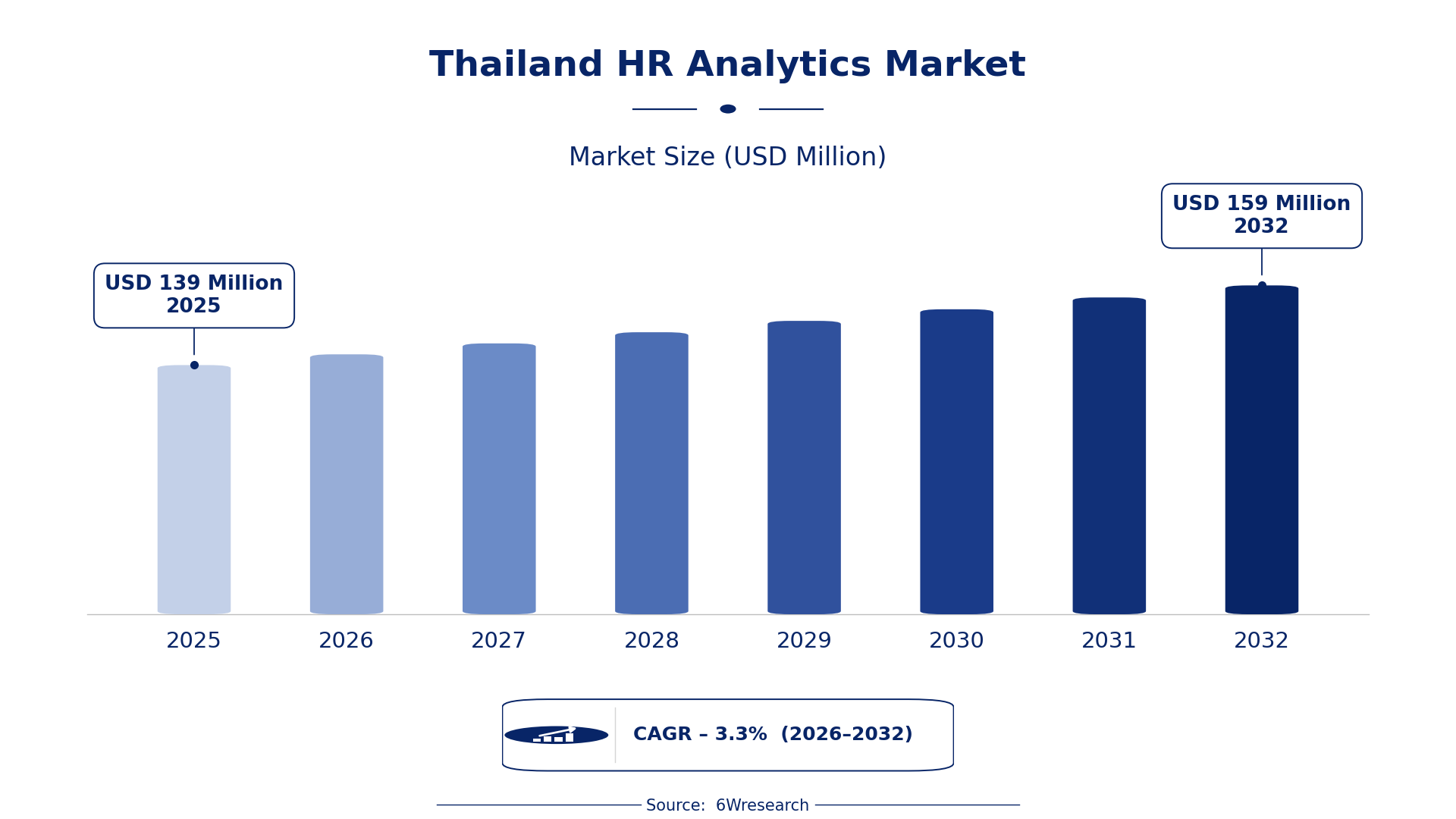
The Thailand HR Analytics Market was estimated at USD 139 Million in 2025 and is projected to reach USD 159 Million by 2032, growing at a CAGR of 3.3% from 2026 to 2032.
Thailand HR Analytics Market Synopsis
The rising emphasis on data-driven decision-making is currently the most significant factor shaping the Thailand HR Analytics Market. Organizations are increasingly turning to analytics to enhance talent acquisition, performance management, and employee retention, recognizing that informed strategies lead to a more engaged workforce.
As businesses in Thailand aim to streamline their HR processes, the demand for analytics solutions is escalating. These tools not only provide insights into employee performance but also foster an environment of continuous improvement, which is essential in today’s competitive landscape.
Thailand HR Analytics Market Year-wise Growth Rate and Key Drivers
This graph illustrates the annual growth rates of the Thailand HR Analytics Market from 2021 to 2032, highlighting a steady upward trajectory and projected expansion over the forecast period.
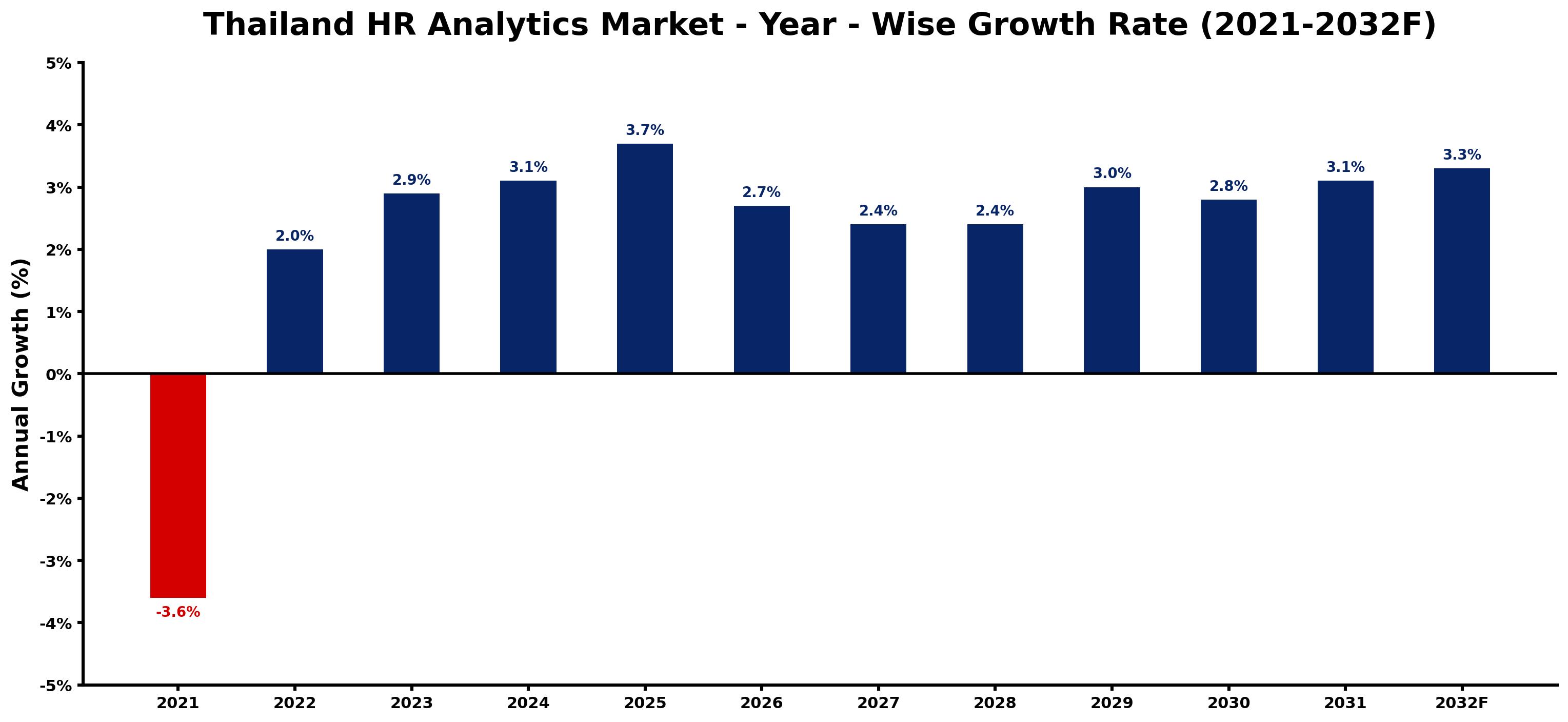
The table below presents the year‑wise growth rates along with the key drivers influencing the market
| Year | Growth Rate | Major Drivers |
| 2021 | -3.6% | Reduced corporate spending amid Thailand's economic downturn. |
| 2022 | 2.0% | Thai government promoting digital workforce transformation initiatives. |
| 2023 | 2.9% | Increase in remote work driving HR data adoption. |
| 2024 | 3.1% | Rising need for predictive analytics in talent management. |
| 2025 | 3.7% | Growth in SMEs adopting HR technology solutions. |
| 2026 | 2.7% | Focus on employee wellness analytics post-pandemic. |
| 2027 | 2.4% | Thai labor reforms enhancing data-driven HR practices. |
| 2028 | 2.4% | Technological advancements in HR tech improving accessibility. |
| 2029 | 3.0% | Corporate investments in talent acquisition analytics rising. |
| 2030 | 2.8% | Emerging interest in AI-driven HR decision support tools. |
| 2031 | 3.1% | Government initiatives supporting HR tech skill development. |
| 2032 | 3.3% | Increased collaboration between HR and IT departments. |
Note: Market size estimations and growth projections presented in this report are based on 6Wresearch's proprietary forecasting methodology, utilizing the latest available industry data, government publications, and primary research inputs.
Thailand HR Analytics Market Key Takeaways
Below are some of the specific key takeaways from the market, including:
- The market is witnessing a shift towards analytics-driven HR strategies aimed at enhancing employee satisfaction.
- Companies are investing in solutions that optimize workforce management and improve talent acquisition processes.
- The need for ethical data use and unbiased decision-making is becoming increasingly critical.
- COVID-19 has accelerated the adoption of HR analytics as organizations adapt to new workforce dynamics.
- Significant opportunities exist for vendors offering innovative analytics solutions tailored to local market needs.
Evaluation of Restraints in Thailand HR Analytics Market
While the Thailand HR Analytics Market is growing, it faces challenges that could hinder its progress. Concerns over the ethical use of employee data and the potential for biased outcomes in decision-making are at the forefront. Organizations are grappling with the need to build a culture of trust, ensuring that data-driven insights are accepted and utilized effectively. on top of that, issues surrounding data accuracy and reliability can create hurdles for companies seeking to implement analytics solutions confidently.
Thailand HR Analytics Market Trends
Key trends shaping the Thailand HR Analytics Market include the increasing integration of artificial intelligence and machine learning into HR tools. This technological advancement allows for more sophisticated analysis and forecasting, enhancing HR departments' capabilities. Additionally, there is a growing focus on employee well-being, driving organizations to use analytics not just for performance metrics but to gauge employee sentiment and satisfaction levels.
Thailand HR Analytics Market Opportunities
Genuine growth opportunities lie in the development of customized HR analytics solutions that cater to the unique needs of Thai businesses. As organizations prioritize talent management and employee engagement, there is a clear demand for tools that offer actionable insights. Companies that can innovate in this space, particularly those addressing the ethical concerns surrounding data usage, stand to capture significant market share.
Government Initiatives in the Thailand HR Analytics Market
Government policy is playing a crucial role in shaping the Thailand HR Analytics Market. As the public sector increasingly recognizes the importance of data-driven decision-making in enhancing workforce management, various initiatives have been launched to support this transition. The regulatory environment is becoming more conducive to the adoption of analytics, making it vital for businesses to align with these government efforts.
- A national initiative to enhance digital infrastructure was launched in early 2025 to support HR tech advancements.
- Current efforts are underway to develop a regulatory framework that mandates transparency in the use of employee data.
- Planned public-private partnerships are set to begin in 2026, aimed at fostering innovation in HR analytics solutions.
- Recent workshops were conducted by the Ministry of Labor to educate businesses on the benefits of HR analytics.
- A strategic plan to integrate analytics into public sector HR functions is in development, expected to roll out by 2028.
Future Insights of the Thailand HR Analytics Market
Looking ahead to 2026-2032, the Thailand HR Analytics Market is set to expand as organizations continue to invest in analytics solutions. The increasing demand for data-driven HR practices will push more businesses to adopt advanced analytics tools, fostering a culture of informed decision-making. As companies adapt to changing workforce dynamics, the role of analytics in strategic HR management will only grow more significant, positioning it as an indispensable asset for attracting and retaining top talent.
Thailand HR Analytics Market Latest Developments
Recent activity in the Thailand HR Analytics Market indicates a clear trend towards innovation and integration of advanced technologies. Over the past year, various organizations have focused on enhancing their analytics capabilities, resulting in a more competitive environment. This momentum reflects a collective push towards leveraging data for better HR outcomes.
- A major technology vendor announced the launch of a new HR analytics platform in Q1 2025, aimed at small to medium enterprises.
- A partnership between leading analytics firms was formed in mid-2025 to develop AI-driven solutions for HR departments.
- Ongoing trials for a predictive analytics tool are being conducted by several large corporations, focusing on employee retention strategies.
- Upcoming initiatives are planned for late 2026 to enhance training programs for HR professionals in analytics usage.
- By Q3 2025, an upgraded version of an existing analytics tool is expected to be rolled out, featuring enhanced user capabilities.
Thailand HR Analytics Market - Key Attractiveness of the Report
- 10 Years of Market Numbers
- Historical Data Starting from 2022 to 2025
- Base Year: 2025
- Forecast Data until 2032
- Key Performance Indicators Impacting the Market
- Major Upcoming Developments and Projects
Key Highlights of the Report:
- Thailand HR Analytics Market Outlook
- Market Size of Thailand HR Analytics Market, 2025
- Forecast of Thailand HR Analytics Market, 2032
- Historical Data and Forecast of Thailand HR Analytics Revenues & Volume for the Period 2022-2032F
- Thailand HR Analytics Market Trend Evolution
- Thailand HR Analytics Market Drivers and Challenges
- Thailand HR Analytics Price Trends
- Thailand HR Analytics Porter's Five Forces
- Thailand HR Analytics Industry Life Cycle
- Historical Data and Forecast of Thailand HR Analytics Market Revenues & Volume By Application Area for the Period 2022-2032F
- Historical Data and Forecast of Thailand HR Analytics Market Revenues & Volume By Payroll for the Period 2022-2032F
- Historical Data and Forecast of Thailand HR Analytics Market Revenues & Volume By Retention for the Period 2022-2032F
- Historical Data and Forecast of Thailand HR Analytics Market Revenues & Volume By Recruitment for the Period 2022-2032F
- Historical Data and Forecast of Thailand HR Analytics Market Revenues & Volume By Workforce Management for the Period 2022-2032F
- Historical Data and Forecast of Thailand HR Analytics Market Revenues & Volume By Employee Engagement for the Period 2022-2032F
- Historical Data and Forecast of Thailand HR Analytics Market Revenues & Volume By Employee Development for the Period 2022-2032F
- Historical Data and Forecast of Thailand HR Analytics Market Revenues & Volume By Vertical for the Period 2022-2032F
- Historical Data and Forecast of Thailand HR Analytics Market Revenues & Volume By Consumer goods and retail for the Period 2022-2032F
- Historical Data and Forecast of Thailand HR Analytics Market Revenues & Volume By BFSI for the Period 2022-2032F
- Historical Data and Forecast of Thailand HR Analytics Market Revenues & Volume By IT and telecom for the Period 2022-2032F
- Historical Data and Forecast of Thailand HR Analytics Market Revenues & Volume By Manufacturing for the Period 2022-2032F
- Historical Data and Forecast of Thailand HR Analytics Market Revenues & Volume By Healthcare for the Period 2022-2032F
- Historical Data and Forecast of Thailand HR Analytics Market Revenues & Volume By Education for the Period 2022-2032F
- Historical Data and Forecast of Thailand HR Analytics Market Revenues & Volume By Others for the Period 2022-2032F
- Historical Data and Forecast of Thailand HR Analytics Market Revenues & Volume By Component for the Period 2022-2032F
- Historical Data and Forecast of Thailand HR Analytics Market Revenues & Volume By Solutions for the Period 2022-2032F
- Historical Data and Forecast of Thailand HR Analytics Market Revenues & Volume By Service for the Period 2022-2032F
- Historical Data and Forecast of Thailand HR Analytics Market Revenues & Volume By Deployment Type for the Period 2022-2032F
- Historical Data and Forecast of Thailand HR Analytics Market Revenues & Volume By On-premises for the Period 2022-2032F
- Historical Data and Forecast of Thailand HR Analytics Market Revenues & Volume By Cloud for the Period 2022-2032F
- Historical Data and Forecast of Thailand HR Analytics Market Revenues & Volume By Organization Size for the Period 2022-2032F
- Historical Data and Forecast of Thailand HR Analytics Market Revenues & Volume By Large Enterprises for the Period 2022-2032F
- Historical Data and Forecast of Thailand HR Analytics Market Revenues & Volume By Small and Medium-Sized Enterprises (SMEs) for the Period 2022-2032F
- Thailand HR Analytics Import Export Trade Statistics
- Market Opportunity Assessment By Application Area
- Market Opportunity Assessment By Vertical
- Market Opportunity Assessment By Component
- Market Opportunity Assessment By Deployment Type
- Market Opportunity Assessment By Organization Size
- Thailand HR Analytics Top Companies Market Share
- Thailand HR Analytics Competitive Benchmarking By Technical and Operational Parameters
- Thailand HR Analytics Company Profiles
- Thailand HR Analytics Key Strategic Recommendations






































