Thailand Motorcycle components Market Size, Share & Growth Rate
The Thailand Motorcycle components Market was estimated at USD 98 Million in 2025 and is projected to reach USD 112 Million by 2032, growing at a CAGR of 1.9% from 2026 to 2032. This growth trajectory is bolstered by the increasing urbanization and the rising trend toward two-wheeler usage as a convenient mode of transport, particularly in congested city areas. The growing demand for high-quality components, driven by technological advancements and consumer preferences for performance and safety, further stimulates market expansion.
Thailand Motorcycle components Market Year-wise Growth Rate and Key Drivers
This graph highlights how the Thailand Motorcycle components Market has steadily grown over the years, supported by major growth factors.
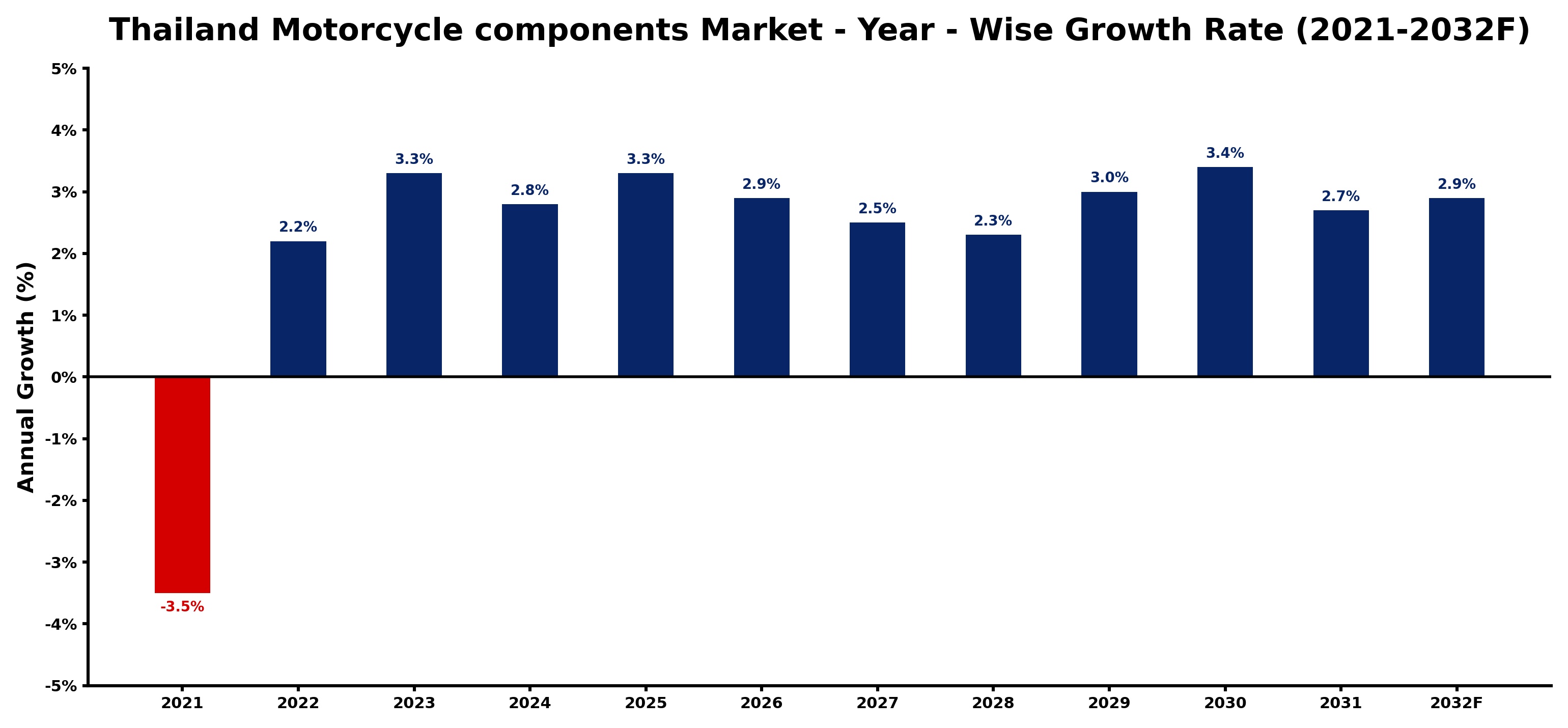
The table below presents the year‑wise growth rates along with the key drivers influencing the market
| Year | Growth Rate | Major Drivers |
| 2021 | -3.5% | Declining motorcycle exports weakened local components manufacturing investments |
| 2022 | 2.2% | Advanced sensor technologies boost motorcycle component manufacturing accuracy |
| 2023 | 3.3% | Local assembly operations boosted demand for motorcycle component supplies |
| 2024 | 2.8% | Regional assembly plant upgrades enhanced motorcycle part production capabilities |
| 2025 | 3.3% | Improved machinery investments boosted motorcycle component manufacturing output |
| 2026 | 2.9% | New assembly line technology boosted motorcycle part production efficiency |
| 2027 | 2.5% | Upgraded manufacturing processes enhanced local motorcycle component production efficiency |
| 2028 | 2.3% | Local suppliers scale operations to meet rising electric motorcycle demand |
| 2029 | 3.0% | Increased domestic assembly plant investments boost component manufacturing output |
| 2030 | 3.4% | Increased foreign investment boosted Thailand's motorcycle parts production capacity |
| 2031 | 2.7% | Production upgrades in Thailand enhanced motorcycle component assembly efficiency |
| 2032 | 2.9% | Local manufacturers invest in robotics for motorcycle component assembly |
Note - Market size estimations and growth projections presented in this report are based on 6Wresearch’s advanced forecasting approach, validated with industry datasets as of June 2026.
Thailand Motorcycle components Market Synopsis
Thailand's motorcycle components market has positioned itself as a vital contributor to the region's automotive sector. With a significant influx of OEMs, the demand for critical components such as engines, frames, and electrical systems is surging. This uptick is not only a reflection of the thriving motorcycle industry but also a response to evolving consumer demands for innovative and customizable solutions.
As urban transportation needs continue to evolve, the market has witnessed a marked increase in the adoption of motorcycles. This shift has catalyzed an innovative environment where suppliers are striving to enhance their product offerings to meet stringent safety and performance standards. With ongoing advancements in motorcycle technology, the market is poised for significant growth.
Thailand Motorcycle components Market Key Takeaways
- The market is anticipated to reach USD 112 million by 2032, showcasing steady growth potential.
- Urban transportation needs and the popularity of motorcycles are major drivers of market expansion.
- Technological innovations are fostering the development of advanced components catering to safety and performance.
- Customization trends are reshaping consumer expectations, prompting manufacturers to innovate continually.
- Quality control remains a critical focus for manufacturers to ensure safety and reliability in the components market.
Evaluation of Restraints in Thailand Motorcycle components Market
Despite its robust growth, the Thailand motorcycle components market faces notable constraints. Ensuring quality control remains a paramount challenge, as the integrity of motorcycle components directly influences safety and performance. The competitive landscape further complicates matters; companies must constantly innovate to differentiate their offerings while balancing cost-effectiveness. These factors necessitate a strategic approach to manufacturing and customer engagement to thrive in this dynamic environment.
Thailand Motorcycle components Market Trends
Emerging trends in the Thailand motorcycle components market are significantly influenced by technological advancements and consumer preferences. The rise of electric motorcycles is prompting a shift in component design, leading to increased demand for specialized parts. Additionally, the focus on sustainable manufacturing processes is gaining traction as consumers become more environmentally conscious. The trend towards digitization, including smart components and connectivity features, is also shaping the future of motorcycle components.
Thailand Motorcycle components Market Opportunities
The Thailand motorcycle components market presents ample opportunities for growth and investment. The increasing demand for electric motorcycles is opening new avenues for component manufacturers to innovate and expand their product ranges. Furthermore, the growing urban population is likely to propel the adoption of two-wheelers, creating a consistent need for high-quality components. Collaborative ventures between manufacturers and technology firms can also enhance product offerings, ultimately driving market growth.
Government Initiatives in the Thailand Motorcycle components Market
The Thai government is actively promoting the motorcycle industry through various initiatives aimed at enhancing local manufacturing capabilities. Policies focusing on infrastructure development and investment incentives are facilitating growth within the sector. Furthermore, programs aimed at encouraging research and development in motorcycle technology are fostering innovation, which is crucial for maintaining competitiveness in the market.
Future Insights of the Thailand Motorcycle components Market
Looking ahead, the Thailand motorcycle components market is expected to evolve significantly between 2026 and 2032. The continued push for urban mobility solutions will likely sustain demand for motorcycles and their components. As consumer preferences shift toward enhanced safety and performance features, manufacturers must adapt by integrating advanced technologies into their offerings. The anticipated growth of electric motorcycles will further redefine the landscape, necessitating innovative approaches to component design and manufacturing.
Thailand Motorcycle components Market Latest Developments (May 2025 - June 2026)
Recent developments in the Thailand motorcycle components market have centered around increased investment in technological innovations. Manufacturers are exploring partnerships with tech firms to incorporate smart technologies into motorcycle components. Additionally, sustainability initiatives are gaining momentum, with companies seeking eco-friendly materials and production methods. As the market rebounds from the pandemic's impact, a renewed focus on quality and performance is evident, reflecting changing consumer priorities.
Thailand Motorcycle components Market - Key Attractiveness of the Report
- 10 Years of Market Numbers
- Historical Data Starting from 2022 to 2025
- Base Year: 2025
- Forecast Data until 2032
- Key Performance Indicators Impacting the Market
- Major Upcoming Developments and Projects
Key Highlights of the Report:
- Thailand Motorcycle components Market Outlook
- Market Size of Thailand Motorcycle components Market, 2025
- Forecast of Thailand Motorcycle components Market, 2032
- Historical Data and Forecast of Thailand Motorcycle components Revenues & Volume for the Period 2022-2032F
- Thailand Motorcycle components Market Trend Evolution
- Thailand Motorcycle components Market Drivers and Challenges
- Thailand Motorcycle components Price Trends
- Thailand Motorcycle components Porter's Five Forces
- Thailand Motorcycle components Industry Life Cycle
- Historical Data and Forecast of Thailand Motorcycle components Market Revenues & Volume By Type for the Period 2022-2032F
- Historical Data and Forecast of Thailand Motorcycle components Market Revenues & Volume By Engine & Drivetrain for the Period 2022-2032F
- Historical Data and Forecast of Thailand Motorcycle components Market Revenues & Volume By Tires for the Period 2022-2032F
- Historical Data and Forecast of Thailand Motorcycle components Market Revenues & Volume By Structural for the Period 2022-2032F
- Historical Data and Forecast of Thailand Motorcycle components Market Revenues & Volume By Electrical and Electronic for the Period 2022-2032F
- Historical Data and Forecast of Thailand Motorcycle components Market Revenues & Volume By Other for the Period 2022-2032F
- Historical Data and Forecast of Thailand Motorcycle components Market Revenues & Volume By Applications for the Period 2022-2032F
- Historical Data and Forecast of Thailand Motorcycle components Market Revenues & Volume By Electric Bicycles for the Period 2022-2032F
- Historical Data and Forecast of Thailand Motorcycle components Market Revenues & Volume By Motorcycles for the Period 2022-2032F
- Thailand Motorcycle components Import Export Trade Statistics
- Market Opportunity Assessment By Type
- Market Opportunity Assessment By Applications
- Thailand Motorcycle components Top Companies Market Share
- Thailand Motorcycle components Competitive Benchmarking By Technical and Operational Parameters
- Thailand Motorcycle components Company Profiles
- Thailand Motorcycle components Key Strategic Recommendations






































