Thailand Processed Meat Market: Import Trend Analysis
Thailand import trend for the processed meat market saw a decline in growth from 2023 to 2024, with a -5.04% rate. The compound annual growth rate (CAGR) for 2020-2024 stood at -5.5%. This negative momentum could be attributed to shifting consumer preferences towards healthier food options or changes in trade policies impacting import volumes.
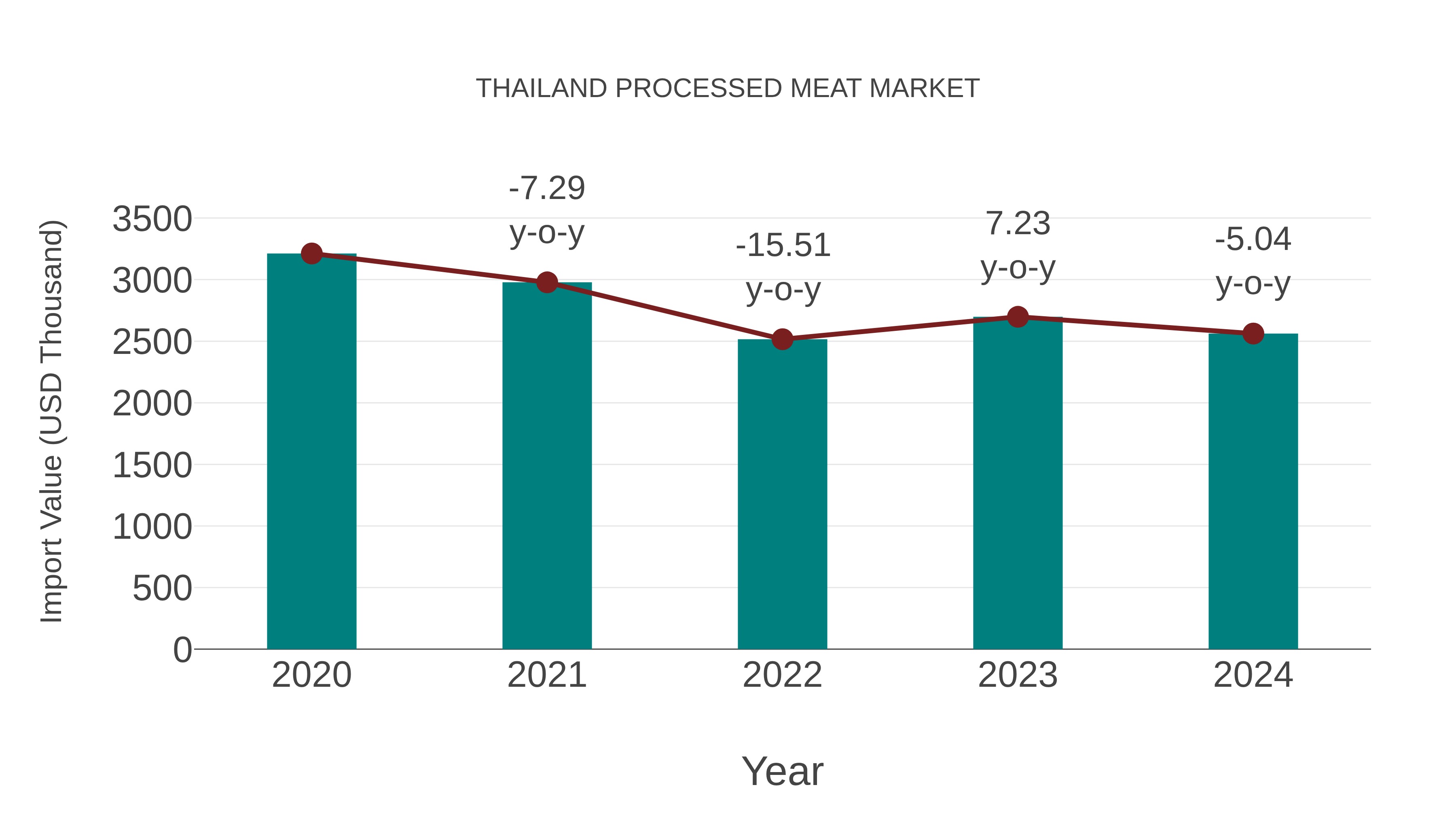
Thailand Export Potential Assessment For Processed Meat Market (Values in USD Thousand)
Thailand Processed Meat Market Synopsis
The processed meat market in Thailand is experiencing steady growth as consumer lifestyles become more fast-paced, leading to a higher demand for convenient and ready-to-eat meat products. Processed meat items such as sausages, ham, bacon, and canned meats are popular choices among Thai consumers. The market is driven by factors like urbanization, increased disposable income, and a preference for convenient meal options. Manufacturers are continuously innovating to offer healthier processed meat products by reducing additives and preservatives and catering to specific dietary preferences, including halal and organic options.
Drivers of the Market
The Thailand processed meat market is expanding due to evolving consumer lifestyles and preferences. Urbanization has led to busier lives, prompting consumers to seek convenient and ready-to-eat meat products. Processed meat items like sausages, bacon, and ham are becoming increasingly popular. Additionally, the emergence of local and international fast-food chains has created a robust market for processed meat in burgers, sandwiches, and pizzas, contributing to sustained growth.
Challenges of the Market
The processed meat market in Thailand faces challenges related to health and dietary concerns. As consumers become more health-conscious, there is growing scrutiny of processed meat products, particularly those with high levels of additives, preservatives, and unhealthy fats. Overcoming these health-related perceptions and adapting to changing consumer preferences for healthier processed meat options is a significant challenge.
COVID-19 Impact on the Market
The Thailand processed meat market experienced mixed effects from the pandemic. Initially, disruptions in supply chains and labor shortages affected production. However, as lockdowns continued, there was a surge in demand for processed meat products, including sausages and canned meat, as consumers stockpiled non-perishable foods. Manufacturers adapted by implementing strict hygiene and safety protocols, and there was a noticeable shift towards online sales and home delivery to meet consumer needs.
Key Players in the Market
In the Thailand processed meat market, companies like Saha Farms Group have established themselves as leading players. Saha Farms Group operates in various segments of the food industry, including poultry processing and the production of processed meat products. Their commitment to quality and innovation has positioned them as a trusted name in the processed meat sector within Thailand.
Key Highlights of the Report:
- Thailand Processed Meat Market Outlook
- Market Size of Thailand Processed Meat Market, 2025
- Forecast of Thailand Processed Meat Market, 2032
- Historical Data and Forecast of Thailand Processed Meat Revenues & Volume for the Period 2022-2032F
- Thailand Processed Meat Market Trend Evolution
- Thailand Processed Meat Market Drivers and Challenges
- Thailand Processed Meat Price Trends
- Thailand Processed Meat Porter's Five Forces
- Thailand Processed Meat Industry Life Cycle
- Historical Data and Forecast of Thailand Processed Meat Market Revenues & Volume By Meat Type for the Period 2022-2032F
- Historical Data and Forecast of Thailand Processed Meat Market Revenues & Volume By Poultry for the Period 2022-2032F
- Historical Data and Forecast of Thailand Processed Meat Market Revenues & Volume By Beef for the Period 2022-2032F
- Historical Data and Forecast of Thailand Processed Meat Market Revenues & Volume By Pork for the Period 2022-2032F
- Historical Data and Forecast of Thailand Processed Meat Market Revenues & Volume By Others for the Period 2022-2032F
- Historical Data and Forecast of Thailand Processed Meat Market Revenues & Volume By Product Type for the Period 2022-2032F
- Historical Data and Forecast of Thailand Processed Meat Market Revenues & Volume By Frozen for the Period 2022-2032F
- Historical Data and Forecast of Thailand Processed Meat Market Revenues & Volume By Chilled for the Period 2022-2032F
- Historical Data and Forecast of Thailand Processed Meat Market Revenues & Volume By Canned for the Period 2022-2032F
- Historical Data and Forecast of Thailand Processed Meat Market Revenues & Volume By Application for the Period 2022-2032F
- Historical Data and Forecast of Thailand Processed Meat Market Revenues & Volume By Commercial for the Period 2022-2032F
- Historical Data and Forecast of Thailand Processed Meat Market Revenues & Volume By Residential for the Period 2022-2032F
- Historical Data and Forecast of Thailand Processed Meat Market Revenues & Volume By Distribution Channel for the Period 2022-2032F
- Historical Data and Forecast of Thailand Processed Meat Market Revenues & Volume By HoReCa for the Period 2022-2032F
- Historical Data and Forecast of Thailand Processed Meat Market Revenues & Volume By Supermarkets/Hypermarkets for the Period 2022-2032F
- Historical Data and Forecast of Thailand Processed Meat Market Revenues & Volume By Convenience Stores for the Period 2022-2032F
- Historical Data and Forecast of Thailand Processed Meat Market Revenues & Volume By Independent Retailers for the Period 2022-2032F
- Historical Data and Forecast of Thailand Processed Meat Market Revenues & Volume By Others for the Period 2022-2032F
- Thailand Processed Meat Import Export Trade Statistics
- Market Opportunity Assessment By Meat Type
- Market Opportunity Assessment By Product Type
- Market Opportunity Assessment By Application
- Market Opportunity Assessment By Distribution Channel
- Thailand Processed Meat Top Companies Market Share
- Thailand Processed Meat Competitive Benchmarking By Technical and Operational Parameters
- Thailand Processed Meat Company Profiles
- Thailand Processed Meat Key Strategic Recommendations






































