Thailand Semiconductor Foundry Market Size, Share & Growth Rate
The Thailand Semiconductor Foundry Market was estimated at USD 97 Million in 2025 and is projected to reach USD 111 Million by 2032, growing at a CAGR of 1.9% from 2026 to 2032. This growth trajectory can be attributed to the surging demand for advanced semiconductor components across various sectors, especially automotive and consumer electronics. Thailand's strategic geographic location and its cost-effective manufacturing capabilities continue to attract multinational companies, solidifying its status as a crucial hub in Southeast Asia's semiconductor landscape.
Thailand Semiconductor Foundry Market Year-wise Growth Rate and Key Drivers
This graph highlights how the Thailand Semiconductor Foundry Market has steadily grown over the years, supported by major growth factors.
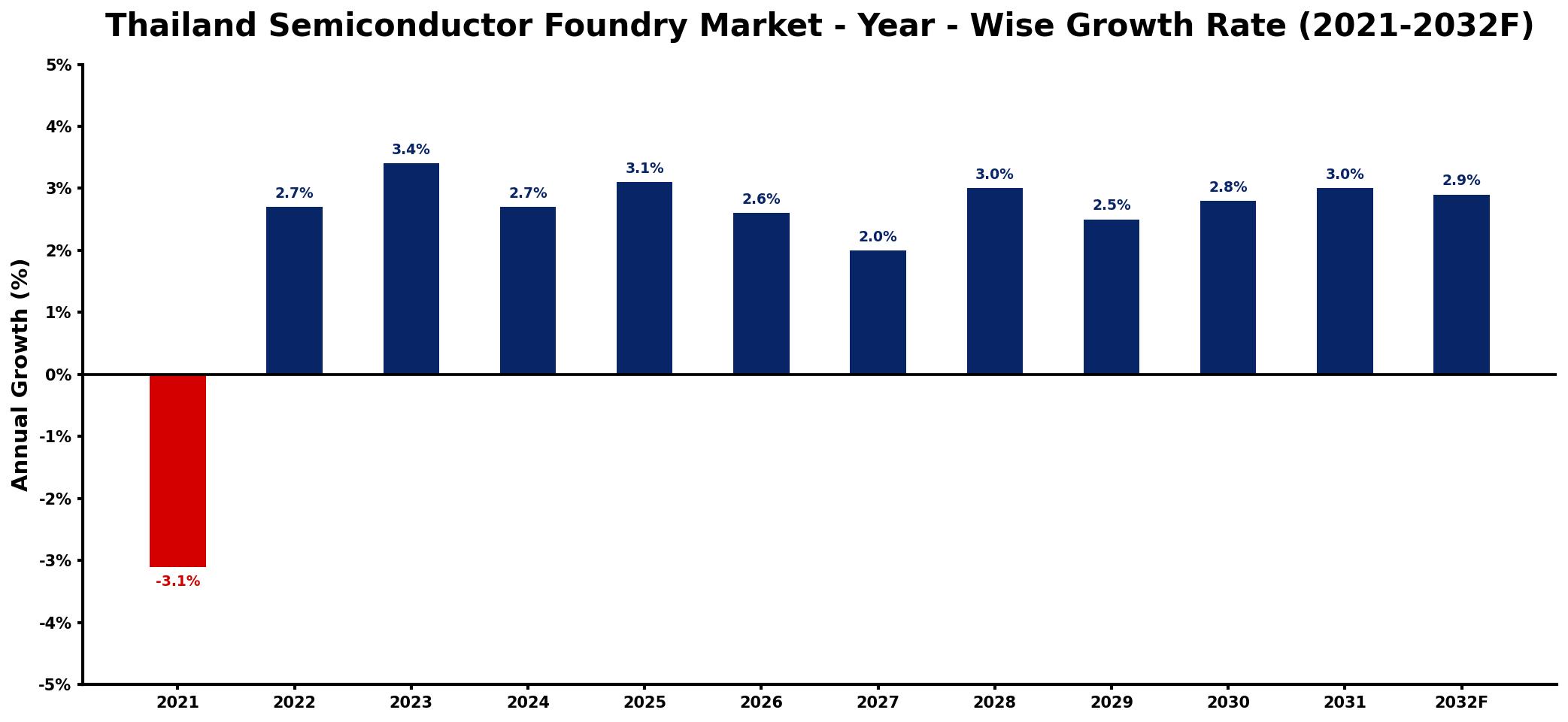
The table below presents the year‑wise growth rates along with the key drivers influencing the market
| Year | Growth Rate | Major Drivers |
| 2021 | -3.1% | decreased investments in technology |
| 2022 | 2.7% | rising demand for electronics manufacturing |
| 2023 | 3.4% | expansion of automotive electronics sector |
| 2024 | 2.7% | growth in mobile device production |
| 2025 | 3.1% | increased cloud computing services adoption |
| 2026 | 2.6% | surge in AI technology applications |
| 2027 | 2.0% | growing downstream application demand |
| 2028 | 3.0% | increased production capacity utilization |
| 2029 | 2.5% | increased demand for consumer electronics |
| 2030 | 2.8% | rising end-use demand growth |
| 2031 | 3.0% | rise in healthcare technology investments |
| 2032 | 2.9% | increased automation in manufacturing |
Note: Market size estimations and growth projections presented in this report are based on 6Wresearch's proprietary forecasting methodology, utilizing the latest available industry data, government publications, and primary research inputs.
Thailand Semiconductor Foundry Market Synopsis
As the global market for electronics escalates, Thailand's semiconductor foundry sector is experiencing a remarkable surge in production capacity. Integrated circuits and semiconductor devices are being manufactured to meet the increasing requirements of industries, especially with the advancements in 5G technology and IoT.
The Thai governments strategic initiatives, including incentives for investment in technology and infrastructure, are fostering a robust environment for semiconductor manufacturing. This has not only led to increased production but also enhanced the country's competitiveness within the regional and global semiconductor markets.
Thailand Semiconductor Foundry Market Key Takeaways
- The market is poised for steady growth, fueled by rising demand for semiconductor components in various industries.
- Thailand's strategic location and skilled labor force are pivotal in attracting foreign investments in semiconductor foundries.
- Government policies aimed at boosting the electronics sector play a crucial role in market expansion.
- The automotive sector, along with consumer electronics, significantly drives the demand for advanced semiconductor solutions.
- Technological advancements in 5G and IoT present new opportunities for the foundry market in Thailand.
Evaluation of Restraints in Thailand Semiconductor Foundry Market
Despite its robust growth potential, the Thailand semiconductor foundry market grapples with several limitations. Intense competition from established semiconductor hubs worldwide necessitates significant investments in cutting-edge technologies to maintain competitiveness. Furthermore, geopolitical tensions and potential trade restrictions pose risks to the supply chain of essential semiconductor materials, hindering seamless production operations. Additionally, the market faces challenges in ensuring a steady supply of a skilled workforce equipped to handle the latest manufacturing processes while safeguarding sensitive intellectual property.
Thailand Semiconductor Foundry Market Trends
Emerging trends in the Thailand semiconductor foundry market include a notable shift towards sustainable and energy-efficient manufacturing practices. Companies are increasingly adopting green technologies and processes to minimize environmental impact, appealing to environmentally conscious consumers and stakeholders. Furthermore, the integration of artificial intelligence in semiconductor manufacturing is enhancing operational efficiency and reducing costs, paving the way for more sophisticated production capabilities. These trends not only help companies stay ahead but also reinforce Thailands position as an innovative leader in semiconductor manufacturing.
Thailand Semiconductor Foundry Market Opportunities
Opportunities in the Thailand semiconductor foundry market abound, particularly in the field of specialized semiconductor manufacturing. The growing demand for automotive electronics, coupled with advancements in technology, creates a lucrative avenue for investments. Furthermore, the expansion of 5G networks and IoT devices presents a significant opportunity for foundries to innovate and diversify their offerings. With the government's continued support and investment incentives, there is considerable potential for new entrants and existing players to explore niche markets and expand their operational footprint.
Government Initiatives in the Thailand Semiconductor Foundry Market
The Thai government has implemented various initiatives to bolster the semiconductor foundry market, focusing on enhancing the country's technological capabilities. These initiatives include offering incentives for research and development, tax breaks for foreign direct investments, and funding for infrastructure improvements aimed at supporting electronics manufacturing. By fostering collaboration between the private sector and educational institutions, the government aims to create a skilled workforce equipped to meet the needs of the rapidly evolving semiconductor landscape.
Future Insights of the Thailand Semiconductor Foundry Market
Looking forward to 2026-2032, the Thailand semiconductor foundry market is expected to experience a transformation driven by technological advancements and rising demand for innovative semiconductor solutions. As industries increasingly adopt smart technologies, the need for high-performance semiconductors will become paramount. Thailand's commitment to strengthening its semiconductor ecosystem will likely enable it to capture a larger share of the global market, positioning the country as a significant player in shaping the future of semiconductor manufacturing in the region.
Thailand Semiconductor Foundry Market Latest Developments (2025 - 2026)
Recent developments in the Thailand semiconductor foundry market indicate a shift towards more innovative manufacturing processes. There has been a notable increase in collaborations between local firms and international technology companies to enhance production capabilities and adopt cutting-edge technologies. Additionally, the market has witnessed investments in advanced manufacturing equipment, reflecting a commitment to improving operational efficiency and product quality.
Thailand Semiconductor Foundry Market - Key Attractiveness of the Report
- 10 Years of Market Numbers
- Historical Data Starting from 2022 to 2025
- Base Year: 2025
- Forecast Data until 2032
- Key Performance Indicators Impacting the Market
- Major Upcoming Developments and Projects
Key Highlights of the Report:
- Thailand Semiconductor Foundry Market Outlook
- Market Size of Thailand Semiconductor Foundry Market, 2025
- Forecast of Thailand Semiconductor Foundry Market, 2032
- Historical Data and Forecast of Thailand Semiconductor Foundry Revenues & Volume for the Period 2022-2032F
- Thailand Semiconductor Foundry Market Trend Evolution
- Thailand Semiconductor Foundry Market Drivers and Challenges
- Thailand Semiconductor Foundry Price Trends
- Thailand Semiconductor Foundry Porter's Five Forces
- Thailand Semiconductor Foundry Industry Life Cycle
- Historical Data and Forecast of Thailand Semiconductor Foundry Market Revenues & Volume By Technology Node for the Period 2022-2032F
- Historical Data and Forecast of Thailand Semiconductor Foundry Market Revenues & Volume By 10/7/5 nm for the Period 2022-2032F
- Historical Data and Forecast of Thailand Semiconductor Foundry Market Revenues & Volume By 16/14 nm for the Period 2022-2032F
- Historical Data and Forecast of Thailand Semiconductor Foundry Market Revenues & Volume By 20 nm for the Period 2022-2032F
- Historical Data and Forecast of Thailand Semiconductor Foundry Market Revenues & Volume By 28 nm for the Period 2022-2032F
- Historical Data and Forecast of Thailand Semiconductor Foundry Market Revenues & Volume By 45/40 nm for the Period 2022-2032F
- Historical Data and Forecast of Thailand Semiconductor Foundry Market Revenues & Volume By 65 nm for the Period 2022-2032F
- Historical Data and Forecast of Thailand Semiconductor Foundry Market Revenues & Volume By Other for the Period 2022-2032F
- Historical Data and Forecast of Thailand Semiconductor Foundry Market Revenues & Volume By Application for the Period 2022-2032F
- Historical Data and Forecast of Thailand Semiconductor Foundry Market Revenues & Volume By Consumer Electronics and Communication for the Period 2022-2032F
- Historical Data and Forecast of Thailand Semiconductor Foundry Market Revenues & Volume By Automotive for the Period 2022-2032F
- Historical Data and Forecast of Thailand Semiconductor Foundry Market Revenues & Volume By Industrial for the Period 2022-2032F
- Historical Data and Forecast of Thailand Semiconductor Foundry Market Revenues & Volume By HPC for the Period 2022-2032F
- Historical Data and Forecast of Thailand Semiconductor Foundry Market Revenues & Volume By Other Applications for the Period 2022-2032F
- Thailand Semiconductor Foundry Import Export Trade Statistics
- Market Opportunity Assessment By Technology Node
- Market Opportunity Assessment By Application
- Thailand Semiconductor Foundry Top Companies Market Share
- Thailand Semiconductor Foundry Competitive Benchmarking By Technical and Operational Parameters
- Thailand Semiconductor Foundry Company Profiles
- Thailand Semiconductor Foundry Key Strategic Recommendations






































