Thailand Soft Drinks Packaging Market Size, Share & Growth Rate
The Thailand Soft Drinks Packaging Market was estimated at USD 158 Million in 2025 and is projected to reach USD 181 Million by 2032, growing at a CAGR of 2.0% from 2026 to 2032. This growth is fueled by shifting consumer preferences favoring healthier beverage options and convenient packaging solutions, particularly in urban areas where lifestyle changes are prominent. As convenience stores expand their offerings, the demand for innovative and portable packaging is expected to rise steadily.
Thailand Soft Drinks Packaging Market Year-wise Growth Rate and Key Drivers
This graph highlights how the Thailand Soft Drinks Packaging Market has steadily grown over the years, supported by major growth factors.
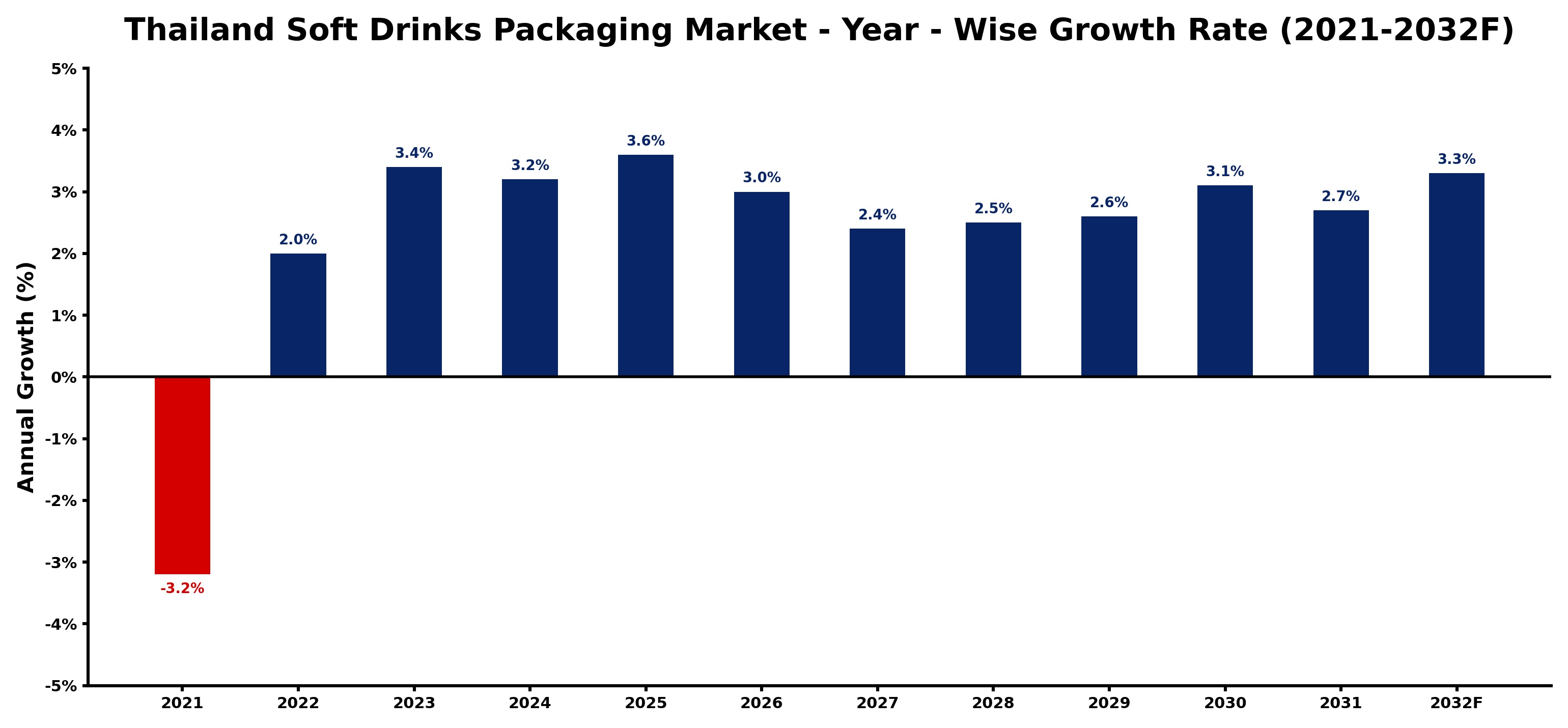
The table below presents the year‑wise growth rates along with the key drivers influencing the market
| Year | Growth Rate | Major Drivers |
| 2021 | -3.2% | Consumer spending decreased significantly |
| 2022 | 2.0% | Health-conscious trends drove demand |
| 2023 | 3.4% | Sustainable packaging gained popularity |
| 2024 | 3.2% | E-commerce growth expanded reach |
| 2025 | 3.6% | Innovative flavors attracted consumers |
| 2026 | 3.0% | Local sourcing enhanced brand loyalty |
| 2027 | 2.4% | Functional beverages gained traction |
| 2028 | 2.5% | Eco-friendly packaging options increased |
| 2029 | 2.6% | Youth market engagement improved sales |
| 2030 | 3.1% | Collaborations with influencers boosted visibility |
| 2031 | 2.7% | Seasonal promotions enhanced consumer interest |
| 2032 | 3.3% | Technological advancements improved efficiency |
Note - Market size estimations and growth projections presented in this report are based on 6Wresearch’s advanced forecasting approach, validated with industry datasets as of June 2026.
Thailand Soft Drinks Packaging Market Synopsis
In Thailand, the soft drinks packaging market is witnessing a remarkable evolution driven by consumer demand for healthier alternatives. Beverages such as organic juices and naturally carbonated drinks are gaining traction, prompting manufacturers to adapt their packaging solutions accordingly. This shift underscores a growing recognition of the importance of health-conscious consumer choices.
Moreover, the convenience of ready-to-drink options has led to significant growth in packaged beverage sales within convenience stores, outperforming traditional food service channels. The rapid urbanization and lifestyle changes among Thai consumers have established a unique market landscape that encourages innovation in soft drinks packaging.
Thailand Soft Drinks Packaging Market Key Takeaways
- Packaging innovation is essential for enhancing brand visibility and consumer engagement.
- The market is driven by a notable demand for eco-friendly and convenient packaging options.
- Changing consumer behavior during the pandemic has significantly altered the packaging landscape.
- Collaboration with design experts is increasingly important for effective brand communication through packaging.
- Investments in sustainable materials are becoming a priority for manufacturers in the soft drinks sector.
Evaluation of Restraints in Thailand Soft Drinks Packaging Market
Despite the positive growth trajectory, the Thailand Soft Drinks Packaging Market faces notable constraints, particularly around sustainability. Manufacturers are challenged by the imperative to reduce plastic waste while simultaneously creating attractive and functional packaging. The technical complexities associated with designing eco-friendly alternatives that meet consumer expectations present significant hurdles. Moreover, regulatory pressures surrounding environmental practices could further complicate the operational landscape for industry players, prompting the need for innovation and adaptation in packaging solutions.
Thailand Soft Drinks Packaging Market Trends
Currently, several key trends are shaping the Thailand Soft Drinks Packaging Market. The rise of health-conscious consumers is encouraging brands to invest in packaging that highlights the natural ingredients and health benefits of their products. Additionally, the growing emphasis on sustainability is prompting manufacturers to explore biodegradable and recyclable materials. Packaging designs are also evolving towards minimalism and transparency, aligning with consumer preferences for simplicity and authenticity. Lastly, the trend of personalization is gaining traction, with brands looking to create unique packaging experiences that resonate with individual consumer identities.
Thailand Soft Drinks Packaging Market Opportunities
The Thailand Soft Drinks Packaging Market presents lucrative growth and investment opportunities, particularly in the domain of sustainable packaging solutions. Entrepreneurs can capitalize on the rising consumer demand for environmentally friendly products by investing in innovative, compostable materials and alternative packaging formats. Furthermore, exploring collaborations with design experts can help brands differentiate themselves and improve consumer engagement. As more retailers shift towards e-commerce and home delivery, the demand for versatile packaging that ensures safety and quality during transport offers additional avenues for growth.
Government Initiatives in the Thailand Soft Drinks Packaging Market
The Thai government is increasingly focusing on sustainability initiatives that encourage reduced plastic consumption and improved waste management. Various policies and programs are aimed at promoting eco-friendly practices within the beverage industry, providing incentives for manufacturers who transition towards greener packaging solutions. Public awareness campaigns highlight the importance of environmental responsibility, driving consumer preference towards brands that embrace sustainable practices. This supportive regulatory framework creates a conducive environment for innovation within the soft drinks packaging sector.
Future Insights of the Thailand Soft Drinks Packaging Market
Looking ahead to 2026-2032, the Thailand Soft Drinks Packaging Market is poised for steady growth driven by the ongoing transformation of consumer preferences. As health and sustainability continue to dominate purchasing decisions, manufacturers are likely to prioritize the development of innovative packaging solutions that align with these values. The integration of smart packaging technology may also emerge, enabling enhanced consumer interaction and better product tracking. Overall, a focus on sustainability and convenience will be critical as the market evolves to meet the dynamic needs of Thai consumers.
Thailand Soft Drinks Packaging Market Latest Developments (May 2025 - June 2026)
In recent months, the Thailand Soft Drinks Packaging Market has seen significant advancements, including the introduction of novel biodegradable materials by several manufacturers. Additionally, strategic partnerships are being formed to enhance design capabilities and streamline production processes. As companies aim to respond swiftly to the increasing consumer demand for eco-conscious packaging, these developments are expected to shape the competitive landscape. Moreover, the shift towards e-commerce continues to influence packaging requirements, with a growing focus on ensuring product integrity during transportation.
Thailand Soft Drinks Packaging Market - Key Attractiveness of the Report
- 10 Years of Market Numbers
- Historical Data Starting from 2022 to 2025
- Base Year: 2025
- Forecast Data until 2032
- Key Performance Indicators Impacting the Market
- Major Upcoming Developments and Projects
Key Highlights of the Report:
- Thailand Soft Drinks Packaging Market Outlook
- Market Size of Thailand Soft Drinks Packaging Market, 2025
- Forecast of Thailand Soft Drinks Packaging Market, 2032
- Historical Data and Forecast of Thailand Soft Drinks Packaging Revenues & Volume for the Period 2022-2032F
- Thailand Soft Drinks Packaging Market Trend Evolution
- Thailand Soft Drinks Packaging Market Drivers and Challenges
- Thailand Soft Drinks Packaging Price Trends
- Thailand Soft Drinks Packaging Porter's Five Forces
- Thailand Soft Drinks Packaging Industry Life Cycle
- Historical Data and Forecast of Thailand Soft Drinks Packaging Market Revenues & Volume By Material for the Period 2022-2032F
- Historical Data and Forecast of Thailand Soft Drinks Packaging Market Revenues & Volume By Paper for the Period 2022-2032F
- Historical Data and Forecast of Thailand Soft Drinks Packaging Market Revenues & Volume By Plastic for the Period 2022-2032F
- Historical Data and Forecast of Thailand Soft Drinks Packaging Market Revenues & Volume By Metal for the Period 2022-2032F
- Historical Data and Forecast of Thailand Soft Drinks Packaging Market Revenues & Volume By Glass for the Period 2022-2032F
- Historical Data and Forecast of Thailand Soft Drinks Packaging Market Revenues & Volume By for the Period 2022-2032F
- Historical Data and Forecast of Thailand Soft Drinks Packaging Market Revenues & Volume By for the Period 2022-2032F
- Historical Data and Forecast of Thailand Soft Drinks Packaging Market Revenues & Volume By Product Type for the Period 2022-2032F
- Historical Data and Forecast of Thailand Soft Drinks Packaging Market Revenues & Volume By Cans for the Period 2022-2032F
- Historical Data and Forecast of Thailand Soft Drinks Packaging Market Revenues & Volume By Boxes for the Period 2022-2032F
- Historical Data and Forecast of Thailand Soft Drinks Packaging Market Revenues & Volume By Bottles for the Period 2022-2032F
- Historical Data and Forecast of Thailand Soft Drinks Packaging Market Revenues & Volume By Cartons for the Period 2022-2032F
- Historical Data and Forecast of Thailand Soft Drinks Packaging Market Revenues & Volume By for the Period 2022-2032F
- Historical Data and Forecast of Thailand Soft Drinks Packaging Market Revenues & Volume By for the Period 2022-2032F
- Historical Data and Forecast of Thailand Soft Drinks Packaging Market Revenues & Volume By Capacity for the Period 2022-2032F
- Historical Data and Forecast of Thailand Soft Drinks Packaging Market Revenues & Volume By Up to 100 ml for the Period 2022-2032F
- Historical Data and Forecast of Thailand Soft Drinks Packaging Market Revenues & Volume By 100 to 250 ml for the Period 2022-2032F
- Historical Data and Forecast of Thailand Soft Drinks Packaging Market Revenues & Volume By 250 to 500 ml for the Period 2022-2032F
- Historical Data and Forecast of Thailand Soft Drinks Packaging Market Revenues & Volume By 500 to 1000 ml for the Period 2022-2032F
- Historical Data and Forecast of Thailand Soft Drinks Packaging Market Revenues & Volume By 1000 to 2000 ml for the Period 2022-2032F
- Historical Data and Forecast of Thailand Soft Drinks Packaging Market Revenues & Volume By Above 2000 ml for the Period 2022-2032F
- Historical Data and Forecast of Thailand Soft Drinks Packaging Market Revenues & Volume By Application for the Period 2022-2032F
- Historical Data and Forecast of Thailand Soft Drinks Packaging Market Revenues & Volume By Carbonated soft drinks for the Period 2022-2032F
- Historical Data and Forecast of Thailand Soft Drinks Packaging Market Revenues & Volume By Functional Drinks for the Period 2022-2032F
- Historical Data and Forecast of Thailand Soft Drinks Packaging Market Revenues & Volume By Sport Drinks for the Period 2022-2032F
- Historical Data and Forecast of Thailand Soft Drinks Packaging Market Revenues & Volume By Energy Drinks for the Period 2022-2032F
- Historical Data and Forecast of Thailand Soft Drinks Packaging Market Revenues & Volume By Others for the Period 2022-2032F
- Historical Data and Forecast of Thailand Soft Drinks Packaging Market Revenues & Volume By Juices for the Period 2022-2032F
- Thailand Soft Drinks Packaging Import Export Trade Statistics
- Market Opportunity Assessment By Material
- Market Opportunity Assessment By Product Type
- Market Opportunity Assessment By Capacity
- Market Opportunity Assessment By Application
- Thailand Soft Drinks Packaging Top Companies Market Share
- Thailand Soft Drinks Packaging Competitive Benchmarking By Technical and Operational Parameters
- Thailand Soft Drinks Packaging Company Profiles
- Thailand Soft Drinks Packaging Key Strategic Recommendations






































