Thailand Sugar Market: Import Trend Analysis
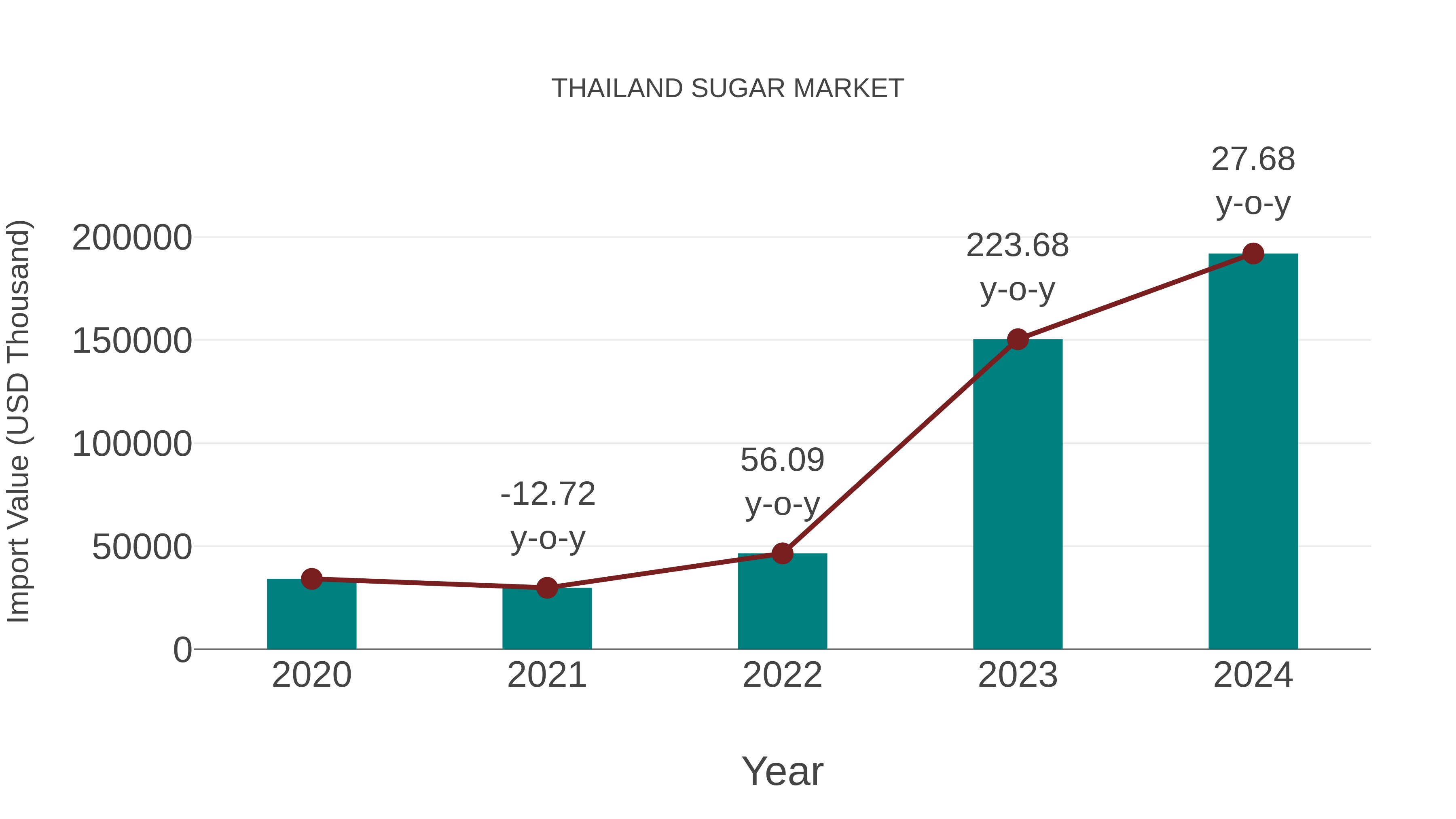
In the Thailand sugar market, the import trend showed significant growth from 2023 to 2024, with a growth rate of 27.68%. The compound annual growth rate (CAGR) for imports between 2020 and 2024 stood at 54.04%. This surge in imports can be attributed to a notable shift in demand dynamics, possibly influenced by changing consumer preferences or supply chain adjustments within the market.
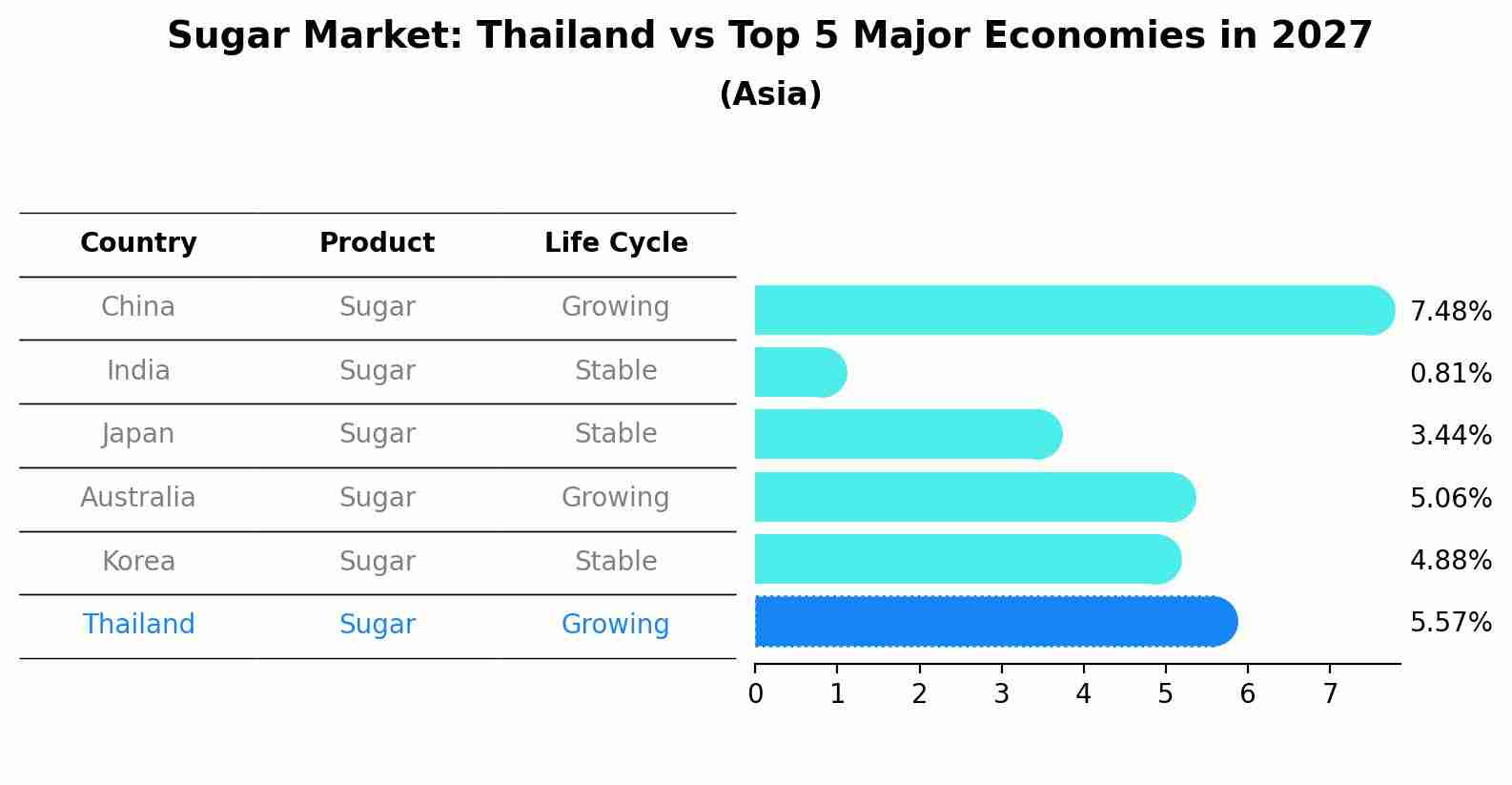
Sugar Market: Thailand vs Top 5 Major Economies in 2027 (Asia)
By 2027, Thailand's Sugar market is forecasted to achieve a growing growth rate of 5.57%, with China leading the Asia region, followed by India, Japan, Australia and South Korea.
Thailand Sugar Market Growth Rate
According to 6Wresearch internal database and industry insights, the Thailand Sugar Market is projected to grow at a compound annual growth rate (CAGR) of 5.4% during the forecast period from 2026 to 2032.
Topics Covered in the Thailand Sugar Market Report
The Thailand Sugar Market report covers the market comprehensively by types, form, end‑users, and sources. The report provides detailed and unbiased analysis of ongoing market trends, opportunities, challenges, and market drivers, assisting stakeholders in aligning strategies with current and future market dynamics.
Thailand Sugar Market Highlights
| Report Name | Thailand Sugar Market |
| Forecast period | 2026-2032 |
| CAGR | 5.4% |
| Growing Sector |
Processed Food |
Thailand Sugar Market Synopsis
The Thailand Sugar Market is expected to experience steady growth, which is backed by the increasing demand for sugar in food & beverages, household consumption, and industrial applications. A rise in the demand for processed foods, confectionery, and beverages in both domestic and export markets, as well as government support for sugarcane production, will accelerate the market expansion. Further, diversification into brown and liquid sugar and the growing emphasis on value‑added sugar products present new market opportunities.
Evaluation of Growth Drivers in the Thailand Sugar Market
Below are some prominent drivers and their impact on the Thailand Sugar Market:
| Drivers | Primary Segment Affected | Why It Matters (Evidence) |
| Growing Demand in Food & Beverages | By End‑Users | The sugar demand is high due to an increased consumption of processed foods and beverages. |
| Support for Sugarcane Farming | By Sources | Government incentives and improved sugarcane yields support raw material supply. |
| Export Market Growth | By Form | Country’s sugar exports to regional markets increase overall production demand. |
| Expansion of Bakery & Confectionery Sector | By Types | Higher use of brown and liquid sugar in value‑added products. |
| Rising Household Consumption | By End‑Users | Rising awareness and spending on household food staples increase sugar consumption. |
The Thailand Sugar Market is projected to grow at a 5.4% CAGR during 2026–2032 on account of the rising domestic consumption and growing industrial demand in both food manufacturing and exports. The growing popularity of organic and sustainable sugar products is also a significant driver, as consumers become more health-conscious and environmentally aware. Also, government support for the sugarcane industry, including subsidies and actions to improve farming practices, contributes to stable sugar production. Improved agricultural practices, coupled with favourable government policies, is likely to support Thailand Sugar Market growth.
Restraints in the Thailand Sugar Market
Below mentioned are some major restraints and their influence on the Thailand Sugar Market dynamics:
| Restraints | Primary Segment Affected | What This Means (Evidence) |
| Price Variations in Raw Materials | By Sources (Sugarcane, Sugarbeet) | Instabilities in the price of sugarcane may lead to volatility in the cost of sugar production, affecting market pricing. |
| Increasing Health Concerns About Sugar Consumption | By Product Type (White Sugar, Brown Sugar, Liquid Sugar) | Rising awareness of the health issues of excessive sugar consumption could decrease demand for traditional sugar products. |
| High Competition from Alternative Sweeteners | By Product Type (White Sugar, Brown Sugar, Liquid Sugar) | There is an increasing adoption of alternative sweeteners, which could limit the growth of the conventional sugar market. |
| Environmental Challenges | By Sources (Sugarcane) | Climate change and other environmental factors affecting sugarcane farming may impact production levels. |
| Regulatory Barriers for New Products | By Product Type (New Sugar Products) | Regulatory hurdles in product certifications can slow the introduction of new sugar products |
Thailand Sugar Market Challenges
The Thailand Sugar Market has a massive growth potential, although, it has a number of obstacles that could affect its growth. These challenges are fluctuations in raw material's prices, particularly in sugarcane and sugarbeet farming, which can result in unstable market prices. Other than that, health concerns related to sugar consumption are creating an urge in consumers to shift toward healthier alternatives, limiting demand for traditional sugar products. Competition from alternative sweeteners such as stevia, agave, and high-fructose corn syrup is also a significant factor.
Trends Shaping the Thailand Sugar Market
Below mentioned are some key trends in the Thailand Sugar Market, which include:
- Shift Towards Natural & Organic Sweeteners: Health-conscious consumers look for healthier sugar options, hence the demand for natural and organic sugar alternatives is increasing in the country.
- Growth of Online Retail: E-commerce platforms are transforming the sugar market by providing consumers with easy access to a wide range of sugar products, which include premium and organic options.
- A Rise in the Demand for Sugar in Processed Foods and Beverages: As the food and beverage sector continues to expand, there is an increased demand for sugar in processed foods, ready-to-eat meals, and beverages, particularly in emerging markets.
Major Investment Opportunities in the Thailand Sugar Market
Below mentioned are some major investment opportunities in the market:
- Organic and Sustainable Sugar Solutions: Investing in organic and sustainable sugar production will cater to the growing demand for healthier and eco-friendly alternatives to traditional sugar.
- E-commerce for Sugar Products: Due to the growing trend of online shopping, there are significant opportunities for investing in e-commerce platforms that offer consumers with convenient access to a variety of sugar products, which include specialty sugars and organic options.
- Processed Food and Beverage Sector: As sugar consumption rises in the processed food and beverage sectors, investing in high-quality sugar solutions tailored to these industries presents a profitable opportunity.
Top 5 Leading Players in the Thailand Sugar Market
Here are some leading companies operating in the Thailand Sugar Market:
1. Mitr Phol Group
| Company Name | Mitr Phol Group |
|---|---|
| Established Year | 1946 |
| Headquarters | Bangkok, Thailand |
| Official Website | Click Here |
Mitr Phol is the largest sugar producer in Thailand and Asia. They operate several mills across Thailand and have significant operations in China, Australia, and Laos. They are industry leaders in diversifying into biomass energy and ethanol.
2. Thai Roong Ruang Group (TRR)
| Company Name | Thai Roong Ruang Group (TRR) |
|---|---|
| Established Year | 1946 |
| Headquarters | Bangkok, Thailand |
| Official Website | Click Here |
TRR is a massive sugar conglomerate operating 10 factories across Thailand. They are well-known for their "Lin" consumer brand and are primary exporters of raw and refined sugar to international markets.
3. Khon Kaen Sugar Industry PCL (KSL)
| Company Name | Khon Kaen Sugar Industry PCL (KSL) |
|---|---|
| Established Year | 1945 |
| Headquarters | Bangkok, Thailand |
| Official Website | Click Here |
KSL is a major listed player with a footprint spanning Thailand, Laos, and Cambodia. Beyond sugar, they are a dominant force in the manufacturing of ethanol and the generation of electricity and steam from agricultural byproducts.
4. Cristalla Co., Ltd. (TCC Group)
| Company Name | Cristalla Co., Ltd. (TCC Group) |
|---|---|
| Established Year | 1994 |
| Headquarters | Bangkok, Thailand |
| Official Website | Click Here |
Part of the TCC Group, Cristalla operates several high-capacity mills. They leverage the group's vast logistics and distribution network to supply industrial sugar to major food and beverage manufacturers.
5. Buriram Sugar PCL (BRR)
| Company Name | Buriram Sugar PCL (BRR) |
|---|---|
| Established Year | 1964 |
| Headquarters | Buriram, Thailand |
| Official Website | Click Here |
BRR focuses on a "Sugar Hub" model in North-Eastern Thailand. They are highly specialized in integrated sugarcane management, including bagasse packaging and renewable energy through power plants.
Government Regulations in the Thailand Sugar Market
According to Thai government data, the sugar market is governed by a number of regulations that are aimed at ensuring the long-term viability and quality of sugar production while also protecting consumers. Sugarcane production is overseen by the Ministry of Agriculture and Cooperatives, which implements policies to support local farmers by providing subsidies and crop price controls. The Thai Food and Drug Administration (FDA) also controls sugar products, ensuring that they meet food safety standards and provide quality assurance. Sugar products, for example, must comply with stringent labeling requirements, which include nutritional content and ingredient sourcing information.
Future Insights of the Thailand Sugar Market
In future, the Thailand Sugar Market share is expected to increase in the coming years, which is influenced by some major factors, such as increasing domestic consumption, particularly in processed foods and beverages. There is an increasing shift towards healthier, organic, and sustainable sugar alternatives as consumers are becoming more health-conscious and demand for eco-friendly products rises. Also, there will be a stable supply of raw materials with the government's continued support for the sugarcane industry and the expansion of production technologies.
Segmentation Analysis
The report offers a comprehensive study of the following market segments and their leading categories:
White Sugar to Lead the Market – By Types
According to Ashutosh, Senior Research Analyst at 6Wresearch, the White Sugar segment is expected to lead the market on the back of its extensive use in the food and beverage sector as a primary sweetener in beverages, processed foods, and confectionery. White sugar remains the most popular and widely consumed sugar type across households and industries.
Food and Beverages to Lead the Market – By End-Users
Food and Beverages are estimated to increase the Thailand Sugar Market revenue, backed by the growing demand for sugar in processed foods, ready-to-eat meals, and beverages, particularly in the expanding food manufacturing industry. As the country's food and beverage sector continues to expand, the demand for high-quality sugar will also rise.
Key Attractiveness of the Report
- 10 Years of Market Numbers
- Historical Data Starting from 2022 to 2025
- Base Year: 2025
- Forecast Data until 2032
- Key Performance Indicators Impacting the Market
- Major Upcoming Developments and Projects
Key Highlights of the Report:
- Thailand Sugar Market Outlook
- Market Size of Thailand Sugar Market, 2025
- Forecast of Thailand Sugar Market, 2032
- Historical Data and Forecast of Thailand Sugar Revenues & Volume for the Period 2022-2032F
- Thailand Sugar Market Trend Evolution
- Thailand Sugar Market Drivers and Challenges
- Thailand Sugar Price Trends
- Thailand Sugar Porter's Five Forces
- Thailand Sugar Industry Life Cycle
- Historical Data and Forecast of Thailand Sugar Market Revenues & Volume By Types for the Period 2022-2032F
- Historical Data and Forecast of Thailand Sugar Market Revenues & Volume By White Sugar for the Period 2022-2032F
- Historical Data and Forecast of Thailand Sugar Market Revenues & Volume By Brown Sugar for the Period 2022-2032F
- Historical Data and Forecast of Thailand Sugar Market Revenues & Volume By Liquid Sugar for the Period 2022-2032F
- Historical Data and Forecast of Thailand Sugar Market Revenues & Volume By Form for the Period 2022-2032F
- Historical Data and Forecast of Thailand Sugar Market Revenues & Volume By Granulated Sugar for the Period 2022-2032F
- Historical Data and Forecast of Thailand Sugar Market Revenues & Volume By Powdered Sugar for the Period 2022-2032F
- Historical Data and Forecast of Thailand Sugar Market Revenues & Volume By Syrup Sugar for the Period 2022-2032F
- Historical Data and Forecast of Thailand Sugar Market Revenues & Volume By End -Users for the Period 2022-2032F
- Historical Data and Forecast of Thailand Sugar Market Revenues & Volume By Food and Beverages for the Period 2022-2032F
- Historical Data and Forecast of Thailand Sugar Market Revenues & Volume By Pharma and Personal Care for the Period 2022-2032F
- Historical Data and Forecast of Thailand Sugar Market Revenues & Volume By Household for the Period 2022-2032F
- Historical Data and Forecast of Thailand Sugar Market Revenues & Volume By Sources for the Period 2022-2032F
- Historical Data and Forecast of Thailand Sugar Market Revenues & Volume By Sugarcane for the Period 2022-2032F
- Historical Data and Forecast of Thailand Sugar Market Revenues & Volume By Sugarbeet for the Period 2022-2032F
- Thailand Sugar Import Export Trade Statistics
- Market Opportunity Assessment By Types
- Market Opportunity Assessment By Form
- Market Opportunity Assessment By End -Users
- Market Opportunity Assessment By Sources
- Thailand Sugar Top Companies Market Share
- Thailand Sugar Competitive Benchmarking By Technical and Operational Parameters
- Thailand Sugar Company Profiles
- Thailand Sugar Key Strategic Recommendations
Markets Covered
The report provides a detailed analysis of the following market segments:
By Types:
- White Sugar
- Brown Sugar
- Liquid Sugar
By Form:
- Granulated Sugar
- Powdered Sugar
- Syrup Sugar
By End-Users:
- Food and Beverages
- Pharma and Personal Care
- Household
By Sources:
- Sugarcane
- Sugarbeet






































