Togo Flour Market Top 5 Importing Countries and Market Competition (HHI) Analysis
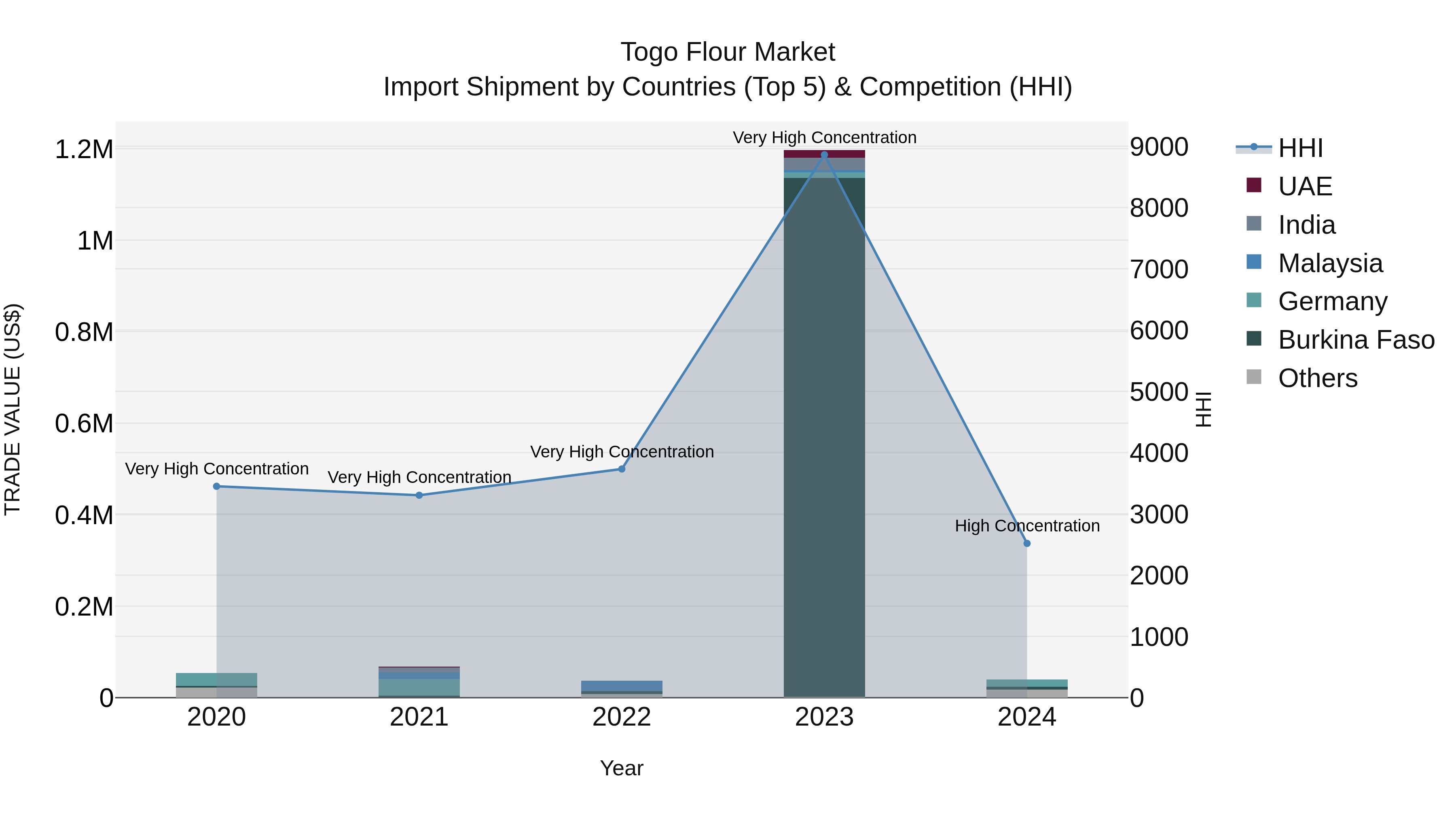
Togo`s flour import market in 2024 continued to be dominated by key players such as Germany, Benin, Nigeria, Burkina Faso, and China. Despite a high concentration of the Herfindahl-Hirschman Index (HHI) in 2023, the market concentration remained high in 2024. The industry experienced a significant decline with a Compound Annual Growth Rate (CAGR) of -7.67% from 2020 to 2024. Furthermore, the growth rate plummeted by -96.7% from 2023 to 2024, indicating a challenging market environment for flour import shipments into Togo.
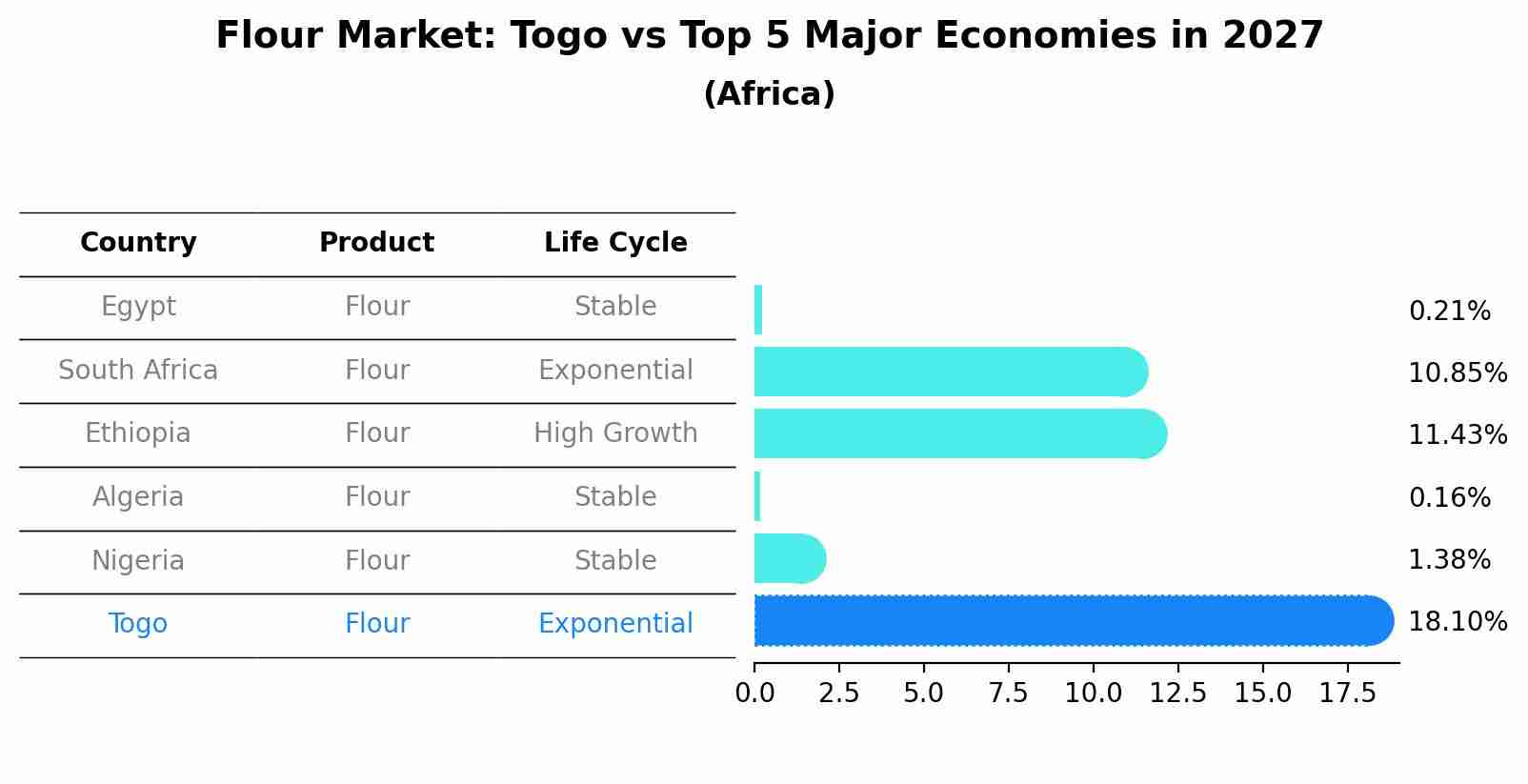
Flour Market: Togo vs Top 5 Major Economies in 2027 (Africa)
The Flour market in Togo is projected to grow at a exponential growth rate of 18.10% by 2027, within the Africa region led by Egypt, along with other countries like South Africa, Ethiopia, Algeria and Nigeria, collectively shaping a dynamic and evolving market environment driven by innovation and increasing adoption of emerging technologies.
Togo Flour Market Growth Rate
According to 6Wresearch internal database and industry insights, the Togo Flour Market is projected to grow at a compound annual growth rate (CAGR) of 5.1% during the forecast period (2025–2031).
Five-Year Growth Trajectory of the Togo Flour Market with Core Drivers
Below mentioned are the evaluation of year-wise growth rate along with key drivers:
| Years | Est. Annual Growth % | Growth Drivers |
| 2020 | 2.7 | Increased demand from household bread makers and informal bakeries sustained baseline growth. |
| 2021 | 3.3 | Increase in modern retail outlets and augmented wheat import logistics increased supply reliability. |
| 2022 | 4 | Rise in fortified flour production aligned with national nutrition improvement programs. |
| 2023 | 4.5 | Increasing demand from industrial bakeries and instant noodle manufacturers increased bulk procurement. |
| 2024 | 4.8 | Technological upgrades in milling efficiency improved product consistency and market competitiveness. |
Topics Covered in the Togo Flour Market Report
The Togo Flour Market report thoroughly covers the market by raw materials, applications, and technology. The report provides a detailed and unbiased analysis of ongoing market trends, high growth areas, opportunities, and drivers, assisting stakeholders in planning future strategies aligned with market dynamics.
Togo Flour Market Highlights
| Report Name | Togo Flour Market |
| Forecast period | 2025-2031 |
| CAGR | 5.1% |
| Growing Sector | Bread & Bakery Processing and Packaged Retail Flour |
Togo Flour Market Synopsis
Togo Flour Market is anticipated to experience major growth due to the increasing consumption of bakery and processed food products. The rising demand for fortified flour and the government’s efforts toward achieving food security and nutrition goals are major growth enablers. Moreover, the increase of urban retail outlets and bakeries across Lomé and Sokodé has augmented flour accessibility and visibility. Solidification of the domestic flour value chain through continuous allocation of money in milling and packaging technology has improved production efficiency and product quality.
Evaluation of Growth Drivers in the Togo Flour Market
Below mentioned are some prominent drivers and their influence to the market dynamics:
| Drivers | Primary Segments Affected | Why it Matters (Evidence) |
| Urbanization and Bakery Expansion | Bread & Bakery; Biscuits | Rising urban population growth is spurring bakery and snack product demand, increasing wheat flour consumption. |
| Food Fortification Programs | Bread & Bakery; Noodles | Government-led initiatives supporting fortified flour for nutritional improvement are proliferating industrial flour needs. |
| Industrial Modernization | All Applications | Adoption of modern milling technology has augmented flour output quality and reduced wastage. |
| Expanding Retail Distribution | All Categories | Advancement of supermarkets and convenience stores across urban areas promotes packaged flour expansion. |
| Cross-border Trade Integration | Maize & Wheat Flour | ECOWAS trade facilitation and the Port of Lomé’s efficiency solidify flour supply across West African markets. |
The Togo Flour Market size is projected to grow at the CAGR of 5.1% during the forecast period of 2025–2031. The market’s growth is promoted by increasing fortified flour adoption, bakery expansion, and technological advancements in local milling facilities that are improving quality consistency and cost efficiency. Additionally, the growing incorporation of modern packaging and branding strategies by local producers is raising product visibility and consumer trust, thereby augmenting the overall competitiveness of the Togo Flour Market.
Evaluation of Restraints in the Togo Flour Market
Below mentioned are some major restraints and their influence to the market dynamics:
| Restraint | Primary Segments Affected | What this Means (Evidence) |
| High Dependence on Imported Wheat | Wheat-based Applications | Large dependency on imported wheat exposes the industry to global price changes and exchange rate risks. |
| High Operational Costs | Industrial Mills | Elevated diesel and power expenses affect production prices for local mills. |
| Limited Access to Finance | SME Mills | Lack of financing options obstructs modernization and capacity expansion efforts. |
| Infrastructure Gaps | Distribution & Retail | Poor rural logistics networks impact flour supply in remote regions, decreasing market reach. |
| Competition from Informal Producers | Local Mills | Unregulated small mills providing cheaper unbranded flour impact profit margins of organized players. |
Togo Flour Market Challenges
Despite promising growth, challenges are there in logistics efficiency, currency volatility, and standardization of fortified flour. Smaller mills face limited capital to allocate money in modern equipment, while increased fuel prices constrain distribution economics. Additionally, inconsistent power supply and fragmented retail chains persist to obstruct market expansion, especially in rural areas.
Togo Flour Market Trends
Several prominent trends reshaping the market growth include:
- Fortified and Enriched Products: Rising concentration on iron- and vitamin-enriched flours to address malnutrition and capture institutional demand.
- Technological Upgradation: Mills deploying modern sifters and quality control systems to align with export-grade standards.
- Shift to Branded Packaged Flour: Rising urban inclination for hygienically packed and branded products over loose bulk flour.
- Multi-Grain Flour Innovation: Increasing consumer knowledge is promoting product diversification with maize and millet blends.
Investment Opportunities in the Togo Flour Industry
Some prominent investment opportunities in the market include:
- Fortification Infrastructure Development – Launch new premix systems and automatic quality control to align with government standards.
- Milling Technology Investments – To decrease production prices and augment extraction yields launch energy-efficient mills.
- Branded Flour Portfolio Expansion – Make fortified and multi-grain packaged flours targeting urban and semi-urban consumers.
Top 5 Leading Players in the Togo Flour Market
Some leading players operating in the Togo Flour Market include:
1. Olam Agri
| Company Name | Olam Agri |
|---|---|
| Headquarters | Singapore |
| Established Year | 1989 |
| Official Website | Click Here |
Olam Agri operates extensively across West Africa, supplying fortified wheat flour to bakeries, food processors, and retail markets. The company emphasizes nutritional quality, product consistency, and supply reliability, supporting local food security and industrial growth in Togo.
2. Seaboard Overseas and Trading Group
| Company Name | Seaboard Overseas and Trading Group |
|---|---|
| Headquarters | Kansas, USA |
| Established Year | 1918 |
| Official Website | Click Here |
Seaboard Overseas and Trading Group provides wheat origination, logistics, and milling support across Africa. The company caters to premium-grade flour for the Togolese industrial and retail markets, leveraging a strong network in agricultural commodity trading and regional supply chains.
3. Flour Mills of Nigeria Plc
| Company Name | Flour Mills of Nigeria Plc |
|---|---|
| Headquarters | Lagos, Nigeria |
| Established Year | 1960 |
| Official Website | Click Here |
Flour Mills of Nigeria Plc distributes high-quality fortified flour to Togo through regional export and distribution networks. The company focuses on serving bakeries, noodle manufacturers, and food service providers, maintaining strong standards in nutrition and consistency.
4. Groupe Mimran (Grands Moulins d’Afrique)
| Company Name | Groupe Mimran (Grands Moulins d’Afrique) |
|---|---|
| Headquarters | Paris, France |
| Established Year | 1956 |
| Official Website | Click Here |
Groupe Mimran is a major milling group with operations throughout West Africa, producing fortified and high-protein wheat flours for retail and industrial buyers. The company’s strong logistics and regional expertise make it a key contributor to Togo’s flour supply ecosystem.
5. Bühler Group
| Company Name | Bühler Group |
|---|---|
| Headquarters | Uzwil, Switzerland |
| Established Year | 1860 |
| Official Website | Click Here |
Bühler Group is a leading technology provider for milling and food processing industries. In Togo, Bühler supports local flour producers with state-of-the-art milling machinery, automation systems, and fortification technologies, improving production efficiency and quality assurance.
Government Regulations Introduced in the Togo Flour Market
According to Togo’s government data, multiple national initiatives have been implemented to enhance domestic flour production and ensure food security. The National Development Plan (PND) and Roadmap 2025 emphasize agro-industrialization, logistics infrastructure improvement, and nutrition fortification. The National Nutrition Policy mandates that all industrial mills produce fortified wheat flour, ensuring nutritional standards across the country. Additionally, Togo’s collaboration with ECOWAS aims to streamline cross-border trade, stabilizing wheat imports and maintaining a consistent flour supply to meet domestic demand.
Future Insights of the Togo Flour Market
The Togo Flour Market Growth is projected to rise steadily, supported by bakery sector development, increasing demand for fortified products, and improved trade logistics. Growing private investments in milling technology and enhanced financial access for SMEs are expected to strengthen industry competitiveness. Furthermore, the shift toward sustainable packaging and diversified grain processing (such as maize and millet flour) will reinforce the market’s long-term growth prospects.
Market Segmentation Analysis
The report provides an in-depth assessment of the following market segments and their leading categories.
Wheat to Dominate the Market – By Raw Material
According to Parth, Senior Research Analyst at 6Wresearch, wheat remains the dominant raw material in the Togo Flour Industry due to its wide application in bread, noodles, and biscuits. Its accessibility, versatility, and consumer preference make it the leading contributor to flour production in the country.
Bread & Bakery Products to Dominate the Market – By Applications
The bread and bakery segment holds the largest share of the Togo Flour Market, as bread continues to be a staple food across the nation. The rise of urban bakeries, institutional procurement, and expanding retail distribution networks are key factors driving this segment’s consistent growth.
Dry Technology to Dominate the Market – By Technology
Dry technology accounts for the largest market share, owing to its cost-effectiveness and high efficiency in maintaining flour quality under Togo’s climatic and infrastructure conditions. It is preferred by both small-scale and industrial millers for its low energy requirements and ease of operation.
Key Attractiveness of the Report
- 10 Years of Market Numbers
- Historical Data Starting from 2021 to 2024
- Base Year: 2024
- Forecast Data until 2029
- Key Performance Indicators Impacting the Market
- Major Upcoming Developments and Projects
Key Highlights of the Report:
- Togo Flour Market Outlook
- Market Size of Togo Flour Market, 2024
- Forecast of Togo Flour Market, 2031
- Historical Data and Forecast of Togo Flour Revenues & Volume for the Period 2021-2031
- Togo Flour Market Trend Evolution
- Togo Flour Market Drivers and Challenges
- Togo Flour Price Trends
- Togo Flour Porter`s Five Forces
- Togo Flour Industry Life Cycle
- Historical Data and Forecast of Togo Flour Market Revenues & Volume By Raw Material for the Period 2021-2031
- Historical Data and Forecast of Togo Flour Market Revenues & Volume By Wheat for the Period 2021-2031
- Historical Data and Forecast of Togo Flour Market Revenues & Volume By Rice for the Period 2021-2031
- Historical Data and Forecast of Togo Flour Market Revenues & Volume By Maize for the Period 2021-2031
- Historical Data and Forecast of Togo Flour Market Revenues & Volume By Others for the Period 2021-2031
- Historical Data and Forecast of Togo Flour Market Revenues & Volume By Applications for the Period 2021-2031
- Historical Data and Forecast of Togo Flour Market Revenues & Volume By Bread & Bakery Products for the Period 2021-2031
- Historical Data and Forecast of Togo Flour Market Revenues & Volume By Noodles & Pasta for the Period 2021-2031
- Historical Data and Forecast of Togo Flour Market Revenues & Volume By Animal Feed for the Period 2021-2031
- Historical Data and Forecast of Togo Flour Market Revenues & Volume By Wafers, Crackers, & Biscuits for the Period 2021-2031
- Historical Data and Forecast of Togo Flour Market Revenues & Volume By Non-Food Application for the Period 2021-2031
- Historical Data and Forecast of Togo Flour Market Revenues & Volume By Others for the Period 2021-2031
- Historical Data and Forecast of Togo Flour Market Revenues & Volume By Technology for the Period 2021-2031
- Historical Data and Forecast of Togo Flour Market Revenues & Volume By Dry Technology for the Period 2021-2031
- Historical Data and Forecast of Togo Flour Market Revenues & Volume By Wet Technology for the Period 2021-2031
- Togo Flour Import Export Trade Statistics
- Market Opportunity Assessment By Raw Material
- Market Opportunity Assessment By Applications
- Market Opportunity Assessment By Technology
- Togo Flour Top Companies Market Share
- Togo Flour Competitive Benchmarking By Technical and Operational Parameters
- Togo Flour Company Profiles
- Togo Flour Key Strategic Recommendations
Market Covered
The report offers a comprehensive study of the subsequent market segments:
By Raw Material
- Wheat
- Rice
- Maize
- Others
By Applications
- Bread & Bakery Products
- Noodles & Pasta
- Animal Feed
- Wafers, Crackers, & Biscuits
- Non-Food Application
- Others
By Technology
- Dry Technology
- Wet Technology






































