Tunisia Ascorbic Acid Market Size, Share & Growth Rate
The Tunisia Ascorbic Acid Market was estimated at USD 465 Million in 2025 and is projected to reach USD 665 Million by 2032, growing at a CAGR of 5.2% from 2026 to 2032. This robust growth trajectory is propelled by heightened consumer awareness regarding the health benefits of Vitamin C and its increasing integration in food and beverage products. Additionally, the rising trend of health consciousness among Tunisians is driving demand across pharmaceuticals and personal care sectors, as consumers seek products that support their wellness journey.
Tunisia Ascorbic Acid Market Year-wise Growth Rate and Key Drivers
This graph highlights how the Tunisia Ascorbic Acid Market has steadily grown over the years, supported by major growth factors.
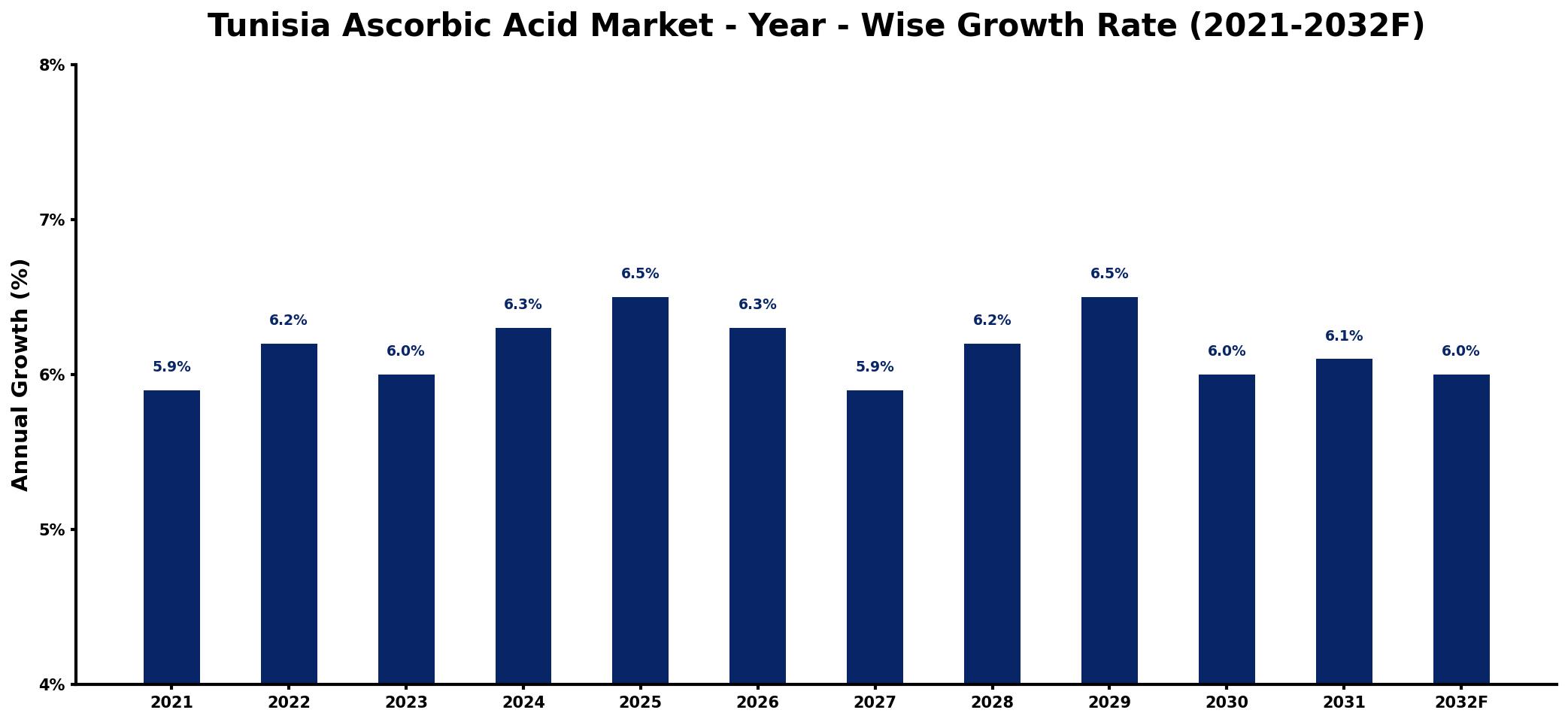
The table below presents the year‑wise growth rates along with the key drivers influencing the market
| Year | Growth Rate | Major Drivers |
| 2021 | 5.9% | Growing health consciousness among consumers |
| 2022 | 6.2% | Rising demand for dietary supplements |
| 2023 | 6.0% | Increased investment in pharmaceuticals |
| 2024 | 6.3% | Expanding functional food market |
| 2025 | 6.5% | Surge in organic product popularity |
| 2026 | 6.3% | Growing interest in natural preservatives |
| 2027 | 5.9% | Heightened focus on wellness products |
| 2028 | 6.2% | Boost in online retail sales |
| 2029 | 6.5% | Expansion of health food stores |
| 2030 | 6.0% | Growth in personalized nutrition trends |
| 2031 | 6.1% | Increased collaboration with manufacturers |
| 2032 | 6.0% | Rising awareness of preventive healthcare |
Note: Market size estimations and growth projections presented in this report are based on 6Wresearch's proprietary forecasting methodology, utilizing the latest available industry data, government publications, and primary research inputs.
Tunisia Ascorbic Acid Market Synopsis
The strongest force currently shaping the Tunisia Ascorbic Acid market is the growing consumer focus on health and wellness. With Vitamin C recognized for its antioxidant properties and immune-boosting capabilities, there's an escalating interest in products fortified with ascorbic acid across various industries. This trend is not just confined to food and beverage sectors; personal care and pharmaceuticals are experiencing similar growth as consumers prioritize health-enhancing ingredients.
Additionally, the market is being positively influenced by innovations and product diversification as manufacturers adapt to the evolving preferences of health-conscious consumers. By expanding their portfolios to include natural and organic sources of ascorbic acid, industry players are aligning with the global shift towards cleaner and more sustainable product offerings.
Tunisia Ascorbic Acid Market Key Takeaways
- The market is experiencing significant growth, driven by increased demand for fortified food and beverages.
- Consumers are increasingly opting for products containing natural and organic ascorbic acid.
- Product innovation is a crucial strategy for manufacturers to meet diverse consumer needs.
- Government support aims to bolster local production and ensure stringent quality standards.
- Collaboration with healthcare sectors presents lucrative investment opportunities for market players.
Evaluation of Restraints in Tunisia Ascorbic Acid Market
While the Tunisia Ascorbic Acid market is expanding, it is not without its challenges. Fluctuating raw material prices pose significant risks to production costs, which can ultimately affect pricing strategies for companies. Additionally, the competitive landscape is growing increasingly saturated with both domestic and international suppliers vying for market share, making differentiation essential. Regulatory constraints regarding quality standards and import/export practices further complicate the operational environment, requiring ongoing compliance efforts that can burden operational efficiencies and increase costs.
Tunisia Ascorbic Acid Market Trends
Current trends in the Tunisia Ascorbic Acid market are highlighting a shift towards transparency and clean labeling. Consumers are seeking products that not only provide health benefits but also align with sustainable practices. This trend is particularly evident in the food and beverage sectors, where ascorbic acid is increasingly used as a natural preservative and antioxidant. Furthermore, the cosmetic industry is leveraging ascorbic acid's properties in skincare formulations, reflecting a broader consumer demand for multifunctional products.
Tunisia Ascorbic Acid Market Opportunities
Significant growth and investment opportunities in the Tunisia Ascorbic Acid market lie within the realm of Vitamin C supplements. As health awareness continues to rise, the consumer appetite for products that enhance immunity and overall well-being is strong. Local partnerships with pharmaceutical companies could yield mutual benefits, providing a pathway for high-quality ascorbic acid distribution. Companies that invest in understanding consumer preferences and trends will be better positioned to capitalize on these opportunities.
Government Initiatives in the Tunisia Ascorbic Acid Market
The Tunisian government plays a pivotal role in shaping the Ascorbic Acid market landscape through various initiatives focused on quality and safety. Policies enforced by the Tunisian Ministry of Health include rigorous quality control standards and strict labeling requirements. The government also supports local manufacturers through subsidies aimed at promoting domestic production and reducing dependence on imports. Furthermore, initiatives to encourage research and development within the industry are fostering innovation, enhancing Tunisias competitive edge in the global market.
Future Insights of the Tunisia Ascorbic Acid Market
Looking forward to the period from 2026 to 2032, the Tunisia Ascorbic Acid market is expected to continue its growth trajectory, driven by rising health consciousness and the demand for Vitamin C-enriched products. With consumers increasingly recognizing the preventive health benefits associated with ascorbic acid, the market is set for dynamic expansion. Manufacturers will likely focus on meeting evolving consumer expectations through innovative and sustainable product offerings, ensuring that they remain relevant in an ever-changing marketplace.
Tunisia Ascorbic Acid Market Latest Developments (2025 - 2026)
Recent developments in the Tunisia Ascorbic Acid market indicate a notable emphasis on sustainability and product quality. Companies are increasingly exploring new sourcing methods for ascorbic acid to meet consumer demand for natural ingredients. Collaborations among manufacturers and health-focused retailers are fostering better distribution networks, thereby enhancing product availability. Additionally, consumer education campaigns about the health benefits of Vitamin C are becoming more prevalent, creating greater market awareness.
Tunisia Ascorbic Acid Market - Key Attractiveness of the Report
- 10 Years of Market Numbers
- Historical Data Starting from 2022 to 2025
- Base Year: 2025
- Forecast Data until 2032
- Key Performance Indicators Impacting the Market
- Major Upcoming Developments and Projects
Key Highlights of the Report:
- Tunisia Ascorbic Acid Market Outlook
- Market Size of Tunisia Ascorbic Acid Market, 2025
- Forecast of Tunisia Ascorbic Acid Market, 2032
- Historical Data and Forecast of Tunisia Ascorbic Acid Revenues & Volume for the Period 2022-2032F
- Tunisia Ascorbic Acid Market Trend Evolution
- Tunisia Ascorbic Acid Market Drivers and Challenges
- Tunisia Ascorbic Acid Price Trends
- Tunisia Ascorbic Acid Porter's Five Forces
- Tunisia Ascorbic Acid Industry Life Cycle
- Historical Data and Forecast of Tunisia Ascorbic Acid Market Revenues & Volume By Grade for the Period 2022-2032F
- Historical Data and Forecast of Tunisia Ascorbic Acid Market Revenues & Volume By Food & Pharmaceutical for the Period 2022-2032F
- Historical Data and Forecast of Tunisia Ascorbic Acid Market Revenues & Volume By Industrial for the Period 2022-2032F
- Historical Data and Forecast of Tunisia Ascorbic Acid Market Revenues & Volume By Application for the Period 2022-2032F
- Historical Data and Forecast of Tunisia Ascorbic Acid Market Revenues & Volume By Food & Beverages for the Period 2022-2032F
- Historical Data and Forecast of Tunisia Ascorbic Acid Market Revenues & Volume By Pharmaceutical for the Period 2022-2032F
- Historical Data and Forecast of Tunisia Ascorbic Acid Market Revenues & Volume By Cosmetics for the Period 2022-2032F
- Historical Data and Forecast of Tunisia Ascorbic Acid Market Revenues & Volume By Chemicals for the Period 2022-2032F
- Historical Data and Forecast of Tunisia Ascorbic Acid Market Revenues & Volume By Agriculture for the Period 2022-2032F
- Historical Data and Forecast of Tunisia Ascorbic Acid Market Revenues & Volume By Others for the Period 2022-2032F
- Tunisia Ascorbic Acid Import Export Trade Statistics
- Market Opportunity Assessment By Grade
- Market Opportunity Assessment By Application
- Tunisia Ascorbic Acid Top Companies Market Share
- Tunisia Ascorbic Acid Competitive Benchmarking By Technical and Operational Parameters
- Tunisia Ascorbic Acid Company Profiles
- Tunisia Ascorbic Acid Key Strategic Recommendations






































