Tunisia Contactless Payment Market Size & Growth Rate (2026-2032)
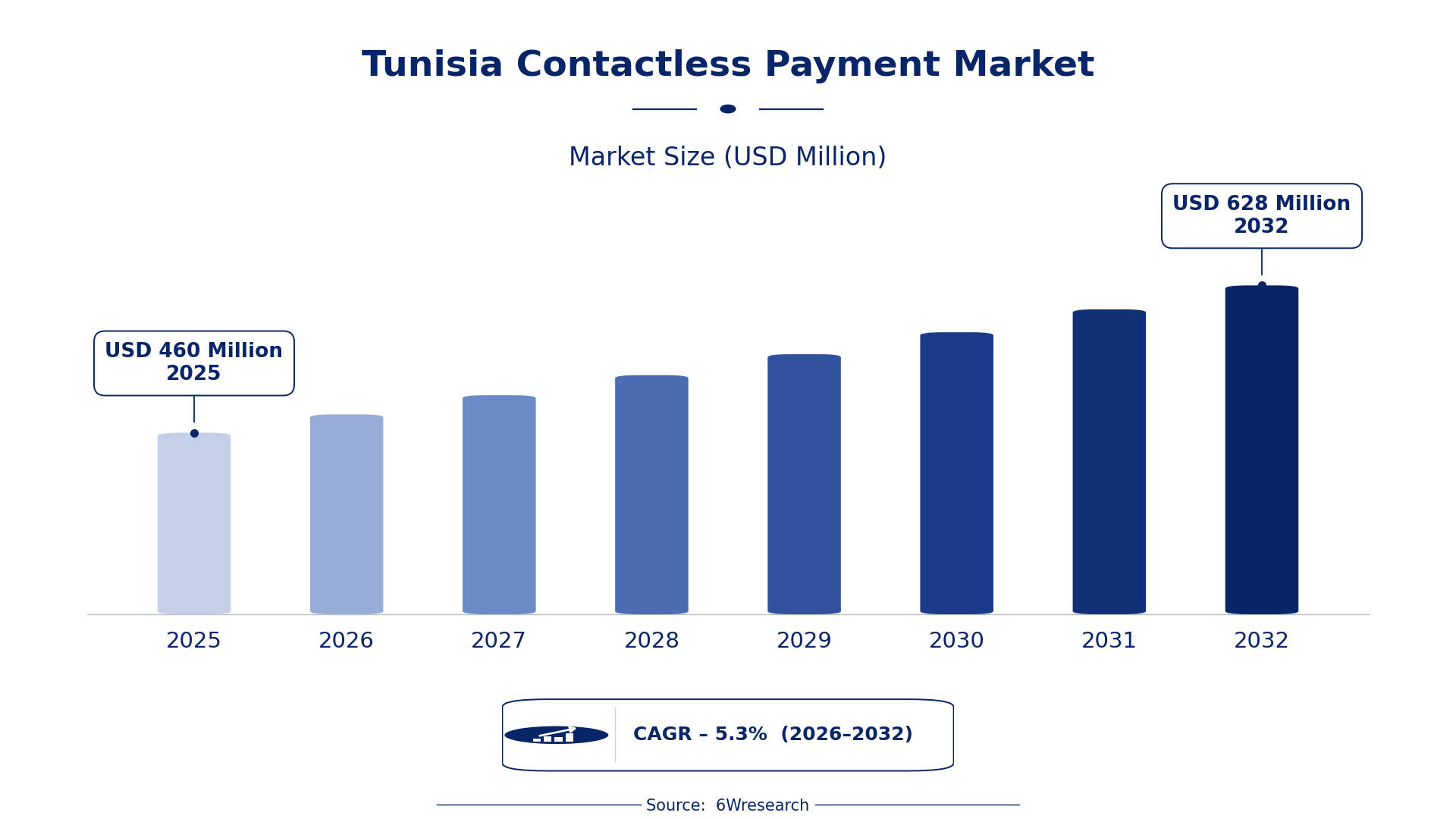
The Tunisia Contactless Payment Market was estimated at USD 460 Million in 2025 and is projected to reach USD 628 Million by 2032, growing at a CAGR of 5.3% from 2026 to 2032.
Tunisia Contactless Payment Market Synopsis
The contactless payment market in Tunisia is experiencing a remarkable shift as digital payment methods gain traction among consumers. The convenience and security offered by contactless transactions have become increasingly appealing, particularly amid the growing smartphone penetration and advancements in NFC technology.
Looking ahead, the market's trajectory is set for substantial growth, driven by a combination of consumer preferences and government initiatives aimed at promoting financial inclusion. As technology continues to evolve, the landscape for contactless payments in Tunisia will become even more dynamic, providing opportunities for innovation and expansion.
Tunisia Contactless Payment Market Year-wise Growth Rate and Key Drivers
This graph illustrates the annual growth rates of the Tunisia Contactless Payment Market from 2021 to 2032, highlighting a steady upward trajectory and projected expansion over the forecast period.
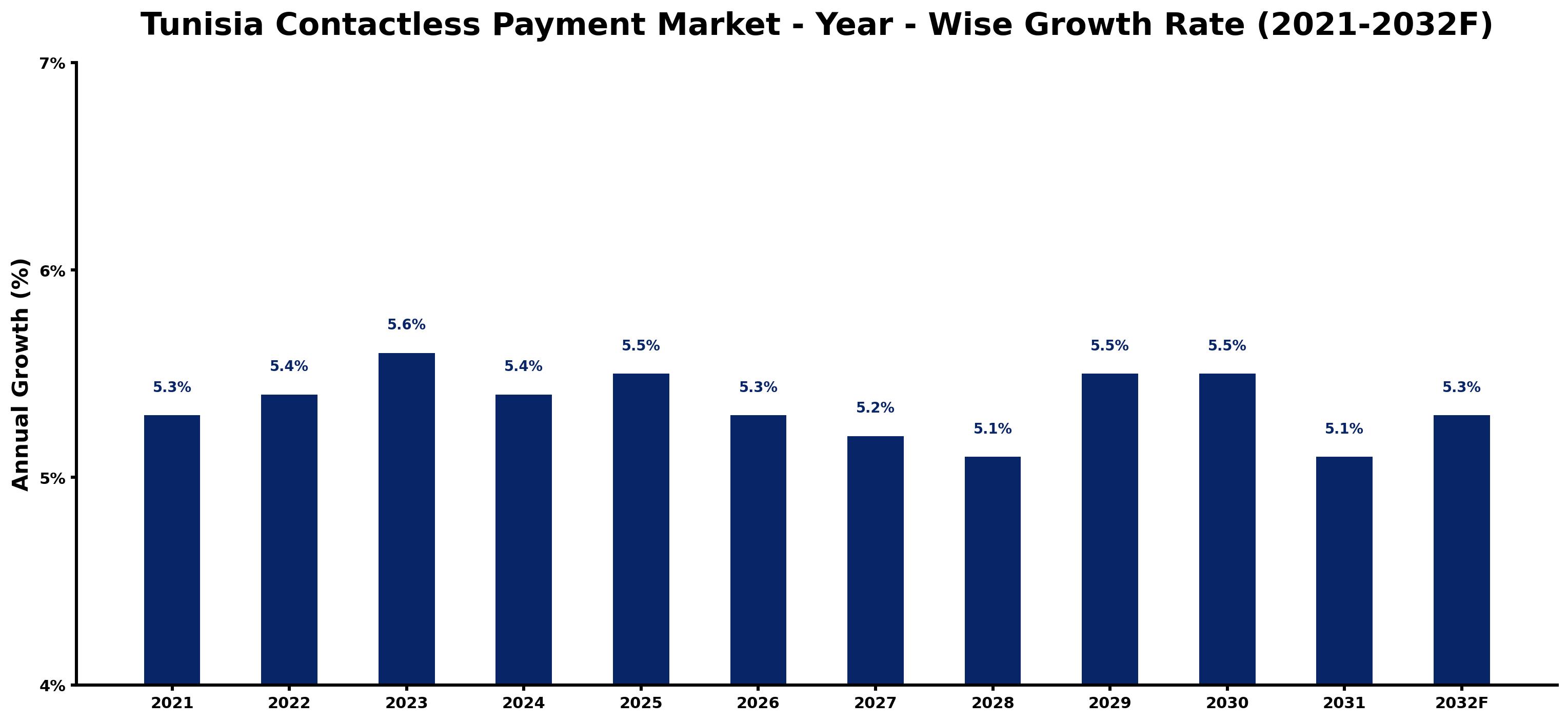
The table below presents the year‑wise growth rates along with the key drivers influencing the market
| Year | Growth Rate | Major Drivers |
| 2021 | 5.3% | Increased smartphone penetration among Tunisian consumers. |
| 2022 | 5.4% | Launch of e-payment initiatives by the Central Bank. |
| 2023 | 5.6% | Growth in online shopping during COVID-19 recovery. |
| 2024 | 5.4% | Partnerships with local banks for enhanced payment solutions. |
| 2025 | 5.5% | Government incentives promoting cashless transactions. |
| 2026 | 5.3% | Rising consumer demand for safe payment alternatives. |
| 2027 | 5.2% | Increased POS terminals deployment across urban retailers. |
| 2028 | 5.1% | Expanding telecom infrastructure supporting digital payment services. |
| 2029 | 5.5% | Corporate adoption of contactless payments in workplaces. |
| 2030 | 5.5% | Integration with international payment systems boosting usability. |
| 2031 | 5.1% | Educational programs driving awareness for digital payments. |
| 2032 | 5.3% | Support from fintech companies enhancing local payment technologies. |
Note: Market size estimations and growth projections presented in this report are based on 6Wresearch's proprietary forecasting methodology, utilizing the latest available industry data, government publications, and primary research inputs.
Tunisia Contactless Payment Market Key Takeaways
Below are some of the specific key takeaways from the market, including:
- The growing adoption of mobile payment solutions is reshaping consumer behavior in Tunisia.
- Government policies are increasingly focused on enhancing digital payment infrastructure and financial inclusion.
- NFC technology advancements are crucial in driving the expansion of contactless payment options.
- Consumer education on contactless payments remains vital for widespread adoption.
- Investment in secure transaction systems will be necessary to build trust among users.
Evaluation of Restraints in Tunisia Contactless Payment Market
Despite its potential, the Tunisia contactless payment market faces notable challenges. Infrastructure readiness is a significant barrier, as many merchants still lack the necessary NFC-enabled terminals. on top of that, varying consumer adoption rates hinder widespread usage, with some demographics remaining hesitant to transition from traditional payment methods. The regulatory framework surrounding electronic payments also requires refinement to ensure compliance and bolster consumer confidence. Building robust security measures and facilitating interoperability between different payment systems will be essential for overcoming these obstacles and unlocking the market's full potential.
Tunisia Contactless Payment Market Trends
Several key trends are shaping the demand and technology in the Tunisia contactless payment market. First, the increasing preference for mobile wallets has gained momentum as consumers seek quick and easy payment options. Additionally, partnerships between financial institutions and technology providers are emerging to enhance the user experience and broaden service offerings. The focus on security continues to grow, with many companies investing in advanced encryption and fraud detection technologies to protect consumer data. on top of that, educational initiatives aimed at informing both merchants and customers about the benefits of contactless payments are becoming more prevalent, fostering a more informed user base.
Tunisia Contactless Payment Market Opportunities
Opportunities for growth in the Tunisia contactless payment market are abundant. As smartphone adoption rises, the potential for mobile payment solutions will expand, providing fertile ground for new entrants and innovations. There's also a significant chance for payment service providers to collaborate with local businesses to enhance transaction capabilities. on top of that, with the government's push for financial inclusion, initiatives aimed at integrating unbanked populations into the digital economy will create new customer segments. Lastly, advancements in technology, particularly in biometric authentication, can further enhance transaction security and user confidence.
Government Initiatives in the Tunisia Contactless Payment Market
Government policy is crucial in shaping the Tunisia contactless payment market, focusing on promoting digital payment infrastructure, consumer protection, and financial inclusion. These policies are designed to encourage the adoption of innovative payment solutions while addressing key regulatory challenges. As the government prioritizes these initiatives, the framework for digital transactions is expected to improve, which will significantly impact market dynamics.
- A national digital payment infrastructure upgrade programme recently launched aims to enhance transaction efficiency across urban and rural areas.
- Ongoing efforts to develop a regulatory framework for electronic payments are underway, focusing on enhancing security and consumer trust.
- Planned initiatives are set to introduce financial literacy programs targeting small businesses to facilitate their transition to digital payments.
- Recent government partnerships with fintech companies are designed to expand access to contactless payment options in underserved regions.
Future Insights of the Tunisia Contactless Payment Market
Between 2026 and 2032, the Tunisia contactless payment market is expected to evolve significantly. With the increasing penetration of smartphones and the growth of mobile banking, consumers will likely demand more versatile payment solutions. The government's ongoing initiatives to bolster digital infrastructure will support this transformation, making contactless payments more accessible and appealing. Additionally, as consumer awareness about security and convenience grows, the market will attract new players, fostering competition and innovation. This combination of factors will create a vibrant environment for the contactless payment market, setting the stage for sustained growth.
Tunisia Contactless Payment Market Latest Developments
Recent developments in the Tunisia contactless payment market indicate a strong push towards modernization and user adoption. Over the past year, industry players have ramped up their efforts to enhance service offerings and expand infrastructure to meet rising consumer demand.
- A major technology vendor launched a new NFC-enabled payment terminal in Q3 2025, aimed at streamlining transactions for small businesses.
- In early 2025, a leading regional operator initiated a consumer awareness campaign about the benefits of contactless payments, which continues to gather traction.
- An ongoing partnership between financial institutions and tech companies is working to develop an integrated mobile wallet solution expected to roll out in late 2026.
- Plans for a public-private initiative to enhance rural payment infrastructure are set to begin in mid-2026, focusing on underserved communities.
Tunisia Contactless Payment Market - Key Attractiveness of the Report
- 10 Years of Market Numbers
- Historical Data Starting from 2022 to 2025
- Base Year: 2025
- Forecast Data until 2032
- Key Performance Indicators Impacting the Market
- Major Upcoming Developments and Projects
Key Highlights of the Report:
- Tunisia Contactless Payment Market Outlook
- Market Size of Tunisia Contactless Payment Market, 2025
- Forecast of Tunisia Contactless Payment Market, 2032
- Historical Data and Forecast of Tunisia Contactless Payment Revenues & Volume for the Period 2022-2032F
- Tunisia Contactless Payment Market Trend Evolution
- Tunisia Contactless Payment Market Drivers and Challenges
- Tunisia Contactless Payment Price Trends
- Tunisia Contactless Payment Porter's Five Forces
- Tunisia Contactless Payment Industry Life Cycle
- Historical Data and Forecast of Tunisia Contactless Payment Market Revenues & Volume By Component for the Period 2022-2032F
- Historical Data and Forecast of Tunisia Contactless Payment Market Revenues & Volume By Hardware for the Period 2022-2032F
- Historical Data and Forecast of Tunisia Contactless Payment Market Revenues & Volume By Solutions for the Period 2022-2032F
- Historical Data and Forecast of Tunisia Contactless Payment Market Revenues & Volume By Services for the Period 2022-2032F
- Historical Data and Forecast of Tunisia Contactless Payment Market Revenues & Volume By Vertical for the Period 2022-2032F
- Historical Data and Forecast of Tunisia Contactless Payment Market Revenues & Volume By Retail for the Period 2022-2032F
- Historical Data and Forecast of Tunisia Contactless Payment Market Revenues & Volume By Hospitality for the Period 2022-2032F
- Historical Data and Forecast of Tunisia Contactless Payment Market Revenues & Volume By Healthcare for the Period 2022-2032F
- Historical Data and Forecast of Tunisia Contactless Payment Market Revenues & Volume By Energy and Utilities for the Period 2022-2032F
- Historical Data and Forecast of Tunisia Contactless Payment Market Revenues & Volume By Transportation and Logistics for the Period 2022-2032F
- Historical Data and Forecast of Tunisia Contactless Payment Market Revenues & Volume By BFSI for the Period 2022-2032F
- Historical Data and Forecast of Tunisia Contactless Payment Market Revenues & Volume By Others (Government, telecommunications, and education) for the Period 2022-2032F
- Tunisia Contactless Payment Import Export Trade Statistics
- Market Opportunity Assessment By Component
- Market Opportunity Assessment By Vertical
- Tunisia Contactless Payment Top Companies Market Share
- Tunisia Contactless Payment Competitive Benchmarking By Technical and Operational Parameters
- Tunisia Contactless Payment Company Profiles
- Tunisia Contactless Payment Key Strategic Recommendations






































