Tunisia Dehydrated Onions Market Size, Share & Growth Rate
The Tunisia Dehydrated Onions Market was estimated at USD 187 Million in 2025 and is projected to reach USD 246 Million by 2032, growing at a CAGR of 4.0% from 2026 to 2032. This growth trajectory is largely driven by rising consumer preferences for convenience foods and the health-conscious shift towards long-lasting ingredients. Additionally, the burgeoning food processing sector in Tunisia is increasingly reliant on dehydrated onions, citing their cost-effectiveness and versatility in a variety of applications.
Tunisia Dehydrated Onions Market Year-wise Growth Rate and Key Drivers
This graph highlights how the Tunisia Dehydrated Onions Market has steadily grown over the years, supported by major growth factors.
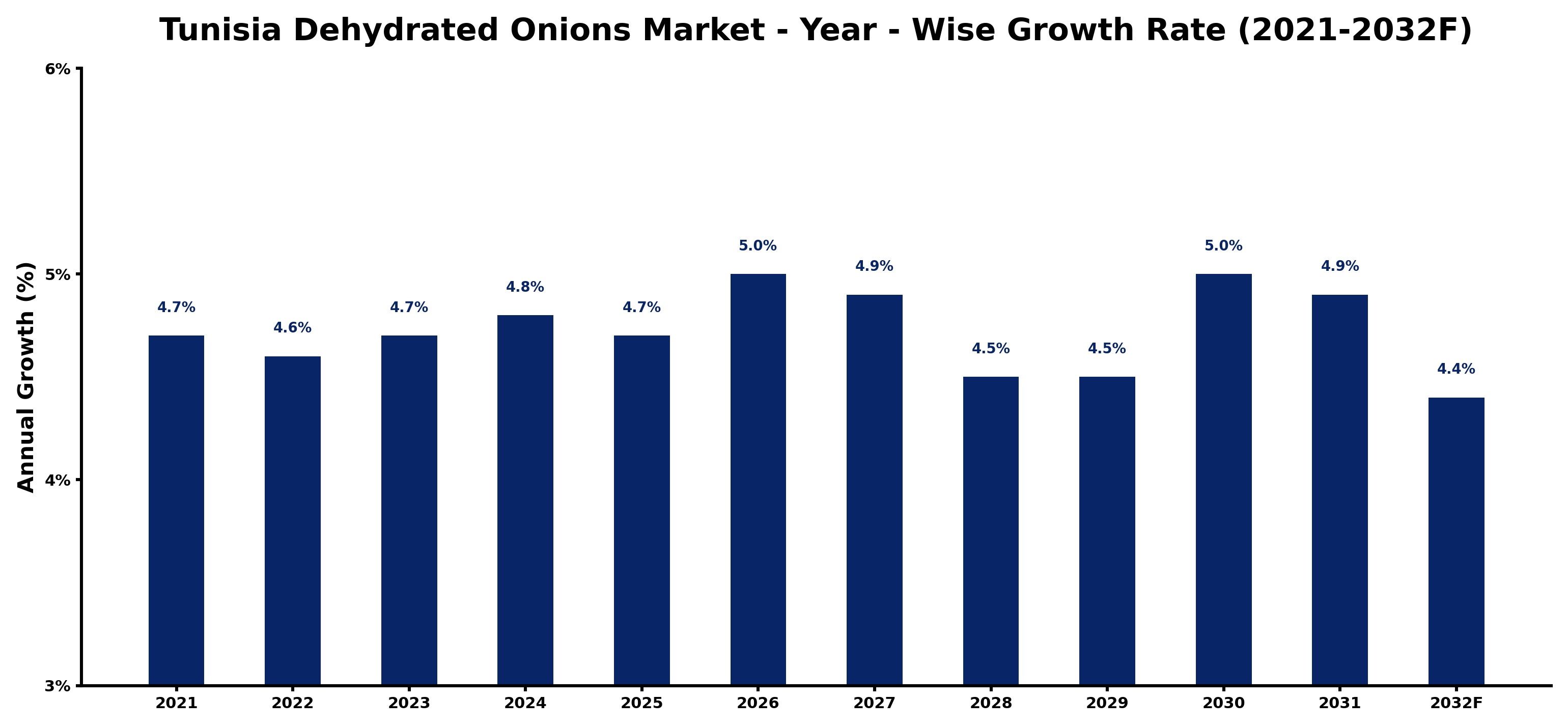
The table below presents the year‑wise growth rates along with the key drivers influencing the market
| Year | Growth Rate | Major Drivers |
| 2021 | 4.7% | Rising demand for convenience foods |
| 2022 | 4.6% | Increased exports to neighboring markets |
| 2023 | 4.7% | Health trends favoring dehydrated products |
| 2024 | 4.8% | Culinary innovation driving product usage |
| 2025 | 4.7% | Growing popularity of organic options |
| 2026 | 5.0% | Food processing sector expansion ongoing |
| 2027 | 4.9% | Home cooking trends gaining momentum |
| 2028 | 4.5% | Sustainable packaging attracting consumers |
| 2029 | 4.5% | Catering services expanding product range |
| 2030 | 5.0% | E-commerce growth enhancing sales channels |
| 2031 | 4.9% | Cultural cuisine integration increasing demand |
| 2032 | 4.4% | Consumer awareness of health benefits |
Note - Market size estimations and growth projections presented in this report are based on 6Wresearch’s advanced forecasting approach, validated with industry datasets as of June 2026.
Tunisia Dehydrated Onions Market Synopsis
In recent years, the Tunisia dehydrated onions market has gained momentum, supported by evolving consumer habits favoring convenience and nutritional benefits. However, as the market progresses, it faces the challenge of maintaining quality standards while managing fluctuating raw material prices. The duality of growing domestic demand and promising export potential is setting a dynamic stage for industry players.
As households increasingly embrace dehydrated onions for their practicality in meal preparation, the industry is witnessing a marked shift towards innovation and sustainability. This burgeoning interest signals a robust outlook for both producers and investors, positioning the Tunisia dehydrated onions market for sustainable growth amidst an evolving landscape.
Tunisia Dehydrated Onions Market Key Takeaways
- The market is primarily driven by increasing consumer demand for convenience and ready-to-eat meals.
- Longer shelf life and ease of storage are key advantages fueling the popularity of dehydrated onions.
- Investment opportunities exist in production technology and sustainable practices to enhance market competitiveness.
- Government policies are actively supporting the market through incentives and quality control measures.
- Emerging trends indicate a growing focus on health benefits, driving further market expansion.
Evaluation of Restraints in Tunisia Dehydrated Onions Market
Several challenges continue to pose constraints on the Tunisia dehydrated onions market. Fluctuating raw material prices can directly impact profitability for producers, leading to uncertainty in pricing strategies. Furthermore, competition from other onion-producing countries necessitates that Tunisian products meet strict quality standards, particularly for export. The market's reliance on maintaining an efficient supply chain, alongside ensuring food safety protocols, adds another layer of complexity that market players must navigate. Additionally, environmental factors and climate change present ongoing threats to consistent production levels, necessitating adaptive strategies to ensure market resilience.
Tunisia Dehydrated Onions Market Trends
A key trend shaping the Tunisia dehydrated onions market is the increased incorporation of dehydrated onions into a variety of ready-to-eat meals and packaged foods. As consumers lean towards quick and hassle-free cooking solutions, manufacturers are innovating product offerings to cater to this demand. Sustainability is also becoming a focal point, as producers aim to adopt eco-friendly practices in sourcing and processing. Moreover, consumer education on the nutritional advantages of dehydrated onions, including their antioxidant properties, is fueling interest and acceptance, setting the stage for a more health-conscious market.
Tunisia Dehydrated Onions Market Opportunities
The Tunisia dehydrated onions market presents various investment avenues that stakeholders can capitalize on. One significant opportunity lies in advancing the technology employed in onion dehydration processes to enhance efficiency and product quality. Additionally, tapping into international markets presents a lucrative pathway for growth, especially as global demand for dehydrated ingredients rises. Marketing and distribution enhancements will also be vital in reaching wider consumer bases, while investments in sustainable cultivation practices align with growing consumer preferences for natural food products.
Government Initiatives in the Tunisia Dehydrated Onions Market
The Tunisian government has initiated various supportive measures to bolster the dehydrated onions market. These include financial incentives and subsidies aimed at encouraging onion producers, as well as research and development programs designed to improve dehydration techniques. Moreover, the government actively promotes export opportunities through trade agreements, enhancing market access for local producers. Establishing rigorous quality control standards has also been a priority, ensuring safety and quality in dehydrated onion products while reinforcing Tunisia's competitiveness in the global marketplace.
Future Insights of the Tunisia Dehydrated Onions Market
Looking ahead, the Tunisia dehydrated onions market is set for steady growth, driven by continued consumer preference for convenience foods and the cost advantages of dehydrated ingredients. The long shelf life and storage benefits associated with dehydrated onions position them favorably against fresh alternatives. Furthermore, as health awareness intensifies, the demand for nutritionally beneficial products is anticipated to rise. Technological advancements in dehydration processes will likely open new avenues for expansion, prompting increased investments and participation from various stakeholders aiming to capitalize on the evolving market landscape.
Tunisia Dehydrated Onions Market Latest Developments (May 2025 - June 2026)
Recent developments in the Tunisia dehydrated onions market indicate a strategic focus on enhancing product quality and expanding international reach. Industry players are actively exploring advanced dehydration technologies to improve efficiency and minimize costs. At the same time, collaborative initiatives with the government are being seen to boost export potential, with several producers participating in international trade fairs to promote their offerings. The market is also witnessing a heightened emphasis on sustainability, with several companies adopting eco-friendly practices in their operations to cater to the growing consumer demand for responsible sourcing.
Tunisia Dehydrated Onions Market - Key Attractiveness of the Report
- 10 Years of Market Numbers
- Historical Data Starting from 2022 to 2025
- Base Year: 2025
- Forecast Data until 2032
- Key Performance Indicators Impacting the Market
- Major Upcoming Developments and Projects
Key Highlights of the Report:
- Tunisia Dehydrated Onions Market Outlook
- Market Size of Tunisia Dehydrated Onions Market, 2025
- Forecast of Tunisia Dehydrated Onions Market, 2032
- Historical Data and Forecast of Tunisia Dehydrated Onions Revenues & Volume for the Period 2022-2032F
- Tunisia Dehydrated Onions Market Trend Evolution
- Tunisia Dehydrated Onions Market Drivers and Challenges
- Tunisia Dehydrated Onions Price Trends
- Tunisia Dehydrated Onions Porter's Five Forces
- Tunisia Dehydrated Onions Industry Life Cycle
- Historical Data and Forecast of Tunisia Dehydrated Onions Market Revenues & Volume By Nature for the Period 2022-2032F
- Historical Data and Forecast of Tunisia Dehydrated Onions Market Revenues & Volume By Organic for the Period 2022-2032F
- Historical Data and Forecast of Tunisia Dehydrated Onions Market Revenues & Volume By Conventional for the Period 2022-2032F
- Historical Data and Forecast of Tunisia Dehydrated Onions Market Revenues & Volume By Variety for the Period 2022-2032F
- Historical Data and Forecast of Tunisia Dehydrated Onions Market Revenues & Volume By White Onion for the Period 2022-2032F
- Historical Data and Forecast of Tunisia Dehydrated Onions Market Revenues & Volume By Red Onion for the Period 2022-2032F
- Historical Data and Forecast of Tunisia Dehydrated Onions Market Revenues & Volume By Pink Onion for the Period 2022-2032F
- Historical Data and Forecast of Tunisia Dehydrated Onions Market Revenues & Volume By Hybrid for the Period 2022-2032F
- Historical Data and Forecast of Tunisia Dehydrated Onions Market Revenues & Volume By Form for the Period 2022-2032F
- Historical Data and Forecast of Tunisia Dehydrated Onions Market Revenues & Volume By Chopped for the Period 2022-2032F
- Historical Data and Forecast of Tunisia Dehydrated Onions Market Revenues & Volume By Minced for the Period 2022-2032F
- Historical Data and Forecast of Tunisia Dehydrated Onions Market Revenues & Volume By Granules for the Period 2022-2032F
- Historical Data and Forecast of Tunisia Dehydrated Onions Market Revenues & Volume By Powder for the Period 2022-2032F
- Historical Data and Forecast of Tunisia Dehydrated Onions Market Revenues & Volume By Flakes for the Period 2022-2032F
- Historical Data and Forecast of Tunisia Dehydrated Onions Market Revenues & Volume By Kibbled for the Period 2022-2032F
- Historical Data and Forecast of Tunisia Dehydrated Onions Market Revenues & Volume By Sliced for the Period 2022-2032F
- Historical Data and Forecast of Tunisia Dehydrated Onions Market Revenues & Volume By End-use for the Period 2022-2032F
- Historical Data and Forecast of Tunisia Dehydrated Onions Market Revenues & Volume By Food Proccessing for the Period 2022-2032F
- Historical Data and Forecast of Tunisia Dehydrated Onions Market Revenues & Volume By Food Service Providers for the Period 2022-2032F
- Historical Data and Forecast of Tunisia Dehydrated Onions Market Revenues & Volume By Retail/Household for the Period 2022-2032F
- Historical Data and Forecast of Tunisia Dehydrated Onions Market Revenues & Volume By Technology for the Period 2022-2032F
- Historical Data and Forecast of Tunisia Dehydrated Onions Market Revenues & Volume By Air Drying for the Period 2022-2032F
- Historical Data and Forecast of Tunisia Dehydrated Onions Market Revenues & Volume By Vaccum Drying for the Period 2022-2032F
- Historical Data and Forecast of Tunisia Dehydrated Onions Market Revenues & Volume By Freeze Drying for the Period 2022-2032F
- Historical Data and Forecast of Tunisia Dehydrated Onions Market Revenues & Volume By Microwave Drying for the Period 2022-2032F
- Historical Data and Forecast of Tunisia Dehydrated Onions Market Revenues & Volume By Spray Drying for the Period 2022-2032F
- Historical Data and Forecast of Tunisia Dehydrated Onions Market Revenues & Volume By Others for the Period 2022-2032F
- Historical Data and Forecast of Tunisia Dehydrated Onions Market Revenues & Volume By Distribution Channel for the Period 2022-2032F
- Historical Data and Forecast of Tunisia Dehydrated Onions Market Revenues & Volume By B2B for the Period 2022-2032F
- Historical Data and Forecast of Tunisia Dehydrated Onions Market Revenues & Volume By B2C for the Period 2022-2032F
- Tunisia Dehydrated Onions Import Export Trade Statistics
- Market Opportunity Assessment By Nature
- Market Opportunity Assessment By Variety
- Market Opportunity Assessment By Form
- Market Opportunity Assessment By End-use
- Market Opportunity Assessment By Technology
- Market Opportunity Assessment By Distribution Channel
- Tunisia Dehydrated Onions Top Companies Market Share
- Tunisia Dehydrated Onions Competitive Benchmarking By Technical and Operational Parameters
- Tunisia Dehydrated Onions Company Profiles
- Tunisia Dehydrated Onions Key Strategic Recommendations






































