Tunisia EdTech and Smart Classrooms Market Size & Growth Rate (2026-2032)
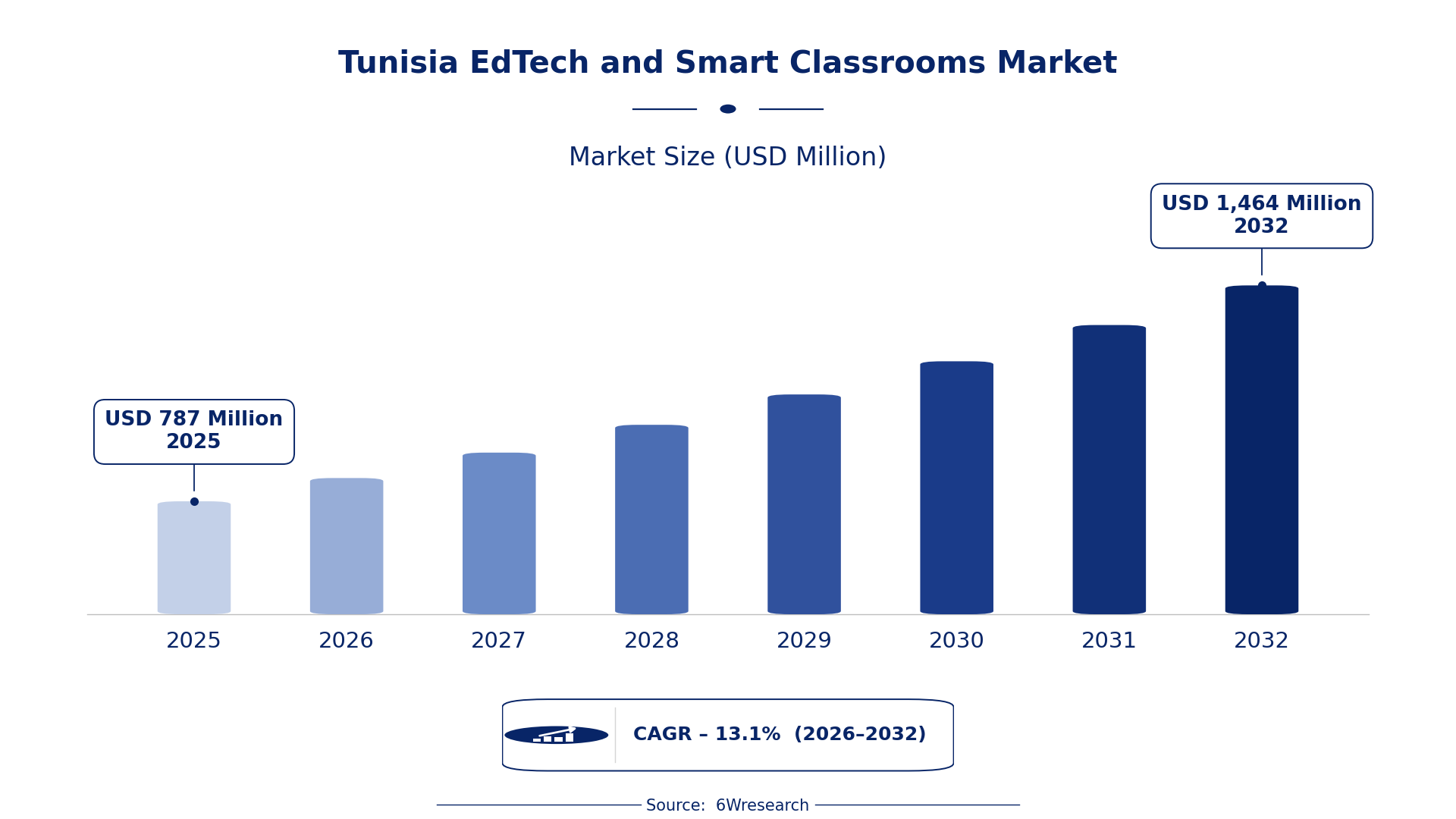
The Tunisia EdTech and Smart Classrooms Market was estimated at USD 787 Million in 2025 and is projected to reach USD 1464 Million by 2032, growing at a CAGR of 13.1% from 2026 to 2032.
Tunisia EdTech and Smart Classrooms Market Synopsis
The Tunisia EdTech and Smart Classrooms market is witnessing an exciting transformation as educational institutions increasingly adopt digital learning solutions. The government's dedication to modernizing the education sector, combined with a growing appetite for personalized and interactive learning, is driving this shift forward.
Innovative technologies such as virtual reality, artificial intelligence, and cloud-based platforms are becoming essential tools in enhancing the learning experience. With both local and international entities competing in this space, the market is poised for continued expansion and innovation in the years to come.
Tunisia EdTech and Smart Classrooms Market Year-wise Growth Rate and Key Drivers
This graph illustrates the annual growth rates of the Tunisia EdTech and Smart Classrooms Market from 2021 to 2032, highlighting a steady upward trajectory and projected expansion over the forecast period.
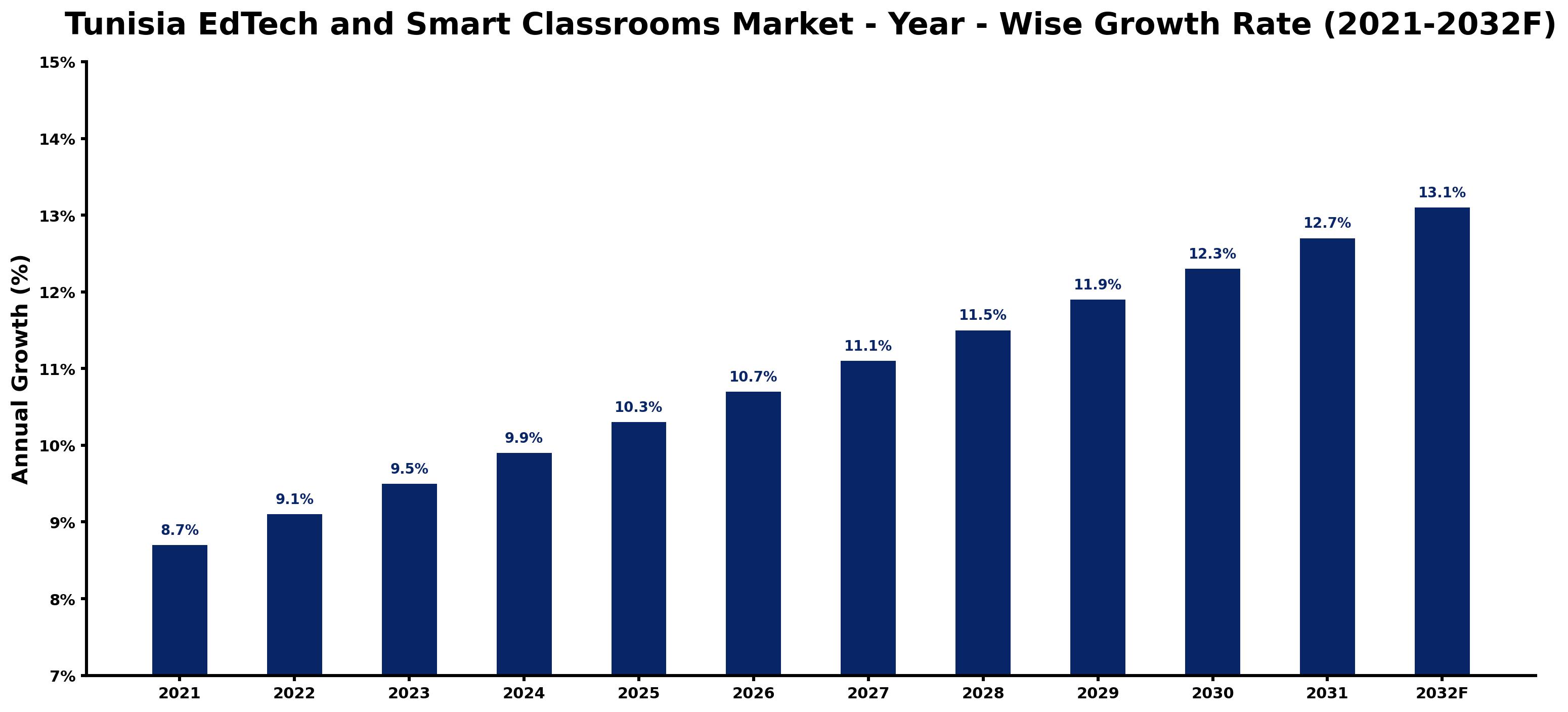
The table below presents the year‑wise growth rates along with the key drivers influencing the market
| Year | Growth Rate | Major Drivers |
| 2021 | 8.7% | Government's commitment to digital education initiatives. |
| 2022 | 9.1% | Increased smartphone penetration among students and teachers. |
| 2023 | 9.5% | Partnerships with international organizations for smart classroom funding. |
| 2024 | 9.9% | National curriculum integration of technology-enhanced learning tools. |
| 2025 | 10.3% | Rise in digital literacy programs for educators. |
| 2026 | 10.7% | Investment in infrastructure for nationwide internet access. |
| 2027 | 11.1% | Supportive policies from Ministry of Education for EdTech. |
| 2028 | 11.5% | Growing parental interest in interactive learning experiences. |
| 2029 | 11.9% | Emergence of local content tailored to Tunisian culture. |
| 2030 | 12.3% | Increased focus on STEM education in schools. |
| 2031 | 12.7% | Development of user-friendly platforms for teacher training. |
| 2032 | 13.1% | Collaboration between public and private sectors on digital tools. |
Note: Market size estimations and growth projections presented in this report are based on 6Wresearch's proprietary forecasting methodology, utilizing the latest available industry data, government publications, and primary research inputs.
Tunisia EdTech and Smart Classrooms Market Key Takeaways
Below are some of the specific key takeaways from the market, including:
- Government initiatives are actively promoting digital transformation within educational institutions.
- Increasing demand for personalized learning solutions is reshaping the EdTech market.
- Challenges such as limited technology access in remote areas hinder wider adoption.
- The integration of emerging technologies is creating immersive learning environments for students.
- Investment opportunities exist in developing tailored educational content and tools.
Evaluation of Restraints in Tunisia EdTech and Smart Classrooms Market
Despite its growth potential, the Tunisia EdTech and Smart Classrooms market faces tangible restraints. Limited access to technology and unreliable internet connectivity, particularly in remote areas, pose significant barriers. Additionally, many schools lack the necessary infrastructure to implement smart classroom solutions effectively. Financial constraints associated with acquiring and maintaining EdTech tools further complicate adoption efforts. Resistance to shifting from traditional teaching methods can also impede progress, as can the shortage of educators trained in utilizing these digital tools effectively. Concerns around data privacy and security add another layer of complexity, necessitating careful consideration from all stakeholders involved.
Tunisia EdTech and Smart Classrooms Market Trends
The demand for personalized learning experiences is rapidly increasing, driven by the growing expectations of students and parents alike. Interactive digital content and online platforms are becoming essential components of the educational experience, enhancing student engagement and learning outcomes. Technologies like artificial intelligence and virtual reality are gaining traction, providing unique ways to present information and facilitate deeper understanding. on top of that, the rise of mobile learning solutions and a focus on teacher professional development are reshaping how education is delivered and consumed in Tunisia.
Tunisia EdTech and Smart Classrooms Market Opportunities
The Tunisia EdTech and Smart Classrooms market presents a wealth of investment opportunities as digital learning technologies gain traction. Investors can capitalize on the demand for educational content and tools that align with the Tunisian curriculum and cultural context. Infrastructure investments in smart classroom technologies, such as interactive whiteboards and educational software, are highly sought after. Collaborations with local educational institutions and government initiatives can further enhance these opportunities, as Tunisia strives to modernize its education system and improve access to quality learning experiences.
Government Initiatives in the Tunisia EdTech and Smart Classrooms Market
The Tunisian government is actively engaged in initiatives aimed at enhancing the education sector through technology integration. Recent policy efforts emphasize modernizing classrooms and promoting digital literacy among students. Such governmental support is crucial for driving the EdTech and Smart Classrooms market forward.
- A National Digital Education Program launched in 2023 aims to incorporate technology into classrooms nationwide.
- Ongoing teacher training initiatives focus on equipping educators with the skills needed to effectively use EdTech tools.
- Current infrastructure enhancement projects are underway to improve connectivity in schools across Tunisia.
- A planned public-private partnership expected to be initiated in 2026 will aim to develop smart classroom infrastructures.
- Efforts to introduce a regulatory framework to improve data privacy and security in digital education are currently in progress.
Future Insights of the Tunisia EdTech and Smart Classrooms Market
Looking ahead to 2026-2032, the Tunisia EdTech and Smart Classrooms market is on track for substantial growth. Factors such as rising internet penetration and an increasing shift towards e-learning platforms will continue to drive market demand. The COVID-19 pandemic has accelerated the adoption of technology in education, reinforcing its importance for both schools and universities. As Tunisia's young population demands quality education, the market environment remains favorable for innovative EdTech solutions.
Tunisia EdTech and Smart Classrooms Market Latest Developments
Over the past year, the Tunisia EdTech and Smart Classrooms market has seen notable activity reflecting its dynamic nature. Various initiatives and developments are taking shape as stakeholders respond to the growing demand for digital learning solutions.
- A major technology vendor initiated a pilot program in early 2025, showcasing the use of virtual reality in the classroom setting.
- Ongoing collaborations between educational institutions and tech providers aim to enhance digital content offerings, with developments reported throughout 2025.
- A rollout of interactive whiteboards is expected to begin in mid-2026, aimed at enhancing classroom interactivity.
- A partnership to develop a comprehensive digital literacy program for students is currently underway, slated for completion by late 2025.
- Plans for a nationwide assessment of school infrastructure to identify upgrade needs are set to commence in early 2026.
Tunisia EdTech and Smart Classrooms Market - Key Attractiveness of the Report
- 10 Years of Market Numbers
- Historical Data Starting from 2022 to 2025
- Base Year: 2025
- Forecast Data until 2032
- Key Performance Indicators Impacting the Market
- Major Upcoming Developments and Projects
Key Highlights of the Report:
- Tunisia EdTech and Smart Classrooms Market Outlook
- Market Size of Tunisia EdTech and Smart Classrooms Market, 2025
- Forecast of Tunisia EdTech and Smart Classrooms Market, 2032
- Historical Data and Forecast of Tunisia EdTech and Smart Classrooms Revenues & Volume for the Period 2022-2032F
- Tunisia EdTech and Smart Classrooms Market Trend Evolution
- Tunisia EdTech and Smart Classrooms Market Drivers and Challenges
- Tunisia EdTech and Smart Classrooms Price Trends
- Tunisia EdTech and Smart Classrooms Porter's Five Forces
- Tunisia EdTech and Smart Classrooms Industry Life Cycle
- Historical Data and Forecast of Tunisia EdTech and Smart Classrooms Market Revenues & Volume By Hardware for the Period 2022-2032F
- Historical Data and Forecast of Tunisia EdTech and Smart Classrooms Market Revenues & Volume By Interactive Displays for the Period 2022-2032F
- Historical Data and Forecast of Tunisia EdTech and Smart Classrooms Market Revenues & Volume By Interactive Projectors for the Period 2022-2032F
- Historical Data and Forecast of Tunisia EdTech and Smart Classrooms Market Revenues & Volume By Education System Solution for the Period 2022-2032F
- Historical Data and Forecast of Tunisia EdTech and Smart Classrooms Market Revenues & Volume By Learning Management System for the Period 2022-2032F
- Historical Data and Forecast of Tunisia EdTech and Smart Classrooms Market Revenues & Volume By Student Information and Administration System for the Period 2022-2032F
- Historical Data and Forecast of Tunisia EdTech and Smart Classrooms Market Revenues & Volume By Student Collaboration System for the Period 2022-2032F
- Historical Data and Forecast of Tunisia EdTech and Smart Classrooms Market Revenues & Volume By Student Response System for the Period 2022-2032F
- Historical Data and Forecast of Tunisia EdTech and Smart Classrooms Market Revenues & Volume By Learning and Gamification for the Period 2022-2032F
- Historical Data and Forecast of Tunisia EdTech and Smart Classrooms Market Revenues & Volume By Test Preparation for the Period 2022-2032F
- Historical Data and Forecast of Tunisia EdTech and Smart Classrooms Market Revenues & Volume By Classroom Management System for the Period 2022-2032F
- Historical Data and Forecast of Tunisia EdTech and Smart Classrooms Market Revenues & Volume By Document Management System for the Period 2022-2032F
- Historical Data and Forecast of Tunisia EdTech and Smart Classrooms Market Revenues & Volume By Deployment Type for the Period 2022-2032F
- Historical Data and Forecast of Tunisia EdTech and Smart Classrooms Market Revenues & Volume By Cloud for the Period 2022-2032F
- Historical Data and Forecast of Tunisia EdTech and Smart Classrooms Market Revenues & Volume By On-Premises for the Period 2022-2032F
- Historical Data and Forecast of Tunisia EdTech and Smart Classrooms Market Revenues & Volume By End User for the Period 2022-2032F
- Historical Data and Forecast of Tunisia EdTech and Smart Classrooms Market Revenues & Volume By K-12 for the Period 2022-2032F
- Historical Data and Forecast of Tunisia EdTech and Smart Classrooms Market Revenues & Volume By Higher Education for the Period 2022-2032F
- Tunisia EdTech and Smart Classrooms Import Export Trade Statistics
- Market Opportunity Assessment By Hardware
- Market Opportunity Assessment By Education System Solution
- Market Opportunity Assessment By Deployment Type
- Market Opportunity Assessment By End User
- Tunisia EdTech and Smart Classrooms Top Companies Market Share
- Tunisia EdTech and Smart Classrooms Competitive Benchmarking By Technical and Operational Parameters
- Tunisia EdTech and Smart Classrooms Company Profiles
- Tunisia EdTech and Smart Classrooms Key Strategic Recommendations






































