Tunisia Over the Top Market Size & Growth Rate (2026-2032)
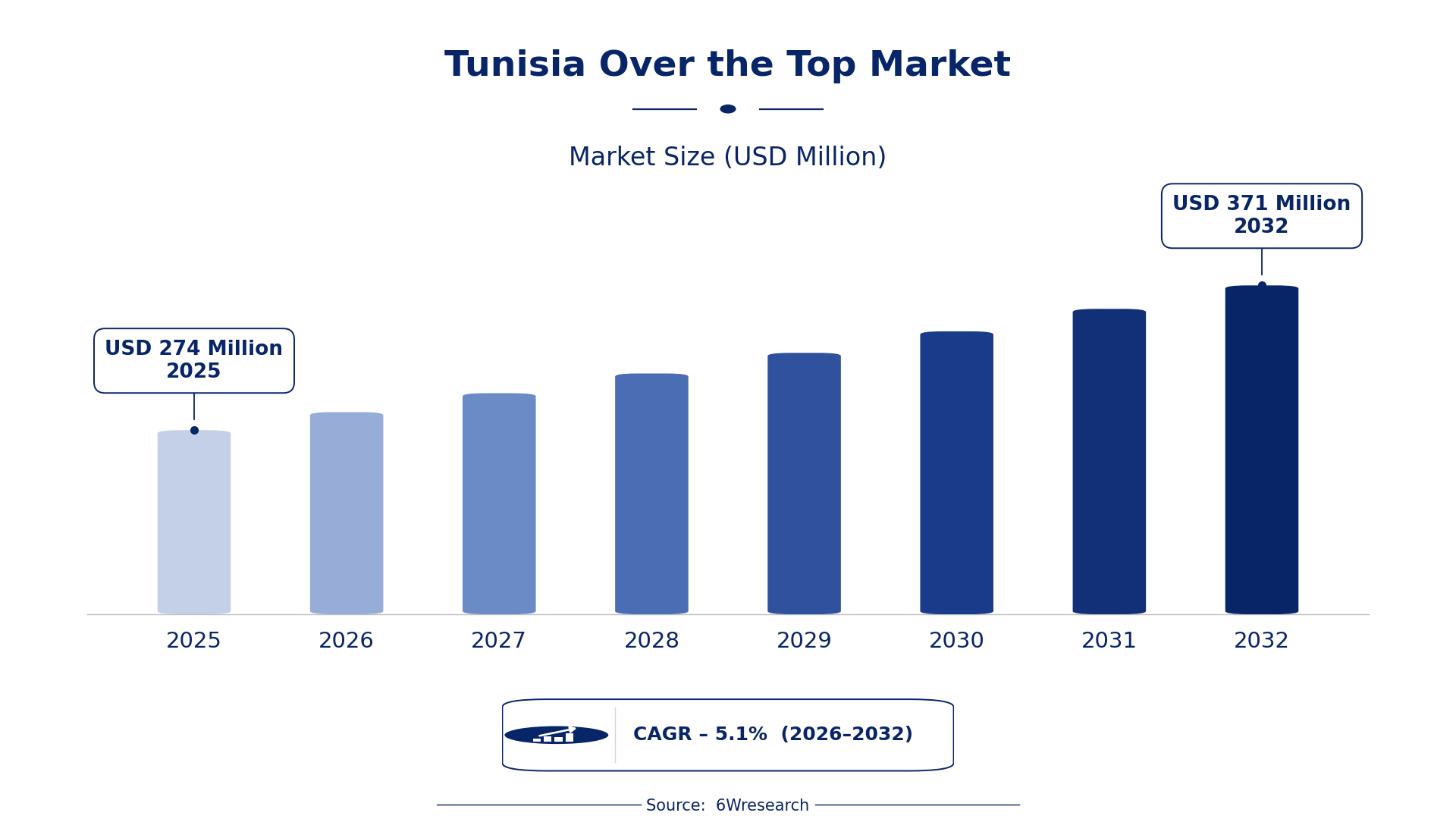
The Tunisia Over the Top Market was estimated at USD 274 Million in 2025 and is projected to reach USD 371 Million by 2032, growing at a CAGR of 5.1% from 2026 to 2032.
Tunisia Over the Top Market Synopsis
The Over the Top (OTT) market in Tunisia has gained significant traction, driven by the surge in internet connectivity and mobile device adoption. As consumers increasingly embrace on-demand content, established players like Netflix and emerging local platforms are vying for market share, indicating a vibrant sector undergoing transformation.
Looking ahead, the growth trajectory of the Tunisia OTT market appears promising as localized content becomes a focal point for providers. As the demand for diverse entertainment options intensifies, the market's evolution hinges on overcoming existing infrastructure challenges and regulatory hurdles.
Tunisia Over the Top Market Year-wise Growth Rate and Key Drivers
This graph illustrates the annual growth rates of the Tunisia Over the Top Market from 2021 to 2032, highlighting a steady upward trajectory and projected expansion over the forecast period.
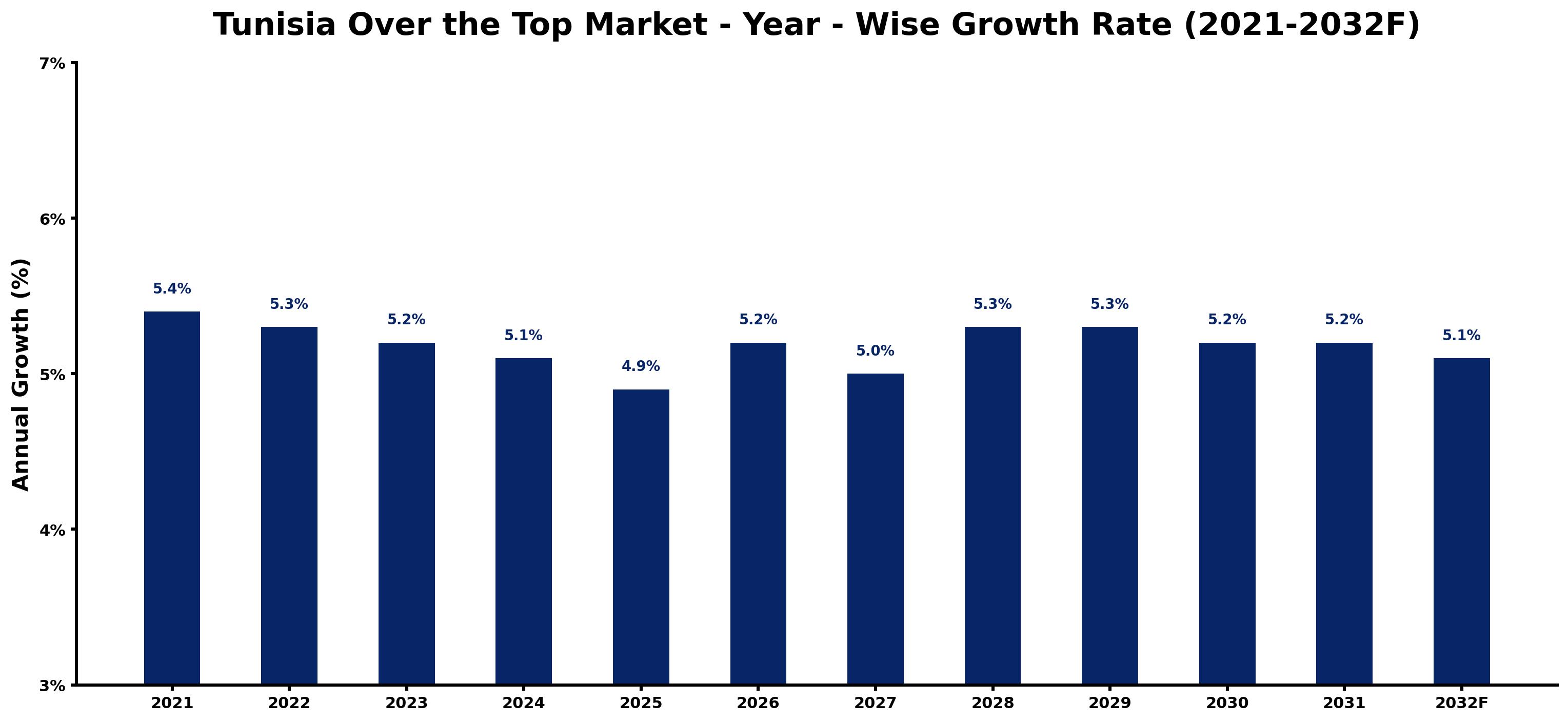
The table below presents the year‑wise growth rates along with the key drivers influencing the market
| Year | Growth Rate | Major Drivers |
| 2021 | 5.4% | Increased smartphone penetration among Tunisian youth. |
| 2022 | 5.3% | Government incentives supporting digital content creation. |
| 2023 | 5.2% | Growth in local streaming platforms attracting Tunisian audiences. |
| 2024 | 5.1% | Increased partnerships with international OTT providers. |
| 2025 | 4.9% | Surge in youth-led social media content production. |
| 2026 | 5.2% | Boost from FIFA World Cup streaming rights acquisition. |
| 2027 | 5.0% | Introduction of local language dubbing enhances accessibility. |
| 2028 | 5.3% | Expanding regional internet speeds improve streaming quality. |
| 2029 | 5.3% | Popularity of Tunisian films on digital platforms rises. |
| 2030 | 5.2% | Increased investments in local production studios. |
| 2031 | 5.2% | Adoption of 5G facilitates high-definition streaming. |
| 2032 | 5.1% | Government support for digital literacy initiatives encourages usage. |
Note: Market size estimations and growth projections presented in this report are based on 6Wresearch's proprietary forecasting methodology, utilizing the latest available industry data, government publications, and primary research inputs.
Tunisia Over the Top Market Key Takeaways
Below are some of the specific key takeaways from the market, including:
- The OTT market is shifting away from traditional viewing habits, with a marked increase in subscriptions to streaming services.
- Localized content is emerging as a significant demand driver, encouraging investment in tailored programming.
- Smartphone penetration is facilitating greater access to OTT services among various demographics.
- Infrastructure improvements are essential to address connectivity issues in less accessible regions.
- Regulatory policies are evolving to create a fair competitive environment for both local and international players.
Evaluation of Restraints in Tunisia Over the Top Market
While the Tunisia OTT market exhibits strong growth potential, several restraints hinder its full realization. A considerable portion of the population still faces limited internet access, particularly in rural areas, which affects service delivery and user experience. Additionally, there exists a general lack of awareness among certain demographics regarding the benefits of OTT platforms, which can delay adoption. The competitive pressure from traditional television providers also poses challenges, as they have established viewer loyalty. Regulatory uncertainties, particularly concerning content management and privacy, create an environment of caution for potential investors, necessitating a cautious approach to market entry strategies.
Tunisia Over the Top Market Trends
Recent trends indicate a robust shift in viewing preferences, with many Tunisian consumers gravitating towards video streaming services for news, entertainment, and education. A notable rise in the consumption of original and localized content is being observed as OTT providers invest in programming tailored to the Tunisian audience. Additionally, the affordability of mobile data plans is fostering increased access to these services, while advancements in network infrastructure are supporting higher-quality streaming experiences. Social media's influence is also significant, as it shapes viewer expectations and drives engagement on OTT platforms.
Tunisia Over the Top Market Opportunities
The Tunisia OTT market presents a wealth of investment opportunities driven by the accelerating demand for digital content. Companies looking to establish a foothold can focus on producing and distributing localized programming that resonates with Tunisian viewers. Furthermore, investments in enhancing technology infrastructure, such as expanding high-speed internet access, will provide a solid foundation for future growth. Collaborating with local telecom and media entities can also unlock synergies, enabling more effective market penetration and audience engagement.
Government Initiatives in the Tunisia Over the Top Market
Government policy is playing a crucial role in shaping the OTT market in Tunisia. With a strong focus on digital transformation, regulatory measures aim to ensure fair competition while fostering innovation in the sector. The government's approach to nurturing a sustainable digital economy is reflected in the introduction of new laws and initiatives aimed at facilitating market growth.
- A digital economy law was enacted in 2018, establishing guidelines for OTT providers and ensuring compliance with local regulations.
- Currently, there is a national initiative underway aimed at enhancing internet infrastructure across underserved regions, addressing connectivity issues impacting OTT services.
- In 2023, the government began a public awareness campaign to educate consumers about the benefits of OTT platforms, targeting segments with low adoption rates.
- A proposed tax reform aimed at foreign OTT services is expected to be implemented in 2025 to bolster local economic contributions while ensuring fair taxation.
- Planned regulatory updates in 2026 will focus on data privacy laws, aiming to establish clearer guidelines for content providers operating within the Tunisian market.
Future Insights of the Tunisia Over the Top Market
Looking towards 2026-2032, the Tunisia OTT market is set for continued expansion as digital consumption becomes increasingly ingrained in daily life. Enhanced internet connectivity, especially with ongoing government initiatives, will likely widen the reach of OTT platforms. With the increasing emphasis on content localization, providers that prioritize culturally relevant programming will gain a competitive edge. Innovations in technology, including the integration of AI and data analytics for personalized content delivery, will further enhance user experiences and drive market engagement. The convergence of telecommunications and OTT services suggests a future where cross-platform synergies could redefine how content is consumed in Tunisia.
Tunisia Over the Top Market Latest Developments
The past year has been characterized by significant movements in the Tunisia OTT market, with local and international players alike making strides to adapt to consumer preferences. The competitive environment is intensifying as platforms vie for viewer loyalty and market presence.
- A leading regional operator launched a new streaming service in early 2023, featuring a mix of local and international content aimed at capturing younger audiences.
- In Q2 2023, a major technology vendor began rolling out advanced streaming technology designed to enhance video quality and user engagement.
- A partnership between two local media firms was announced in late 2023 to co-produce content specifically targeting Tunisian culture and storytelling.
- Plans for a comprehensive user feedback system were unveiled in mid-2023, aiming to gather insights to improve content offerings and viewer experience.
- An upcoming promotional campaign set for early 2024 is expected to boost subscriber numbers by emphasizing the unique features of available content on local platforms.
Tunisia Over the Top Market - Key Attractiveness of the Report
- 10 Years of Market Numbers
- Historical Data Starting from 2022 to 2025
- Base Year: 2025
- Forecast Data until 2032
- Key Performance Indicators Impacting the Market
- Major Upcoming Developments and Projects
Key Highlights of the Report:
- Tunisia Over the Top Market Outlook
- Market Size of Tunisia Over the Top Market, 2025
- Forecast of Tunisia Over the Top Market, 2032
- Historical Data and Forecast of Tunisia Over the Top Revenues & Volume for the Period 2022-2032F
- Tunisia Over the Top Market Trend Evolution
- Tunisia Over the Top Market Drivers and Challenges
- Tunisia Over the Top Price Trends
- Tunisia Over the Top Porter's Five Forces
- Tunisia Over the Top Industry Life Cycle
- Historical Data and Forecast of Tunisia Over the Top Market Revenues & Volume By Type for the Period 2022-2032F
- Historical Data and Forecast of Tunisia Over the Top Market Revenues & Volume By Game Streaming for the Period 2022-2032F
- Historical Data and Forecast of Tunisia Over the Top Market Revenues & Volume By Audio Streaming for the Period 2022-2032F
- Historical Data and Forecast of Tunisia Over the Top Market Revenues & Volume By Video Streaming for the Period 2022-2032F
- Historical Data and Forecast of Tunisia Over the Top Market Revenues & Volume By Communication for the Period 2022-2032F
- Historical Data and Forecast of Tunisia Over the Top Market Revenues & Volume By Monetization Model for the Period 2022-2032F
- Historical Data and Forecast of Tunisia Over the Top Market Revenues & Volume By Subscription-based for the Period 2022-2032F
- Historical Data and Forecast of Tunisia Over the Top Market Revenues & Volume By Advertising-based for the Period 2022-2032F
- Historical Data and Forecast of Tunisia Over the Top Market Revenues & Volume By Transaction-based for the Period 2022-2032F
- Historical Data and Forecast of Tunisia Over the Top Market Revenues & Volume By Streaming Device for the Period 2022-2032F
- Historical Data and Forecast of Tunisia Over the Top Market Revenues & Volume By Smartphones and Tablets for the Period 2022-2032F
- Historical Data and Forecast of Tunisia Over the Top Market Revenues & Volume By Desktops and Laptops for the Period 2022-2032F
- Historical Data and Forecast of Tunisia Over the Top Market Revenues & Volume By IPTV and Consoles for the Period 2022-2032F
- Historical Data and Forecast of Tunisia Over the Top Market Revenues & Volume By Vertical for the Period 2022-2032F
- Historical Data and Forecast of Tunisia Over the Top Market Revenues & Volume By Media and Entertainment for the Period 2022-2032F
- Historical Data and Forecast of Tunisia Over the Top Market Revenues & Volume By Education and Learning for the Period 2022-2032F
- Historical Data and Forecast of Tunisia Over the Top Market Revenues & Volume By Gaming for the Period 2022-2032F
- Historical Data and Forecast of Tunisia Over the Top Market Revenues & Volume By Service Utilities for the Period 2022-2032F
- Tunisia Over the Top Import Export Trade Statistics
- Market Opportunity Assessment By Type
- Market Opportunity Assessment By Monetization Model
- Market Opportunity Assessment By Streaming Device
- Market Opportunity Assessment By Vertical
- Tunisia Over the Top Top Companies Market Share
- Tunisia Over the Top Competitive Benchmarking By Technical and Operational Parameters
- Tunisia Over the Top Company Profiles
- Tunisia Over the Top Key Strategic Recommendations






































