Tunisia Smart Locks Market Size, Share & Growth Rate
The Tunisia Smart Locks Market was estimated at USD 568 Million in 2025 and is projected to reach USD 989 Million by 2032, growing at a CAGR of 8.2% from 2026 to 2032. This growth trajectory is primarily propelled by an increasing awareness of home security among consumers and the burgeoning adoption of smart home technologies. Urbanization trends, rising disposable incomes, and a strong focus on home automation further underpin the demand for advanced locking solutions.
Tunisia Smart Locks Market Year-wise Growth Rate and Key Drivers
This graph highlights how the Tunisia Smart Locks Market has steadily grown over the years, supported by major growth factors.
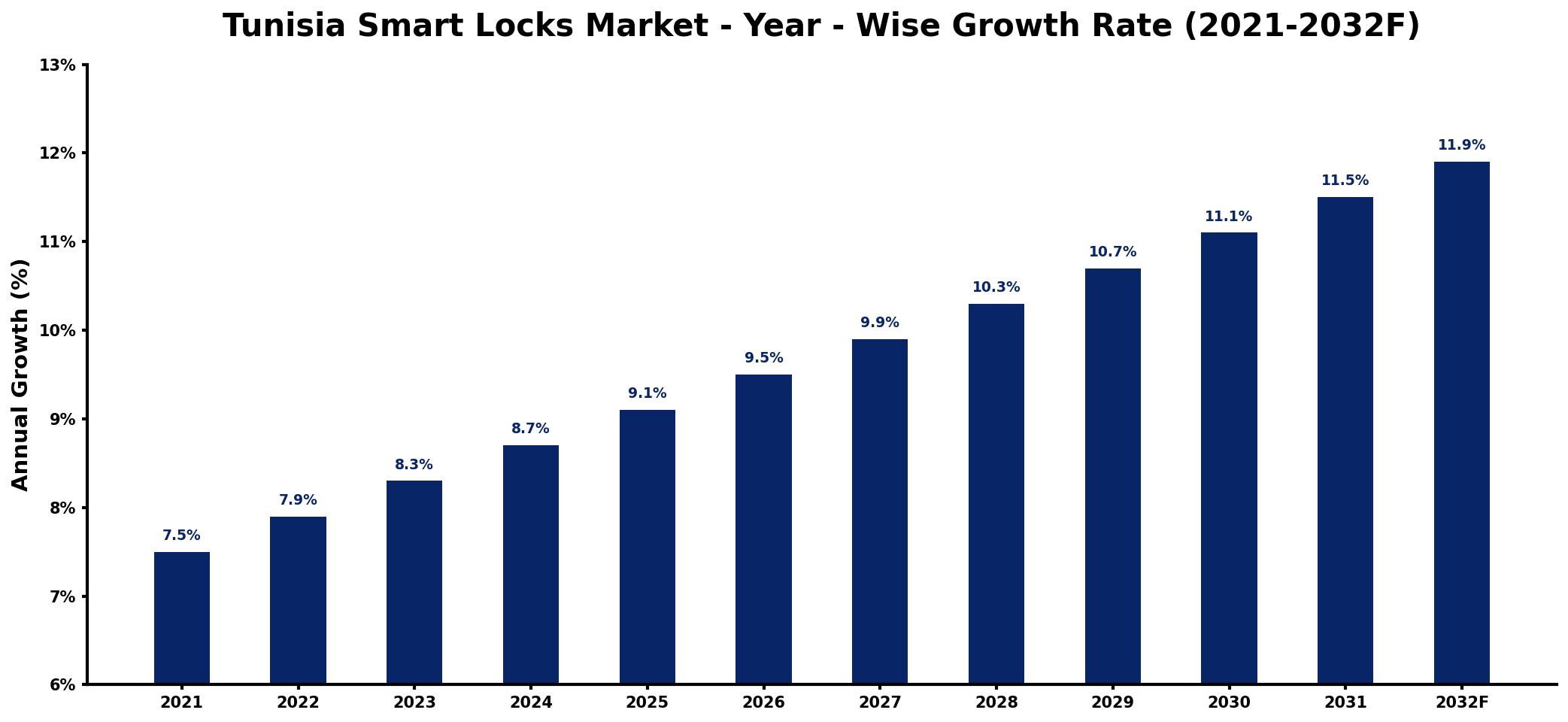
The table below presents the year‑wise growth rates along with the key drivers influencing the market
| Year | Growth Rate | Major Drivers |
| 2021 | 7.5% | Rising urbanization and modernization |
| 2022 | 7.9% | Growing demand for home security |
| 2023 | 8.3% | Increased technology adoption rates |
| 2024 | 8.7% | Expansion of residential construction projects |
| 2025 | 9.1% | expanding healthcare application demand |
| 2026 | 9.5% | increased production capacity utilization |
| 2027 | 9.9% | Enhanced awareness of cybersecurity |
| 2028 | 10.3% | Growth in rental property market |
| 2029 | 10.7% | Rising consumer disposable income levels |
| 2030 | 11.1% | Development of innovative security solutions |
| 2031 | 11.5% | Increased government regulations on safety |
| 2032 | 11.9% | Higher consumer preference for automation |
Note: Market size estimations and growth projections presented in this report are based on 6Wresearch's proprietary forecasting methodology, utilizing the latest available industry data, government publications, and primary research inputs.
Tunisia Smart Locks Market Synopsis
A significant force shaping the Tunisia Smart Locks Market is the heightened awareness of security concerns among homeowners. As households seek reliable and efficient means to safeguard their properties, the demand for smart locks has escalated, giving rise to an array of innovative solutions.
The market is marked by the proliferation of various players introducing cutting-edge smart lock technologies. With features such as biometric authentication and seamless integration with existing smart home systems, manufacturers are keenly responding to the evolving preferences of Tunisian consumers.
Tunisia Smart Locks Market Key Takeaways
- Rapid urbanization is driving the demand for smart locks as consumers seek enhanced security solutions.
- The integration of IoT technology is revolutionizing home access control systems in Tunisia.
- Product innovation, including mobile app integration and biometric systems, is a focal point for market players.
- Government initiatives are fostering growth by encouraging partnerships and providing incentives for smart lock technology adoption.
- The trend of short-term rentals is increasing the necessity for advanced security measures among property owners.
Evaluation of Restraints in Tunisia Smart Locks Market
Despite promising growth, several restraints are impacting the Tunisia Smart Locks Market. Concerns regarding data security and privacy remain paramount, particularly with the increasing connectivity of smart devices. Limited awareness among consumers about the benefits of smart locks can hinder adoption rates, while compatibility issues with existing hardware may deter some potential buyers. Additionally, the higher price point of smart locks compared to traditional options poses a significant barrier, particularly in price-sensitive segments. Addressing these limitations through education and affordable solutions will be crucial for market expansion.
Tunisia Smart Locks Market Trends
The Tunisia Smart Locks Market is witnessing a dynamic shift towards the adoption of smart home technologies, prompting a surge in interest for innovative locking solutions. Key trends include the increasing demand for keyless entry systems and remote access features, appealing to consumers desiring convenience and control. Biometric authentication and voice-activated functionality are emerging as popular advancements, further enriching the user experience. As more consumers integrate smart devices within their homes, the compatibility and interoperability of smart locks with other home automation systems will play a significant role in influencing purchasing decisions.
Tunisia Smart Locks Market Opportunities
The Tunisia Smart Locks Market harbors significant investment opportunities, particularly in light of rising urbanization and an increasing focus on security. Investors have the potential to engage in partnerships with smart lock manufacturers and explore distribution channels tailored to local consumer preferences. Furthermore, with the growing penetration of smartphones in Tunisia, there is an opportunity to develop mobile-centric smart lock solutions that can cater to tech-savvy homeowners. The ongoing trend of short-term rentals also presents avenues for customized smart lock offerings, enhancing security and convenience for property owners.
Government Initiatives in the Tunisia Smart Locks Market
The Tunisian government is actively promoting the integration of smart lock technology within the nations security framework. Initiatives aimed at enhancing public safety through advanced security solutions include tax incentives and subsidies for businesses venturing into smart lock systems. Encouragement of collaborations between local and international technology firms is also a priority, aiming to foster innovation in product offerings. These governmental strategies are instrumental in modernizing Tunisias security infrastructure and facilitating the broader adoption of advanced technologies.
Future Insights of the Tunisia Smart Locks Market
Looking ahead to 2026-2032, the Tunisia Smart Locks Market is set for considerable growth, driven by evolving consumer preferences and technological advancements. The increasing integration of IoT devices and the quest for enhanced security solutions will catalyze the demand for smart locks. As awareness of the advantages of smart home technologies spreads, manufacturers will need to innovate continually to maintain competitive positioning. Consumer demand for improved convenience and security features, coupled with governmental support, will pave the way for a thriving market landscape.
Tunisia Smart Locks Market Latest Developments (2025 - 2026)
In recent months, the Tunisia Smart Locks Market has seen a notable shift towards enhanced connectivity and user-friendly features. Manufacturers are focusing on developing locks that can be integrated seamlessly with existing smart home ecosystems, ensuring ease of use for consumers. Furthermore, there has been an uptick in partnerships between local firms and international technology leaders, aimed at bringing innovative solutions to market. The growing trend of integrating voice-activated controls is also gaining traction, reflecting consumer demands for convenience and advanced functionality.
Tunisia Smart Locks Market - Key Attractiveness of the Report
- 10 Years of Market Numbers
- Historical Data Starting from 2022 to 2025
- Base Year: 2025
- Forecast Data until 2032
- Key Performance Indicators Impacting the Market
- Major Upcoming Developments and Projects
Key Highlights of the Report:
- Tunisia Smart Locks Market Outlook
- Market Size of Tunisia Smart Locks Market, 2025
- Forecast of Tunisia Smart Locks Market, 2032
- Historical Data and Forecast of Tunisia Smart Locks Revenues & Volume for the Period 2022-2032F
- Tunisia Smart Locks Market Trend Evolution
- Tunisia Smart Locks Market Drivers and Challenges
- Tunisia Smart Locks Price Trends
- Tunisia Smart Locks Porter's Five Forces
- Tunisia Smart Locks Industry Life Cycle
- Historical Data and Forecast of Tunisia Smart Locks Market Revenues & Volume By Product for the Period 2022-2032F
- Historical Data and Forecast of Tunisia Smart Locks Market Revenues & Volume By Deadbolts for the Period 2022-2032F
- Historical Data and Forecast of Tunisia Smart Locks Market Revenues & Volume By Lever Handles for the Period 2022-2032F
- Historical Data and Forecast of Tunisia Smart Locks Market Revenues & Volume By Padlocks for the Period 2022-2032F
- Historical Data and Forecast of Tunisia Smart Locks Market Revenues & Volume By Others for the Period 2022-2032F
- Historical Data and Forecast of Tunisia Smart Locks Market Revenues & Volume By Technology for the Period 2022-2032F
- Historical Data and Forecast of Tunisia Smart Locks Market Revenues & Volume By Bluetooth for the Period 2022-2032F
- Historical Data and Forecast of Tunisia Smart Locks Market Revenues & Volume By Wi-Fi for the Period 2022-2032F
- Historical Data and Forecast of Tunisia Smart Locks Market Revenues & Volume By End User for the Period 2022-2032F
- Historical Data and Forecast of Tunisia Smart Locks Market Revenues & Volume By Residential for the Period 2022-2032F
- Historical Data and Forecast of Tunisia Smart Locks Market Revenues & Volume By Commercial for the Period 2022-2032F
- Tunisia Smart Locks Import Export Trade Statistics
- Market Opportunity Assessment By Product
- Market Opportunity Assessment By Technology
- Market Opportunity Assessment By End User
- Tunisia Smart Locks Top Companies Market Share
- Tunisia Smart Locks Competitive Benchmarking By Technical and Operational Parameters
- Tunisia Smart Locks Company Profiles
- Tunisia Smart Locks Key Strategic Recommendations






































