Tunisia Soft Drinks Packaging Market Size, Share & Growth Rate
The Tunisia Soft Drinks Packaging Market was estimated at USD 365 Million in 2025 and is projected to reach USD 498 Million by 2032, growing at a CAGR of 4.5% from 2026 to 2032. This growth trajectory is primarily fueled by evolving consumer preferences towards convenient and eco-friendly packaging solutions amidst rising urbanization and disposable income levels. As the market adapts to these changes, investments in innovative packaging technologies are likely to shape its future dynamics.
Tunisia Soft Drinks Packaging Market Year-wise Growth Rate and Key Drivers
This graph highlights how the Tunisia Soft Drinks Packaging Market has steadily grown over the years, supported by major growth factors.
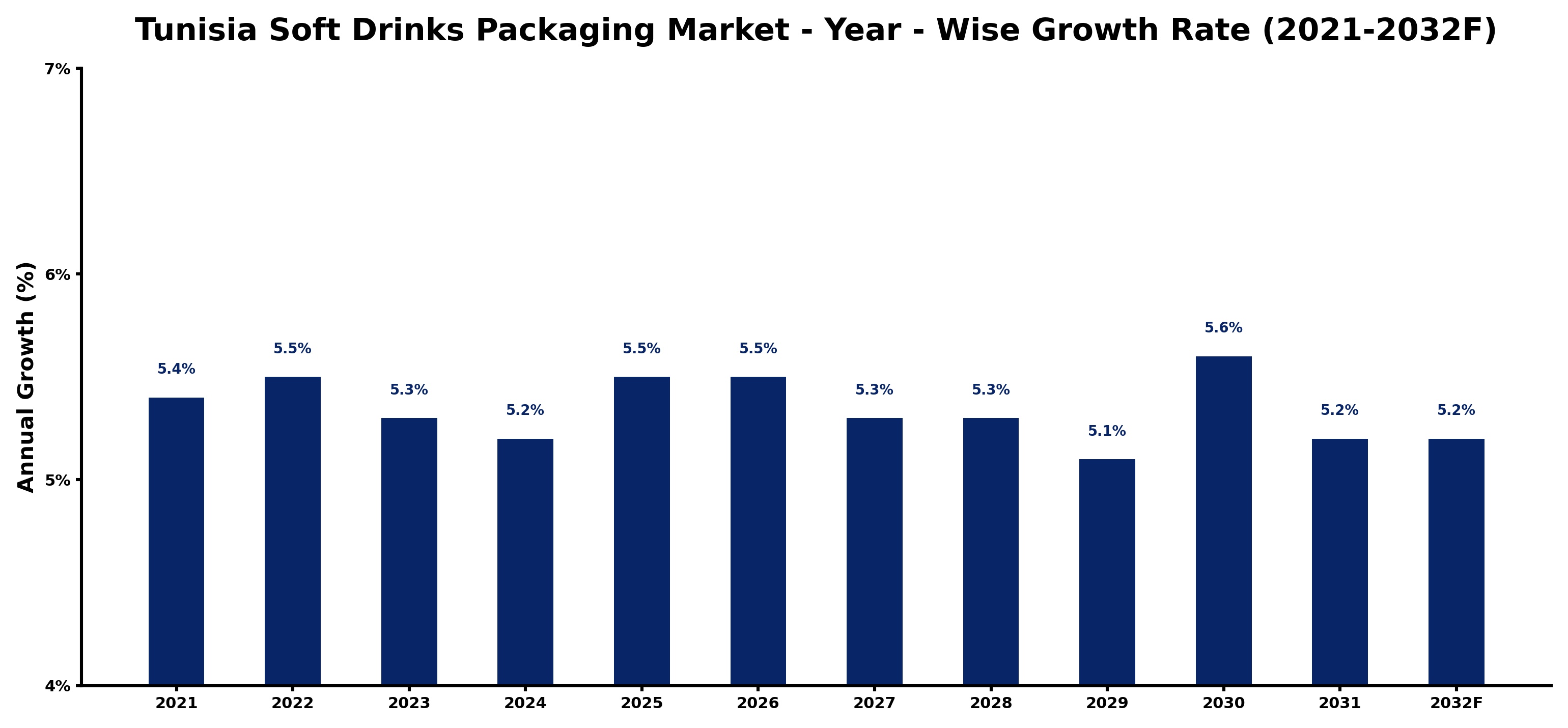
The table below presents the year‑wise growth rates along with the key drivers influencing the market
| Year | Growth Rate | Major Drivers |
| 2021 | 5.4% | Consumer demand for convenience packaging |
| 2022 | 5.5% | Sustainability trends influenced packaging choices |
| 2023 | 5.3% | Innovative designs attracted new customers |
| 2024 | 5.2% | Health-conscious products gained popularity |
| 2025 | 5.5% | E-commerce growth expanded market reach |
| 2026 | 5.5% | Local sourcing increased brand loyalty |
| 2027 | 5.3% | Seasonal flavors drove product launches |
| 2028 | 5.3% | Collaborations with local brands flourished |
| 2029 | 5.1% | Functional beverages gained consumer interest |
| 2030 | 5.6% | Cultural events boosted beverage sales |
| 2031 | 5.2% | Packaging technology advancements improved efficiency |
| 2032 | 5.2% | Increased focus on brand storytelling |
Note - Market size estimations and growth projections presented in this report are based on 6Wresearch’s advanced forecasting approach, validated with industry datasets as of June 2026.
Tunisia Soft Drinks Packaging Market Synopsis
A significant demand surge for PET bottles and cans is evident in the Tunisia soft drinks packaging market, driven by an increasingly busy lifestyle among consumers seeking convenience. Additionally, the rising popularity of sustainable packaging solutions, including recyclable and biodegradable materials, reflects a broader shift towards environmental consciousness within the industry.
As manufacturers respond to these shifts, there is a noticeable emphasis on enhancing product visibility and brand appeal through unique and innovative packaging designs. This evolution in packaging formats not only meets consumer demands but also aligns with the growing regulatory push for sustainability in the marketplace.
Tunisia Soft Drinks Packaging Market Key Takeaways
- The market is projected to grow from USD 365 Million in 2025 to USD 498 Million by 2032.
- Sustainable packaging solutions are increasingly sought after by environmentally conscious consumers.
- Urbanization and rising disposable incomes are significant drivers of soft drink consumption.
- Innovative packaging designs are essential for manufacturers to differentiate their products.
- Government regulations encourage sustainable practices in packaging, impacting market strategies.
Evaluation of Restraints in Tunisia Soft Drinks Packaging Market
Despite the promising growth outlook, the Tunisia soft drinks packaging market faces several constraints. Environmental concerns surrounding single-use plastics are fostering a demand for more sustainable options, which can present challenges for manufacturers accustomed to traditional materials. Fluctuating raw material prices further complicate production planning and profitability. Moreover, adherence to stringent regulatory requirements can strain resources, compelling companies to balance compliance with innovative packaging solutions.
Tunisia Soft Drinks Packaging Market Trends
A significant trend shaping the Tunisia soft drinks packaging market is the increasing preference for eco-friendly materials. Consumers are becoming more discerning about the environmental impact of their purchasing decisions, prompting brands to invest in recyclable and biodegradable packaging. Concurrently, the convenience factor remains a top priority, leading to a rise in demand for lightweight and portable packaging formats like PET bottles and cans.
Additionally, advancements in packaging technology, such as smart packaging solutions and enhanced labeling, are poised to improve consumer engagement and product interaction. Brands that effectively leverage these innovations can foster greater brand loyalty and differentiation in a crowded market.
Tunisia Soft Drinks Packaging Market Opportunities
The Tunisia soft drinks packaging market presents numerous investment opportunities, particularly in the realm of sustainable packaging. With a growing consumer base that favors eco-friendly products, there is substantial potential for developing recyclable PET bottles and biodegradable materials. Furthermore, as demand for healthier beverage options increases, packaging that highlights organic and natural qualities can attract discerning consumers.
Collaborating with beverage manufacturers to create tailored packaging solutions that align with modern lifestyle trends offers another promising avenue for growth. The overall investment landscape is ripe for innovation that prioritizes sustainability, convenience, and consumer appeal.
Government Initiatives in the Tunisia Soft Drinks Packaging Market
The Tunisian government is actively promoting environmental sustainability within the soft drinks packaging market. Key initiatives include a ban on single-use plastic bottles to reduce waste and foster the adoption of eco-friendly alternatives. Furthermore, the government has implemented strict labeling requirements to enhance transparency and ensure consumer safety. Recycling initiatives are also being encouraged to mitigate the ecological impact of packaging waste, signaling a robust commitment to sustainable practices in the industry.
Future Insights of the Tunisia Soft Drinks Packaging Market
Looking ahead to 2026-2032, the Tunisia soft drinks packaging market is positioned for robust growth. A continued shift towards healthier beverage options is expected to influence packaging design and material choices, driving demand for innovative solutions. The trend toward sustainability will likely accelerate, pushing brands to prioritize eco-friendly packaging formats. Additionally, technological advancements in packaging may redefine consumer engagement and brand loyalty, shaping the competitive landscape in the years to come.
Tunisia Soft Drinks Packaging Market Latest Developments (May 2025 - June 2026)
Recent developments in the Tunisia soft drinks packaging market indicate a heightened focus on sustainability and innovation. Manufacturers are increasingly exploring new materials that offer both convenience and environmental benefits. Additionally, brands are introducing packaging that leverages smart technology to enhance consumer interaction, aligning with global trends. This strategic pivot towards sustainability is reshaping competitive dynamics and marketing strategies in the sector.
Tunisia Soft Drinks Packaging Market - Key Attractiveness of the Report
- 10 Years of Market Numbers
- Historical Data Starting from 2022 to 2025
- Base Year: 2025
- Forecast Data until 2032
- Key Performance Indicators Impacting the Market
- Major Upcoming Developments and Projects
Key Highlights of the Report:
- Tunisia Soft Drinks Packaging Market Outlook
- Market Size of Tunisia Soft Drinks Packaging Market, 2025
- Forecast of Tunisia Soft Drinks Packaging Market, 2032
- Historical Data and Forecast of Tunisia Soft Drinks Packaging Revenues & Volume for the Period 2022-2032F
- Tunisia Soft Drinks Packaging Market Trend Evolution
- Tunisia Soft Drinks Packaging Market Drivers and Challenges
- Tunisia Soft Drinks Packaging Price Trends
- Tunisia Soft Drinks Packaging Porter's Five Forces
- Tunisia Soft Drinks Packaging Industry Life Cycle
- Historical Data and Forecast of Tunisia Soft Drinks Packaging Market Revenues & Volume By Material for the Period 2022-2032F
- Historical Data and Forecast of Tunisia Soft Drinks Packaging Market Revenues & Volume By Paper for the Period 2022-2032F
- Historical Data and Forecast of Tunisia Soft Drinks Packaging Market Revenues & Volume By Plastic for the Period 2022-2032F
- Historical Data and Forecast of Tunisia Soft Drinks Packaging Market Revenues & Volume By Metal for the Period 2022-2032F
- Historical Data and Forecast of Tunisia Soft Drinks Packaging Market Revenues & Volume By Glass for the Period 2022-2032F
- Historical Data and Forecast of Tunisia Soft Drinks Packaging Market Revenues & Volume By for the Period 2022-2032F
- Historical Data and Forecast of Tunisia Soft Drinks Packaging Market Revenues & Volume By for the Period 2022-2032F
- Historical Data and Forecast of Tunisia Soft Drinks Packaging Market Revenues & Volume By Product Type for the Period 2022-2032F
- Historical Data and Forecast of Tunisia Soft Drinks Packaging Market Revenues & Volume By Cans for the Period 2022-2032F
- Historical Data and Forecast of Tunisia Soft Drinks Packaging Market Revenues & Volume By Boxes for the Period 2022-2032F
- Historical Data and Forecast of Tunisia Soft Drinks Packaging Market Revenues & Volume By Bottles for the Period 2022-2032F
- Historical Data and Forecast of Tunisia Soft Drinks Packaging Market Revenues & Volume By Cartons for the Period 2022-2032F
- Historical Data and Forecast of Tunisia Soft Drinks Packaging Market Revenues & Volume By for the Period 2022-2032F
- Historical Data and Forecast of Tunisia Soft Drinks Packaging Market Revenues & Volume By for the Period 2022-2032F
- Historical Data and Forecast of Tunisia Soft Drinks Packaging Market Revenues & Volume By Capacity for the Period 2022-2032F
- Historical Data and Forecast of Tunisia Soft Drinks Packaging Market Revenues & Volume By Up to 100 ml for the Period 2022-2032F
- Historical Data and Forecast of Tunisia Soft Drinks Packaging Market Revenues & Volume By 100 to 250 ml for the Period 2022-2032F
- Historical Data and Forecast of Tunisia Soft Drinks Packaging Market Revenues & Volume By 250 to 500 ml for the Period 2022-2032F
- Historical Data and Forecast of Tunisia Soft Drinks Packaging Market Revenues & Volume By 500 to 1000 ml for the Period 2022-2032F
- Historical Data and Forecast of Tunisia Soft Drinks Packaging Market Revenues & Volume By 1000 to 2000 ml for the Period 2022-2032F
- Historical Data and Forecast of Tunisia Soft Drinks Packaging Market Revenues & Volume By Above 2000 ml for the Period 2022-2032F
- Historical Data and Forecast of Tunisia Soft Drinks Packaging Market Revenues & Volume By Application for the Period 2022-2032F
- Historical Data and Forecast of Tunisia Soft Drinks Packaging Market Revenues & Volume By Carbonated soft drinks for the Period 2022-2032F
- Historical Data and Forecast of Tunisia Soft Drinks Packaging Market Revenues & Volume By Functional Drinks for the Period 2022-2032F
- Historical Data and Forecast of Tunisia Soft Drinks Packaging Market Revenues & Volume By Sport Drinks for the Period 2022-2032F
- Historical Data and Forecast of Tunisia Soft Drinks Packaging Market Revenues & Volume By Energy Drinks for the Period 2022-2032F
- Historical Data and Forecast of Tunisia Soft Drinks Packaging Market Revenues & Volume By Others for the Period 2022-2032F
- Historical Data and Forecast of Tunisia Soft Drinks Packaging Market Revenues & Volume By Juices for the Period 2022-2032F
- Tunisia Soft Drinks Packaging Import Export Trade Statistics
- Market Opportunity Assessment By Material
- Market Opportunity Assessment By Product Type
- Market Opportunity Assessment By Capacity
- Market Opportunity Assessment By Application
- Tunisia Soft Drinks Packaging Top Companies Market Share
- Tunisia Soft Drinks Packaging Competitive Benchmarking By Technical and Operational Parameters
- Tunisia Soft Drinks Packaging Company Profiles
- Tunisia Soft Drinks Packaging Key Strategic Recommendations






































