Turkey 3D Animation Market Size & Growth Rate (2026-2032)
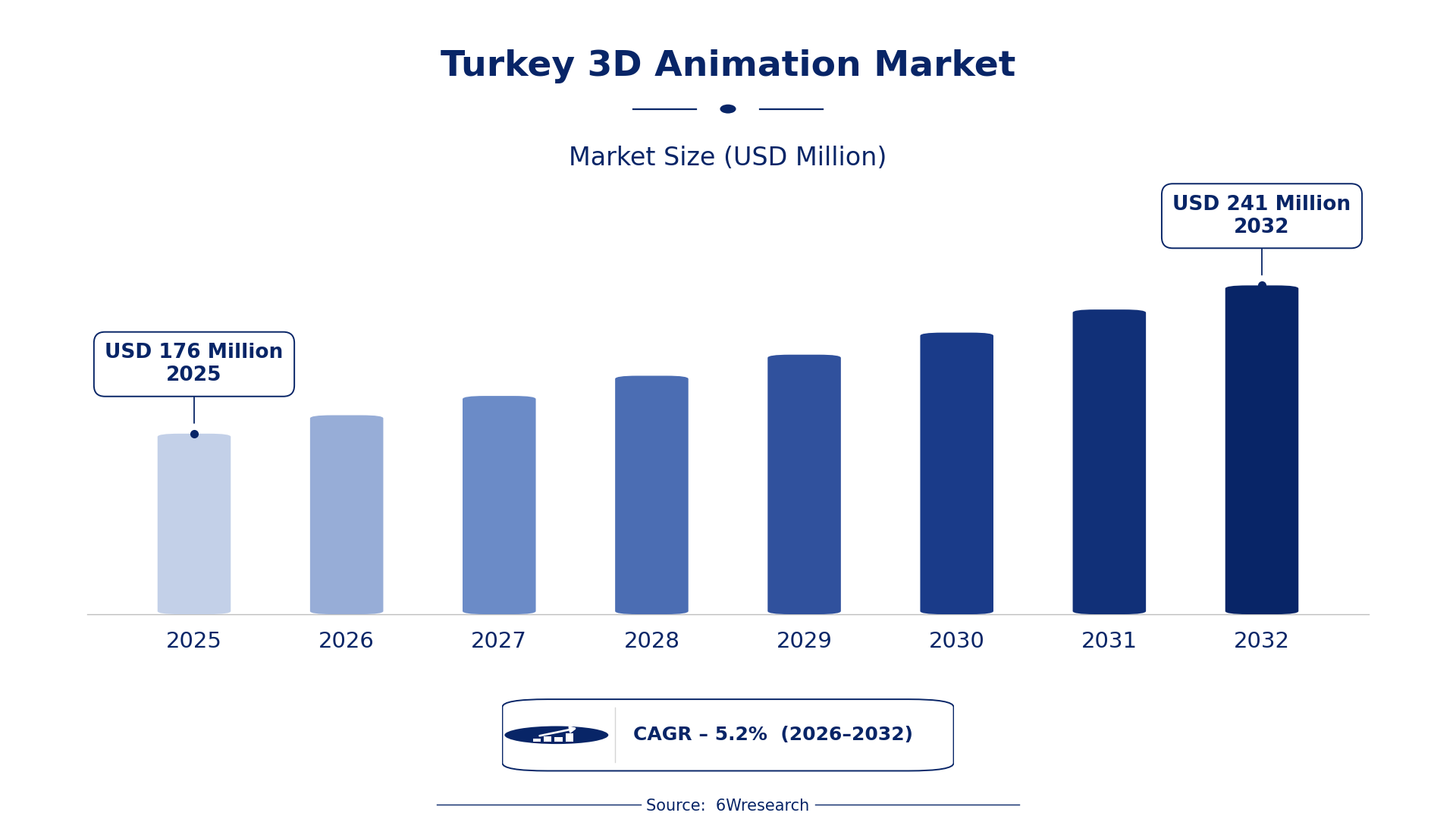
The Turkey 3D Animation Market was estimated at USD 176 Million in 2025 and is projected to reach USD 241 Million by 2032, growing at a CAGR of 5.2% from 2026 to 2032.
Turkey 3D Animation Market Synopsis
The Turkey 3D animation market is currently witnessing a notable surge, fueled by the growing demand for high-quality visual content across multiple sectors. As traditional media shifts towards digital platforms, animation is becoming central to storytelling in entertainment, advertising, and education.
Looking ahead, the market is expected to evolve further with advancements in technology such as virtual reality (VR) and augmented reality (AR). The increasing integration of 3D animation in various industries, including architecture and healthcare, indicates that this growth trajectory will continue to accelerate in the coming years.
Turkey 3D Animation Market Year-wise Growth Rate and Key Drivers
This graph illustrates the annual growth rates of the Turkey 3D Animation Market from 2021 to 2032, highlighting a steady upward trajectory and projected expansion over the forecast period.
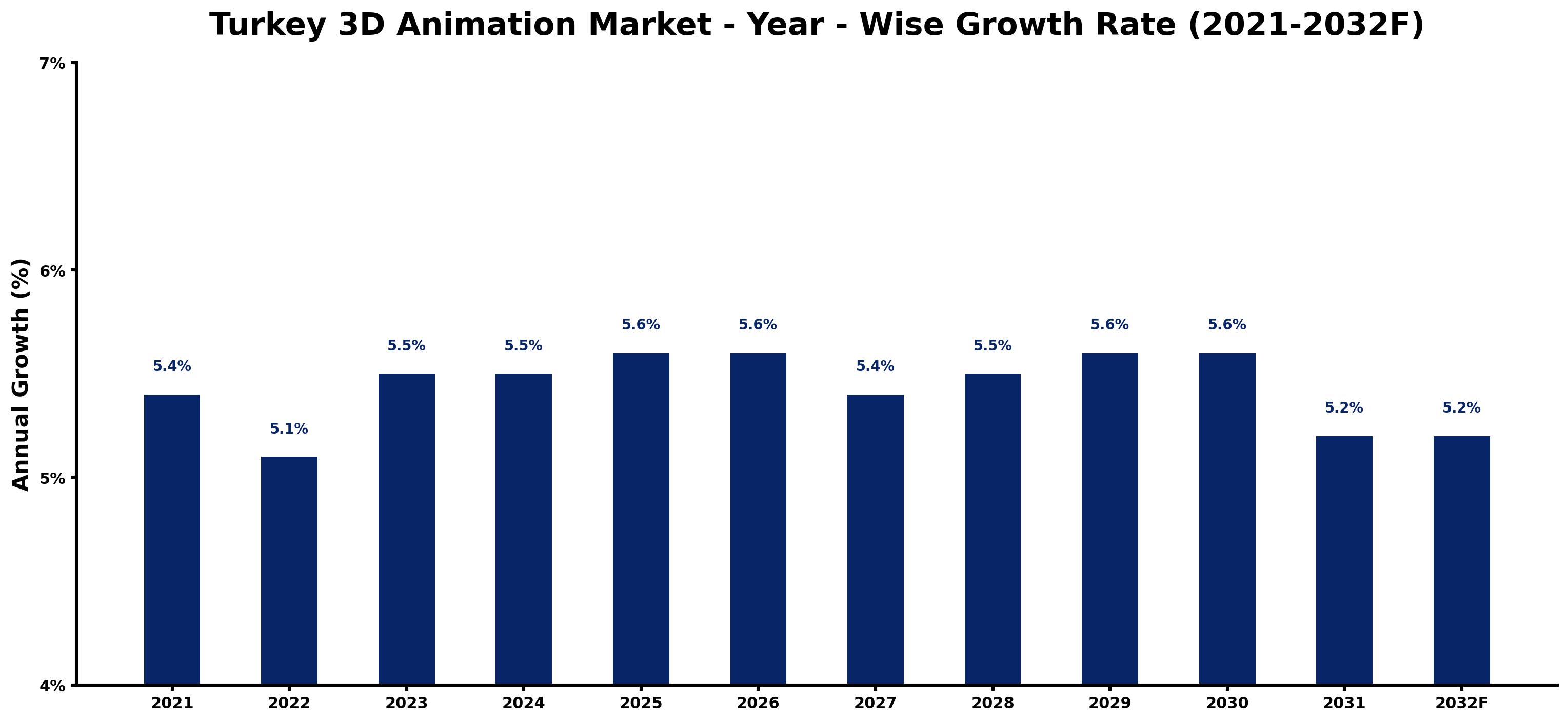
The table below presents the year‑wise growth rates along with the key drivers influencing the market
| Year | Growth Rate | Major Drivers |
| 2021 | 5.4% | Government incentives boost digital content production initiatives. |
| 2022 | 5.1% | Surge in local demand for cultural preservation animations. |
| 2023 | 5.5% | Rise in educational institutions offering animation courses. |
| 2024 | 5.5% | Increased collaborations with global streaming services. |
| 2025 | 5.6% | Turkey's strategic position fosters cross-border animation projects. |
| 2026 | 5.6% | Growing popularity of Turkish animated series in Prime Video. |
| 2027 | 5.4% | Local animation studios receiving funding from Turkish Technology Fund. |
| 2028 | 5.5% | Implementation of training programs by Anadolu University. |
| 2029 | 5.6% | Support for youth entrepreneurship in the creative industries. |
| 2030 | 5.6% | Emergence of augmented reality in Turkish advertising campaigns. |
| 2031 | 5.2% | Boost in government grants for innovative animation startups. |
| 2032 | 5.2% | Increased foreign interest in Turkish animation talent showcases. |
Note: Market size estimations and growth projections presented in this report are based on 6Wresearch's proprietary forecasting methodology, utilizing the latest available industry data, government publications, and primary research inputs.
Turkey 3D Animation Market Key Takeaways
Below are some of the specific key takeaways from the market, including:
- The market is set for sustained growth, driven by rising demand in entertainment, gaming, and education.
- Technological innovations, particularly in VR and AR, are reshaping animation production processes.
- Collaboration between local studios and international partners is becoming increasingly common.
- The Turkish government is actively promoting the animation sector through grants and training initiatives.
- A young, tech-savvy population is driving consumer demand for high-quality 3D content.
Evaluation of Restraints in Turkey 3D Animation Market
Despite its growth potential, the Turkey 3D animation market faces substantial challenges. A critical shortage of skilled professionals hampers creativity and quality in animation projects. on top of that, limited access to the latest technology and software constrains studios from fully realizing their potential. The competitive pressure from international studios further complicates the landscape, necessitating strategic investments in talent development and technology upgrades to maintain a competitive edge.
Turkey 3D Animation Market Trends
Several key trends are shaping the Turkey 3D animation market. The increasing incorporation of immersive technologies like VR and AR is creating new avenues for interactive storytelling. Turkish animation studios are focusing on original content to differentiate themselves, while collaborations with international players expand their market reach. on top of that, advancements in real-time rendering and motion capture technologies are streamlining production workflows, enhancing the overall quality of animations.
Turkey 3D Animation Market Opportunities
The market presents numerous investment opportunities, particularly for studios that can deliver high-quality animation across diverse industries. The growing emphasis on digital content creation offers a fertile ground for new entrants and established players alike. With Turkey's strategic location bridging Europe and Asia, there are significant opportunities for serving a global clientele. As demand for animation continues to rise, sectors such as healthcare and architecture are also expected to increase their reliance on 3D visualization, further expanding the market.
Government Initiatives in the Turkey 3D Animation Market
Government policies are instrumental in nurturing the Turkey 3D animation market, promoting digital content production and fostering a vibrant creative industry. Initiatives from the Ministry of Culture and Tourism aim to bolster the sector through funding and skill enhancement programs. These efforts are crucial as they address the market's need for skilled professionals while safeguarding intellectual property rights.
- A national funding program launched in early 2025 provides grants to support local animation projects.
- Current initiatives include partnerships with universities to enhance the skill sets of aspiring animators.
- Ongoing workshops focus on the latest animation technologies, ensuring that professionals stay updated.
- A planned public-private initiative aims to establish a digital content incubator by 2028.
- Regulatory frameworks are being strengthened to protect intellectual property rights for creators.
Future Insights of the Turkey 3D Animation Market
Looking towards 2026-2032, the Turkey 3D animation market is expected to undergo substantial transformation. The continued rise of digital platforms and content consumption will drive demand for innovative animation solutions. Enhanced capabilities in VR and AR will also open new horizons for animated storytelling, while the growing focus on education and training will help bridge the talent gap. As these trends unfold, the market is well-positioned for a promising future.
Turkey 3D Animation Market Latest Developments
Recent developments within the Turkey 3D animation market indicate a dynamic shift towards innovation and collaboration. Over the past year, local studios have increasingly embraced cutting-edge technologies to enhance their offerings. A surge in original content production has also been noted, aligning with global trends.
- A collaboration between local studios and an international partner launched in early 2025, focusing on original animated series.
- Investment in new animation software has been made by several Turkish studios, aiming to enhance production quality.
- A technology upgrade initiative, currently underway, is set to modernize equipment across multiple animation studios by mid-2026.
- A major exhibition showcasing Turkish animation talent is planned for late 2025, aimed at attracting international attention.
- Upcoming partnerships with educational institutions are expected to begin in early 2026, focusing on skill development.
Turkey 3D Animation Market - Key Attractiveness of the Report
- 10 Years of Market Numbers
- Historical Data Starting from 2022 to 2025
- Base Year: 2025
- Forecast Data until 2032
- Key Performance Indicators Impacting the Market
- Major Upcoming Developments and Projects
Key Highlights of the Report:
- Turkey 3D Animation Market Outlook
- Market Size of Turkey 3D Animation Market, 2025
- Forecast of Turkey 3D Animation Market, 2032
- Historical Data and Forecast of Turkey 3D Animation Revenues & Volume for the Period 2022-2032F
- Turkey 3D Animation Market Trend Evolution
- Turkey 3D Animation Market Drivers and Challenges
- Turkey 3D Animation Price Trends
- Turkey 3D Animation Porter's Five Forces
- Turkey 3D Animation Industry Life Cycle
- Historical Data and Forecast of Turkey 3D Animation Market Revenues & Volume By Technology for the Period 2022-2032F
- Historical Data and Forecast of Turkey 3D Animation Market Revenues & Volume By 3D Modeling for the Period 2022-2032F
- Historical Data and Forecast of Turkey 3D Animation Market Revenues & Volume By Motion Graphics for the Period 2022-2032F
- Historical Data and Forecast of Turkey 3D Animation Market Revenues & Volume By 3D Rendering for the Period 2022-2032F
- Historical Data and Forecast of Turkey 3D Animation Market Revenues & Volume By Visual Effects for the Period 2022-2032F
- Historical Data and Forecast of Turkey 3D Animation Market Revenues & Volume By Service for the Period 2022-2032F
- Historical Data and Forecast of Turkey 3D Animation Market Revenues & Volume By Consulting for the Period 2022-2032F
- Historical Data and Forecast of Turkey 3D Animation Market Revenues & Volume By Support and Maintenance for the Period 2022-2032F
- Historical Data and Forecast of Turkey 3D Animation Market Revenues & Volume By Integration and Deployment for the Period 2022-2032F
- Historical Data and Forecast of Turkey 3D Animation Market Revenues & Volume By Education and Training for the Period 2022-2032F
- Historical Data and Forecast of Turkey 3D Animation Market Revenues & Volume By Vertical for the Period 2022-2032F
- Historical Data and Forecast of Turkey 3D Animation Market Revenues & Volume By Media and Entertainment for the Period 2022-2032F
- Historical Data and Forecast of Turkey 3D Animation Market Revenues & Volume By Construction and Architecture for the Period 2022-2032F
- Historical Data and Forecast of Turkey 3D Animation Market Revenues & Volume By Healthcare and Lifesciences for the Period 2022-2032F
- Historical Data and Forecast of Turkey 3D Animation Market Revenues & Volume By Manufacturing for the Period 2022-2032F
- Historical Data and Forecast of Turkey 3D Animation Market Revenues & Volume By Education and Academia for the Period 2022-2032F
- Historical Data and Forecast of Turkey 3D Animation Market Revenues & Volume By Others for the Period 2022-2032F
- Historical Data and Forecast of Turkey 3D Animation Market Revenues & Volume By Deployment for the Period 2022-2032F
- Historical Data and Forecast of Turkey 3D Animation Market Revenues & Volume By On-Premises for the Period 2022-2032F
- Historical Data and Forecast of Turkey 3D Animation Market Revenues & Volume By On-Demand for the Period 2022-2032F
- Turkey 3D Animation Import Export Trade Statistics
- Market Opportunity Assessment By Technology
- Market Opportunity Assessment By Service
- Market Opportunity Assessment By Vertical
- Market Opportunity Assessment By Deployment
- Turkey 3D Animation Top Companies Market Share
- Turkey 3D Animation Competitive Benchmarking By Technical and Operational Parameters
- Turkey 3D Animation Company Profiles
- Turkey 3D Animation Key Strategic Recommendations






































