Turkey Cargo Shipping Market Size, Share & Growth Rate
The Turkey Cargo Shipping Market was estimated at USD 325 Million in 2025 and is projected to reach USD 439 Million by 2032, growing at a CAGR of 4.4% from 2026 to 2032. This growth trajectory is primarily fueled by Turkey's unique geographical position as a bridge between Europe, Asia, and the Middle East, which enhances its role as a logistics hub. In addition, the surge in international trade, alongside increasing investments in port infrastructure and logistics capabilities, is accelerating demand for reliable shipping services.
Turkey Cargo Shipping Market Year-wise Growth Rate and Key Drivers
This graph highlights how the Turkey Cargo Shipping Market has steadily grown over the years, supported by major growth factors.
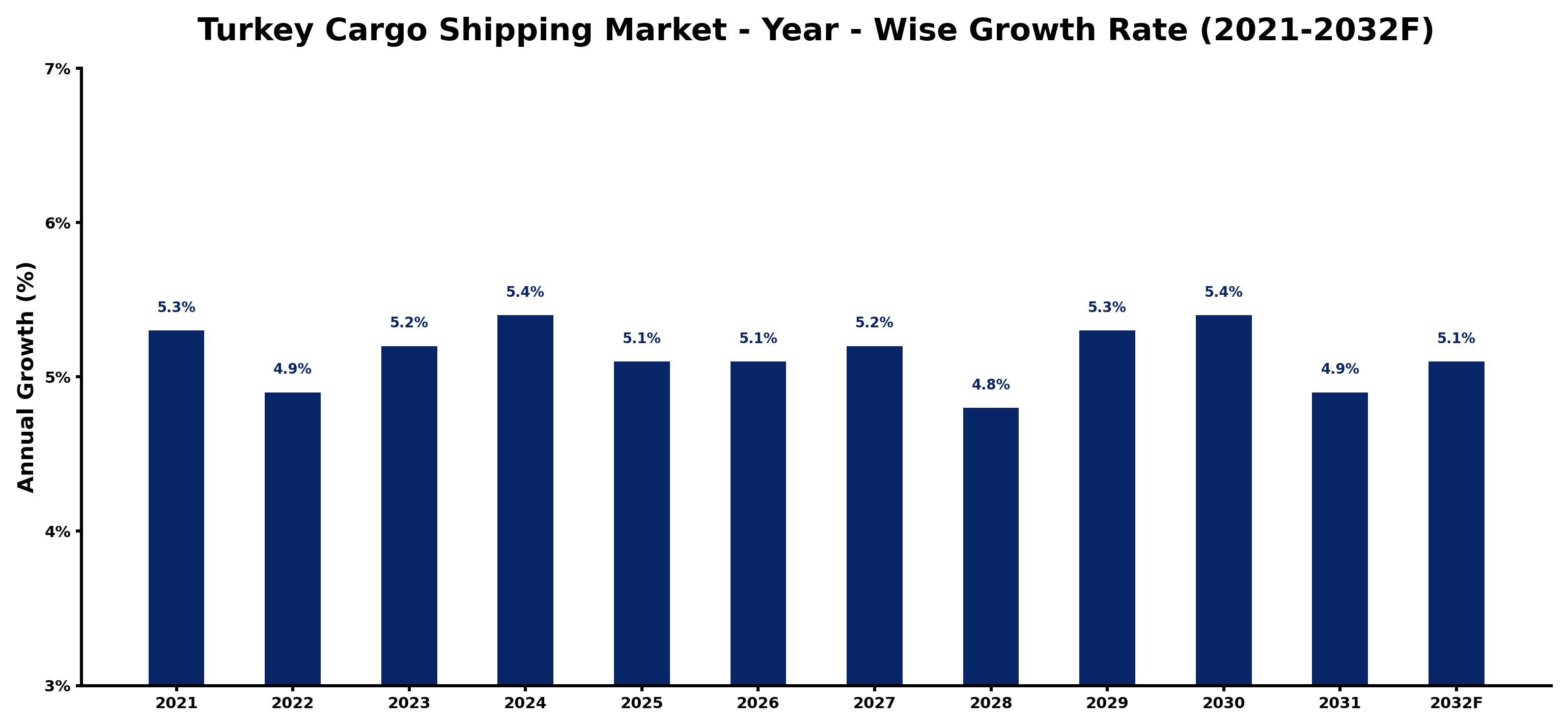
The table below presents the year‑wise growth rates along with the key drivers influencing the market
| Year | Growth Rate | Major Drivers |
| 2021 | 5.3% | Expansion of transportation and logistics networks |
| 2022 | 4.9% | Increasing industrial infrastructure investments |
| 2023 | 5.2% | Increasing industrial automation investments |
| 2024 | 5.4% | Increasing industrial automation investments |
| 2025 | 5.1% | Increasing smart city development projects |
| 2026 | 5.1% | Increasing adoption of advanced technologies |
| 2027 | 5.2% | Increasing smart city development projects |
| 2028 | 4.8% | Increasing industrial infrastructure investments |
| 2029 | 5.3% | Expansion of commercial construction activities |
| 2030 | 5.4% | Expansion of commercial construction activities |
| 2031 | 4.9% | Increasing industrial automation investments |
| 2032 | 5.1% | Increasing industrial automation investments |
Note - Market size estimations and growth projections presented in this report are based on 6Wresearch’s advanced forecasting approach, validated with industry datasets as of June 2026.
Turkey Cargo Shipping Market Synopsis
The most significant force currently shaping the Turkey Cargo Shipping Market is the ongoing expansion of international trade. As global markets evolve, Turkey is poised to enhance its connectivity and efficiency, thereby attracting more shipping activities. Concurrently, the rapid growth of e-commerce is necessitating more sophisticated and timely shipping solutions.
Furthermore, advancements in shipping technologies and intermodal transport solutions are streamlining operations within the industry. As these innovations gain traction, they are set to reshape the logistics landscape, driving competitiveness and operational efficiency in Turkey's cargo shipping sector.
Turkey Cargo Shipping Market Key Takeaways
- The market benefits from Turkey's strategic location as a logistics hub connecting multiple continents.
- Rising international trade volumes significantly contribute to the growth of the cargo shipping market.
- Advancements in shipping technologies are enhancing operational efficiencies across the sector.
- Government investments in port infrastructure are crucial for meeting future logistics demands.
- Growth in e-commerce is driving the need for innovative and timely shipping solutions.
Evaluation of Restraints in Turkey Cargo Shipping Market
While the Turkey Cargo Shipping Market is positioned for growth, it faces certain restraints that could impact its trajectory. Fluctuating fuel prices remain a primary concern, as they directly affect operational costs for shipping companies. Additionally, regulatory changes can create uncertainties, complicating compliance for operators. Moreover, competition from alternative transport modes, such as rail and road, poses challenges for market players aiming to maintain their share in this evolving landscape.
Turkey Cargo Shipping Market Trends
One of the most notable trends in the Turkey Cargo Shipping Market is the increasing adoption of digital shipping platforms. These technologies facilitate real-time tracking, streamline logistics, and enhance customer engagement. Moreover, sustainability initiatives are gaining traction, as companies explore eco-friendly shipping practices to meet regulatory requirements and consumer preferences. The drive for efficiency in shipping operations is also prompting the adoption of advanced intermodal transport solutions.
Turkey Cargo Shipping Market Opportunities
Genuine growth opportunities within the Turkey Cargo Shipping Market lie in the ongoing investments in port infrastructure and logistics hubs. As the government prioritizes these developments, businesses that align their strategies with these initiatives stand to benefit significantly. Additionally, the expansion of e-commerce presents opportunities for tailored shipping services, catering specifically to the demands of online retailers seeking efficient distribution channels.
Government Initiatives in the Turkey Cargo Shipping Market
The Turkish government has been proactive in enhancing the cargo shipping sector, focusing on improving port facilities and logistics infrastructure. Public spending initiatives aim to modernize existing ports while constructing new ones, facilitating smoother trade flows. Moreover, incentives for adopting digital technologies and sustainability practices in shipping are increasingly being introduced, aiming to elevate Turkey's standing as a major logistics hub.
Future Insights of the Turkey Cargo Shipping Market
Looking ahead to 2026-2032, the Turkey Cargo Shipping Market is set to experience robust growth, underpinned by the country's strategic geographical advantages and increasing trade activities. Innovations in logistics and shipping technologies will likely continue to play a pivotal role, enhancing operational efficiencies. Additionally, expanding e-commerce will drive demand for agile shipping solutions, positioning Turkey as a competitive player in the global logistics landscape.
Turkey Cargo Shipping Market Latest Developments (May 2025 - June 2026)
In recent months, the Turkey Cargo Shipping Market has seen a heightened focus on the integration of digital platforms to enhance operational efficiencies and customer service. As companies invest in new technologies, there is also a noteworthy emphasis on sustainable shipping practices. Moreover, infrastructure projects are progressing, with several key ports undergoing upgrades to support increasing shipping volumes and improve service delivery.
Turkey Cargo Shipping Market - Key Attractiveness of the Report
- 10 Years of Market Numbers
- Historical Data Starting from 2022 to 2025
- Base Year: 2025
- Forecast Data until 2032
- Key Performance Indicators Impacting the Market
- Major Upcoming Developments and Projects
Key Highlights of the Report:
- Turkey Cargo Shipping Market Outlook
- Market Size of Turkey Cargo Shipping Market, 2025
- Forecast of Turkey Cargo Shipping Market, 2032
- Historical Data and Forecast of Turkey Cargo Shipping Revenues & Volume for the Period 2022-2032F
- Turkey Cargo Shipping Market Trend Evolution
- Turkey Cargo Shipping Market Drivers and Challenges
- Turkey Cargo Shipping Price Trends
- Turkey Cargo Shipping Porter's Five Forces
- Turkey Cargo Shipping Industry Life Cycle
- Historical Data and Forecast of Turkey Cargo Shipping Market Revenues & Volume By Cargo Infrastructure for the Period 2022-2032F
- Historical Data and Forecast of Turkey Cargo Shipping Market Revenues & Volume By Port Developments in Asia for the Period 2022-2032F
- Historical Data and Forecast of Turkey Cargo Shipping Market Revenues & Volume By Port Developments in Europe for the Period 2022-2032F
- Historical Data and Forecast of Turkey Cargo Shipping Market Revenues & Volume By Port Developments in North America for the Period 2022-2032F
- Historical Data and Forecast of Turkey Cargo Shipping Market Revenues & Volume By Port Developments in South America for the Period 2022-2032F
- Historical Data and Forecast of Turkey Cargo Shipping Market Revenues & Volume By Port Developments in Africa for the Period 2022-2032F
- Historical Data and Forecast of Turkey Cargo Shipping Market Revenues & Volume By Cargo Type for the Period 2022-2032F
- Historical Data and Forecast of Turkey Cargo Shipping Market Revenues & Volume By Container Cargo for the Period 2022-2032F
- Historical Data and Forecast of Turkey Cargo Shipping Market Revenues & Volume By Bulk Cargo for the Period 2022-2032F
- Historical Data and Forecast of Turkey Cargo Shipping Market Revenues & Volume By General Cargo for the Period 2022-2032F
- Historical Data and Forecast of Turkey Cargo Shipping Market Revenues & Volume By Oil & Gas for the Period 2022-2032F
- Historical Data and Forecast of Turkey Cargo Shipping Market Revenues & Volume By Industry Type for the Period 2022-2032F
- Historical Data and Forecast of Turkey Cargo Shipping Market Revenues & Volume By Food, Manufacturing for the Period 2022-2032F
- Historical Data and Forecast of Turkey Cargo Shipping Market Revenues & Volume By Oil & Ores for the Period 2022-2032F
- Historical Data and Forecast of Turkey Cargo Shipping Market Revenues & Volume By Electrical & Electronics for the Period 2022-2032F
- Turkey Cargo Shipping Import Export Trade Statistics
- Market Opportunity Assessment By Cargo Infrastructure
- Market Opportunity Assessment By Cargo Type
- Market Opportunity Assessment By Industry Type
- Turkey Cargo Shipping Top Companies Market Share
- Turkey Cargo Shipping Competitive Benchmarking By Technical and Operational Parameters
- Turkey Cargo Shipping Company Profiles
- Turkey Cargo Shipping Key Strategic Recommendations






































