Turkey Data Center Physical Security Market Size & Growth Rate (2026-2032)
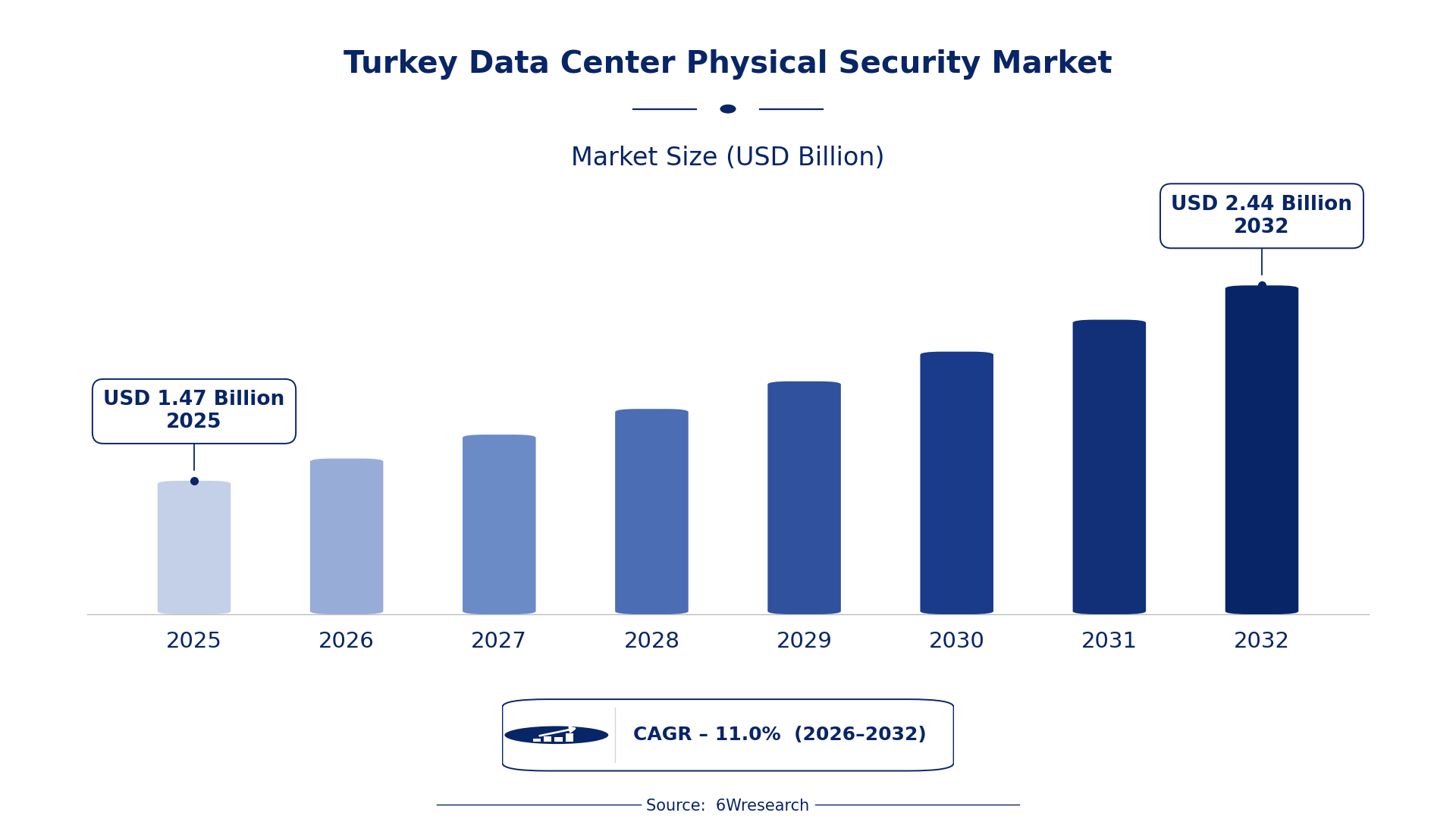
The Turkey Data Center Physical Security Market was estimated at USD 1473 Million in 2025 and is projected to reach USD 2443 Million by 2032, growing at a CAGR of 11.0% from 2026 to 2032.
Turkey Data Center Physical Security Market Synopsis
Recent developments in Turkey's data center physical security market indicate a strong upward trajectory, reflecting a heightened awareness of the need for comprehensive protection of critical infrastructure. As security threats evolve, the demand for sophisticated surveillance and access control technologies is surging.
Looking ahead, the market is expected to embrace innovations in biometric systems and intelligent surveillance, enhancing operational resilience. The increasing prevalence of colocation services and stricter regulatory frameworks are driving further investments, reinforcing the essential nature of physical security within Turkey's data center operations.
Turkey Data Center Physical Security Market Year-wise Growth Rate and Key Drivers
This graph illustrates the annual growth rates of the Turkey Data Center Physical Security Market from 2021 to 2032, highlighting a steady upward trajectory and projected expansion over the forecast period.
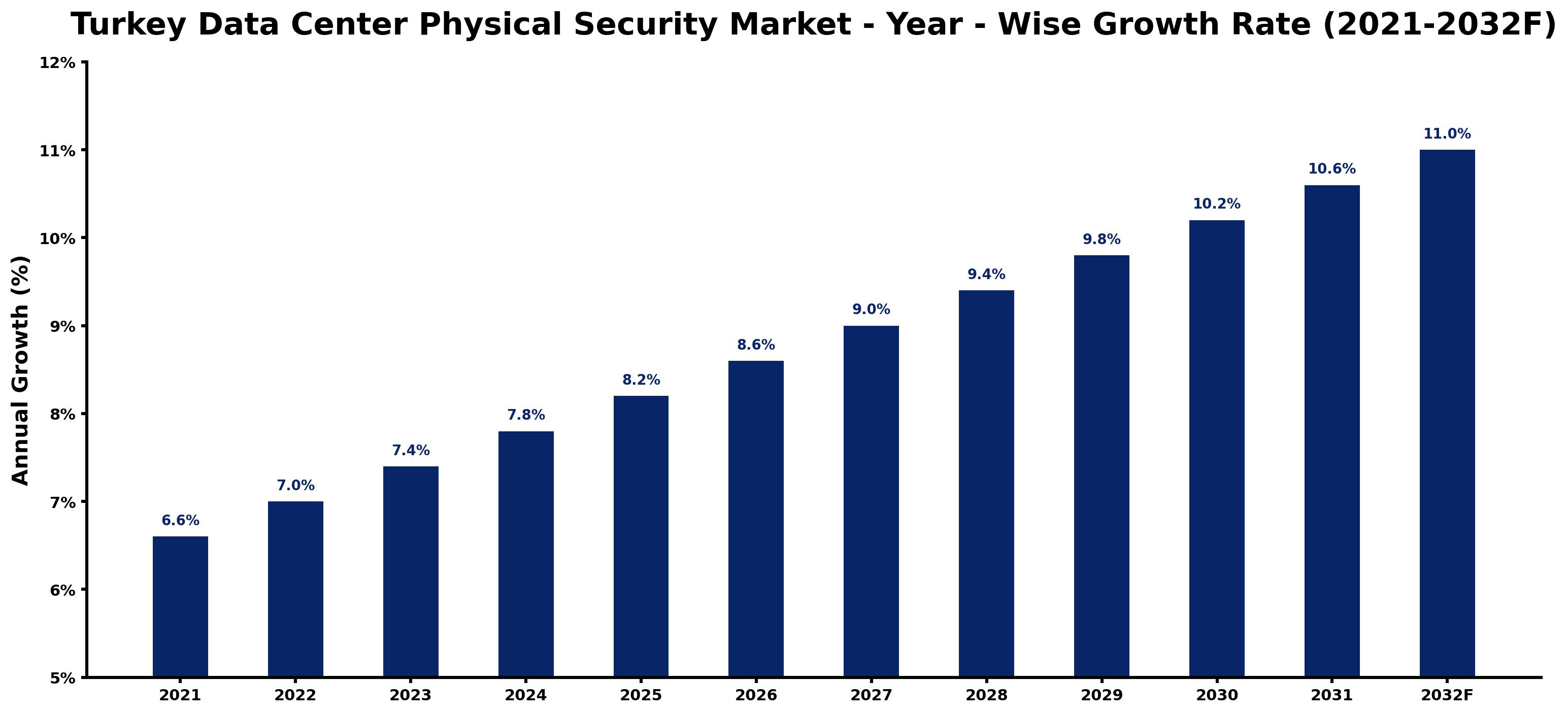
The table below presents the year‑wise growth rates along with the key drivers influencing the market
| Year | Growth Rate | Major Drivers |
| 2021 | 6.6% | Increased cybersecurity threats prompting enhanced physical security measures. |
| 2022 | 7.0% | Government incentives for tech industry growth boosting data centers. |
| 2023 | 7.4% | Turkey’s urbanization driving data center physical security needs. |
| 2024 | 7.8% | Regulatory compliance for energy efficiency in data centers. |
| 2025 | 8.2% | Rising foreign investments enhancing physical security standards. |
| 2026 | 8.6% | Growing adoption of cloud services increasing local data center security. |
| 2027 | 9.0% | Stricter regulations on data protection ensuring security upgrades. |
| 2028 | 9.4% | Increased demand for colocation services boosting security investments. |
| 2029 | 9.8% | Emerging cybersecurity startups enhancing physical security innovations. |
| 2030 | 10.2% | Government’s digital transformation agenda intensifying data security focus. |
| 2031 | 10.6% | Proliferation of IoT devices elevating security protocol requirements. |
| 2032 | 11.0% | Strong growth in remote work fueling data security enhancements. |
Note: Market size estimations and growth projections presented in this report are based on 6Wresearch's proprietary forecasting methodology, utilizing the latest available industry data, government publications, and primary research inputs.
Turkey Data Center Physical Security Market Key Takeaways
Below are some of the specific key takeaways from the market, including:
- Significant growth opportunities driven by the escalating demand for advanced security measures.
- Increasing investments in surveillance cameras, biometric access controls, and perimeter security solutions.
- Regulatory frameworks are enhancing compliance and operational resilience in data center operations.
- The trend toward colocation services heightens the need for stringent physical security standards.
- Innovations in video analytics and security management are transforming traditional security approaches.
Evaluation of Restraints in Turkey Data Center Physical Security Market
The Turkey data center physical security market faces several constraints that could hinder its growth. Access control measures, while crucial, often suffer from implementation complexities and technological integration challenges. Surveillance monitoring can be limited by resource constraints and inadequate staff training, which impacts threat detection capabilities. Compliance with evolving security regulations adds to operational pressures, making it challenging for data center operators to maintain robust security postures. on top of that, the adoption of advanced physical security measures may be slowed down by budget constraints and the need for continuous updates to protect against emerging threats.
Turkey Data Center Physical Security Market Trends
Current trends in Turkey's data center physical security market point towards the integration of artificial intelligence and machine learning technologies in surveillance systems. This shift is facilitating more proactive threat detection and response capabilities. Biometric authentication is gaining traction, with more operators prioritizing identity management solutions that enhance security while ensuring smooth user access. Additionally, the ongoing shift to colocation services is pushing for stricter adherence to physical security standards, as operators seek to reassure clients about the integrity of their data protection measures.
Turkey Data Center Physical Security Market Opportunities
The Turkish market offers significant opportunities for growth, particularly in advanced security technology adoption. As organizations increase their reliance on data-driven operations, the demand for comprehensive physical security solutions will rise. Investments in disaster recovery and business continuity plans present opportunities for companies offering integrated security solutions. on top of that, the ongoing digital transformation across industries creates a fertile ground for security technology vendors to introduce innovative products tailored to the specific needs of data centers.
Government Initiatives in the Turkey Data Center Physical Security Market
Government policies are playing a crucial role in shaping the Turkey data center physical security market, focusing on enhancing facility safety and infrastructure resilience. The emphasis on regulatory compliance in physical security standards is prompting data center operators to adopt more sophisticated solutions. These initiatives are critical as they align with national priorities to safeguard digital assets and promote sector growth.
- A regulatory framework introduced in 2025 mandating enhanced monitoring and response protocols for data center facilities.
- A national digital infrastructure upgrade program initiated in early 2026 aims to improve physical security compliance across critical sectors.
- Currently ongoing government support initiatives focused on funding for surveillance system upgrades in public data centers.
- A planned public-private partnership expected to enhance perimeter security for critical infrastructure by 2027.
- Recent legislative measures promoting the use of biometric access controls to boost overall security in data centers.
Future Insights of the Turkey Data Center Physical Security Market
Looking ahead to 2026-2032, the Turkey data center physical security market is set for sustained growth as demand for security solutions escalates. The integration of smart technologies and greater reliance on remote management tools will redefine security protocols. Data center operators will increasingly prioritize not just compliance, but proactive measures that anticipate potential threats. As the digital economy expands, ensuring the safety of sensitive information will remain a central concern, and those who invest in advanced security technologies now will likely be the leaders of tomorrow.
Turkey Data Center Physical Security Market Latest Developments
In the last year, Turkey's data center physical security market has seen notable advancements, primarily focused on enhancing security frameworks amid growing threats. The push for regulatory compliance has prompted data center operators to invest more in innovative physical security measures that can adapt to evolving security challenges.
- A major initiative launched in late 2025 introduced a new standard for surveillance systems, improving reliability and operational compliance.
- An upgrade project for biometric security systems at multiple facilities is currently underway, with a completion expected by mid-2026.
- By early 2026, several data centers initiated partnerships with technology vendors to integrate AI-driven surveillance solutions into their security protocols.
- A planned rollout of an enhanced perimeter security initiative is expected to begin in late 2026, focusing on key data center sites across Turkey.
- Recent developments include the adoption of cloud-based security management platforms by major operators, aimed at streamlining monitoring and response processes.
Turkey Data Center Physical Security Market - Key Attractiveness of the Report
- 10 Years of Market Numbers
- Historical Data Starting from 2022 to 2025
- Base Year: 2025
- Forecast Data until 2032
- Key Performance Indicators Impacting the Market
- Major Upcoming Developments and Projects
Key Highlights of the Report:
- Turkey Data Center Physical Security Market Outlook
- Market Size of Turkey Data Center Physical Security Market, 2025
- Forecast of Turkey Data Center Physical Security Market, 2032
- Historical Data and Forecast of Turkey Data Center Physical Security Revenues & Volume for the Period 2022-2032F
- Turkey Data Center Physical Security Market Trend Evolution
- Turkey Data Center Physical Security Market Drivers and Challenges
- Turkey Data Center Physical Security Price Trends
- Turkey Data Center Physical Security Porter's Five Forces
- Turkey Data Center Physical Security Industry Life Cycle
- Historical Data and Forecast of Turkey Data Center Physical Security Market Revenues & Volume By Solution Types for the Period 2022-2032F
- Historical Data and Forecast of Turkey Data Center Physical Security Market Revenues & Volume By Video Surveillance for the Period 2022-2032F
- Historical Data and Forecast of Turkey Data Center Physical Security Market Revenues & Volume By Monitoring for the Period 2022-2032F
- Historical Data and Forecast of Turkey Data Center Physical Security Market Revenues & Volume By Access Control for the Period 2022-2032F
- Historical Data and Forecast of Turkey Data Center Physical Security Market Revenues & Volume By Service Types for the Period 2022-2032F
- Historical Data and Forecast of Turkey Data Center Physical Security Market Revenues & Volume By Consulting for the Period 2022-2032F
- Historical Data and Forecast of Turkey Data Center Physical Security Market Revenues & Volume By System Integration for the Period 2022-2032F
- Historical Data and Forecast of Turkey Data Center Physical Security Market Revenues & Volume By Professional Services for the Period 2022-2032F
- Turkey Data Center Physical Security Import Export Trade Statistics
- Market Opportunity Assessment By Solution Types
- Market Opportunity Assessment By Service Types
- Turkey Data Center Physical Security Top Companies Market Share
- Turkey Data Center Physical Security Competitive Benchmarking By Technical and Operational Parameters
- Turkey Data Center Physical Security Company Profiles
- Turkey Data Center Physical Security Key Strategic Recommendations






































