Turkey Digital Insurance Platform Market Size & Growth Rate (2026-2032)
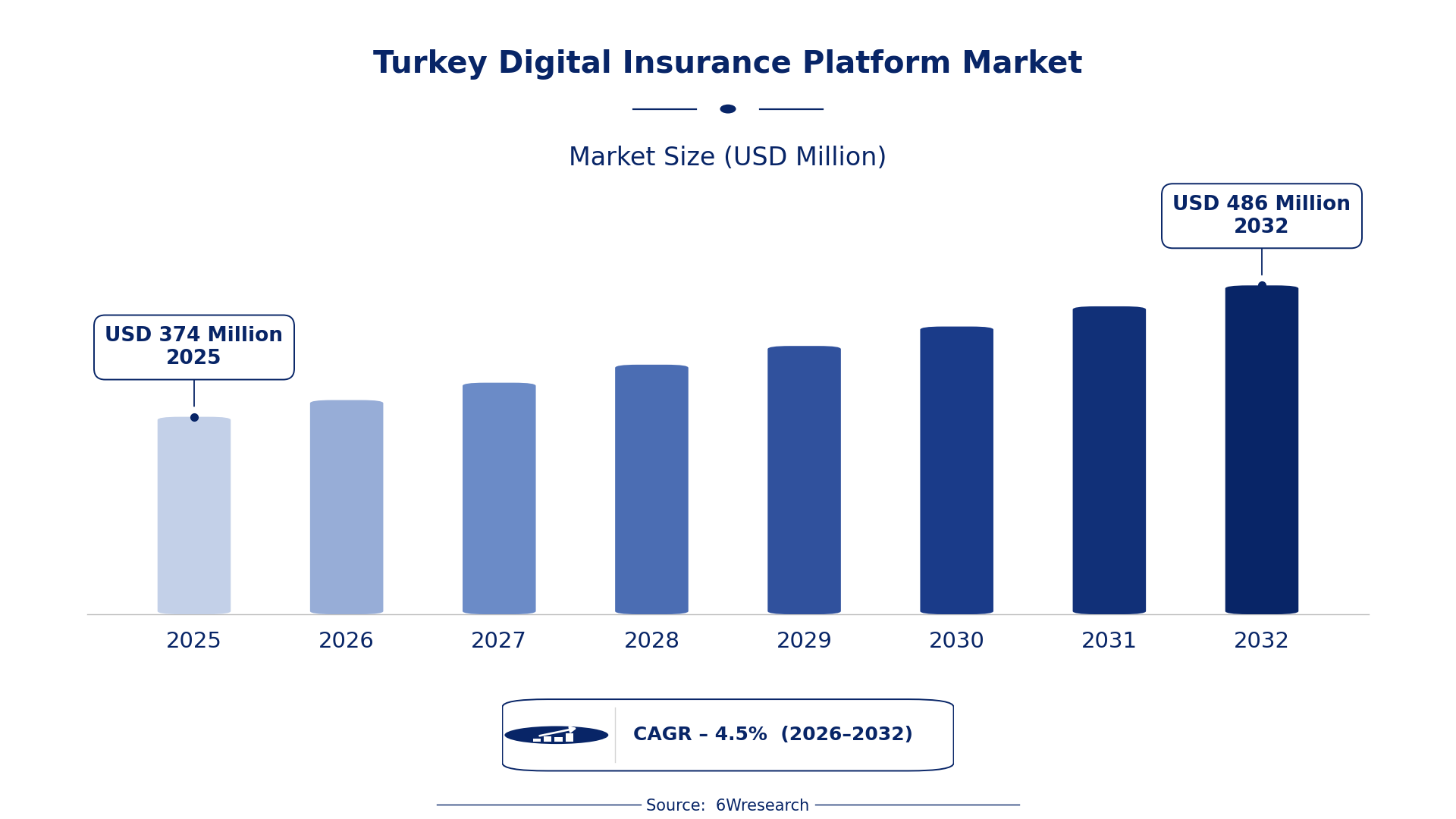
The Turkey Digital Insurance Platform Market was estimated at USD 374 Million in 2025 and is projected to reach USD 486 Million by 2032, growing at a CAGR of 4.5% from 2026 to 2032.
Turkey Digital Insurance Platform Market Synopsis
The digital transformation of the insurance sector is the strongest force shaping the Turkey Digital Insurance Platform Market. Insurance companies are increasingly investing in technology to improve customer engagement, streamline operations, and adapt to changing consumer preferences.
As digital solutions gain traction, companies are exploring innovative platforms for policy management and claims processing. This shift not only enhances customer experience but also caters to the growing demand for personalized insurance products tailored to individual needs.
Turkey Digital Insurance Platform Market Year-wise Growth Rate and Key Drivers
This graph illustrates the annual growth rates of the Turkey Digital Insurance Platform Market from 2021 to 2032, highlighting a steady upward trajectory and projected expansion over the forecast period.
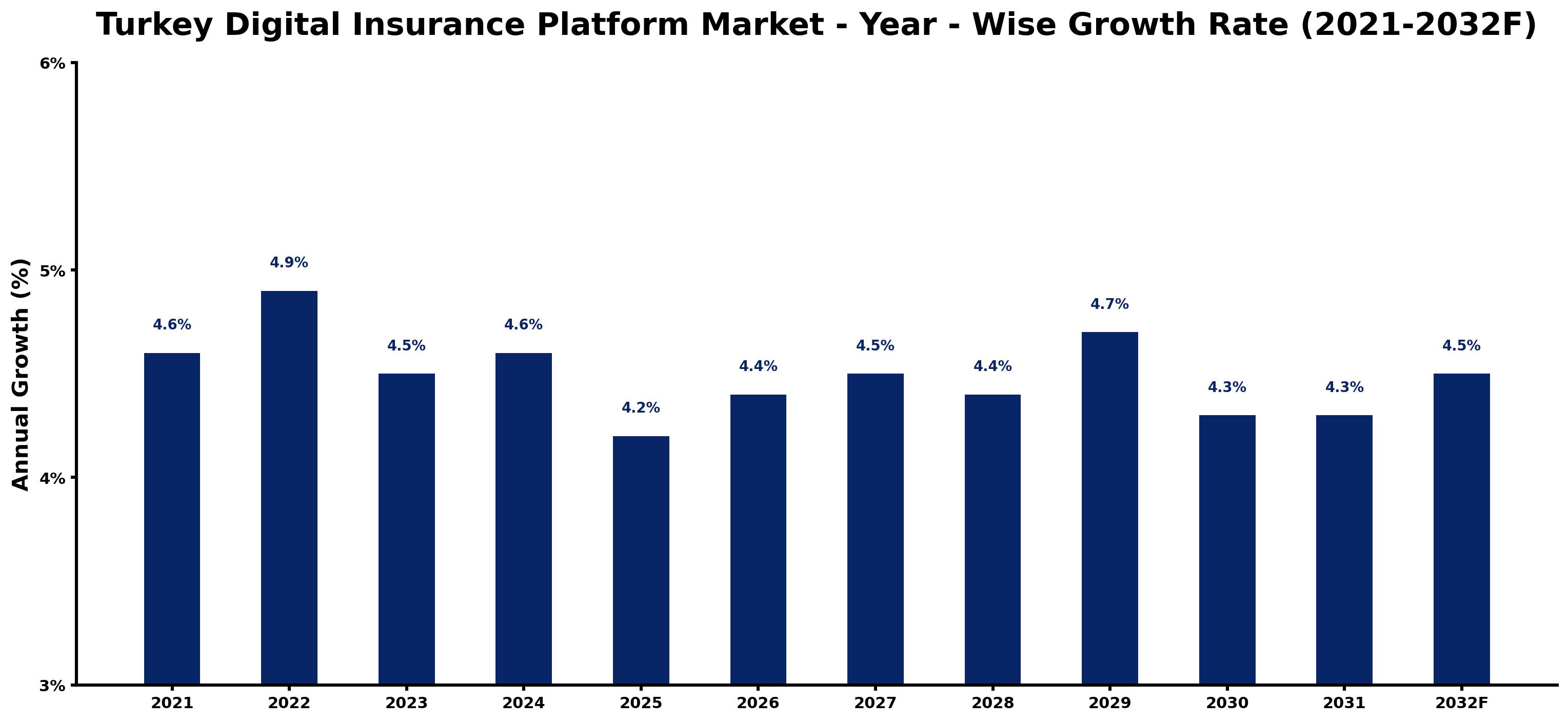
The table below presents the year‑wise growth rates along with the key drivers influencing the market
| Year | Growth Rate | Major Drivers |
| 2021 | 4.6% | Increased smartphone penetration boosts digital insurance uptake. |
| 2022 | 4.9% | Regulatory support for fintech innovations enhances market access. |
| 2023 | 4.5% | Rising consumer preference for online insurance services grows demand. |
| 2024 | 4.6% | Government initiatives promote digital transformation in financial services. |
| 2025 | 4.2% | Youth demographic driving adoption of insurtech solutions. |
| 2026 | 4.4% | Collaboration between insurers and tech startups accelerates growth. |
| 2027 | 4.5% | Increased awareness of risk management benefits boosts subscriptions. |
| 2028 | 4.4% | Telematics usage in vehicles expands insurance personalization options. |
| 2029 | 4.7% | Integration of artificial intelligence improves customer service experiences. |
| 2030 | 4.3% | E-commerce growth influences online policy purchases significantly. |
| 2031 | 4.3% | Rising cyber insurance demand responds to security risks. |
| 2032 | 4.5% | Enhanced mobile apps streamline claims processing for users. |
Note: Market size estimations and growth projections presented in this report are based on 6Wresearch's proprietary forecasting methodology, utilizing the latest available industry data, government publications, and primary research inputs.
Turkey Digital Insurance Platform Market Key Takeaways
Below are some of the specific key takeaways from the market, including:
- The market is experiencing steady growth driven by increased adoption of digital technologies.
- Customer experience enhancement is a primary focus for insurers implementing digital platforms.
- Operational efficiency remains a critical goal for companies as they transition to digital solutions.
- Regulatory compliance challenges are prevalent as the sector navigates data privacy issues.
- Government initiatives are actively promoting digital transformation within the insurance industry.
Evaluation of Restraints in Turkey Digital Insurance Platform Market
Several key factors are hindering the growth of the Turkey Digital Insurance Platform Market. A notable restraint is customer reluctance to adopt digital channels, especially for complex insurance products that require more personalized guidance. Many consumers still prefer traditional methods, which can slow the market's digital transition.
Another significant challenge lies in balancing personalized customer experiences with the stringent regulatory requirements surrounding data handling and privacy. Insurers must invest in technology that aligns with compliance standards while ensuring a user-friendly experience, which can be a complex undertaking.
Turkey Digital Insurance Platform Market Trends
The Turkey Digital Insurance Platform Market is currently witnessing trends that reflect broader shifts in consumer behavior and technology. The rise of mobile applications is making insurance services more accessible and user-friendly. Customers expect real-time updates and streamlined interactions, driving insurers to adopt omnichannel strategies.
Additionally, the integration of artificial intelligence and machine learning into digital platforms is becoming increasingly prevalent. These technologies enhance predictive analytics, enabling insurers to offer personalized products and improve claims processing efficiency.
Turkey Digital Insurance Platform Market Opportunities
Opportunities for growth in the Turkey Digital Insurance Platform Market are abundant. Insurers can capitalize on the increasing demand for online solutions, particularly among younger demographics who are more tech-savvy and expect seamless digital interactions. This demographic shift presents a significant chance for companies to innovate and create tailored products.
on top of that, collaboration with tech firms for developing advanced digital tools can help insurers stay competitive. Investment in cybersecurity measures will also become crucial as more sensitive customer data is processed through digital platforms, creating a dual opportunity for growth and trust-building.
Government Initiatives in the Turkey Digital Insurance Platform Market
The Turkish government is actively fostering digital transformation within the insurance sector through various initiatives. By promoting digital insurance platforms, authorities aim to enhance customer service and operational efficiency while ensuring compliance with data protection standards. These policies are crucial for encouraging insurers to adopt innovative technologies that can streamline operations.
- A recent initiative focused on providing incentives for the development of innovative digital solutions to improve customer engagement.
- Current collaborations between government bodies and insurance companies aim to establish best practices for digital platforms.
- A regulatory framework that mandates data protection and privacy compliance was introduced to safeguard customer information.
- Ongoing government workshops are designed to educate insurance companies on the latest digital trends and technologies.
- A planned public-private partnership is expected to enhance infrastructure supporting digital services by 2028.
Future Insights of the Turkey Digital Insurance Platform Market
Looking ahead to 2026-2032, the Turkey Digital Insurance Platform Market is set for sustained growth. As digital adoption becomes ingrained in consumer behavior, insurers will need to innovate continuously to stay relevant. The integration of advanced technologies will not only streamline operations but also redefine customer experiences.
on top of that, the convergence of insurance with fintech solutions will likely create new business models, further reshaping the market dynamics. Insurers willing to embrace change and invest in technology will find ample opportunities for expansion and customer loyalty.
Turkey Digital Insurance Platform Market Latest Developments
In the past year, activity in the Turkey Digital Insurance Platform Market has intensified, with numerous advancements in technology and service offerings. Insurers are increasingly focusing on enhancing their digital capabilities to meet customer expectations and comply with evolving regulatory standards.
- A leading insurance company launched a new mobile app in early 2025, allowing users to manage policies and file claims seamlessly.
- An ongoing project began in mid-2025, where several firms are collaborating to create a shared digital claims processing system.
- A major technology vendor is expected to roll out AI-driven analytics tools for insurers by the second half of 2026.
- A recent partnership was formed between an insurance provider and a fintech startup to develop personalized insurance products, which is currently underway.
- In early 2025, a national campaign was initiated to raise awareness about the benefits of digital insurance solutions among consumers.
Turkey Digital Insurance Platform Market - Key Attractiveness of the Report
- 10 Years of Market Numbers
- Historical Data Starting from 2022 to 2025
- Base Year: 2025
- Forecast Data until 2032
- Key Performance Indicators Impacting the Market
- Major Upcoming Developments and Projects
Key Highlights of the Report:
- Turkey Digital Insurance Platform Market Outlook
- Market Size of Turkey Digital Insurance Platform Market, 2025
- Forecast of Turkey Digital Insurance Platform Market, 2032
- Historical Data and Forecast of Turkey Digital Insurance Platform Revenues & Volume for the Period 2022-2032F
- Turkey Digital Insurance Platform Market Trend Evolution
- Turkey Digital Insurance Platform Market Drivers and Challenges
- Turkey Digital Insurance Platform Price Trends
- Turkey Digital Insurance Platform Porter's Five Forces
- Turkey Digital Insurance Platform Industry Life Cycle
- Historical Data and Forecast of Turkey Digital Insurance Platform Market Revenues & Volume By Component for the Period 2022-2032F
- Historical Data and Forecast of Turkey Digital Insurance Platform Market Revenues & Volume By Tools for the Period 2022-2032F
- Historical Data and Forecast of Turkey Digital Insurance Platform Market Revenues & Volume By Services for the Period 2022-2032F
- Historical Data and Forecast of Turkey Digital Insurance Platform Market Revenues & Volume By Service for the Period 2022-2032F
- Historical Data and Forecast of Turkey Digital Insurance Platform Market Revenues & Volume By Managed services for the Period 2022-2032F
- Historical Data and Forecast of Turkey Digital Insurance Platform Market Revenues & Volume By Professional services for the Period 2022-2032F
- Historical Data and Forecast of Turkey Digital Insurance Platform Market Revenues & Volume By End-user for the Period 2022-2032F
- Historical Data and Forecast of Turkey Digital Insurance Platform Market Revenues & Volume By Insurance companies for the Period 2022-2032F
- Historical Data and Forecast of Turkey Digital Insurance Platform Market Revenues & Volume By Third-party administrators and brokers for the Period 2022-2032F
- Historical Data and Forecast of Turkey Digital Insurance Platform Market Revenues & Volume By Aggregators for the Period 2022-2032F
- Historical Data and Forecast of Turkey Digital Insurance Platform Market Revenues & Volume By Insurance Application for the Period 2022-2032F
- Historical Data and Forecast of Turkey Digital Insurance Platform Market Revenues & Volume By Automotive and transportation for the Period 2022-2032F
- Historical Data and Forecast of Turkey Digital Insurance Platform Market Revenues & Volume By Home and commercial buildings for the Period 2022-2032F
- Historical Data and Forecast of Turkey Digital Insurance Platform Market Revenues & Volume By Life and health for the Period 2022-2032F
- Historical Data and Forecast of Turkey Digital Insurance Platform Market Revenues & Volume By Business and enterprise for the Period 2022-2032F
- Historical Data and Forecast of Turkey Digital Insurance Platform Market Revenues & Volume By Consumer electronics and industrial machines for the Period 2022-2032F
- Historical Data and Forecast of Turkey Digital Insurance Platform Market Revenues & Volume By Travel for the Period 2022-2032F
- Historical Data and Forecast of Turkey Digital Insurance Platform Market Revenues & Volume By Organization Size for the Period 2022-2032F
- Historical Data and Forecast of Turkey Digital Insurance Platform Market Revenues & Volume By Small and Medium-sized Enterprises (SMEs) for the Period 2022-2032F
- Historical Data and Forecast of Turkey Digital Insurance Platform Market Revenues & Volume By Large enterprises for the Period 2022-2032F
- Turkey Digital Insurance Platform Import Export Trade Statistics
- Market Opportunity Assessment By Component
- Market Opportunity Assessment By Service
- Market Opportunity Assessment By End-user
- Market Opportunity Assessment By Insurance Application
- Market Opportunity Assessment By Organization Size
- Turkey Digital Insurance Platform Top Companies Market Share
- Turkey Digital Insurance Platform Competitive Benchmarking By Technical and Operational Parameters
- Turkey Digital Insurance Platform Company Profiles
- Turkey Digital Insurance Platform Key Strategic Recommendations






































