Turkey E-wallet Market Size, Share & Growth Rate
The Turkey E-wallet Market was estimated at USD 449 Million in 2025 and is projected to reach USD 620 Million by 2032, growing at a CAGR of 4.7% from 2026 to 2032. This growth trajectory reflects a significant shift in consumer behavior as digital payments gain acceptance, driven by an increasing reliance on smartphones and mobile devices. The market's expansion is further propelled by the burgeoning e-commerce sector and the rising trend of contactless payment methods.
Turkey E-wallet Market Year-wise Growth Rate and Key Drivers
This graph highlights how the Turkey E-wallet Market has steadily grown over the years, supported by major growth factors.
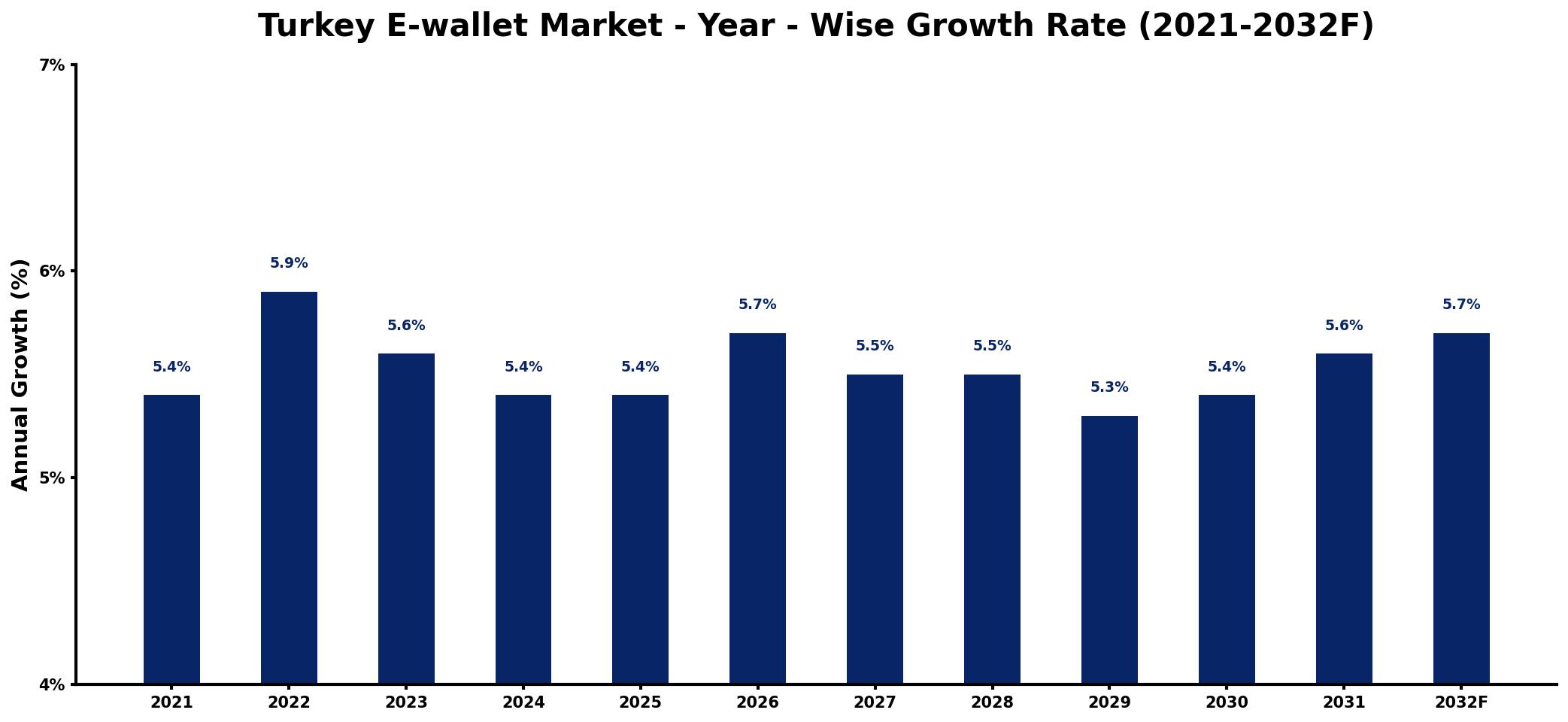
The table below presents the year‑wise growth rates along with the key drivers influencing the market
| Year | Growth Rate | Major Drivers |
| 2021 | 5.4% | Rise in digital payment adoption |
| 2022 | 5.9% | Increased smartphone penetration rates |
| 2023 | 5.6% | Expansion of e-commerce platforms |
| 2024 | 5.4% | Growth in fintech innovations |
| 2025 | 5.4% | Surge in cross-border transactions |
| 2026 | 5.7% | Enhanced cybersecurity measures implemented |
| 2027 | 5.5% | Higher consumer trust in technology |
| 2028 | 5.5% | Development of new payment solutions |
| 2029 | 5.3% | Increased participation from SMEs |
| 2030 | 5.4% | Adoption of contactless payment methods |
| 2031 | 5.6% | Rising demand for mobile banking |
| 2032 | 5.7% | Integration with loyalty programs |
Note: Market size estimations and growth projections presented in this report are based on 6Wresearch's proprietary forecasting methodology, utilizing the latest available industry data, government publications, and primary research inputs.
Turkey E-wallet Market Synopsis
Recent years have seen a remarkable surge in the adoption of e-wallets in Turkey, marking a new era in financial transactions. However, as we look toward the future, a stronger focus on regulatory compliance and security features will be crucial for sustained growth in the Turkey E-wallet Market.
As users increasingly demand seamless, secure payment options, e-wallet providers must innovate and enhance their services. The convergence of technology with consumer expectations indicates that the market will not only grow but will also evolve, pushing the boundaries of what e-wallets can offer.
Turkey E-wallet Market Key Takeaways
- Significant growth projected, with the market size expected to reach USD 620 Million by 2032.
- Increasing smartphone penetration and digital payment adoption are key market drivers.
- Security concerns and consumer trust remain pivotal challenges for market stakeholders.
- Government initiatives are fostering a favorable environment for e-wallet development.
- Innovations in features such as loyalty programs are crucial for competitive differentiation.
Evaluation of Restraints in Turkey E-wallet Market
Despite its promising outlook, the Turkey E-wallet Market faces notable constraints that could impede its growth. One of the primary issues is consumer trust; many potential users remain hesitant to embrace digital payment solutions due to concerns about security and data privacy. Furthermore, the integration of e-wallet services with traditional banking systems is still in the early stages, posing technical challenges that could limit accessibility. Regulatory dynamics also require constant adaptation, as compliance with emerging digital finance standards may slow down innovation and deployment in the sector.
Turkey E-wallet Market Trends
A significant trend influencing the Turkey E-wallet Market is the increasing acceptance of contactless payment solutions, especially among younger consumers. This demographic values convenience and speed, driving demand for versatile e-wallet functionalities. Additionally, the integration of e-wallets with loyalty programs and rewards systems is becoming a popular feature, allowing businesses to enhance customer engagement and retention.
Moreover, the rise of social commerce platforms in Turkey is promoting new avenues for e-wallet usage, enabling users to transact directly within social applications. As technology continues to advance, we can expect the emergence of AI-driven solutions that personalize user experiences and improve transaction security.
Turkey E-wallet Market Opportunities
The Turkey E-wallet Market presents several growth opportunities driven by ongoing technological advancements and shifting consumer preferences. The expansion of e-commerce is a critical area where e-wallets can flourish, especially as online shopping becomes more integrated with daily life. Additionally, there is a significant opportunity for e-wallet providers to enhance their offerings with digital ID management solutions, catering to a market increasingly concerned with identity verification and fraud prevention.
Furthermore, partnerships between e-wallet services and local businesses can create unique propositions, such as exclusive discounts and promotions that drive customer loyalty. Investing in user education about the benefits and security of e-wallets will also be vital to overcoming existing barriers to adoption.
Government Initiatives in the Turkey E-wallet Market
The Turkish government is proactively promoting the digitalization of financial services through various policies aimed at fostering the e-wallet sector. These initiatives include incentives for developing secure, user-friendly e-wallet solutions that facilitate digital transactions. Regulatory frameworks are being established to ensure compliance with financial and privacy standards, which not only safeguard user information but also aim to bolster consumer confidence in digital payment methods. Collaborative efforts between government bodies, financial institutions, and technology providers are focusing on creating best practices and standards that will shape the future of the e-wallet landscape in Turkey.
Future Insights of the Turkey E-wallet Market
Looking ahead, the Turkey E-wallet Market is poised for substantial evolution through 2032. The growing emphasis on digital finance, coupled with increasing smartphone usage, indicates a robust potential for market expansion. As e-wallet providers innovate and respond to consumer demands for enhanced security and functionality, we can expect to see a diversification of services that goes beyond simple transactions. The integration of advanced technologies such as blockchain and AI is likely to redefine user experiences and streamline operations within the financial sector.
Turkey E-wallet Market Latest Developments (2025 - 2026)
In recent months, the Turkey E-wallet Market has witnessed significant momentum with several key developments. Companies are increasingly focusing on partnerships aimed at enhancing the features and security of their e-wallet offerings. As part of a broader push to integrate e-wallets with retail ecosystems, businesses are exploring collaborations that promote user engagement through loyalty rewards and personalized offers. Additionally, regulatory bodies are intensifying their efforts to ensure that e-wallet services meet updated security protocols, paving the way for greater consumer acceptance and trust.
Turkey E-wallet Market - Key Attractiveness of the Report
- 10 Years of Market Numbers
- Historical Data Starting from 2022 to 2025
- Base Year: 2025
- Forecast Data until 2032
- Key Performance Indicators Impacting the Market
- Major Upcoming Developments and Projects
Key Highlights of the Report:
- Turkey E-wallet Market Outlook
- Market Size of Turkey E-wallet Market, 2025
- Forecast of Turkey E-wallet Market, 2032
- Historical Data and Forecast of Turkey E-wallet Revenues & Volume for the Period 2022-2032F
- Turkey E-wallet Market Trend Evolution
- Turkey E-wallet Market Drivers and Challenges
- Turkey E-wallet Price Trends
- Turkey E-wallet Porter's Five Forces
- Turkey E-wallet Industry Life Cycle
- Historical Data and Forecast of Turkey E-wallet Market Revenues & Volume By Application for the Period 2022-2032F
- Historical Data and Forecast of Turkey E-wallet Market Revenues & Volume By Restaurants for the Period 2022-2032F
- Historical Data and Forecast of Turkey E-wallet Market Revenues & Volume By Transportation for the Period 2022-2032F
- Historical Data and Forecast of Turkey E-wallet Market Revenues & Volume By Banking for the Period 2022-2032F
- Historical Data and Forecast of Turkey E-wallet Market Revenues & Volume By Retail for the Period 2022-2032F
- Historical Data and Forecast of Turkey E-wallet Market Revenues & Volume By Type for the Period 2022-2032F
- Historical Data and Forecast of Turkey E-wallet Market Revenues & Volume By Closed E Wallets for the Period 2022-2032F
- Historical Data and Forecast of Turkey E-wallet Market Revenues & Volume By Semi Closed E Wallets for the Period 2022-2032F
- Historical Data and Forecast of Turkey E-wallet Market Revenues & Volume By Open E Wallets for the Period 2022-2032F
- Historical Data and Forecast of Turkey E-wallet Market Revenues & Volume By Mode for the Period 2022-2032F
- Historical Data and Forecast of Turkey E-wallet Market Revenues & Volume By Online for the Period 2022-2032F
- Historical Data and Forecast of Turkey E-wallet Market Revenues & Volume By M Wallet for the Period 2022-2032F
- Historical Data and Forecast of Turkey E-wallet Market Revenues & Volume By Mode for the Period 2022-2032F
- Historical Data and Forecast of Turkey E-wallet Market Revenues & Volume By Online for the Period 2022-2032F
- Historical Data and Forecast of Turkey E-wallet Market Revenues & Volume By M Wallet for the Period 2022-2032F
- Turkey E-wallet Import Export Trade Statistics
- Market Opportunity Assessment By Application
- Market Opportunity Assessment By Type
- Market Opportunity Assessment By Mode
- Turkey E-wallet Top Companies Market Share
- Turkey E-wallet Competitive Benchmarking By Technical and Operational Parameters
- Turkey E-wallet Company Profiles
- Turkey E-wallet Key Strategic Recommendations






































