Turkey Fruit Pulp Market Size, Share & Growth Rate
The Turkey Fruit Pulp Market was estimated at USD 366 Million in 2025 and is projected to reach USD 497 Million by 2032, growing at a CAGR of 4.5% from 2026 to 2032. This upward trajectory is primarily driven by the rising consumer preference for natural and healthy food products, alongside the surging popularity of fruit-based beverages and desserts. As health-conscious eating trends persist, the demand for versatile food ingredients like fruit pulp is set to expand, further bolstered by technological advancements in food processing.
Turkey Fruit Pulp Market Year-wise Growth Rate and Key Drivers
This graph highlights how the Turkey Fruit Pulp Market has steadily grown over the years, supported by major growth factors.
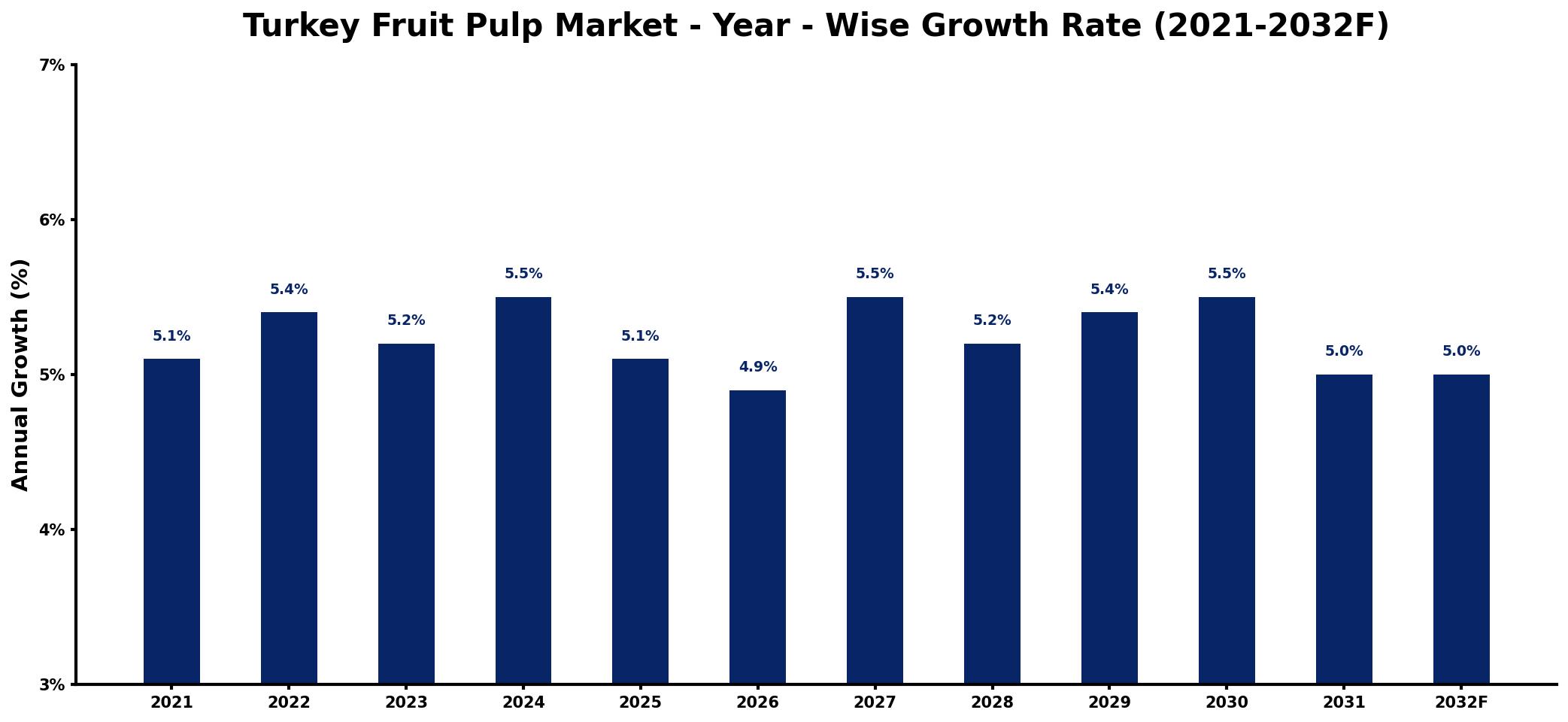
The table below presents the year‑wise growth rates along with the key drivers influencing the market
| Year | Growth Rate | Major Drivers |
| 2021 | 5.1% | Rising health consciousness among consumers |
| 2022 | 5.4% | Increased demand for natural ingredients |
| 2023 | 5.2% | Growth in beverage sector applications |
| 2024 | 5.5% | Expansion of export markets opportunities |
| 2025 | 5.1% | Investment in sustainable production methods |
| 2026 | 4.9% | Emergence of innovative processing technologies |
| 2027 | 5.5% | Strong retail sector performance growth |
| 2028 | 5.2% | Higher consumer preference for convenience |
| 2029 | 5.4% | Enhanced product diversification strategies |
| 2030 | 5.5% | Growing popularity of plant-based foods |
| 2031 | 5.0% | Strengthened supply chain efficiencies |
| 2032 | 5.0% | Boosted interest in organic certifications |
Note: Market size estimations and growth projections presented in this report are based on 6Wresearch's proprietary forecasting methodology, utilizing the latest available industry data, government publications, and primary research inputs.
Turkey Fruit Pulp Market Synopsis
The most significant force currently shaping the Turkey Fruit Pulp Market is the increasing consumer inclination toward natural and healthy dietary choices. This trend not only stimulates demand for fruit pulp but also aligns with the growing popularity of fruit-infused products across various segments.
Moreover, the advancements in food processing technologies play a crucial role in enhancing the efficiency and quality of fruit pulp production. These innovations, coupled with the expanding food and beverage industry, are propelling the market into a new phase of growth, characterized by greater product variety and improved supply chains.
Turkey Fruit Pulp Market Key Takeaways
- The Turkey Fruit Pulp Market is experiencing robust growth driven by the demand for healthy and natural ingredients.
- Technological advancements are crucial in improving processing efficiencies and product quality.
- Fruit-based beverages and desserts are becoming increasingly popular, further enhancing market dynamics.
- Government support through subsidies and export incentives is fostering market expansion.
- Seasonal variations and logistics challenges continue to present operational hurdles for market participants.
Evaluation of Restraints in Turkey Fruit Pulp Market
Despite the promising growth trajectory, the Turkey Fruit Pulp Market faces several challenges that can impede its potential. Seasonal variations in fruit supply create fluctuations in availability, impacting production consistency. Additionally, logistics and transportation costs often escalate due to the perishable nature of fruit products, which can squeeze profit margins. Market players also grapple with price volatility and the need for innovative processing technologies to maintain competitive advantage amidst changing consumer preferences.
Turkey Fruit Pulp Market Trends
Current trends indicate a significant shift towards organic and sustainable sourcing of fruit pulp, as consumers increasingly demand transparency and traceability in their food products. The rise of health-focused lifestyles is also encouraging the development of functional fruit pulp variants enriched with added nutrients, catering to health-conscious consumers. Furthermore, the growing trend of customization in food and beverages is driving innovation in pulp flavors and applications.
Turkey Fruit Pulp Market Opportunities
The Turkey Fruit Pulp Market holds considerable growth potential, particularly in the development of new product lines that cater to evolving consumer tastes. There is an opportunity to penetrate international markets by leveraging the Turkish government's export incentives. Investing in modern processing technologies can also enhance production capabilities, allowing businesses to meet the increasing demand for high-quality fruit pulp products efficiently.
Government Initiatives in the Turkey Fruit Pulp Market
The Turkish government is actively promoting the growth of the fruit pulp market through various initiatives aimed at boosting agricultural productivity and processing capabilities. These initiatives include subsidies for fruit growers, investments in modern processing facilities, and support for export development. Quality standards are also enforced rigorously to ensure that Turkish fruit pulp meets international market requirements, enhancing its competitiveness on the global stage.
Future Insights of the Turkey Fruit Pulp Market
Looking ahead to 2026-2032, the Turkey Fruit Pulp Market is poised for sustained growth fueled by the unrelenting demand for healthier food options. As consumer preferences continue to evolve, the market will likely see an influx of innovative product offerings. Enhanced processing technologies will also contribute significantly to market dynamics, ensuring that Turkish fruit pulp maintains its position as a key ingredient in both domestic and international food and beverage applications.
Turkey Fruit Pulp Market Latest Developments (2025 - 2026)
Recent developments in the Turkey Fruit Pulp Market have highlighted a shift towards organic product lines, driven by increasing consumer demand for sustainably sourced ingredients. Additionally, advancements in processing technologies have been noted, allowing for better preservation of nutritional value and flavor. The market landscape is also witnessing collaborations and partnerships aimed at expanding distribution channels, enabling broader access to innovative fruit pulp products.
Turkey Fruit Pulp Market - Key Attractiveness of the Report
- 10 Years of Market Numbers
- Historical Data Starting from 2022 to 2025
- Base Year: 2025
- Forecast Data until 2032
- Key Performance Indicators Impacting the Market
- Major Upcoming Developments and Projects
Key Highlights of the Report:
- Turkey Fruit Pulp Market Outlook
- Market Size of Turkey Fruit Pulp Market, 2025
- Forecast of Turkey Fruit Pulp Market, 2032
- Historical Data and Forecast of Turkey Fruit Pulp Revenues & Volume for the Period 2022-2032F
- Turkey Fruit Pulp Market Trend Evolution
- Turkey Fruit Pulp Market Drivers and Challenges
- Turkey Fruit Pulp Price Trends
- Turkey Fruit Pulp Porter's Five Forces
- Turkey Fruit Pulp Industry Life Cycle
- Historical Data and Forecast of Turkey Fruit Pulp Market Revenues & Volume By Fruit Type for the Period 2022-2032F
- Historical Data and Forecast of Turkey Fruit Pulp Market Revenues & Volume By Mango for the Period 2022-2032F
- Historical Data and Forecast of Turkey Fruit Pulp Market Revenues & Volume By Strawberry for the Period 2022-2032F
- Historical Data and Forecast of Turkey Fruit Pulp Market Revenues & Volume By Apple for the Period 2022-2032F
- Historical Data and Forecast of Turkey Fruit Pulp Market Revenues & Volume By Guava for the Period 2022-2032F
- Historical Data and Forecast of Turkey Fruit Pulp Market Revenues & Volume By Berries for the Period 2022-2032F
- Historical Data and Forecast of Turkey Fruit Pulp Market Revenues & Volume By Citrus Fruits for the Period 2022-2032F
- Historical Data and Forecast of Turkey Fruit Pulp Market Revenues & Volume By Others for the Period 2022-2032F
- Historical Data and Forecast of Turkey Fruit Pulp Market Revenues & Volume By Form for the Period 2022-2032F
- Historical Data and Forecast of Turkey Fruit Pulp Market Revenues & Volume By Liquid for the Period 2022-2032F
- Historical Data and Forecast of Turkey Fruit Pulp Market Revenues & Volume By Powder for the Period 2022-2032F
- Historical Data and Forecast of Turkey Fruit Pulp Market Revenues & Volume By Application for the Period 2022-2032F
- Historical Data and Forecast of Turkey Fruit Pulp Market Revenues & Volume By Food and Beverages for the Period 2022-2032F
- Historical Data and Forecast of Turkey Fruit Pulp Market Revenues & Volume By Distribution for the Period 2022-2032F
- Historical Data and Forecast of Turkey Fruit Pulp Market Revenues & Volume By E-Commerce for the Period 2022-2032F
- Historical Data and Forecast of Turkey Fruit Pulp Market Revenues & Volume By Convenience Stores for the Period 2022-2032F
- Historical Data and Forecast of Turkey Fruit Pulp Market Revenues & Volume By Supermarkets/Hypermarkets for the Period 2022-2032F
- Historical Data and Forecast of Turkey Fruit Pulp Market Revenues & Volume By Specialty Stores for the Period 2022-2032F
- Historical Data and Forecast of Turkey Fruit Pulp Market Revenues & Volume By Others for the Period 2022-2032F
- Turkey Fruit Pulp Import Export Trade Statistics
- Market Opportunity Assessment By Fruit Type
- Market Opportunity Assessment By Form
- Market Opportunity Assessment By Application
- Market Opportunity Assessment By Distribution
- Turkey Fruit Pulp Top Companies Market Share
- Turkey Fruit Pulp Competitive Benchmarking By Technical and Operational Parameters
- Turkey Fruit Pulp Company Profiles
- Turkey Fruit Pulp Key Strategic Recommendations






































