Turkey Gamification in Education Market Size & Growth Rate (2026-2032)
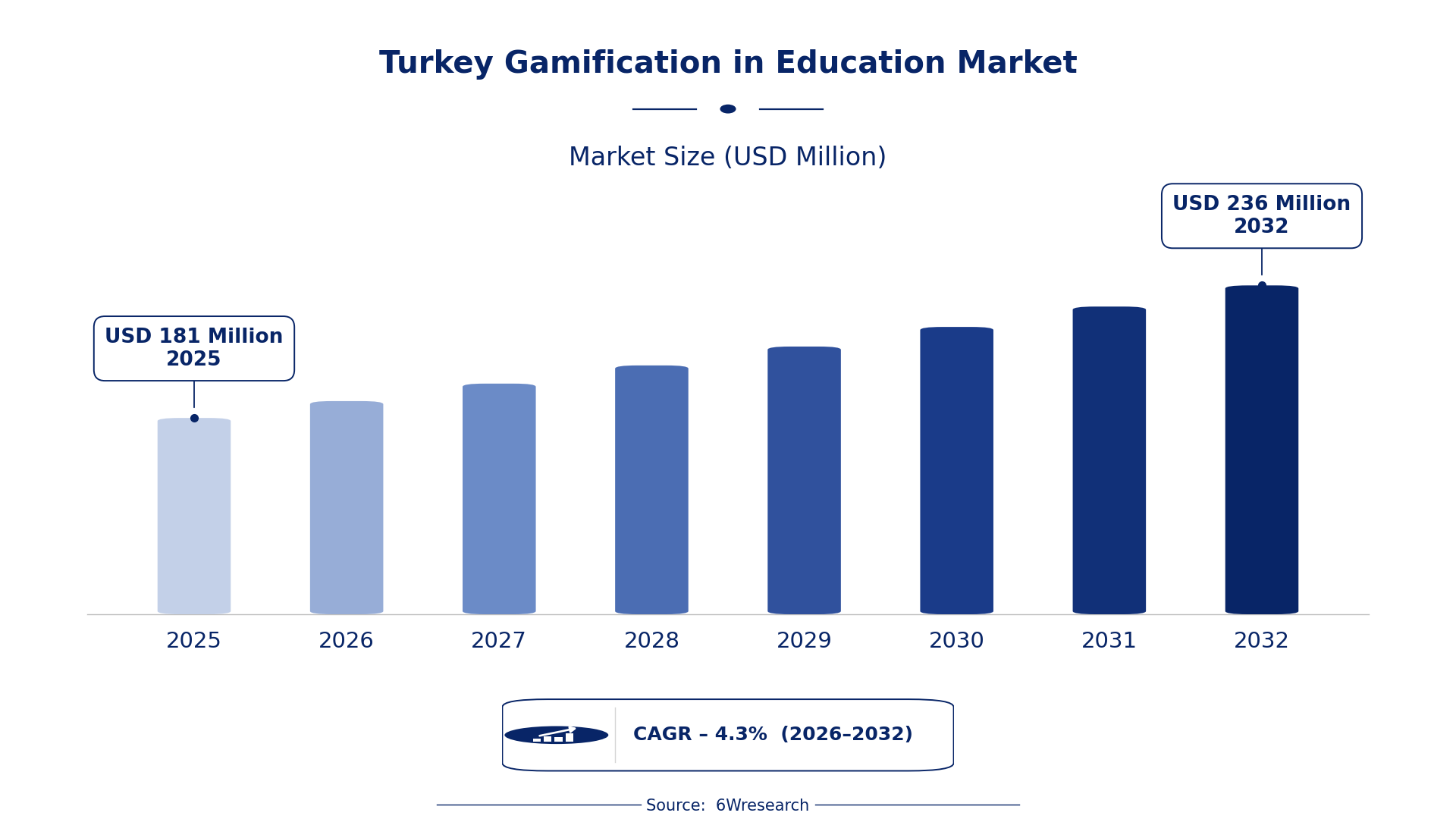
The Turkey Gamification in Education Market was estimated at USD 181 Million in 2025 and is projected to reach USD 236 Million by 2032, growing at a CAGR of 4.3% from 2026 to 2032.
Turkey Gamification in Education Market Synopsis
The driving force behind the Turkey Gamification in Education Market is the widespread integration of technology into classrooms. This shift not only enhances student engagement but also transforms traditional teaching methods, making education more interactive and effective.
As educational institutions increasingly recognize the potential of gamified learning experiences, there’s a notable uptick in demand for innovative platforms and applications. The focus is on creating personalized learning environments that cater to diverse student needs and learning styles.
Turkey Gamification in Education Market Year-wise Growth Rate and Key Drivers
This graph illustrates the annual growth rates of the Turkey Gamification in Education Market from 2021 to 2032, highlighting a steady upward trajectory and projected expansion over the forecast period.
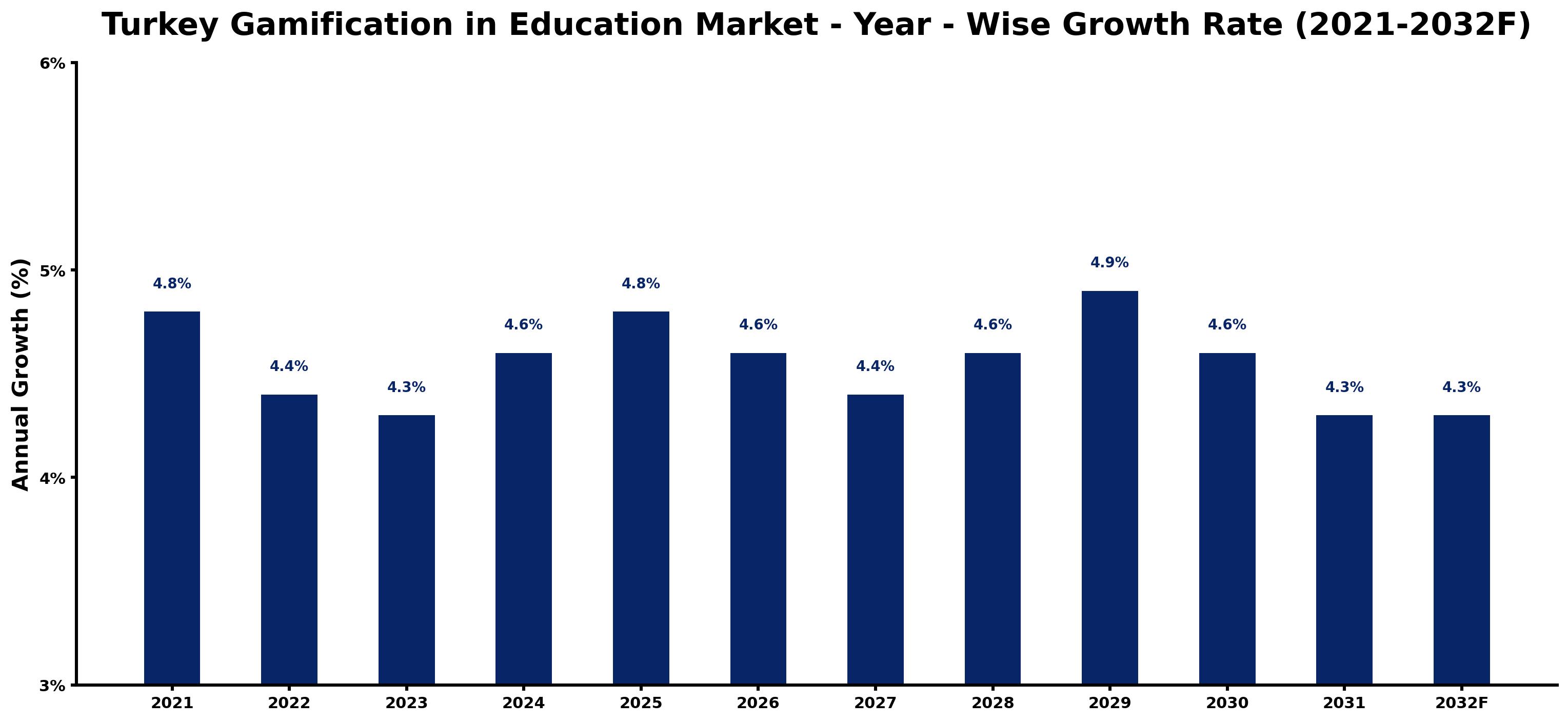
The table below presents the year‑wise growth rates along with the key drivers influencing the market
| Year | Growth Rate | Major Drivers |
| 2021 | 4.8% | Government's digital education initiative boosting online learning tools. |
| 2022 | 4.4% | Increased private investment in EdTech startups across Turkey. |
| 2023 | 4.3% | Emergence of localized gamified content engaging students effectively. |
| 2024 | 4.6% | Growing awareness of gamification benefits in educational outcomes. |
| 2025 | 4.8% | Partnerships between universities and gaming developers enhancing curriculum. |
| 2026 | 4.6% | Surge in mobile device usage among students fostering engagement. |
| 2027 | 4.4% | Focus on STEM education leading to gamified learning adoption. |
| 2028 | 4.6% | Increased interest in virtual reality applications in education. |
| 2029 | 4.9% | Rise of competitive gaming events promoting educational engagement. |
| 2030 | 4.6% | Adoption of blended learning models incorporating gamified elements. |
| 2031 | 4.3% | Support from Ministry of National Education for innovative tools. |
| 2032 | 4.3% | Popularity of online learning platforms integrating gamification strategies. |
Note: Market size estimations and growth projections presented in this report are based on 6Wresearch's proprietary forecasting methodology, utilizing the latest available industry data, government publications, and primary research inputs.
Turkey Gamification in Education Market Key Takeaways
Below are some of the specific key takeaways from the market, including:
- The market is set for a steady growth trajectory, highlighting the increasing adoption of technology in education.
- Gamified platforms are becoming a staple in both K-12 and higher education sectors.
- Integration of VR and AR technologies is enhancing immersive learning experiences.
- Personalized learning approaches are gaining traction, allowing students to learn at their own pace.
- Government initiatives are actively supporting the integration of gamification in educational frameworks.
Evaluation of Restraints in Turkey Gamification in Education Market
Despite the promising growth, the Turkey Gamification in Education Market faces certain constraints. A significant barrier is the limited understanding of gamification's advantages among educators and decision-makers, which often leads to skepticism about its effectiveness. on top of that, the absence of standardized guidelines for implementation creates inconsistencies across institutions. Infrastructure challenges, such as inadequate access to technology and internet connectivity, also impede broader adoption. Addressing these issues will require comprehensive training, clear evidence of effectiveness, and collaborative efforts among stakeholders.
Turkey Gamification in Education Market Trends
Several key trends are influencing the Turkey Gamification in Education Market. The rise of gamified learning applications is reshaping how students interact with educational content, making learning more engaging and fun. Additionally, the incorporation of VR and AR technologies is creating immersive educational experiences that captivate students' attention and enhance retention. A strong focus on personalized learning is emerging, allowing students to receive tailored feedback and progress at their own pace. As digital transformation continues, these trends will play a critical role in shaping future educational practices.
Turkey Gamification in Education Market Opportunities
The market presents a wealth of investment opportunities, particularly as educational institutions look for innovative ways to engage students. There is potential in developing gamified educational tools and platforms tailored specifically for the Turkish market. Partnerships with schools and universities can facilitate the integration of gamification into existing curricula, enhancing learning experiences. As demand for these solutions grows, investors can capitalize on the shift towards interactive and technology-driven education.
Government Initiatives in the Turkey Gamification in Education Market
Government policies are playing a crucial role in shaping the Turkey Gamification in Education Market. The Turkish government is committed to fostering technology integration in education, which has led to various initiatives aimed at promoting gamification. Such policies are essential for ensuring that educational institutions can effectively implement these innovative teaching methods.
- The "Fatih Project" is a significant initiative aimed at integrating technology into schools, including gamified educational tools.
- The "eTwinning" platform, launched by the Ministry of National Education, encourages collaboration among European schools through gamified projects.
- Recent funding allocations support the development of educational games and platforms, enhancing access to gamification.
- Ongoing programs focus on training educators to effectively incorporate gamification into their teaching practices.
- Planned initiatives include public-private partnerships to expand digital resources in schools by 2028.
Future Insights of the Turkey Gamification in Education Market
Looking ahead to 2026-2032, the Turkey Gamification in Education Market is poised for considerable growth. The increasing reliance on technology in education will drive demand for gamified learning solutions. Educators are expected to prioritize interactive and personalized learning experiences, especially for the digital native generation. As technology continues to advance, the development of more sophisticated gamification tools will unlock new avenues for teaching and learning, further enhancing educational outcomes.
Turkey Gamification in Education Market Latest Developments
In the past year, the Turkey Gamification in Education Market has witnessed notable developments that reflect a strong momentum towards innovation. As educational institutions embrace technology, numerous initiatives have been launched to enhance learning through gamification.
- A major technology vendor launched a new gamified learning platform in early 2025, aiming to improve student engagement across multiple subjects.
- Ongoing collaborations between educational institutions and tech startups are developing interactive tools that facilitate gamified learning experiences.
- A public initiative to upgrade digital infrastructure in schools is currently underway, with expectations for completion by mid-2026.
- Upcoming plans include the introduction of a national gamification strategy to be rolled out by 2027, focusing on curriculum integration.
- In late 2025, a conference on gamification in education brought together educators and technologists to share best practices and innovative solutions.
Turkey Gamification in Education Market - Key Attractiveness of the Report
- 10 Years of Market Numbers
- Historical Data Starting from 2022 to 2025
- Base Year: 2025
- Forecast Data until 2032
- Key Performance Indicators Impacting the Market
- Major Upcoming Developments and Projects
Key Highlights of the Report:
- Turkey Gamification in Education Market Outlook
- Market Size of Turkey Gamification in Education Market, 2025
- Forecast of Turkey Gamification in Education Market, 2032
- Historical Data and Forecast of Turkey Gamification in Education Revenues & Volume for the Period 2022-2032F
- Turkey Gamification in Education Market Trend Evolution
- Turkey Gamification in Education Market Drivers and Challenges
- Turkey Gamification in Education Price Trends
- Turkey Gamification in Education Porter's Five Forces
- Turkey Gamification in Education Industry Life Cycle
- Historical Data and Forecast of Turkey Gamification in Education Market Revenues & Volume By Offering for the Period 2022-2032F
- Historical Data and Forecast of Turkey Gamification in Education Market Revenues & Volume By Software for the Period 2022-2032F
- Historical Data and Forecast of Turkey Gamification in Education Market Revenues & Volume By Services for the Period 2022-2032F
- Historical Data and Forecast of Turkey Gamification in Education Market Revenues & Volume By End User for the Period 2022-2032F
- Historical Data and Forecast of Turkey Gamification in Education Market Revenues & Volume By Academic for the Period 2022-2032F
- Historical Data and Forecast of Turkey Gamification in Education Market Revenues & Volume By Corporate Training for the Period 2022-2032F
- Historical Data and Forecast of Turkey Gamification in Education Market Revenues & Volume By Deployment Mode for the Period 2022-2032F
- Historical Data and Forecast of Turkey Gamification in Education Market Revenues & Volume By Cloud for the Period 2022-2032F
- Historical Data and Forecast of Turkey Gamification in Education Market Revenues & Volume By On-Premises for the Period 2022-2032F
- Turkey Gamification in Education Import Export Trade Statistics
- Market Opportunity Assessment By Offering
- Market Opportunity Assessment By End User
- Market Opportunity Assessment By Deployment Mode
- Turkey Gamification in Education Top Companies Market Share
- Turkey Gamification in Education Competitive Benchmarking By Technical and Operational Parameters
- Turkey Gamification in Education Company Profiles
- Turkey Gamification in Education Key Strategic Recommendations






































