Turkey Helicopter Market Size, Share & Growth Rate
The Turkey Helicopter Market was estimated at USD 1129 Million in 2025 and is projected to reach USD 1617 Million by 2032, growing at a CAGR of 5.3% from 2026 to 2032. This growth is primarily driven by an increasing demand for helicopters across sectors such as defense, tourism, and emergency medical services. Additionally, military modernization efforts and a strategic focus on enhancing aerial capabilities are expected to further propel the market forward.
Turkey Helicopter Market Year-wise Growth Rate and Key Drivers
This graph highlights how the Turkey Helicopter Market has steadily grown over the years, supported by major growth factors.
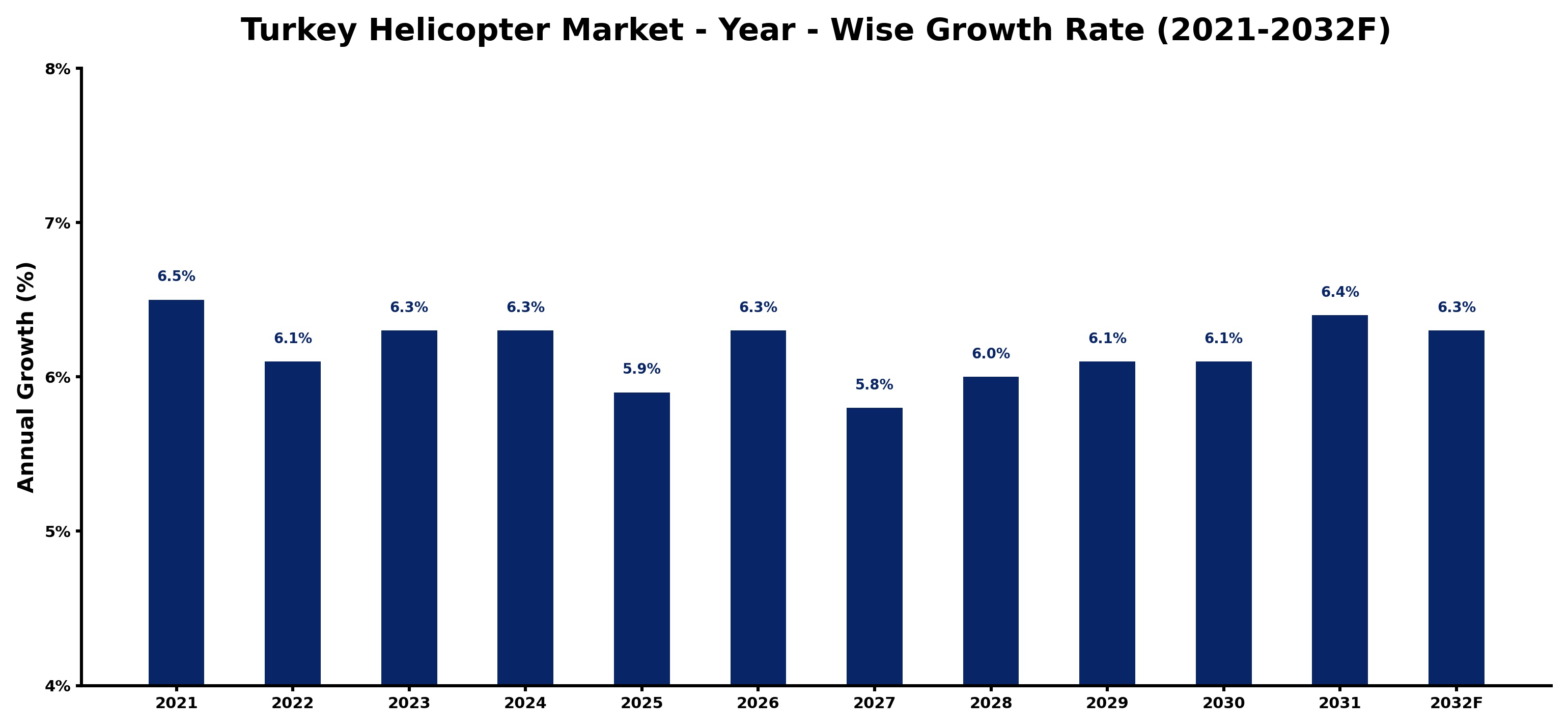
The table below presents the year‑wise growth rates along with the key drivers influencing the market
| Year | Growth Rate | Major Drivers |
| 2021 | 6.5% | Local production facilities boost indigenous helicopter manufacturing capabilities |
| 2022 | 6.1% | Turkish defense contracts boost local helicopter manufacturing capacity utilization |
| 2023 | 6.3% | Defense contracts stimulate advanced rotorcraft manufacturing capacity investments |
| 2024 | 6.3% | Local helicopter manufacturers adopt advanced avionics systems for competitiveness |
| 2025 | 5.9% | Defense sector contracts stimulated local helicopter manufacturing investments |
| 2026 | 6.3% | Local assembly partnerships boosted helicopter production capabilities in Turkey |
| 2027 | 5.8% | Helicopter leasing growth boosts maintenance service contract opportunities |
| 2028 | 6.0% | Local helicopter assembly facilities expanded to meet export demands |
| 2029 | 6.1% | Domestic helicopter manufacturers prioritize technology upgrades for competitive exports |
| 2030 | 6.1% | Local helicopter assembly plants attract significant foreign manufacturing investments |
| 2031 | 6.4% | Increased domestic demand drove helicopter component manufacturing capacity upgrades |
| 2032 | 6.3% | Increased domestic defense contracts boost local helicopter manufacturing capabilities |
Note - Market size estimations and growth projections presented in this report are based on 6Wresearch's advanced forecasting approach, validated with industry datasets as of June 2026.
Turkey Helicopter Market Synopsis
Recently, the Turkey helicopter market has experienced consistent momentum, spurred by a growing emphasis on both military and civilian applications. However, while current demand is robust, the market is transitioning towards more advanced and efficient helicopter technologies that address specific operational needs.
Looking ahead, the market appears poised for substantial growth, underpinned by ongoing investments in infrastructure and technological advancements. As sectors such as tourism and emergency services continue to expand, the role of helicopters in supporting these industries is becoming increasingly critical.
Turkey Helicopter Market Key Takeaways
- The market is driven by demand from defense, tourism, and emergency services.
- Technological advancements are leading to a preference for modern helicopters with enhanced features.
- Government policies are increasingly supportive of local manufacturing and operational capabilities.
- There is significant investment potential in helicopter infrastructure and fleet modernization.
- Geopolitical dynamics and economic conditions continue to shape market growth prospects.
Evaluation of Restraints in Turkey Helicopter Market
Despite its potential, the Turkey helicopter market faces notable constraints. Regulatory hurdles surrounding airspace management often limit operational flexibility for companies. Additionally, economic fluctuations can affect consumer demand for helicopter services, leading to unpredictable market conditions. Geopolitical tensions in the region may create further uncertainties for stakeholders, while competition from alternative transportation modes, such as fixed-wing aircraft, remains a relevant concern. Addressing these challenges requires strategic navigation and a nuanced understanding of the local market landscape.
Turkey Helicopter Market Trends
A prominent trend within the Turkey helicopter market is the growing preference for light and medium helicopters, particularly in tourism and emergency medical services. There is also a noticeable shift towards more technologically sophisticated models that prioritize safety, fuel efficiency, and overall performance. Furthermore, collaboration between international manufacturers and local aerospace firms is on the rise, facilitating the development of indigenous helicopter solutions tailored to the specific requirements of Turkey's diverse operational landscape.
Turkey Helicopter Market Opportunities
The Turkey helicopter market offers several promising avenues for investment, driven by increasing demand across various sectors. Opportunities for modernization and fleet expansion are ripe, particularly within tourism and emergency services. Investors may find lucrative prospects in manufacturing, maintenance services, and helicopter leasing. Moreover, the need for enhanced infrastructure—such as heliports and maintenance facilities—presents an enticing area for development. Collaborating with local authorities and stakeholders to provide targeted training and technology transfer initiatives can further capitalize on this expanding market.
Government Initiatives in the Turkey Helicopter Market
Government policies in Turkey are increasingly favorable towards the helicopter market, with regulations set by the General Directorate of Civil Aviation (DGCA) ensuring safety and operational standards. The government actively promotes domestic manufacturing through various incentives, aiming to enhance local production capabilities and reduce reliance on imports. Initiatives aimed at boosting the use of helicopters in crucial sectors—such as law enforcement and emergency services—are also helping to solidify the market's growth potential.
Future Insights of the Turkey Helicopter Market
As we look towards 2026-2032, the Turkey helicopter market is expected to continue on its growth trajectory, with strong demand across defense, tourism, and search-and-rescue operations. Military modernization will significantly influence the demand for sophisticated helicopters, while the trend of private helicopter ownership among affluent individuals is anticipated to rise. Technological innovations focused on improving fuel efficiency and minimizing environmental impacts are poised to play a vital role in shaping the future landscape of the market.
Turkey Helicopter Market Latest Developments (May 2025 - June 2026)
In recent months, the Turkey helicopter market has seen a surge in activity, with several initiatives aimed at advancing local helicopter capabilities. Companies are focusing on developing next-generation helicopters that integrate cutting-edge technologies for improved operational performance. Additionally, there has been a noticeable uptick in partnerships between local manufacturers and foreign entities to bolster production and maintenance capabilities. The market is adapting quickly to evolving requirements, driven by both governmental support and private sector innovation.
Turkey Helicopter Market - Key Attractiveness of the Report
- 10 Years of Market Numbers
- Historical Data Starting from 2022 to 2025
- Base Year: 2025
- Forecast Data until 2032
- Key Performance Indicators Impacting the Market
- Major Upcoming Developments and Projects
Key Highlights of the Report:
- Turkey Helicopter Market Outlook
- Market Size of Turkey Helicopter Market, 2025
- Forecast of Turkey Helicopter Market, 2032
- Historical Data and Forecast of Turkey Helicopter Revenues & Volume for the Period 2022-2032F
- Turkey Helicopter Market Trend Evolution
- Turkey Helicopter Market Drivers and Challenges
- Turkey Helicopter Price Trends
- Turkey Helicopter Porter's Five Forces
- Turkey Helicopter Industry Life Cycle
- Historical Data and Forecast of Turkey Helicopter Market Revenues & Volume By End-users for the Period 2022-2032F
- Historical Data and Forecast of Turkey Helicopter Market Revenues & Volume By Commercial for the Period 2022-2032F
- Historical Data and Forecast of Turkey Helicopter Market Revenues & Volume By Military for the Period 2022-2032F
- Historical Data and Forecast of Turkey Helicopter Market Revenues & Volume By Component for the Period 2022-2032F
- Historical Data and Forecast of Turkey Helicopter Market Revenues & Volume By Aerostructures/Airframes for the Period 2022-2032F
- Historical Data and Forecast of Turkey Helicopter Market Revenues & Volume By Rotary System for the Period 2022-2032F
- Historical Data and Forecast of Turkey Helicopter Market Revenues & Volume By Engine for the Period 2022-2032F
- Historical Data and Forecast of Turkey Helicopter Market Revenues & Volume By Undercarriage for the Period 2022-2032F
- Historical Data and Forecast of Turkey Helicopter Market Revenues & Volume By Avionics for the Period 2022-2032F
- Historical Data and Forecast of Turkey Helicopter Market Revenues & Volume By Cabin Interiors for the Period 2022-2032F
- Historical Data and Forecast of Turkey Helicopter Market Revenues & Volume By Environmental Control System for the Period 2022-2032F
- Historical Data and Forecast of Turkey Helicopter Market Revenues & Volume By Sales Channels for the Period 2022-2032F
- Historical Data and Forecast of Turkey Helicopter Market Revenues & Volume By OEM for the Period 2022-2032F
- Historical Data and Forecast of Turkey Helicopter Market Revenues & Volume By Maintenance for the Period 2022-2032F
- Historical Data and Forecast of Turkey Helicopter Market Revenues & Volume By Repair for the Period 2022-2032F
- Historical Data and Forecast of Turkey Helicopter Market Revenues & Volume By Overhaul for the Period 2022-2032F
- Turkey Helicopter Import Export Trade Statistics
- Market Opportunity Assessment By End-users
- Market Opportunity Assessment By Component
- Market Opportunity Assessment By Sales Channels
- Turkey Helicopter Top Companies Market Share
- Turkey Helicopter Competitive Benchmarking By Technical and Operational Parameters
- Turkey Helicopter Company Profiles
- Turkey Helicopter Key Strategic Recommendations






































