Turkey Microlearning Market Size & Growth Rate (2026-2032)
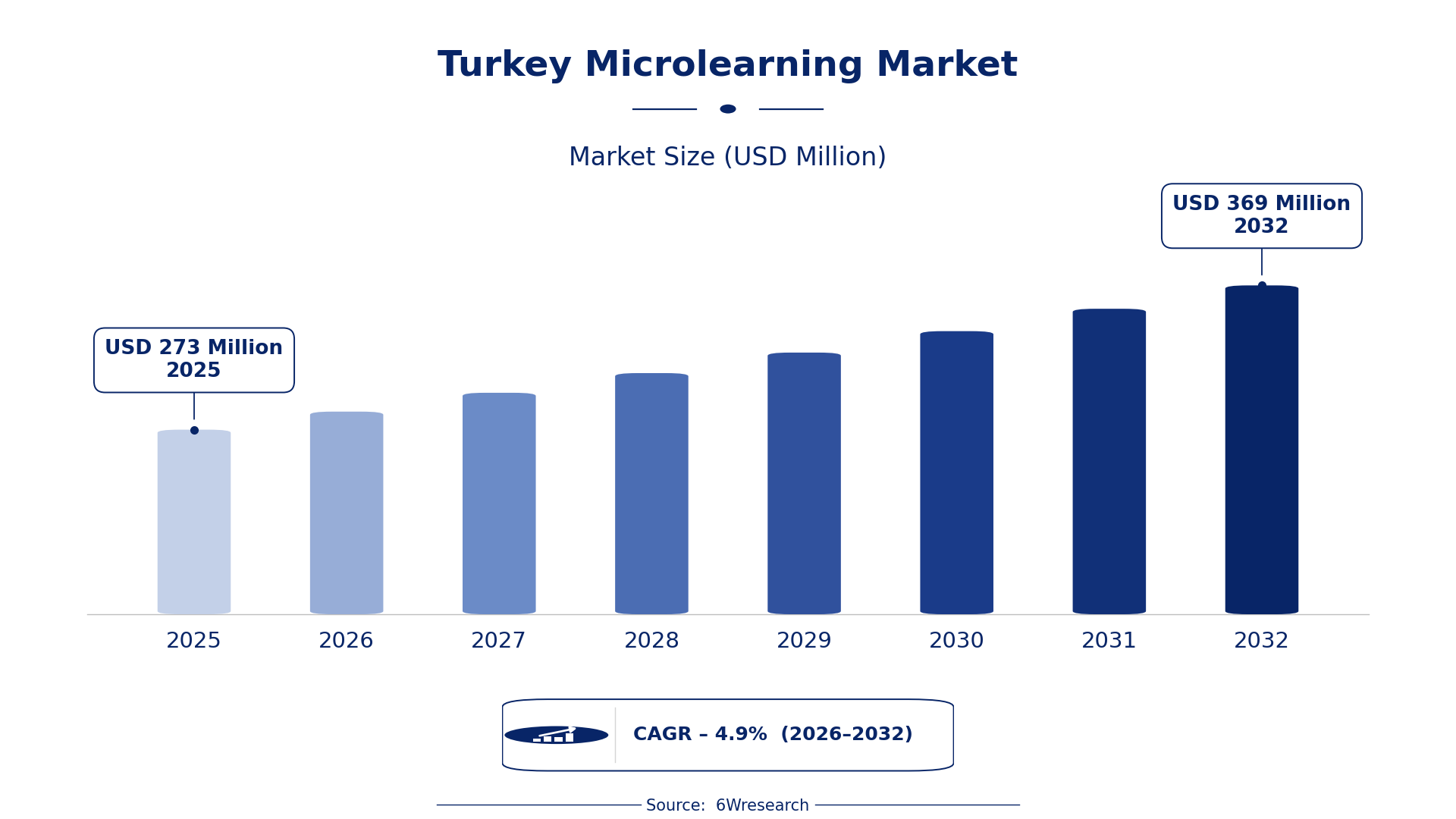
The Turkey Microlearning Market was estimated at USD 273 Million in 2025 and is projected to reach USD 369 Million by 2032, growing at a CAGR of 4.9% from 2026 to 2032.
Turkey Microlearning Market Synopsis
The drive for personalized learning experiences is the strongest force shaping the Turkey Microlearning Market today. As organizations and educational institutions prioritize efficiency, the demand for bite-sized training solutions has surged, revolutionizing traditional learning methods.
In Turkey, the increasing adoption of mobile learning platforms is further propelling this market. Microlearning's ability to cater to individual learning preferences significantly enhances engagement and retention, making it an attractive option for corporate training and professional development.
Turkey Microlearning Market Year-wise Growth Rate and Key Drivers
This graph illustrates the annual growth rates of the Turkey Microlearning Market from 2021 to 2032, highlighting a steady upward trajectory and projected expansion over the forecast period.
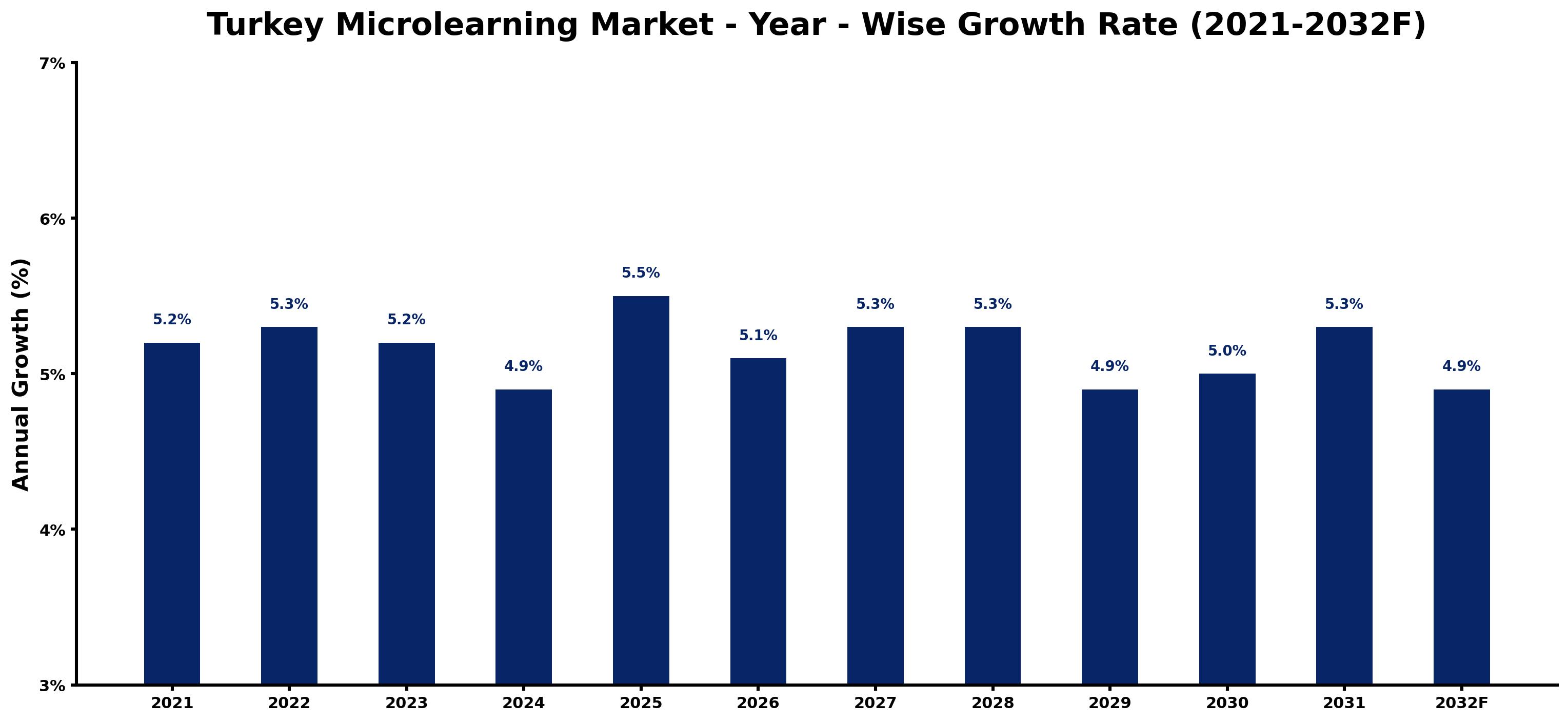
The table below presents the year‑wise growth rates along with the key drivers influencing the market
| Year | Growth Rate | Major Drivers |
| 2021 | 5.2% | Rising smartphone adoption among Turkish learners. |
| 2022 | 5.3% | Government investment in digital education technologies. |
| 2023 | 5.2% | Increased proliferation of online educational platforms. |
| 2024 | 4.9% | Corporate training initiatives embrace microlearning methodologies. |
| 2025 | 5.5% | Growing focus on upskilling in tech-oriented jobs. |
| 2026 | 5.1% | Partnerships with local universities for microlearning courses. |
| 2027 | 5.3% | Shift to remote work driving demand for bite-sized learning. |
| 2028 | 5.3% | Local companies implementing continuous learning frameworks. |
| 2029 | 4.9% | Youth demographic driving demand for mobile learning solutions. |
| 2030 | 5.0% | Cultural shift towards lifelong learning among professionals. |
| 2031 | 5.3% | Rising importance of quick skill acquisition in market. |
| 2032 | 4.9% | Increased use of microlearning in corporate talent development. |
Note: Market size estimations and growth projections presented in this report are based on 6Wresearch's proprietary forecasting methodology, utilizing the latest available industry data, government publications, and primary research inputs.
Turkey Microlearning Market Key Takeaways
Below are some of the specific key takeaways from the market, including:
- Rapid growth is anticipated in the corporate training sector, driven by the need for flexible learning solutions.
- Mobile learning platforms are becoming increasingly vital for delivering microlearning content.
- Personalized learning approaches are gaining traction, enhancing learner engagement and retention.
- Government initiatives are supporting the integration of technology in educational frameworks.
- Infrastructure improvements are crucial for the broader adoption of digital learning solutions across Turkey.
Evaluation of Restraints in Turkey Microlearning Market
Several challenges hinder the growth of the Turkey Microlearning Market. One key restraint is the integration of personalized learning technologies, which requires substantial investment and expertise. Additionally, ensuring that content remains relevant and engaging for users is a constant hurdle. There are also significant infrastructure limitations that need to be addressed to facilitate widespread adoption of digital learning solutions, particularly in rural areas.
Turkey Microlearning Market Trends
The microlearning trend is characterized by an increasing focus on mobile-first content delivery. Organizations are recognizing the benefits of short, focused learning sessions that can be accessed anytime, anywhere. This shift is being driven by the proliferation of smartphones and mobile internet access in Turkey.
Another significant trend is the use of data analytics to personalize learning experiences. By analyzing user behavior and preferences, educational institutions and corporations are tailoring content to meet the specific needs of learners, ultimately improving outcomes.
Turkey Microlearning Market Opportunities
The Turkey Microlearning Market presents numerous opportunities for growth and investment. As more organizations adopt mobile learning platforms, there is a clear demand for innovative content creation tools that facilitate the development of microlearning modules. on top of that, partnerships between educational institutions and technology providers could lead to enhanced learning experiences, making this an attractive area for investment.
Government Initiatives in the Turkey Microlearning Market
Government policy is actively shaping the Turkey Microlearning Market through various initiatives aimed at enhancing digital education. The emphasis on technology integration in schools and workplaces underscores the government's commitment to improving educational standards and accessibility. These policies are crucial for driving the adoption of microlearning solutions across the country.
- A national digital education initiative was launched in 2023, focusing on integrating microlearning methodologies into primary and secondary education curricula.
- Currently, there is an ongoing project to upgrade digital infrastructure in rural areas, aimed at increasing access to online learning resources.
- A planned public-private partnership initiative is expected to be introduced by 2025, designed to enhance digital literacy training in the workforce.
- Recent regulations were put in place to ensure that educational content meets national standards, encouraging the development of high-quality microlearning materials.
- The government has initiated a program to provide funding for educational institutions to adopt microlearning platforms and technologies, expected to roll out in early 2024.
Future Insights of the Turkey Microlearning Market
Looking ahead to 2026-2032, the Turkey Microlearning Market is set to experience substantial growth. As educational institutions and corporate training programs increasingly prioritize efficiency, microlearning will likely become a cornerstone of training strategies. The convergence of mobile technology and personalized learning experiences will drive innovation, making learning more engaging and accessible for all sectors.
Turkey Microlearning Market Latest Developments
In the past year, the Turkey Microlearning Market has seen significant advancements, reflecting a shift toward more integrated learning solutions. Organizations are increasingly investing in technology to enhance their training programs, demonstrating a growing commitment to effective learning methodologies.
- A major technology vendor launched a new microlearning platform in mid-2023, aimed at corporate clients seeking to streamline employee training.
- An initiative began in late 2022 to develop localized microlearning content tailored for the Turkish educational sector, which is currently ongoing.
- In early 2024, a leading educational institution plans to pilot a microlearning program designed to improve student engagement and retention rates.
- A partnership between two regional operators was formed in early 2023 to create a comprehensive library of microlearning resources for professional development.
- An upcoming conference focused on digital learning strategies is scheduled for late 2024, showcasing innovations in the microlearning space.
Turkey Microlearning Market - Key Attractiveness of the Report
- 10 Years of Market Numbers
- Historical Data Starting from 2022 to 2025
- Base Year: 2025
- Forecast Data until 2032
- Key Performance Indicators Impacting the Market
- Major Upcoming Developments and Projects
Key Highlights of the Report:
- Turkey Microlearning Market Outlook
- Market Size of Turkey Microlearning Market, 2025
- Forecast of Turkey Microlearning Market, 2032
- Historical Data and Forecast of Turkey Microlearning Revenues & Volume for the Period 2022-2032F
- Turkey Microlearning Market Trend Evolution
- Turkey Microlearning Market Drivers and Challenges
- Turkey Microlearning Price Trends
- Turkey Microlearning Porter's Five Forces
- Turkey Microlearning Industry Life Cycle
- Historical Data and Forecast of Turkey Microlearning Market Revenues & Volume By Component for the Period 2022-2032F
- Historical Data and Forecast of Turkey Microlearning Market Revenues & Volume By Solution for the Period 2022-2032F
- Historical Data and Forecast of Turkey Microlearning Market Revenues & Volume By Services for the Period 2022-2032F
- Historical Data and Forecast of Turkey Microlearning Market Revenues & Volume By Industry for the Period 2022-2032F
- Historical Data and Forecast of Turkey Microlearning Market Revenues & Volume By Retail for the Period 2022-2032F
- Historical Data and Forecast of Turkey Microlearning Market Revenues & Volume By Manufacturing for the Period 2022-2032F
- Historical Data and Forecast of Turkey Microlearning Market Revenues & Volume By Logistics for the Period 2022-2032F
- Historical Data and Forecast of Turkey Microlearning Market Revenues & Volume By BFSI for the Period 2022-2032F
- Historical Data and Forecast of Turkey Microlearning Market Revenues & Volume By Telecom for the Period 2022-2032F
- Historical Data and Forecast of Turkey Microlearning Market Revenues & Volume By IT for the Period 2022-2032F
- Historical Data and Forecast of Turkey Microlearning Market Revenues & Volume By Healthcare for the Period 2022-2032F
- Historical Data and Forecast of Turkey Microlearning Market Revenues & Volume By Life Sciences for the Period 2022-2032F
- Historical Data and Forecast of Turkey Microlearning Market Revenues & Volume By Deployment Type for the Period 2022-2032F
- Historical Data and Forecast of Turkey Microlearning Market Revenues & Volume By On-Premises for the Period 2022-2032F
- Historical Data and Forecast of Turkey Microlearning Market Revenues & Volume By Cloud for the Period 2022-2032F
- Historical Data and Forecast of Turkey Microlearning Market Revenues & Volume By Organization Size for the Period 2022-2032F
- Historical Data and Forecast of Turkey Microlearning Market Revenues & Volume By SMEs for the Period 2022-2032F
- Historical Data and Forecast of Turkey Microlearning Market Revenues & Volume By Large Enterprises for the Period 2022-2032F
- Turkey Microlearning Import Export Trade Statistics
- Market Opportunity Assessment By Component
- Market Opportunity Assessment By Industry
- Market Opportunity Assessment By Deployment Type
- Market Opportunity Assessment By Organization Size
- Turkey Microlearning Top Companies Market Share
- Turkey Microlearning Competitive Benchmarking By Technical and Operational Parameters
- Turkey Microlearning Company Profiles
- Turkey Microlearning Key Strategic Recommendations






































