Turkey Needle Loom Market (2026-2032) | Trends, Growth, Share, Companies, Industry, Analysis, Size, Value, Revenue & Forecast
Market Forecast By Type (High Speed Needling Machines, Medium Speed Needling Machines, Others), By Application (Artificial Leather, Automotive Felts, Carpets, Insulation Materials, Technical Felts, Blankets, Others) And Competitive Landscape
| Product Code: ETC422194 | Publication Date: Oct 2022 | Updated Date: May 2026 | Product Type: Market Research Report | |
| Publisher: 6Wresearch | Author: Ravi Bhandari | No. of Pages: 75 | No. of Figures: 35 | No. of Tables: 20 |
Turkey Needle Loom Market Growth Rate
According to 6Wresearch internal database and industry insights, the Turkey Needle Loom Market is growing at a compound annual growth rate (CAGR) of 7.5% during the forecast period (2026-2032).
Turkey Needle Loom Market Year-wise Growth Rate and Key Drivers
This graph highlights how the Turkey Needle Loom Market has steadily grown over the past five years, supported by major growth factors.
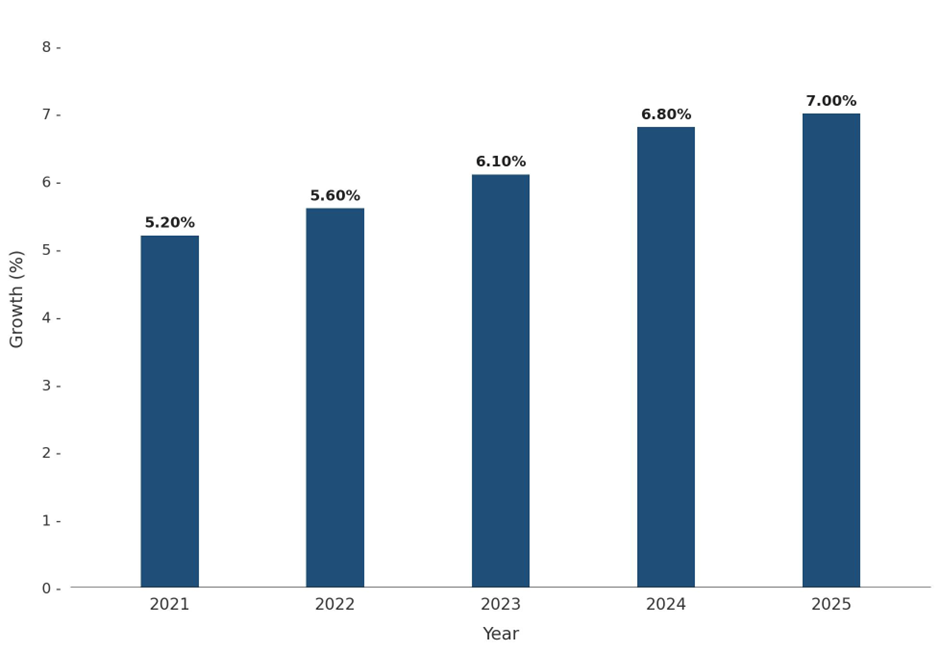
The table below presents the year‑wise growth rates along with the key drivers influencing the market
| Years | Est. Annual Growth in % | Growth Drivers |
| 2021 | 5.2% | Rising demand for non-woven fabric products in various industries. |
| 2022 | 5.6% | Technological advancements in needle loom machines which enhances productivity. |
| 2023 | 6.1% | Increasing demand for high-quality nonwoven fabrics, especially in the automotive and insulation industries. |
| 2024 | 6.8% | Expansion of needle loom manufacturing plants to meet the growing demand. |
| 2025 | 7% | Expanding use of nonwoven fabrics in hygiene, medical, and industrial applications. |
Topics Covered in the Turkey Needle Loom Market Report
The Turkey Needle Loom Market report thoroughly covers the market by types and applications. The report provides an unbiased and detailed analysis of ongoing market trends, opportunities/high growth areas, and market drivers, which would help stakeholders devise and align their market strategies according to the current and future market dynamics.
Turkey Needle Loom Market Highlights
| Report Name |
Turkey Needle Loom Market |
| Forecast period | 2026-2032 |
| CAGR | 7.5% |
| Market Size |
Nonwoven Fabrics |
Turkey Needle Loom Market Synopsis
The Turkey Needle Loom Market is set to experience a steady growth led by the increasing demand for nonwoven fabrics across various sectors such as automotive, construction, and hygiene products. Technological advancements in needle loom machinery, coupled with significant investments in manufacturing infrastructure, are driving market expansion. Moreover, the market is being fueled by the increasing demand for high-quality nonwoven fabrics in key applications like artificial leather, insulation materials, and automotive felts. Also, government initiatives and the growth of industrialization are also set to propel the market forward.
Evaluation of Growth Drivers in the Turkey Needle Loom Market (2026-2032)
Below mentioned are some growth drivers and their impact on market dynamics:
| Drivers | Primary Segments Affected | Why It Matters |
| Technological Advancements | Needle Loom Machines, Nonwoven Fabrics | Improves productivity and quality of end-products. |
| Rising Demand for Nonwoven Fabrics | Artificial Leather, Insulation Materials | Meets the rising needs in automotive, construction, and medical sectors. |
| Expansion of Manufacturing Plants | Needle Loom Machines, Nonwoven Fabrics | Supports the increasing demand for high-quality nonwoven fabrics. |
| Government Support for Manufacturing | All Segments | Provides funding and regulatory incentives to expand market’s growth. |
| Adoption of Sustainable Practices | Needle Loom Machines, Nonwoven Fabrics | Attracts eco-friendly conscious consumers and businesses. |
The Turkey Needle Loom Market is projected to grow significantly with a CAGR of 7.5% during the forecast period of 2026-2032. The key drivers leads behind this growth are technological advancements in needle loom machinery, a surge in demand for high-quality nonwoven fabrics, and the development of manufacturing capabilities. Besides, with government support through favorable policies and a shift towards eco-friendly practices, the market is set to strengthen further.
Evaluation of Restraints in the Turkey Needle Loom Market
Below mentioned are some major restraints and their influence on market dynamics:
| Restraints | Primary Segments Affected | What This Means |
| Limited Raw Material Availability | Needle Loom Machines, Nonwoven Fabrics | Disrupts production and supply chain operations. |
| High Equipment Costs | Needle Loom Machines | Limits market penetration, especially among smaller players. |
| Competition from Synthetic Materials | Nonwoven Fabrics | Minimizes demand for nonwoven fabrics in certain sectors. |
| Strict Regulatory Compliance | All Segments | Expands production costs and impacts global trade access. |
| Fluctuating Energy Costs | Needle Loom Machines, Nonwoven Fabrics | Grows production costs and affects overall profitability |
Turkey Needle Loom Market Challenges
In the Turkey Needle Loom Market, limited raw material availability and high machinery costs restricts market expansion. Although, the increasing competition from synthetic alternatives presents a challenge to the demand for nonwoven fabrics. Furthermore, strict regulatory adherence and the cost of ensuring certification can restrict market entry for smaller players, impacting their competitiveness. On top of that, shifting in raw material prices and supply chain disruptions can further worsen production costs, creating uncertainty in the market and challenging manufacturers in maintaining stable pricing.
Turkey Needle Loom Market Trends
Some major trends contributing to the Turkey Needle Loom Market Growth are:
- Automation in Needle Loom Machines: Combination of automation and intelligent control systems to raise efficiency, minimize labor costs, and enhance quality control.
- Rising Demand for Eco-friendly Products: Nonwoven fabrics made from recyclable and biodegradable materials to cater to the growing consumer preference for eco-friendly products.
- Smart Manufacturing Technologies: The usage of AI and machine learning in manufacturing processes to enhance precision and reduce waste in needle loom machines.
Investment Opportunities in the Turkey Needle Loom Market
Here are some investment opportunities in the Turkey Needle Loom Industry:
- Smart Manufacturing Solutions: Expansion in intelligent systems for better performance which is predictive maintenance, and enhanced operational efficiency.
- Eco-friendly Nonwoven Fabrics: Developing eco-friendly nonwoven fabrics to attract consumers that are more focused on environmental conservation.
- Expansion of Production Capacity: Setting up new production facilities to meet an increasing demand, especially in emerging sectors like hygiene and medical applications.
Top 5 Leading Players in the Turkey Needle Loom Market
Here are some top companies contributing to Turkey Needle Loom Market Share:
1. KARL MAYER
| Company Name | KARL MAYER |
|---|---|
| Established Year | 1937 |
| Headquarters | Obertshausen, Germany |
| Official Website | Click Here |
KARL MAYER is a leading player in the global textile machinery market, specializing in the manufacturing of needle loom machines for nonwoven fabric production. The company’s commitment to innovation and efficiency strengthens its presence in the Turkish market.
2. Trutzschler
| Company Name | Trützschler |
|---|---|
| Established Year | 1888 |
| Headquarters | Mönchengladbach, Germany |
| Official Website | Click Here |
Trützschler is a prominent player in the textile machinery market, offering needle loom machines that cater to the growing demand for nonwoven fabrics across multiple industries, including automotive and hygiene.
3. Autefa Solutions
| Company Name | Autefa Solutions |
|---|---|
| Established Year | 1949 (incorporating Fehrer technology) |
| Headquarters | Friedberg, Germany |
| Official Website | Click Here |
Market Insight: Autefa is highly regarded in Turkey for their Stylus series of needle looms. Their technology is frequently used by Turkish manufacturers to produce synthetic leather and high-performance filtration media.
4. ANDRITZ AG
| Company Name | ANDRITZ AG |
|---|---|
| Established Year | 1852 |
| Headquarters | Graz, Austria |
| Official Website | Click Here |
ANDRITZ is a global leader in supplying needle loom machines, known for its advanced solutions in the nonwoven fabrics sector. The company’s innovative technologies cater to a diverse range of applications in Turkey.
5. Oerlikon Nonwoven
| Company Name | Oerlikon Nonwoven |
|---|---|
| Established Year | 1922 |
| Headquarters | Neumünster, Germany |
| Official Website | Click Here |
Market Insight: While widely known for man-made fiber systems, Oerlikon’s expansion into needlepunching technology has gained traction in Turkey. Their focus on sustainability and "digital twins" for machinery allows Turkish factory managers to monitor production efficiency in real-time, aligning with the "Maroc Digital" and similar regional tech-transformation trends.
Government Regulations Introduced in the Turkey Needle Loom Market
According to the Turkish government data, it supports the needle loom market through initiatives aimed at improving textile manufacturing infrastructure and providing subsidies for energy-efficient machinery. The Ministry of Industry and Technology has launched programs to promote industrial automation and innovation in textile machinery which provides funding for companies investing in advanced needle loom machines. Moreover, government-backed research and development grants supports sustainable practices within the industry, making sure of the market that can adapt to global sustainability standards.
Future Insights of the Turkey Needle Loom Market
The outcome for the Turkey Needle Loom Market is optimistic, with a strong CAGR forecasted. Some government policies promotes automation, sustainability, and export growth, that will play a crucial role in shaping the market landscape. As demand for nonwoven fabrics continues to rise-up in applications like artificial leather, insulation materials, and hygiene products, Turkey's needle loom market will see sustained growth. Furthermore, advancements in high-speed needling machines and automation will drive the market toward higher productivity and quality output.
Market Segmentation Analysis
The report offers a comprehensive study of the following market segments and their leading categories.
High-Speed Needling Machines to Dominate the Market - By Type
According to Mansi Aneja, Senior Research Analyst at 6Wresearch, High-Speed Needling Machines dominate the market due to their ability to cater to large-scale nonwoven fabric production while maintaining a high quality and it should be efficient. These machines are certainly popular in industries which requires high-volume, fast production, like automotive and construction.
Artificial Leather to Dominate the Market - By Application
Artificial Leather leads the market, driven by the increasing demand for sustainable and durable materials in fashion, automotive, and furniture sectors. The popularity of artificial leather in various consumer goods is pushing forward for the need of nonwoven fabrics produced by needle loom machines.
Key attractiveness of the report
- 10 Years Market Numbers.
- Historical Data Starting from 2022 to 2025.
- Base Year: 2025
- Forecast Data until 2032.
- Key Performance Indicators Impacting the Market.
- Major Upcoming Developments and Projects.
Key Highlights of the Report:
- Turkey Needle Loom Market Outlook
- Market Size of Turkey Needle Loom Market, 2025
- Forecast of Turkey Needle Loom Market, 2032
- Historical Data and Forecast of Turkey Needle Loom Revenues & Volume for the Period 2022-2032
- Turkey Needle Loom Market Trend Evolution
- Turkey Needle Loom Market Drivers and Challenges
- Turkey Needle Loom Price Trends
- Turkey Needle Loom Porter's Five Forces
- Turkey Needle Loom Industry Life Cycle
- Historical Data and Forecast of Turkey Needle Loom Market Revenues & Volume By Type for the Period 2022-2032
- Historical Data and Forecast of Turkey Needle Loom Market Revenues & Volume By High Speed Needling Machines for the Period 2022-2032
- Historical Data and Forecast of Turkey Needle Loom Market Revenues & Volume By Medium Speed Needling Machines for the Period 2022-2032
- Historical Data and Forecast of Turkey Needle Loom Market Revenues & Volume By Others for the Period 2022-2032
- Historical Data and Forecast of Turkey Needle Loom Market Revenues & Volume By Application for the Period 2022-2032
- Historical Data and Forecast of Turkey Needle Loom Market Revenues & Volume By Artificial Leather for the Period 2022-2032
- Historical Data and Forecast of Turkey Needle Loom Market Revenues & Volume By Automotive Felts for the Period 2022-2032
- Historical Data and Forecast of Turkey Needle Loom Market Revenues & Volume By Carpets for the Period 2022-2032
- Historical Data and Forecast of Turkey Needle Loom Market Revenues & Volume By Insulation Materials for the Period 2022-2032
- Historical Data and Forecast of Turkey Needle Loom Market Revenues & Volume By Technical Felts for the Period 2022-2032
- Historical Data and Forecast of Turkey Needle Loom Market Revenues & Volume By Blankets for the Period 2022-2032
- Historical Data and Forecast of Turkey Needle Loom Market Revenues & Volume By Others for the Period 2022-2032
- Turkey Needle Loom Import Export Trade Statistics
- Market Opportunity Assessment By Type
- Market Opportunity Assessment By Application
- Turkey Needle Loom Top Companies Market Share
- Turkey Needle Loom Competitive Benchmarking By Technical and Operational Parameters
- Turkey Needle Loom Company Profiles
- Turkey Needle Loom Key Strategic Recommendations
Market covered
The report subsequently covers the market by the following segments and subsegments:
By Type
- High-Speed Needling Machines
- Medium Speed Needling Machines
- Others
By Application
- Artificial Leather
- Automotive Felts
- Carpets
- Insulation Materials
- Technical Felts
- Blankets
- Others
Turkey Needle Loom Market (2026-2032): FAQs
The Turkey Needle Loom Market is projected to grow at a CAGR of 7.5% during the forecast period (2026-2032).
Advances in automation, high-speed needle loom machines, and sustainable practices are driving technological changes in the market.
The growth in this area is driven by the increasing demand for nonwoven fabrics, improvements in needle loom technology, and government support for industrial development.
Challenges include limited raw material availability, high equipment costs, and competition from synthetic materials.
6Wresearch actively monitors the Turkey Needle Loom Market and publishes its comprehensive annual report, highlighting emerging trends, growth drivers, revenue analysis, and forecast outlook. Our insights help businesses to make data-backed strategic decisions with ongoing market dynamics. Our analysts track relevent industries related to the Turkey Needle Loom Market, allowing our clients with actionable intelligence and reliable forecasts tailored to emerging regional needs.
Yes, we provide customisation as per your requirements. To learn more, feel free to contact us on sales@6wresearch.com
| 1 Executive Summary |
| 2 Introduction |
| 2.1 Key Highlights of the Report |
| 2.2 Report Description |
| 2.3 Market Scope & Segmentation |
| 2.4 Research Methodology |
| 2.5 Assumptions |
| 3 Turkey Needle Loom Market Overview |
| 3.1 Turkey Country Macro Economic Indicators |
| 3.2 Turkey Needle Loom Market Revenues & Volume, 2022 & 2032F |
| 3.3 Turkey Needle Loom Market - Industry Life Cycle |
| 3.4 Turkey Needle Loom Market - Porter's Five Forces |
| 3.5 Turkey Needle Loom Market Revenues & Volume Share, By Type, 2022 & 2032F |
| 3.6 Turkey Needle Loom Market Revenues & Volume Share, By Application, 2022 & 2032F |
| 4 Turkey Needle Loom Market Dynamics |
| 4.1 Impact Analysis |
| 4.2 Market Drivers |
| 4.2.1 Increasing demand for technical textiles and nonwoven fabrics |
| 4.2.2 Growing focus on automation and efficiency in textile manufacturing |
| 4.2.3 Rising adoption of needle loom machines for producing high-quality fabrics |
| 4.3 Market Restraints |
| 4.3.1 High initial investment cost for setting up needle loom manufacturing units |
| 4.3.2 Intense competition from alternative technologies such as shuttle looms or circular knitting machines |
| 5 Turkey Needle Loom Market Trends |
| 6 Turkey Needle Loom Market, By Types |
| 6.1 Turkey Needle Loom Market, By Type |
| 6.1.1 Overview and Analysis |
| 6.1.2 Turkey Needle Loom Market Revenues & Volume, By Type, 2022 - 2032F |
| 6.1.3 Turkey Needle Loom Market Revenues & Volume, By High Speed Needling Machines, 2022 - 2032F |
| 6.1.4 Turkey Needle Loom Market Revenues & Volume, By Medium Speed Needling Machines, 2022 - 2032F |
| 6.1.5 Turkey Needle Loom Market Revenues & Volume, By Others, 2022 - 2032F |
| 6.2 Turkey Needle Loom Market, By Application |
| 6.2.1 Overview and Analysis |
| 6.2.2 Turkey Needle Loom Market Revenues & Volume, By Artificial Leather, 2022 - 2032F |
| 6.2.3 Turkey Needle Loom Market Revenues & Volume, By Automotive Felts, 2022 - 2032F |
| 6.2.4 Turkey Needle Loom Market Revenues & Volume, By Carpets, 2022 - 2032F |
| 6.2.5 Turkey Needle Loom Market Revenues & Volume, By Insulation Materials, 2022 - 2032F |
| 6.2.6 Turkey Needle Loom Market Revenues & Volume, By Technical Felts, 2022 - 2032F |
| 6.2.7 Turkey Needle Loom Market Revenues & Volume, By Blankets, 2022 - 2032F |
| 7 Turkey Needle Loom Market Import-Export Trade Statistics |
| 7.1 Turkey Needle Loom Market Export to Major Countries |
| 7.2 Turkey Needle Loom Market Imports from Major Countries |
| 8 Turkey Needle Loom Market Key Performance Indicators |
| 8.1 Average production speed of needle loom machines |
| 8.2 Percentage of downtime for needle loom machines |
| 8.3 Energy efficiency of needle loom machines |
| 8.4 Adoption rate of Industry 4.0 technologies in needle loom manufacturing |
| 8.5 Percentage of manufacturers offering customization options |
| 9 Turkey Needle Loom Market - Opportunity Assessment |
| 9.1 Turkey Needle Loom Market Opportunity Assessment, By Type, 2022 & 2032F |
| 9.2 Turkey Needle Loom Market Opportunity Assessment, By Application, 2022 & 2032F |
| 10 Turkey Needle Loom Market - Competitive Landscape |
| 10.1 Turkey Needle Loom Market Revenue Share, By Companies, 2025 |
| 10.2 Turkey Needle Loom Market Competitive Benchmarking, By Operating and Technical Parameters |
| 11 Company Profiles |
| 12 Recommendations |
| 13 Disclaimer |
Export potential assessment - trade Analytics for 2030
Export potential enables firms to identify high-growth global markets with greater confidence by combining advanced trade intelligence with a structured quantitative methodology. The framework analyzes emerging demand trends and country-level import patterns while integrating macroeconomic and trade datasets such as GDP and population forecasts, bilateral import–export flows, tariff structures, elasticity differentials between developed and developing economies, geographic distance, and import demand projections. Using weighted trade values from 2020–2024 as the base period to project country-to-country export potential for 2030, these inputs are operationalized through calculated drivers such as gravity model parameters, tariff impact factors, and projected GDP per-capita growth. Through an analysis of hidden potentials, demand hotspots, and market conditions that are most favorable to success, this method enables firms to focus on target countries, maximize returns, and global expansion with data, backed by accuracy.
By factoring in the projected importer demand gap that is currently unmet and could be potential opportunity, it identifies the potential for the Exporter (Country) among 190 countries, against the general trade analysis, which identifies the biggest importer or exporter.
To discover high-growth global markets and optimize your business strategy:
Click Here
Pricing
- Single User License$ 1,995
- Department License$ 2,400
- Site License$ 3,120
- Global License$ 3,795

Search
Thought Leadership and Analyst Meet





Our Clients








Latest Reports
- Philippines Polyhydroxybutyrate-co-Hydroxyvalerate Market (2026-2032) | Trends, Insights, Challenges, Restraints, Competition, Size, Value, Forecast, Pricing, Share, Outlook, Revenue, Investment Opportunities, Strategy, Drivers, Demand, Growth, segmentation, Analysis, Companies
- Peru Polyhydroxybutyrate-co-Hydroxyvalerate Market (2026-2032) | Growth, Demand, Challenges, Share, Trends, Analysis, Pricing, Investment Opportunities, Drivers, Value, Forecast, Competition, Size, Companies, Insights, Outlook, Restraints, segmentation, Revenue, Strategy
- Pakistan Polyhydroxybutyrate-co-Hydroxyvalerate Market (2026-2032) | Restraints, segmentation, Pricing, Forecast, Share, Strategy, Competition, Trends, Insights, Drivers, Challenges, Growth, Revenue, Outlook, Value, Investment Opportunities, Companies, Size, Analysis, Demand
- Oman Polyhydroxybutyrate-co-Hydroxyvalerate Market (2026-2032) | Drivers, segmentation, Insights, Competition, Pricing, Outlook, Size, Revenue, Challenges, Forecast, Analysis, Growth, Value, Share, Trends, Investment Opportunities, Strategy, Restraints, Companies, Demand
- Nigeria Polyhydroxybutyrate-co-Hydroxyvalerate Market (2026-2032) | Value, Investment Opportunities, Analysis, Revenue, Restraints, Pricing, Outlook, Competition, Demand, Growth, Forecast, Companies, Trends, Challenges, segmentation, Drivers, Insights, Share, Size, Strategy
- Nepal Polyhydroxybutyrate-co-Hydroxyvalerate Market (2026-2032) | Insights, Analysis, Drivers, Share, Revenue, Demand, segmentation, Investment Opportunities, Competition, Forecast, Growth, Pricing, Companies, Strategy, Trends, Restraints, Challenges, Outlook, Size, Value
- Myanmar Polyhydroxybutyrate-co-Hydroxyvalerate Market (2026-2032) | Outlook, Revenue, Strategy, Restraints, Drivers, segmentation, Share, Forecast, Competition, Insights, Growth, Pricing, Size, Demand, Value, Companies, Trends, Challenges, Investment Opportunities, Analysis
- Morocco Polyhydroxybutyrate-co-Hydroxyvalerate Market (2026-2032) | Outlook, Investment Opportunities, Restraints, Strategy, Forecast, Challenges, Drivers, Growth, Companies, segmentation, Trends, Size, Competition, Revenue, Demand, Insights, Share, Analysis, Value, Pricing
- Mexico Polyhydroxybutyrate-co-Hydroxyvalerate Market (2026-2032) | Size, Drivers, Outlook, Share, Strategy, Growth, Pricing, Challenges, Companies, Demand, Value, Investment Opportunities, Restraints, Trends, Forecast, segmentation, Analysis, Insights, Competition, Revenue
- Malaysia Polyhydroxybutyrate-co-Hydroxyvalerate Market (2026-2032) | Share, segmentation, Size, Companies, Analysis, Insights, Forecast, Value, Revenue, Drivers, Restraints, Challenges, Investment Opportunities, Trends, Competition, Strategy, Demand, Growth, Outlook, Pricing
Industry Events and Analyst Meet

HIMTEX 2026

India Refining Summit 2026

India EV Show 2026

EV tech India Expo 2026

Auto Tech Asia 2026
Whitepaper
- Middle East & Africa Commercial Security Market Click here to view more.
- Middle East & Africa Fire Safety Systems & Equipment Market Click here to view more.
- GCC Drone Market Click here to view more.
- Middle East Lighting Fixture Market Click here to view more.
- GCC Physical & Perimeter Security Market Click here to view more.
6WResearch In News
- Doha a strategic location for EV manufacturing hub: IPA Qatar
- Demand for luxury TVs surging in the GCC, says Samsung
- Empowering Growth: The Thriving Journey of Bangladesh’s Cable Industry
- Demand for luxury TVs surging in the GCC, says Samsung
- Video call with a traditional healer? Once unthinkable, it’s now common in South Africa
- Intelligent Buildings To Smooth GCC’s Path To Net Zero


