Turkey Over the Top Market Size & Growth Rate (2026-2032)
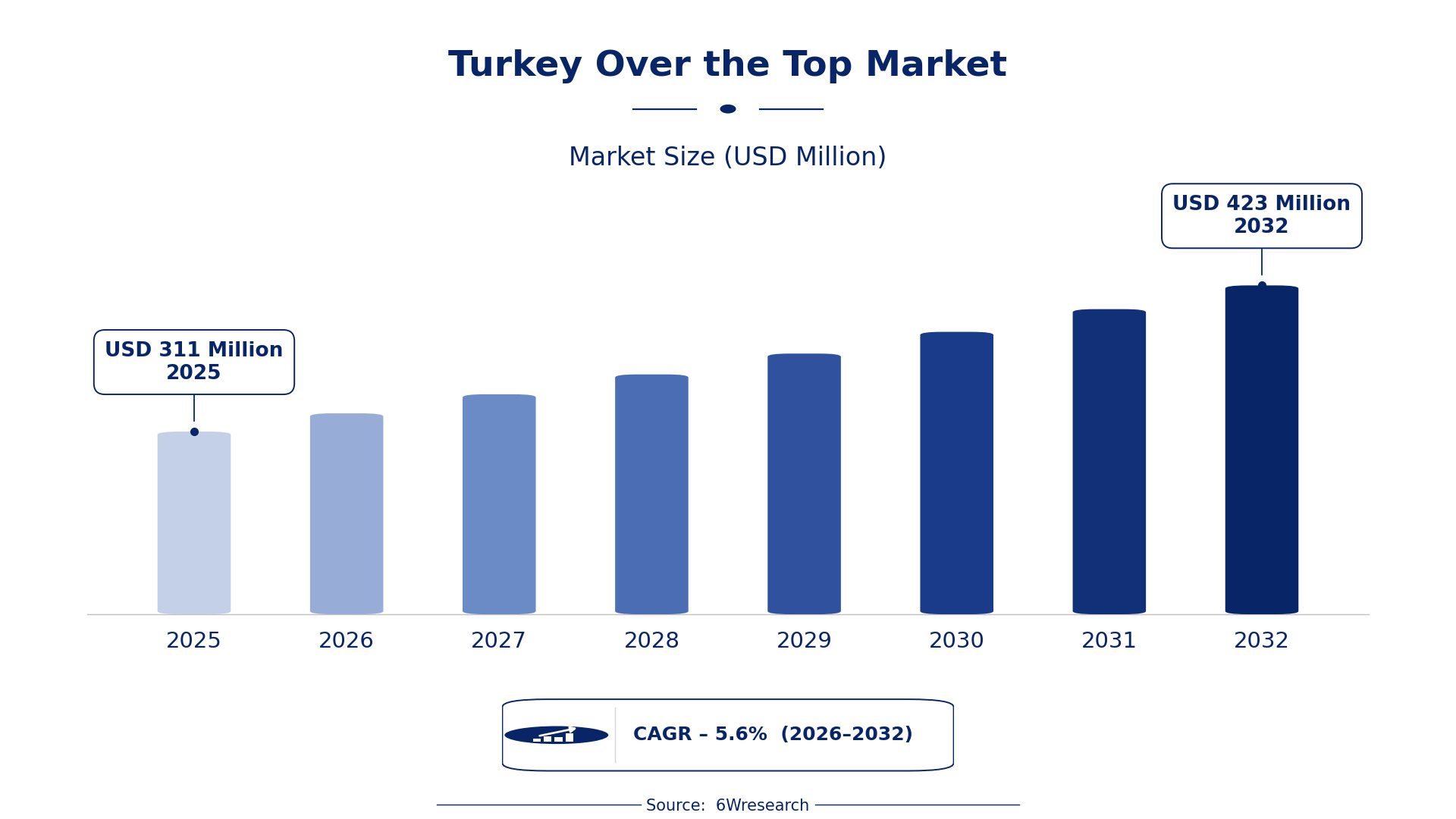
The Turkey Over the Top Market was estimated at USD 311 Million in 2025 and is projected to reach USD 423 Million by 2032, growing at a CAGR of 5.6% from 2026 to 2032.
Turkey Over the Top Market Synopsis
The driving force behind the Turkey Over the Top (OTT) market's expansion is the escalating consumer demand for streaming services. As internet penetration deepens and smartphone usage rises, platforms like Netflix and local favorites such as BluTV have captured the attention of viewers, signaling a shift away from traditional TV formats.
This market transition is marked by an increasing preference for on-demand content, where convenience reigns. OTT providers are investing heavily in content localization and original productions to attract subscribers, while partnerships with telecom operators for bundled services are becoming common, further solidifying the market's growth potential.
Turkey Over the Top Market Year-wise Growth Rate and Key Drivers
This graph illustrates the annual growth rates of the Turkey Over the Top Market from 2021 to 2032, highlighting a steady upward trajectory and projected expansion over the forecast period.
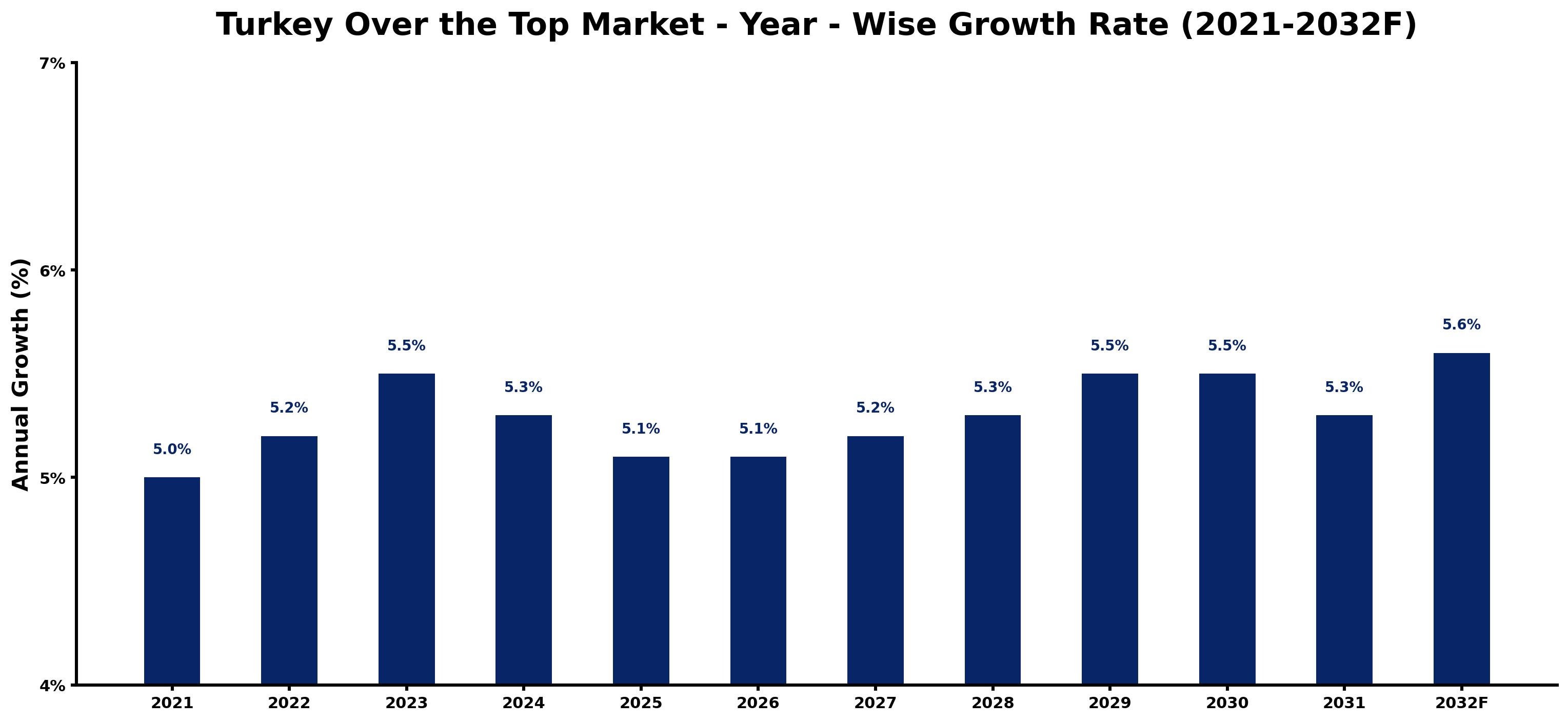
The table below presents the year‑wise growth rates along with the key drivers influencing the market
| Year | Growth Rate | Major Drivers |
| 2021 | 5.0% | Launch of BTK's digital broadcasting regulation initiatives. |
| 2022 | 5.2% | Increase in smartphone penetration among Turkish consumers. |
| 2023 | 5.5% | Growth in local content production attracting wider audiences. |
| 2024 | 5.3% | Government support for domestic OTT platforms' innovation. |
| 2025 | 5.1% | Emergence of integrated platforms boosting subscriber engagement. |
| 2026 | 5.1% | Rise in social media usage driving content consumption. |
| 2027 | 5.2% | Improved digital literacy among youth enhancing OTT adoption. |
| 2028 | 5.3% | Development of user-friendly interfaces appealing to older adults. |
| 2029 | 5.5% | Partnerships with local telecoms for bundled subscriptions. |
| 2030 | 5.5% | Increased marketing spend on regional content promotions. |
| 2031 | 5.3% | Emergence of new payment systems streamlining subscriptions. |
| 2032 | 5.6% | Regulatory reforms enhancing consumer protections in streaming. |
Note: Market size estimations and growth projections presented in this report are based on 6Wresearch's proprietary forecasting methodology, utilizing the latest available industry data, government publications, and primary research inputs.
Turkey Over the Top Market Key Takeaways
Below are some of the specific key takeaways from the market, including:
- Streaming services are rapidly overtaking traditional television in popularity.
- Local OTT platforms are increasingly focusing on original Turkish content to build loyalty.
- Partnerships with telecom operators are expanding to offer attractive bundled services.
- Consumer preferences are shifting towards subscription-based models for ad-free viewing experiences.
- The market is likely to see a rise in live streaming and exclusive content offerings in the near future.
Evaluation of Restraints in Turkey Over the Top Market
Despite promising growth, the Turkey OTT market faces several hurdles that hinder its full potential. The fierce competition among numerous service providers creates a fragmented market, leading to price wars and challenges in distinguishing services. Content licensing and intellectual property issues can restrict access to popular content, complicating strategic positioning. Additionally, evolving government regulations and potential censorship pose risks that could impact the operational freedoms of OTT platforms, necessitating careful navigation and planning.
Turkey Over the Top Market Trends
The Turkey OTT market is currently witnessing notable trends that are reshaping the consumer experience. A significant movement towards subscription-based services is evident, as audiences increasingly favor ad-free viewing. Original productions in the Turkish language are gaining traction, meeting the demand for localized content. Furthermore, strategic partnerships with telecom operators to bundle services are on the rise, enhancing access and affordability for consumers. There's also a growing emphasis on live sports content, which is becoming a key driver for viewership in this competitive environment.
Turkey Over the Top Market Opportunities
With the rising tide of digital content consumption, substantial investment opportunities are emerging within the Turkey OTT market. Local providers focusing on original Turkish content stand to benefit significantly as they cater to national preferences. Collaborations with content creators and production companies can enhance diverse offerings, while partnerships with telecom operators can broaden market reach. Adopting advanced data analytics tools can help refine user experiences, allowing platforms to attract targeted demographics more effectively.
Government Initiatives in the Turkey Over the Top Market
Government policies are shaping the Turkey OTT market with a focus on promoting competition, safeguarding consumer rights, and ensuring data privacy. The regulatory framework is designed to balance stakeholder interests while fostering a fair market environment. These policies are particularly relevant as they address key issues around content licensing and user data protection, making the market more attractive for investment.
- A national digital infrastructure upgrade programme now in its rollout phase aims to enhance internet access nationwide.
- Regulations established by the Radio and Television Supreme Council (RTUK) are currently overseeing OTT platform licensing to ensure content quality and safety.
- Recently completed initiatives include the introduction of guidelines aimed at improving consumer data protection and privacy rights.
- A planned public-private initiative is expected to bolster partnerships between OTT providers and local content creators by 2028.
- Current efforts are underway to revise the legal framework governing intellectual property rights concerning OTT content.
Future Insights of the Turkey Over the Top Market
The outlook for the Turkey OTT market between 2026 and 2032 appears optimistic, driven by increasing internet accessibility and a growing consumer preference for digital content. As high-speed internet continues to expand and new global players enter the Turkish market, competition is expected to spur innovation and content diversification. OTT providers that adapt quickly to shifting viewer preferences and invest in original content creation will likely gain a competitive edge and capture greater market share in this dynamic environment.
Turkey Over the Top Market Latest Developments
Recent months have seen significant activity in the Turkey OTT market, with providers racing to enhance their offerings and expand their reach. The trend of localized content production is ramping up, reflecting the preferences of a diverse audience base. As the industry adapts to both consumer demands and regulatory developments, several key initiatives and projects are underway.
- A major local OTT platform launched a new series aimed at attracting younger viewers, which began streaming in early 2025 and has garnered substantial viewership.
- Partnerships between telecom providers and OTT platforms are ongoing, with new bundled service packages expected to be rolled out by mid-2026.
- In Q1 2025, a leading regional operator introduced a free trial option for its OTT service, making it more accessible for first-time users.
- An initiative to enhance streaming technology for better quality is currently underway, focusing on 4K content delivery.
- A planned expansion of distribution channels for local content is expected to begin in late 2025 to reach a broader audience.
Turkey Over the Top Market - Key Attractiveness of the Report
- 10 Years of Market Numbers
- Historical Data Starting from 2022 to 2025
- Base Year: 2025
- Forecast Data until 2032
- Key Performance Indicators Impacting the Market
- Major Upcoming Developments and Projects
Key Highlights of the Report:
- Turkey Over the Top Market Outlook
- Market Size of Turkey Over the Top Market, 2025
- Forecast of Turkey Over the Top Market, 2032
- Historical Data and Forecast of Turkey Over the Top Revenues & Volume for the Period 2022-2032F
- Turkey Over the Top Market Trend Evolution
- Turkey Over the Top Market Drivers and Challenges
- Turkey Over the Top Price Trends
- Turkey Over the Top Porter's Five Forces
- Turkey Over the Top Industry Life Cycle
- Historical Data and Forecast of Turkey Over the Top Market Revenues & Volume By Type for the Period 2022-2032F
- Historical Data and Forecast of Turkey Over the Top Market Revenues & Volume By Game Streaming for the Period 2022-2032F
- Historical Data and Forecast of Turkey Over the Top Market Revenues & Volume By Audio Streaming for the Period 2022-2032F
- Historical Data and Forecast of Turkey Over the Top Market Revenues & Volume By Video Streaming for the Period 2022-2032F
- Historical Data and Forecast of Turkey Over the Top Market Revenues & Volume By Communication for the Period 2022-2032F
- Historical Data and Forecast of Turkey Over the Top Market Revenues & Volume By Monetization Model for the Period 2022-2032F
- Historical Data and Forecast of Turkey Over the Top Market Revenues & Volume By Subscription-based for the Period 2022-2032F
- Historical Data and Forecast of Turkey Over the Top Market Revenues & Volume By Advertising-based for the Period 2022-2032F
- Historical Data and Forecast of Turkey Over the Top Market Revenues & Volume By Transaction-based for the Period 2022-2032F
- Historical Data and Forecast of Turkey Over the Top Market Revenues & Volume By Streaming Device for the Period 2022-2032F
- Historical Data and Forecast of Turkey Over the Top Market Revenues & Volume By Smartphones and Tablets for the Period 2022-2032F
- Historical Data and Forecast of Turkey Over the Top Market Revenues & Volume By Desktops and Laptops for the Period 2022-2032F
- Historical Data and Forecast of Turkey Over the Top Market Revenues & Volume By IPTV and Consoles for the Period 2022-2032F
- Historical Data and Forecast of Turkey Over the Top Market Revenues & Volume By Vertical for the Period 2022-2032F
- Historical Data and Forecast of Turkey Over the Top Market Revenues & Volume By Media and Entertainment for the Period 2022-2032F
- Historical Data and Forecast of Turkey Over the Top Market Revenues & Volume By Education and Learning for the Period 2022-2032F
- Historical Data and Forecast of Turkey Over the Top Market Revenues & Volume By Gaming for the Period 2022-2032F
- Historical Data and Forecast of Turkey Over the Top Market Revenues & Volume By Service Utilities for the Period 2022-2032F
- Turkey Over the Top Import Export Trade Statistics
- Market Opportunity Assessment By Type
- Market Opportunity Assessment By Monetization Model
- Market Opportunity Assessment By Streaming Device
- Market Opportunity Assessment By Vertical
- Turkey Over the Top Top Companies Market Share
- Turkey Over the Top Competitive Benchmarking By Technical and Operational Parameters
- Turkey Over the Top Company Profiles
- Turkey Over the Top Key Strategic Recommendations






































