Turkey Personal Computers Market Size, Share & Growth Rate
The Turkey Personal Computers Market was estimated at USD 487 Million in 2025 and is projected to reach USD 673 Million by 2032, growing at a CAGR of 4.7% from 2026 to 2032. This growth trajectory is primarily fueled by the increasing demand for laptops and portable devices, driven by the rise in remote working and e-learning trends. Additionally, a burgeoning tech-savvy population and the growing penetration of e-commerce platforms are expected to enhance market dynamics significantly.
Turkey Personal Computers Market Year-wise Growth Rate and Key Drivers
This graph highlights how the Turkey Personal Computers Market has steadily grown over the years, supported by major growth factors.
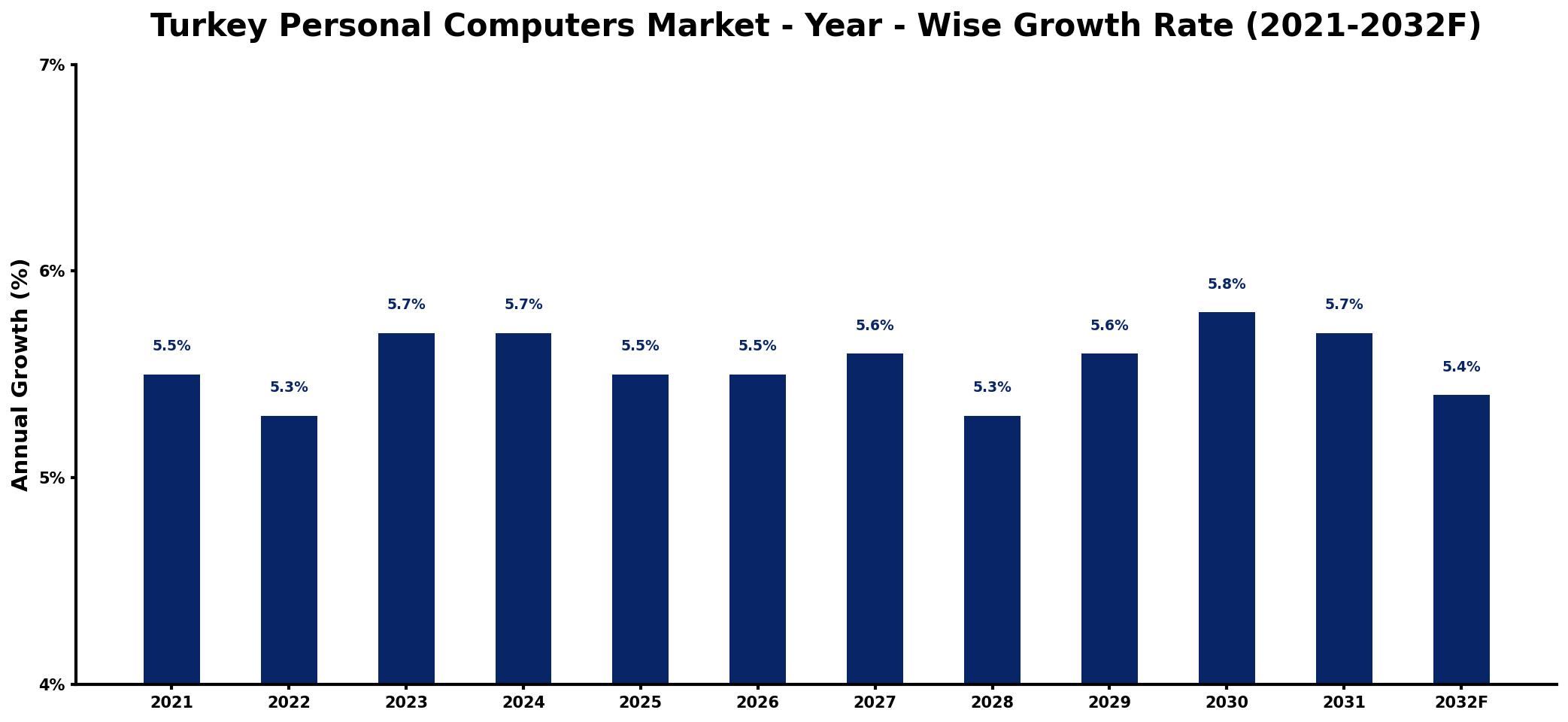
The table below presents the year‑wise growth rates along with the key drivers influencing the market
| Year | Growth Rate | Major Drivers |
| 2021 | 5.5% | Rising demand for remote work |
| 2022 | 5.3% | Increased investment in education |
| 2023 | 5.7% | Growth in digital content consumption |
| 2024 | 5.7% | Expansion of e-commerce platforms |
| 2025 | 5.5% | Surge in online gaming popularity |
| 2026 | 5.5% | Advancements in cloud technologies |
| 2027 | 5.6% | Boost in tech startup funding |
| 2028 | 5.3% | Increased focus on cybersecurity measures |
| 2029 | 5.6% | increased overall sector activity |
| 2030 | 5.8% | increased domestic production output |
| 2031 | 5.7% | Increased adoption of AI solutions |
| 2032 | 5.4% | growing regional consumption patterns |
Note: Market size estimations and growth projections presented in this report are based on 6Wresearch's proprietary forecasting methodology, utilizing the latest available industry data, government publications, and primary research inputs.
Turkey Personal Computers Market Synopsis
The Turkey Personal Computers Market is currently experiencing a notable shift towards portable computing solutions, aligning with the country's ongoing digital transformation. While traditional desktops still hold a segment of market share, the increasing preference for laptops, especially ultrabooks and 2-in-1 devices, is redefining the landscape.
As the demand for high-performance gaming PCs rises, the market is adapting to cater to both professional and recreational users. Factors like affordability, product diversity, and technological advancements continue to propel growth, promising a vibrant market environment.
Turkey Personal Computers Market Key Takeaways
- The market is shifting towards portable devices, particularly ultrabooks and 2-in-1 laptops, enhancing user flexibility.
- Growth is driven by remote work and online education, resulting in a heightened demand for versatile computing solutions.
- Sustainability trends are gaining traction, encouraging the development of eco-friendly and energy-efficient products.
- The rise of e-commerce platforms has expanded purchasing options, empowering consumers with more choices.
- Investment in local PC manufacturing and IT services offers substantial growth opportunities for stakeholders.
Evaluation of Restraints in Turkey Personal Computers Market
Despite the growth opportunities, the Turkey Personal Computers Market faces significant restraints. The rising competition from mobile devices like tablets and smartphones poses a challenge to traditional PC sales, as many consumers opt for the mobility and multifunctionality these devices offer. Economic uncertainties, including fluctuations in consumer purchasing power, also contribute to a more cautious buying environment. Additionally, rapid technological advancements require manufacturers to continuously innovate, which can be resource-intensive. The complexities introduced by trade policies and exchange rate fluctuations add to the operational challenges in this sector.
Turkey Personal Computers Market Trends
Current trends in the Turkey Personal Computers Market illustrate a clear shift towards enhanced portability and multi-functionality in computing devices. Increasingly, consumers are looking for laptops that are not only powerful but also lightweight and versatile for both work and leisure. The gaming segment is gaining traction, with more consumers investing in high-performance PCs for an immersive gaming experience. Additionally, an emerging trend is the focus on sustainability, with manufacturers exploring eco-friendly materials and energy-efficient technologies in response to consumer demand for responsible products.
Turkey Personal Computers Market Opportunities
The Turkey Personal Computers Market presents several attractive investment opportunities. With technology adoption on the rise, there is significant potential in the manufacturing sector, particularly among local producers. Companies involved in developing software solutions and IT services tailored to personal computer users are also well-positioned for growth. Furthermore, as e-commerce continues to thrive, there are lucrative opportunities in online distribution channels. The evolving consumer landscape, shaped by younger demographics seeking innovative products, invites the introduction of new technologies and smart accessories.
Government Initiatives in the Turkey Personal Computers Market
The Turkish government has implemented various initiatives to foster growth in the personal computers market. Policies include import tariffs aimed at promoting domestic manufacturing and tax incentives for companies investing in research and development within the tech sector. Furthermore, government efforts to enhance digital literacy and increase technology access in rural areas aim to bridge the digital divide, ensuring that technology benefits a wider segment of the population. Regulations addressing e-waste management demonstrate a commitment to sustainability, contributing to a more responsible approach within the industry.
Future Insights of the Turkey Personal Computers Market
Looking ahead to 2026-2032, the Turkey Personal Computers Market is poised for steady growth, driven primarily by increasing demand for laptops and desktops fueled by remote work and e-learning trends. Technological advancements such as artificial intelligence integration and enhanced gaming capabilities are expected to redefine product offerings. While challenges like supply chain disruptions and competition from mobile devices persist, the government's focus on digital literacy and technology adoption will likely spur continued market development, presenting opportunities for innovative solutions.
Turkey Personal Computers Market Latest Developments (2025 - 2026)
Recent developments in the Turkey Personal Computers Market showcase a progressive shift towards advanced product offerings. Innovations in hardware technology, particularly related to performance and energy efficiency, are being prioritized. In addition, companies are increasingly collaborating with e-commerce platforms to enhance distribution channels and reach wider consumer bases. The focus on sustainability is also manifesting in new product lines designed to meet eco-friendly standards, positioning brands favorably in a competitive landscape.
Turkey Personal Computers Market - Key Attractiveness of the Report
- 10 Years of Market Numbers
- Historical Data Starting from 2022 to 2025
- Base Year: 2025
- Forecast Data until 2032
- Key Performance Indicators Impacting the Market
- Major Upcoming Developments and Projects
Key Highlights of the Report:
- Turkey Personal Computers Market Outlook
- Market Size of Turkey Personal Computers Market, 2025
- Forecast of Turkey Personal Computers Market, 2032
- Historical Data and Forecast of Turkey Personal Computers Revenues & Volume for the Period 2022-2032F
- Turkey Personal Computers Market Trend Evolution
- Turkey Personal Computers Market Drivers and Challenges
- Turkey Personal Computers Price Trends
- Turkey Personal Computers Porter's Five Forces
- Turkey Personal Computers Industry Life Cycle
- Historical Data and Forecast of Turkey Personal Computers Market Revenues & Volume By Product Type for the Period 2022-2032F
- Historical Data and Forecast of Turkey Personal Computers Market Revenues & Volume By Desktop for the Period 2022-2032F
- Historical Data and Forecast of Turkey Personal Computers Market Revenues & Volume By Notebook for the Period 2022-2032F
- Historical Data and Forecast of Turkey Personal Computers Market Revenues & Volume By Workstation for the Period 2022-2032F
- Historical Data and Forecast of Turkey Personal Computers Market Revenues & Volume By Others for the Period 2022-2032F
- Historical Data and Forecast of Turkey Personal Computers Market Revenues & Volume By Distribution Channel for the Period 2022-2032F
- Historical Data and Forecast of Turkey Personal Computers Market Revenues & Volume By Business-To-Business (B2B) for the Period 2022-2032F
- Historical Data and Forecast of Turkey Personal Computers Market Revenues & Volume By Business-To-Consumer (B2C) for the Period 2022-2032F
- Historical Data and Forecast of Turkey Personal Computers Market Revenues & Volume By Application for the Period 2022-2032F
- Historical Data and Forecast of Turkey Personal Computers Market Revenues & Volume By Consumer for the Period 2022-2032F
- Historical Data and Forecast of Turkey Personal Computers Market Revenues & Volume By Commercial for the Period 2022-2032F
- Historical Data and Forecast of Turkey Personal Computers Market Revenues & Volume By Industrial for the Period 2022-2032F
- Turkey Personal Computers Import Export Trade Statistics
- Market Opportunity Assessment By Product Type
- Market Opportunity Assessment By Distribution Channel
- Market Opportunity Assessment By Application
- Turkey Personal Computers Top Companies Market Share
- Turkey Personal Computers Competitive Benchmarking By Technical and Operational Parameters
- Turkey Personal Computers Company Profiles
- Turkey Personal Computers Key Strategic Recommendations






































