Turkey Publishing Market Summary
The turkey publishing market was estimated at USD 468 Million in 2025 and is projected to reach USD 639 Million by 2032, growing at a CAGR of 5.1% from 2026 to 2032.
Turkey Publishing Market Year-wise Growth Rate and Key Drivers
This graph highlights how the Turkey Publishing Market has steadily grown over the past five years, supported by major growth factors.
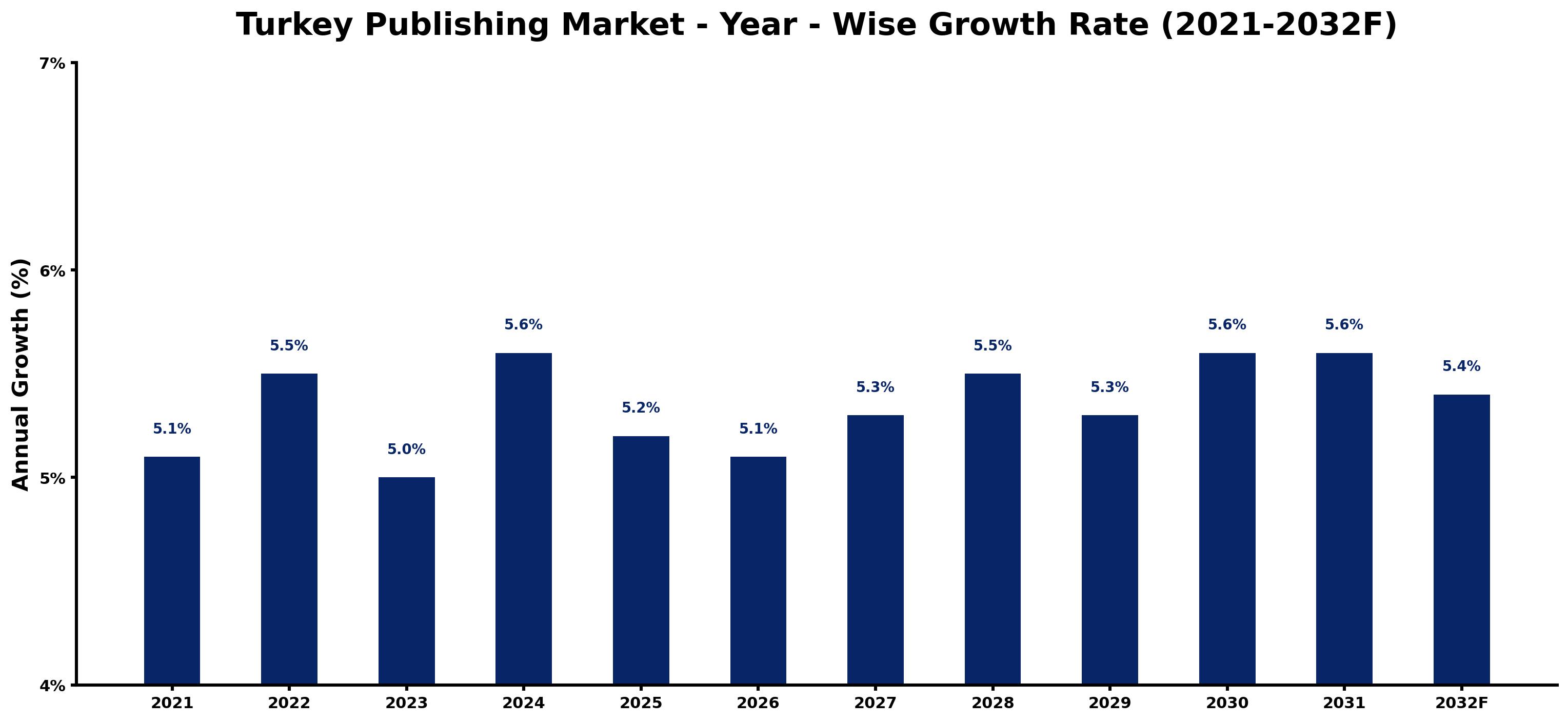
The table below presents the year wise growth rates along with the key drivers influencing the market
| Year | Growth Rate | Major Drivers |
| 2021 | 5.1% | E-books and audiobooks gained traction as digital consumption increased across demographics. |
| 2022 | 5.5% | Local authors saw heightened interest, boosting sales in regional publishing houses significantly. |
| 2023 | 5.0% | Print-on-demand services simplified publishing processes, allowing niche voices to flourish. |
| 2024 | 5.6% | Online platforms expanded distribution, enabling independent publishers to reach broader audiences. |
| 2025 | 5.2% | Youth engagement with storytelling through social media spurred innovative publishing formats. |
| 2026 | 5.1% | Collaborations with tech firms enhanced interactive reading experiences, attracting tech-savvy readers. |
| 2027 | 5.3% | Environmental concerns prompted sustainable practices in paper sourcing and production methods. |
| 2028 | 5.5% | International co-publishing ventures increased, enriching local stories with global perspectives. |
| 2029 | 5.3% | Literary festivals became pivotal for connecting authors with new readerships and markets. |
| 2030 | 5.6% | Integrating multimedia content transformed traditional books into immersive, cross-platform experiences. |
| 2031 | 5.6% | Government support for cultural initiatives fostered greater investments in local literature and arts. |
| 2032 | 5.4% | Changing consumer behaviors tilted towards personalized content, reshaping publishing strategies significantly. |
Note - Market size estimations and growth projections presented in this report are based on 6Wresearch's advanced forecasting approach, validated with industry datasets as of June 2026.
Turkey Publishing Market Synopsis
The Turkey Publishing Market is projected to reach 5.1% and witness significant growth during the forecast period (2026-2032). The landscape of publishing in Turkey is multifaceted, including both print and digital media that cater to diverse consumer preferences. Traditional print mediums, while experiencing challenges, are increasingly supplemented by the rise of digital publishing, e-books, and online content. This duality presents both challenges and opportunities for publishers as they navigate the evolving preferences of consumers in a dynamic digital age.
Turkey Publishing Market Growth Drivers
Several factors are propelling the growth of the Turkey Publishing Market. The shift towards digital platforms has been a significant catalyst, as publishers are actively embracing e-books and digital distribution methods. Additionally, there is a growing demand for educational content driven by reforms in the Turkish education system, which underscores the importance of accessible learning materials.
- The adaptation of Turkish publishers to e-commerce platforms is allowing for broader audience reach, both domestically and internationally.
- Increasing internet penetration and mobile device usage is facilitating easier access to digital books and publications, boosting reader engagement.
- Technological advancements in digital rights management are fostering a secure environment for content creators and publishers, encouraging innovation in publishing formats.
- The cultural support through government initiatives enhances the visibility of local authors and titles, creating a richer publishing ecosystem.
- Innovative publishing services are emerging that offer solutions such as multi-platform publishing and tailored content creation, meeting diverse reader needs.
Turkey Publishing Market Challenges and Restraints
While the Turkey Publishing Market presents various growth avenues, several challenges persist. Publishers are confronted with the imperative to adapt quickly to technological disruptions and shifting reader preferences, all while maintaining compliance with stringent regulatory frameworks.
- The rapid pace of digital transformation demands substantial investment in new technologies, which may not be feasible for all publishers.
- Changing reader preferences can lead to market volatility, as consumer demand fluctuates between print and digital formats.
- Compliance with copyright laws and intellectual property rights adds complexity to the licensing and distribution processes, potentially hindering market expansion.
- Economic factors related to consumer spending influence demand for both print and digital media, creating financial pressures on publishers.
- The competitive landscape, intensified by global players and online content aggregators, necessitates strategic partnerships and innovative approaches to remain relevant.
Turkey Publishing Market Government Investment and Initiatives
The Turkish government has implemented various policies aimed at enhancing the publishing sector, focusing on cultural diversity, freedom of expression, and intellectual property protection. Such initiatives are designed to stimulate growth and sustainability in the market.
- Government regulations promote editorial independence and journalistic integrity, empowering publishers to create impactful content.
- Literacy programs and educational initiatives are being supported, increasing access to books and learning resources across different demographics.
- The government invests in literary festivals and events that showcase local authors, fostering a culture of reading and writing in Turkey.
- Digital publishing initiatives underscore the importance of technological integration within the publishing sector, encouraging innovation.
- Incentives for cultural preservation and heritage projects are fostering the creation of literature that reflects Turkey's diverse histories and traditions.
Turkey Publishing Market Latest Developments (May 2025 - June 2026)
Recent developments in the Turkey Publishing Market indicate a persistent trend towards digitalization. As publishers adapt to the changing landscape, many are investing heavily in enhancing their digital offerings. Various collaborations between educational institutions and publishing houses are being formed to develop interactive learning materials that leverage technology to engage learners.
- New partnerships between local publishers and international distributors are expanding the reach of Turkish literature to global audiences.
- There has been an increase in the adoption of mobile reading applications, making access to e-books more user-friendly and widespread.
- Publishers are increasingly focusing on content diversity, including genres that cater to niche markets, thereby appealing to a broader range of readers.
- Technological innovations in printing processes are enabling quicker turnaround times for print production, allowing publishers to respond more agilely to market demands.
- Overall, the industry is witnessing a keen interest in preserving cultural narratives through literature, fuelled by both government initiatives and private sector commitments.
Turkey Publishing Market - Key Attractiveness of the Report
- 10 Years of Market Numbers
- Historical Data Starting from 2022 to 2025
- Base Year: 2025
- Forecast Data until 2032
- Key Performance Indicators Impacting the Market
- Major Upcoming Developments and Projects
Key Highlights of the Report:
- Turkey Publishing Market Outlook
- Market Size of Turkey Publishing Market, 2025
- Forecast of Turkey Publishing Market, 2032
- Historical Data and Forecast of Turkey Publishing Revenues & Volume for the Period 2022-2032F
- Turkey Publishing Market Trend Evolution
- Turkey Publishing Market Drivers and Challenges
- Turkey Publishing Price Trends
- Turkey Publishing Porter's Five Forces
- Turkey Publishing Industry Life Cycle
- Historical Data and Forecast of Turkey Publishing Market Revenues & Volume By Types for the Period 2022-2032F
- Historical Data and Forecast of Turkey Publishing Market Revenues & Volume By Newspaper for the Period 2022-2032F
- Historical Data and Forecast of Turkey Publishing Market Revenues & Volume By Journals for the Period 2022-2032F
- Historical Data and Forecast of Turkey Publishing Market Revenues & Volume By Catalogues for the Period 2022-2032F
- Historical Data and Forecast of Turkey Publishing Market Revenues & Volume By Magazine for the Period 2022-2032F
- Historical Data and Forecast of Turkey Publishing Market Revenues & Volume By Books for the Period 2022-2032F
- Historical Data and Forecast of Turkey Publishing Market Revenues & Volume By E-Books for the Period 2022-2032F
- Historical Data and Forecast of Turkey Publishing Market Revenues & Volume By Platform for the Period 2022-2032F
- Historical Data and Forecast of Turkey Publishing Market Revenues & Volume By Digital? for the Period 2022-2032F
- Historical Data and Forecast of Turkey Publishing Market Revenues & Volume By Paper for the Period 2022-2032F
- Turkey Publishing Import Export Trade Statistics
- Market Opportunity Assessment By Types
- Market Opportunity Assessment By Platform
- Turkey Publishing Top Companies Market Share
- Turkey Publishing Competitive Benchmarking By Technical and Operational Parameters
- Turkey Publishing Company Profiles
- Turkey Publishing Key Strategic Recommendations






































