Turkiye Substation Automation Market Size Growth Rate
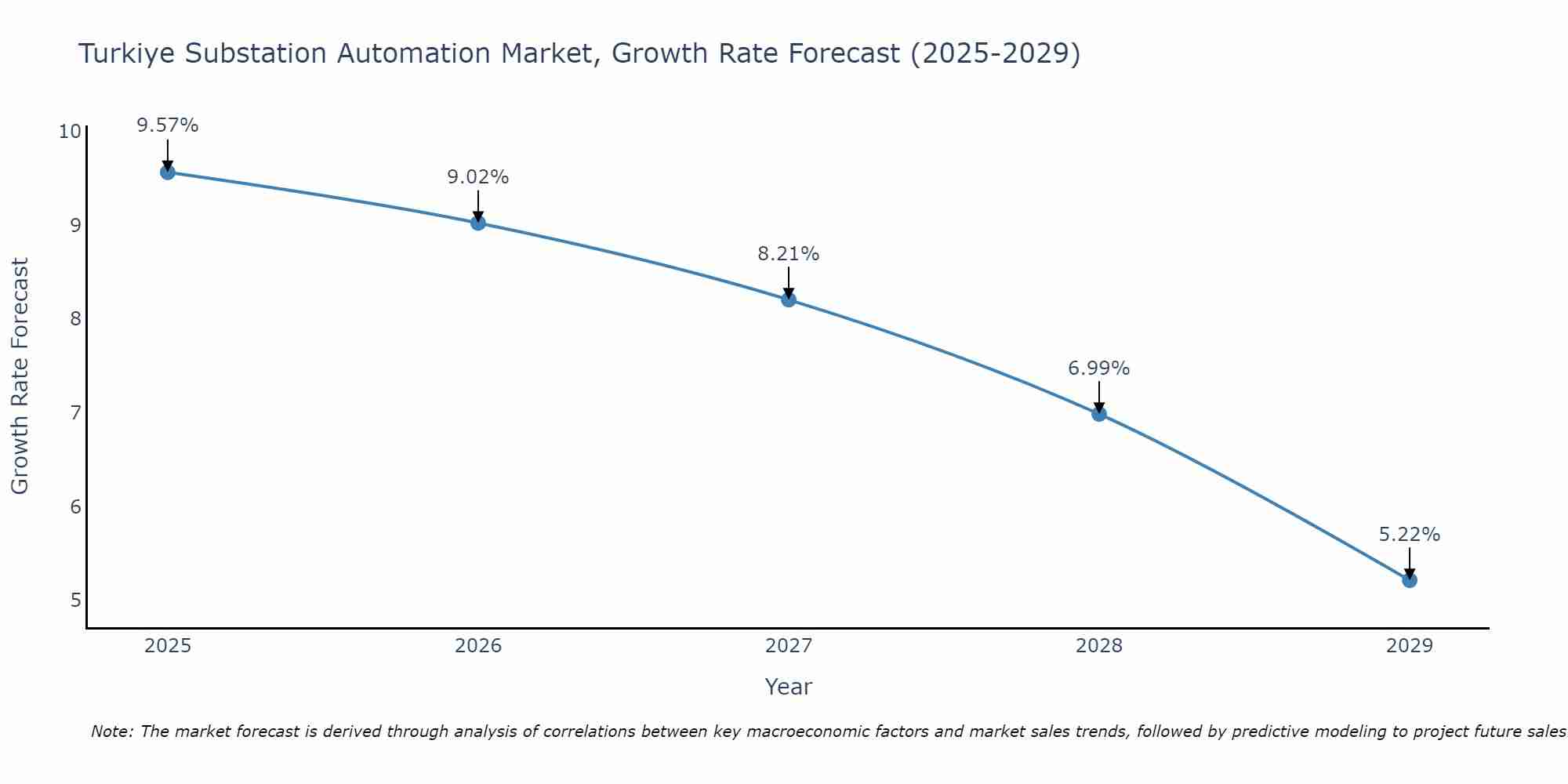
The Turkiye Substation Automation Market may undergo a gradual slowdown in growth rates between 2025 and 2029. Starting high at 9.57% in 2025, the market steadily declines to 5.22% by 2029.
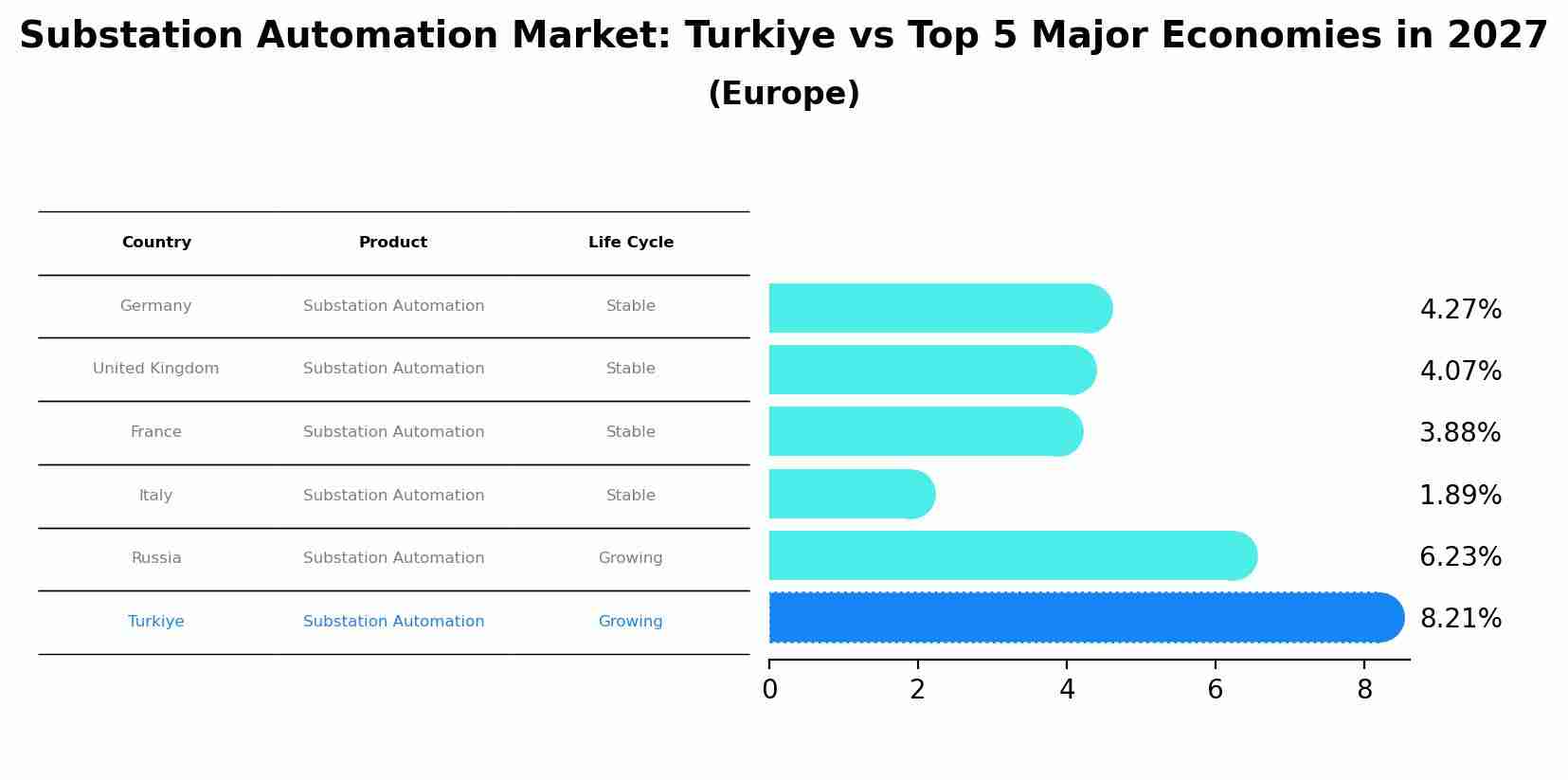
Substation Automation Market: Turkiye vs Top 5 Major Economies in 2027 (Europe)
By 2027, Turkiye's Substation Automation market is forecasted to achieve a growing growth rate of 8.21%, with Germany leading the Europe region, followed by United Kingdom, France, Italy and Russia.
Turkey Substation Automation Market Synopsis
The Turkey Substation Automation Market is witnessing significant growth driven by the increasing demand for reliable and efficient power distribution systems. The implementation of smart grid technologies, coupled with the need to enhance grid stability and reduce transmission losses, is fueling the adoption of substation automation solutions in the country. The market is characterized by a surge in investments in modernization projects to upgrade aging infrastructure and integrate renewable energy sources into the grid. Key players in the Turkey Substation Automation Market include ABB, Siemens, Schneider Electric, and General Electric, offering a range of products such as intelligent electronic devices, communication networks, and advanced control systems. With the government`s emphasis on energy efficiency and grid modernization initiatives, the Turkey Substation Automation Market is poised for continued growth in the coming years.
Turkey Substation Automation Market Trends
The Turkey Substation Automation Market is experiencing a shift towards smart grid technologies, driven by the increasing need for efficient energy management and grid reliability. Key trends include the adoption of advanced communication protocols, integration of IoT devices for real-time monitoring and control, and the implementation of digital substations. Opportunities in the market lie in the growing demand for renewable energy integration, grid modernization projects, and the emphasis on enhancing grid security and resilience. Additionally, the government`s initiatives to upgrade the existing infrastructure and improve energy efficiency further contribute to the market`s growth potential. Companies operating in the Turkey Substation Automation Market can capitalize on these trends by offering innovative solutions that enable utilities to optimize their operations and improve overall grid performance.
Turkey Substation Automation Market Challenges
In the Turkey Substation Automation Market, some challenges are faced due to the aging infrastructure of existing substations, which may limit the integration of advanced automation technologies. Additionally, the lack of standardized communication protocols across different vendors and systems can pose interoperability issues, hindering seamless automation implementation. The need for skilled professionals who are knowledgeable in both electrical engineering and IT to effectively manage and maintain automated substation systems is another challenge. Furthermore, ensuring cybersecurity measures to protect critical infrastructure from potential cyber threats is a growing concern in the Turkey Substation Automation Market. Overall, addressing these challenges will be crucial for the successful adoption and advancement of substation automation technologies in Turkey.
Turkey Substation Automation Market Investment Opportunities
The Turkey Substation Automation Market is being driven by several key factors. The increasing demand for reliable and efficient energy distribution systems, along with the integration of smart grid technologies, is fueling the growth of automation solutions in substations. The need to modernize aging infrastructure, improve grid reliability, and enhance operational efficiency are also driving the adoption of substation automation technologies in Turkey. Additionally, government initiatives and regulations aimed at promoting renewable energy integration and reducing carbon emissions are further propelling the market. The growing focus on digitalization, data analytics, and IoT applications within substations is creating opportunities for advanced automation solutions to optimize grid operations and maintenance in Turkey.
Turkey Substation Automation Market Government Polices
The Turkish government has been focusing on modernizing its energy infrastructure, including the substation automation sector, to improve efficiency, reliability, and grid stability. In recent years, policies such as the Renewable Energy Law, which aims to increase the share of renewable energy sources in the country`s energy mix, have driven investments in substation automation technologies. Additionally, initiatives like the National Smart Grid Roadmap and the Energy Efficiency Strategy target the optimization of energy consumption and the integration of smart technologies, further boosting the demand for advanced substation automation solutions in Turkey. The government`s supportive regulations, incentives, and funding schemes for the development of smart grid infrastructure are expected to drive growth and innovation in the Turkish substation automation market.
Turkey Substation Automation Market Future Outlook
The Turkey Substation Automation Market is projected to experience steady growth in the coming years driven by factors such as the government`s initiatives to modernize the power infrastructure, increasing demand for reliable and efficient energy distribution systems, and the integration of advanced technologies like smart grid solutions. Key trends shaping the market include the adoption of digital substations, IoT-enabled devices for real-time monitoring and control, and the implementation of intelligent electronic devices for improved operational efficiency. Additionally, the growing focus on renewable energy sources and the need for grid stability are expected to further propel the demand for substation automation solutions in Turkey. Overall, the market is anticipated to witness sustained growth opportunities, with a shift towards more automated, interconnected, and intelligent power systems.
Key Highlights of the Report:
- Turkey Substation Automation Market Outlook
- Market Size of Turkey Substation Automation Market, 2022
- Forecast of Turkey Substation Automation Market, 2031
- Historical Data and Forecast of Turkey Substation Automation Revenues & Volume for the Period 2021 - 2031
- Turkey Substation Automation Market Trend Evolution
- Turkey Substation Automation Market Drivers and Challenges
- Turkey Substation Automation Price Trends
- Turkey Substation Automation Porter's Five Forces
- Turkey Substation Automation Industry Life Cycle
- Historical Data and Forecast of Turkey Substation Automation Market Revenues & Volume By Offering for the Period 2021 - 2031
- Historical Data and Forecast of Turkey Substation Automation Market Revenues & Volume By Hardware for the Period 2021 - 2031
- Historical Data and Forecast of Turkey Substation Automation Market Revenues & Volume By Software for the Period 2021 - 2031
- Historical Data and Forecast of Turkey Substation Automation Market Revenues & Volume By Services for the Period 2021 - 2031
- Historical Data and Forecast of Turkey Substation Automation Market Revenues & Volume By Type for the Period 2021 - 2031
- Historical Data and Forecast of Turkey Substation Automation Market Revenues & Volume By Transmission for the Period 2021 - 2031
- Historical Data and Forecast of Turkey Substation Automation Market Revenues & Volume By Distribution for the Period 2021 - 2031
- Historical Data and Forecast of Turkey Substation Automation Market Revenues & Volume By End Use for the Period 2021 - 2031
- Historical Data and Forecast of Turkey Substation Automation Market Revenues & Volume By Utilities for the Period 2021 - 2031
- Historical Data and Forecast of Turkey Substation Automation Market Revenues & Volume By Steel for the Period 2021 - 2031
- Historical Data and Forecast of Turkey Substation Automation Market Revenues & Volume By Oil & Gas for the Period 2021 - 2031
- Historical Data and Forecast of Turkey Substation Automation Market Revenues & Volume By Mining for the Period 2021 - 2031
- Historical Data and Forecast of Turkey Substation Automation Market Revenues & Volume By Transportation for the Period 2021 - 2031
- Historical Data and Forecast of Turkey Substation Automation Market Revenues & Volume By Installation Type for the Period 2021 - 2031
- Historical Data and Forecast of Turkey Substation Automation Market Revenues & Volume By New Installations for the Period 2021 - 2031
- Historical Data and Forecast of Turkey Substation Automation Market Revenues & Volume By Retrofit Installations for the Period 2021 - 2031
- Turkey Substation Automation Import Export Trade Statistics
- Market Opportunity Assessment By Offering
- Market Opportunity Assessment By Type
- Market Opportunity Assessment By End Use
- Market Opportunity Assessment By Installation Type
- Turkey Substation Automation Top Companies Market Share
- Turkey Substation Automation Competitive Benchmarking By Technical and Operational Parameters
- Turkey Substation Automation Company Profiles
- Turkey Substation Automation Key Strategic Recommendations






































