Turkey Whiskey Market Size, Share & Growth Rate
The Turkey Whiskey Market was estimated at USD 162 Million in 2025 and is projected to reach USD 223 Million by 2032, growing at a CAGR of 4.7% from 2026 to 2032. This anticipated growth is primarily driven by an expanding interest in premium spirits among consumers and the rise of whiskey-based cocktails, which appeal especially to the younger demographic. Additionally, the increasing disposable incomes of the middle-class population are fueling demand for high-quality products, reinforcing the trajectory of the market.
Turkey Whiskey Market Growth Rate Analysis (2021-2032)
The Turkish whiskey market has exhibited stable growth, with an annual increase of 5.2% in both 2021 and 2022, reflecting a consistent rise in consumer interest and expanding luxury spending. This trend continued into 2023 and 2024, where growth reached 5.5%. Factors such as a burgeoning middle class and increased tourism have driven demand for premium whiskey brands. While fluctuations in growth rates—evident with a slight dip to 5.4% in 2026—can be attributed to regional economic uncertainties, the market rebounded to 5.8% in 2025 and anticipated similar rates through 2032. Investments in local distillation technology and infrastructure are further supporting this upward trajectory, solidifying whiskey's place in Turkey's evolving beverage landscape.
Turkey Whiskey Market Year-wise Growth Rate and Key Drivers
This graph highlights how the Turkey Whiskey Market has steadily grown over the past five years, supported by major growth factors.
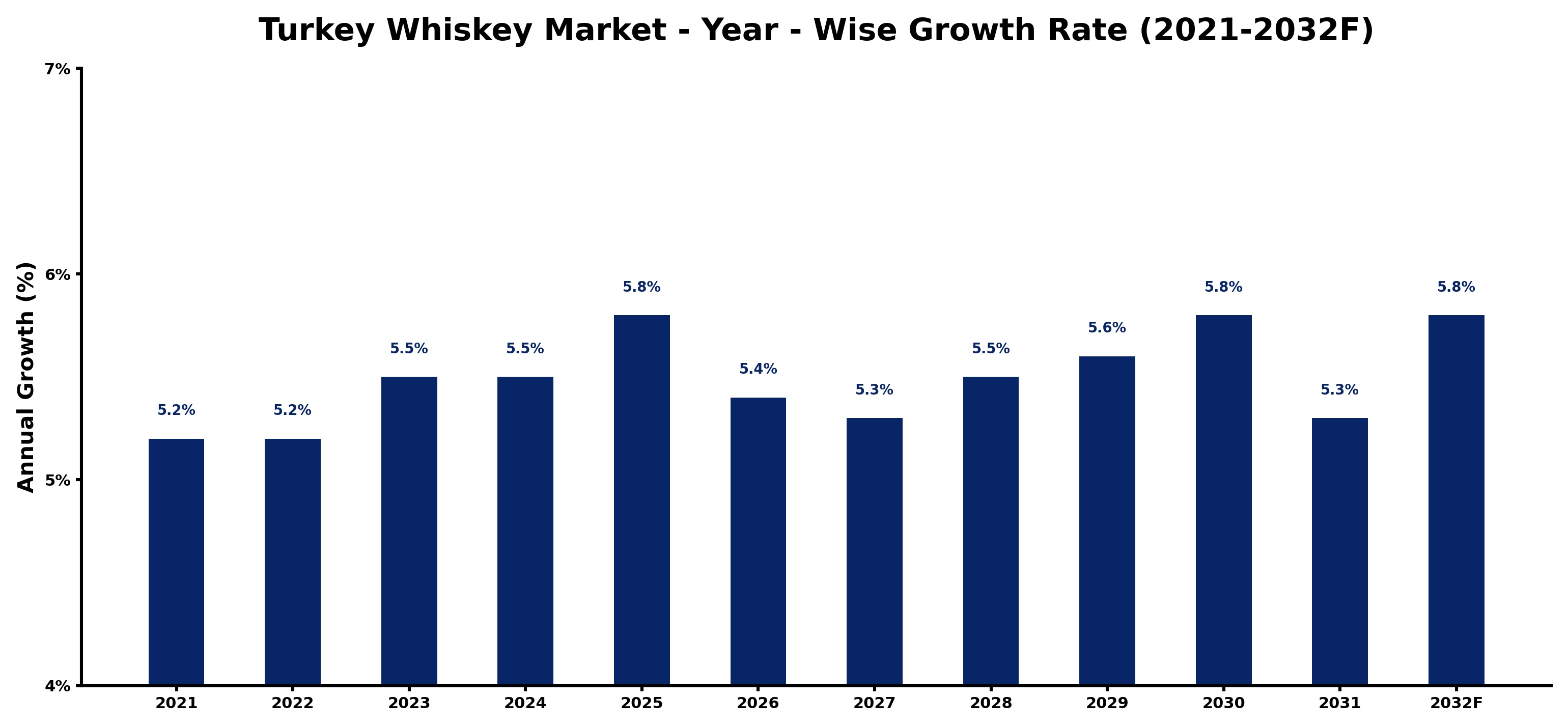
The table below presents the year‑wise growth rates along with the key drivers influencing the market
| Year | Growth Rate | Major Drivers |
| 2021 | 5.2% | Craft whiskey brands gained popularity |
| 2022 | 5.2% | Whiskey tourism attracted new consumers |
| 2023 | 5.5% | Increased social media marketing efforts |
| 2024 | 5.5% | Local distilleries expanded production capacity |
| 2025 | 5.8% | Whiskey cocktail culture flourished significantly |
| 2026 | 5.4% | Sustainable practices enhanced brand loyalty |
| 2027 | 5.3% | Consumer interest in premium offerings |
| 2028 | 5.5% | Whiskey tasting events gained traction |
| 2029 | 5.6% | Innovative flavor profiles attracted attention |
| 2030 | 5.8% | Collaborations with local artisans increased |
| 2031 | 5.3% | E-commerce platforms expanded market reach |
| 2032 | 5.8% | Whiskey education programs grew significantly |
Note - Market size estimations and growth projections presented in this report are based on 6Wresearch’s advanced forecasting approach, validated with industry datasets as of June 2026.
Turkey Whiskey Market Synopsis
Consumer demand for premium and craft whiskeys is the strongest force shaping the Turkey whiskey market today. As tastes evolve and more consumers seek unique flavor profiles, brands are responding with innovative offerings, including artisanal blends and flavored variants.
Another significant factor is the burgeoning cocktail culture, which has elevated whiskey from a traditional spirit to a contemporary choice for social occasions. This trend is coupled with regulatory support from the government, aimed at ensuring quality and promoting responsible consumption, which is helping to create a robust market environment.
Turkey Whiskey Market Key Takeaways
- The market is witnessing a shift towards premium and craft whiskey segments, fueled by evolving consumer preferences.
- Whiskey-based cocktails are becoming increasingly popular, contributing to overall market growth.
- Regulatory frameworks are being developed to support quality standards and responsible consumption practices.
- Middle-class consumer spending on alcohol is on the rise, particularly for imported and high-quality options.
- Challenges related to regulatory compliance and competition with local spirits persist but are being strategically managed.
Evaluation of Restraints in Turkey Whiskey Market
Despite its promising growth, the Turkey whiskey market faces several restraints that could hinder progress. Regulatory compliance remains a significant challenge, as licensing requirements can differ widely across various regions in Turkey. Additionally, economic fluctuations and taxation policies can impact pricing strategies and ultimately affect consumer affordability. The market also contends with intense competition from local spirits, which may influence brand positioning for international whiskey producers seeking to establish a foothold.
Turkey Whiskey Market Trends
Several trends are currently shaping the Turkey whiskey market. One of the most prominent is the premiumization trend, where consumers increasingly opt for higher-quality, artisanal products over mass-produced options. Furthermore, the introduction of flavored whiskeys caters to younger consumers looking for variety and novel experiences in their drinking habits. Sustainability is also becoming a notable focus, with brands looking to implement eco-friendly practices in production and packaging.
Turkey Whiskey Market Opportunities
The Turkey whiskey market presents genuine growth opportunities primarily through the expansion of product lines that cater to diverse consumer tastes. There is significant potential for the development of local distilleries that can produce unique blends appealing to both domestic and international markets. Additionally, the increasing interest in cocktail culture opens avenues for partnerships with bars and restaurants, further enhancing brand visibility and market penetration.
Government Initiatives in the Turkey Whiskey Market
The Turkish government is actively involved in regulating the whiskey market to ensure compliance with both national and international standards. This includes implementing quality control measures, tax regulations, and import restrictions aimed at maintaining a competitive marketplace. By collaborating with industry stakeholders, the government is fostering an environment that promotes responsible consumption while supporting local and international producers.
Future Insights of the Turkey Whiskey Market
Looking ahead to 2026-2032, the Turkey whiskey market is poised for continued growth, driven by an evolving consumer base that increasingly favors premium spirits. The demand for high-quality imported whiskeys is expected to rise as disposable incomes continue to increase. Additionally, innovative marketing strategies and collaborations with the hospitality sector will likely play a crucial role in capturing the attention of the younger demographic, further bolstering market expansion.
Turkey Whiskey Market Latest Developments (May 2025 - June 2026)
Recent developments in the Turkey whiskey market indicate a strong push towards innovation and diversification. Many brands are launching new flavor profiles to attract younger consumers and enhance their product offerings. Furthermore, there is an observable trend towards more sustainable practices in production and packaging. Industry stakeholders are also engaging in collaborations that aim to enhance the cocktail culture, creating unique experiences that spotlight whiskey.
Turkey Whiskey Market - Key Attractiveness of the Report
- 10 Years of Market Numbers
- Historical Data Starting from 2022 to 2025
- Base Year: 2025
- Forecast Data until 2032
- Key Performance Indicators Impacting the Market
- Major Upcoming Developments and Projects
Key Highlights of the Report:
- Turkey Whiskey Market Outlook
- Market Size of Turkey Whiskey Market, 2025
- Forecast of Turkey Whiskey Market, 2032
- Historical Data and Forecast of Turkey Whiskey Revenues & Volume for the Period 2022-2032F
- Turkey Whiskey Market Trend Evolution
- Turkey Whiskey Market Drivers and Challenges
- Turkey Whiskey Price Trends
- Turkey Whiskey Porter's Five Forces
- Turkey Whiskey Industry Life Cycle
- Historical Data and Forecast of Turkey Whiskey Market Revenues & Volume By Product Type for the Period 2022-2032F
- Historical Data and Forecast of Turkey Whiskey Market Revenues & Volume By American Whisky for the Period 2022-2032F
- Historical Data and Forecast of Turkey Whiskey Market Revenues & Volume By Irish Whisky for the Period 2022-2032F
- Historical Data and Forecast of Turkey Whiskey Market Revenues & Volume By Scotch Whisky for the Period 2022-2032F
- Historical Data and Forecast of Turkey Whiskey Market Revenues & Volume By Canadian Whisky for the Period 2022-2032F
- Historical Data and Forecast of Turkey Whiskey Market Revenues & Volume By Others for the Period 2022-2032F
- Historical Data and Forecast of Turkey Whiskey Market Revenues & Volume By Distribution Channel for the Period 2022-2032F
- Historical Data and Forecast of Turkey Whiskey Market Revenues & Volume By On-trade for the Period 2022-2032F
- Historical Data and Forecast of Turkey Whiskey Market Revenues & Volume By Off-trade for the Period 2022-2032F
- Turkey Whiskey Import Export Trade Statistics
- Market Opportunity Assessment By Product Type
- Market Opportunity Assessment By Distribution Channel
- Turkey Whiskey Top Companies Market Share
- Turkey Whiskey Competitive Benchmarking By Technical and Operational Parameters
- Turkey Whiskey Company Profiles
- Turkey Whiskey Key Strategic Recommendations






































