Turkey Yerba Mate Market Size, Share & Growth Rate
The Turkey Yerba Mate Market was estimated at USD 367 Million in 2025 and is projected to reach USD 479 Million by 2032, growing at a CAGR of 3.9% from 2026 to 2032. This growth is driven by an increasing awareness among consumers regarding the numerous health benefits of yerba mate, which includes its strong antioxidant properties and natural energy-boosting effects. As more Turkish consumers seek alternatives to traditional coffees and teas, yerba mate is becoming a popular choice, contributing to its rising market share.
Turkey Yerba Mate Market Year-wise Growth Rate and Key Drivers
This graph highlights how the Turkey Yerba Mate Market has steadily grown over the years, supported by major growth factors.
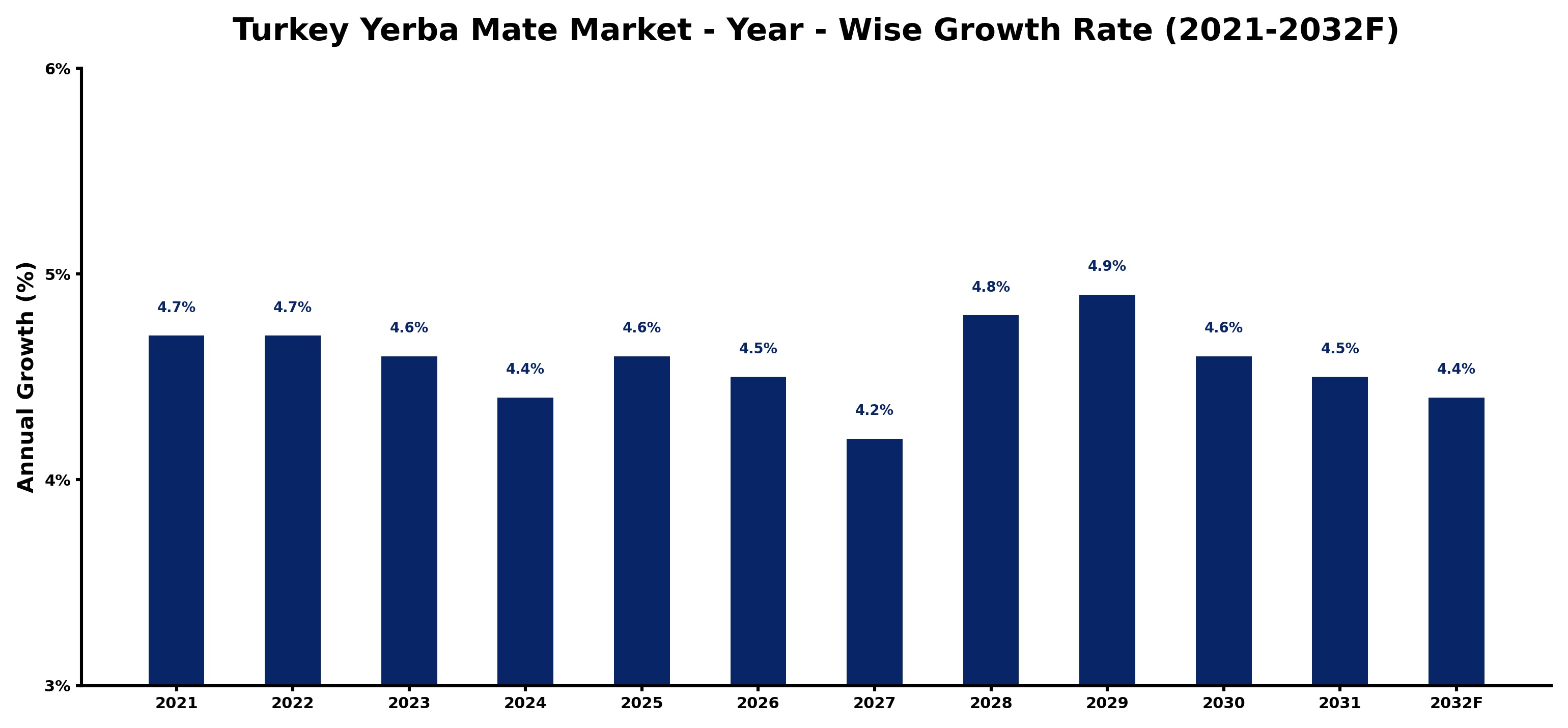
The table below presents the year‑wise growth rates along with the key drivers influencing the market
| Year | Growth Rate | Major Drivers |
| 2021 | 4.7% | Health benefits gained consumer attention |
| 2022 | 4.7% | Cultural integration enhanced market presence |
| 2023 | 4.6% | Sustainable packaging attracted eco-conscious buyers |
| 2024 | 4.4% | Social media marketing increased visibility |
| 2025 | 4.6% | New flavor innovations captivated consumers |
| 2026 | 4.5% | Local sourcing improved brand loyalty |
| 2027 | 4.2% | Increased export opportunities expanded reach |
| 2028 | 4.8% | Wellness trends drove consumption growth |
| 2029 | 4.9% | Collaborations with cafes boosted sales |
| 2030 | 4.6% | E-commerce platforms enhanced accessibility |
| 2031 | 4.5% | Educational campaigns raised product awareness |
| 2032 | 4.4% | Community events promoted brand engagement |
Note - Market size estimations and growth projections presented in this report are based on 6Wresearch's advanced forecasting approach, validated with industry datasets as of June 2026.
Turkey Yerba Mate Market Synopsis
The demand for yerba mate in Turkey is significantly influenced by a shift towards healthier beverage choices, which has prompted a growing number of consumers to seek natural and functional drinks. This trend is complemented by an increase in health consciousness among the population, particularly among younger demographics who are willing to experiment with new flavors and health-focused products.
In addition, the yerba mate market is experiencing a gradual increase in distribution channels, including cafes and health food stores, which are pivotal for enhancing accessibility. However, as the market expands, it faces the challenge of limited penetration and brand recognition among Turkish consumers who are traditionally accustomed to local teas and coffees.
Turkey Yerba Mate Market Key Takeaways
- The yerba mate market in Turkey is witnessing an upward trajectory driven by health-conscious consumer preferences.
- Import regulations and local competition pose challenges that require strategic navigation by stakeholders.
- Rising distribution channels are enhancing product availability and consumer exposure to yerba mate.
- Government initiatives are promoting awareness of yerba mate's health benefits, aiding market growth.
- Ongoing market growth presents significant opportunities for investment and product innovation in the sector.
Evaluation of Restraints in Turkey Yerba Mate Market
Despite the promising growth of the Turkey yerba mate market, several restraints hinder its full potential. Limited consumer awareness poses a significant barrier, as many Turkish consumers are not familiar with yerba mate, its origins, or its benefits. Additionally, import restrictions create challenges in sourcing high-quality yerba mate, impacting availability and pricing. The entrenched competition from traditional Turkish teas and coffee further complicates market dynamics, requiring concerted marketing efforts to shift consumer habits.
Turkey Yerba Mate Market Trends
Current trends in the Turkey yerba mate market reflect a rising interest in organic and natural beverages, aligning with global health and wellness movements. Consumers are increasingly drawn to products perceived as clean-label, prompting brands to highlight organic certifications and health benefits in their marketing. Another notable trend is the growing popularity of flavored yerba mate, catering to diverse taste preferences and broadening its appeal among younger consumers.
Turkey Yerba Mate Market Opportunities
The Turkey yerba mate market presents a wealth of opportunities for growth and investment. With a young, health-conscious population, brands can introduce innovative product lines that emphasize health benefits, organic sourcing, and unique flavor profiles. Collaborations with cafes and restaurants to create signature yerba mate beverages could further enhance visibility and consumer trial. Additionally, the exploration of e-commerce platforms to reach a broader audience can significantly drive market penetration and sales.
Government Initiatives in the Turkey Yerba Mate Market
The Turkish government has been proactive in regulating the yerba mate market, focusing on importation, distribution, and quality standards. Initiatives aimed at promoting awareness of yerba mate's health benefits are being implemented to inform consumers and encourage growth. Trade agreements with yerba mate-producing countries are being pursued to enhance import opportunities while ensuring compliance with food safety regulations, thereby creating a more favorable environment for market development.
Future Insights of the Turkey Yerba Mate Market
Looking ahead to the period from 2026 to 2032, the Turkey yerba mate market is poised for significant development. As consumer preferences continue to evolve towards healthier alternatives, yerba mate is likely to solidify its position as a staple beverage among Turkish consumers. The expansion of distribution networks, coupled with ongoing government support and consumer education campaigns, will catalyze further market penetration and brand loyalty. This period will see emerging brands capitalizing on market dynamics to establish a robust presence in the rapidly evolving beverage landscape.
Turkey Yerba Mate Market Latest Developments (May 2025 - June 2026)
Recent developments in the Turkey yerba mate market indicate a growing interest from both consumers and retailers. The launch of new product variants, including ready-to-drink yerba mate beverages, has caught the attention of health-conscious buyers. Furthermore, educational campaigns regarding the benefits of yerba mate are being implemented to increase consumer awareness. These efforts are expected to foster a positive trajectory for the market as it adapts to changing consumer preferences and enhances market penetration.
Turkey Yerba Mate Market - Key Attractiveness of the Report
- 10 Years of Market Numbers
- Historical Data Starting from 2022 to 2025
- Base Year: 2025
- Forecast Data until 2032
- Key Performance Indicators Impacting the Market
- Major Upcoming Developments and Projects
Key Highlights of the Report:
- Turkey Yerba Mate Market Outlook
- Market Size of Turkey Yerba Mate Market, 2025
- Forecast of Turkey Yerba Mate Market, 2032
- Historical Data and Forecast of Turkey Yerba Mate Revenues & Volume for the Period 2022-2032F
- Turkey Yerba Mate Market Trend Evolution
- Turkey Yerba Mate Market Drivers and Challenges
- Turkey Yerba Mate Price Trends
- Turkey Yerba Mate Porter's Five Forces
- Turkey Yerba Mate Industry Life Cycle
- Historical Data and Forecast of Turkey Yerba Mate Market Revenues & Volume By Type for the Period 2022-2032F
- Historical Data and Forecast of Turkey Yerba Mate Market Revenues & Volume By Powder for the Period 2022-2032F
- Historical Data and Forecast of Turkey Yerba Mate Market Revenues & Volume By Concentrate for the Period 2022-2032F
- Historical Data and Forecast of Turkey Yerba Mate Market Revenues & Volume By Others for the Period 2022-2032F
- Historical Data and Forecast of Turkey Yerba Mate Market Revenues & Volume By Applications for the Period 2022-2032F
- Historical Data and Forecast of Turkey Yerba Mate Market Revenues & Volume By Dietary Supplements for the Period 2022-2032F
- Historical Data and Forecast of Turkey Yerba Mate Market Revenues & Volume By Functional Foods for the Period 2022-2032F
- Historical Data and Forecast of Turkey Yerba Mate Market Revenues & Volume By Food & Beverage for the Period 2022-2032F
- Historical Data and Forecast of Turkey Yerba Mate Market Revenues & Volume By Cosmetics & Personal Care for the Period 2022-2032F
- Historical Data and Forecast of Turkey Yerba Mate Market Revenues & Volume By Distribution Channel for the Period 2022-2032F
- Historical Data and Forecast of Turkey Yerba Mate Market Revenues & Volume By Retails Stores for the Period 2022-2032F
- Historical Data and Forecast of Turkey Yerba Mate Market Revenues & Volume By Hyper Market for the Period 2022-2032F
- Historical Data and Forecast of Turkey Yerba Mate Market Revenues & Volume By Online Sites for the Period 2022-2032F
- Turkey Yerba Mate Import Export Trade Statistics
- Market Opportunity Assessment By Type
- Market Opportunity Assessment By Applications
- Market Opportunity Assessment By Distribution Channel
- Turkey Yerba Mate Top Companies Market Share
- Turkey Yerba Mate Competitive Benchmarking By Technical and Operational Parameters
- Turkey Yerba Mate Company Profiles
- Turkey Yerba Mate Key Strategic Recommendations






































