Topics Covered in United Kingdom Long-term Care Insurance Market Report
United Kingdom Long-term Care Insurance Market Report thoroughly covers the market by Risk Covered, by Policy Type, by Benefit Duration, by Benefit Amount and by Premium Payment Structure. United Kingdom Long-term Care Insurance Market Outlook report provides an unbiased and detailed analysis of the ongoing United Kingdom Long-term Care Insurance Market trends, opportunities/high growth areas, and market drivers. This would help stakeholders devise and align their market strategies according to the current and future market dynamics.
United Kingdom Long-term Care Insurance Market Synopsis
The United Kingdom Long-term care insurance market witnessed steady growth between 2022 and 2025, supported by a rapidly aging population, rising healthcare and social care costs, and increasing pressure on the public healthcare system. The old aged population and above reached at a high number in 2023, accounting for nearly less than half of the total population, highlighting the growing demand for long-term care services. The expansion of the elderly population has led to a higher prevalence of chronic conditions, mobility limitations, and cognitive disorders, increasing reliance on home care, assisted living, and nursing facilities.
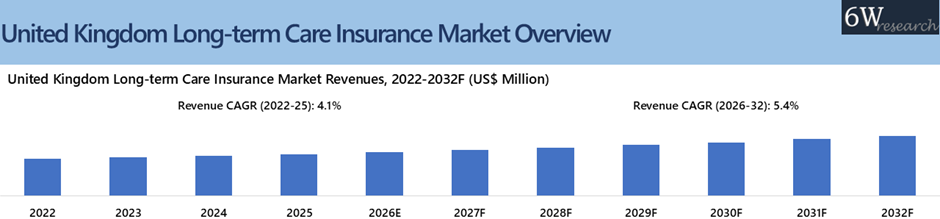
According to 6Wresearch, United Kingdom Long-term Care Insurance Market revenue size is projected to grow at a CAGR of 5.4% during 2026-2032, The market is expected to maintain strong growth momentum, supported by continued demographic aging and a rising dependency burden. Additionally, the old-age dependency ratio is projected to rise massively, intensifying pressure on the working population and public healthcare systems. Rising care costs are also expected to persist, driven by workforce shortages and increasing service complexity, further encouraging individuals to opt for insurance-based financial protection.
Moreover, expanding private care infrastructure and increasing reliance on self-funded care, is expected to accelerate adoption of long-term care insurance products. These structural trends, combined with growing awareness of retirement planning and asset protection, are expected to support sustained expansion of the market over the forecast period.
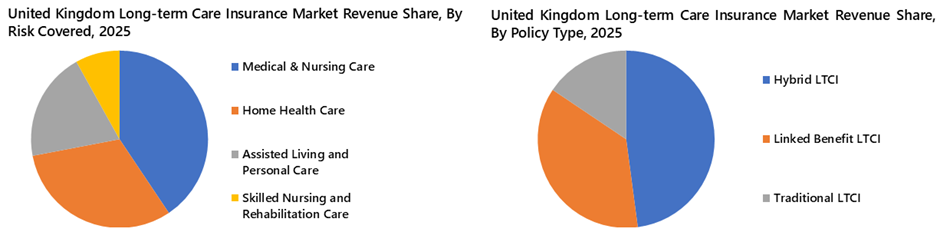
Market Segmentation By Risk Covered
The Home Health Care segment is expected to witness the fastest growth in the UK long-term care insurance market. This growth is primarily driven by the rapidly aging population and a strong preference for “aging in place,” where elderly individuals choose to receive care at home rather than in institutional settings. Additionally, rising healthcare costs and pressure on care facilities are shifting demand toward cost-effective, personalized home-based care solutions. Technological advancements such as telehealth and remote monitoring further support this transition, making home healthcare more accessible and efficient, thereby accelerating its growth trajectory.
Market Segmentation By Policy Type
The Hybrid Long-Term Care Insurance (LTCI) segment is expected to witness the fastest growth in the UK market. This is driven by its ability to combine life insurance with long-term care benefits, offering greater flexibility and value retention. Consumers increasingly prefer products that provide dual benefits, ensuring that premiums are not “lost” if care is not needed. Additionally, rising awareness of long-term care planning and demand for comprehensive financial protection solutions are further accelerating adoption. Insurers are also actively promoting hybrid products, making them more accessible and attractive across a broader customer base.
Market Segmentation By Benefit Duration
The Combination of Indefinite and Limited Benefit Periods segment is expected to witness the fastest growth in the UK long-term care insurance market. This growth is driven by increasing consumer preference for flexible coverage options that balance affordability with extended protection. Such hybrid duration policies allow policyholders to optimize premiums while still securing long-term care support beyond fixed periods. Additionally, rising uncertainty around healthcare needs and longevity is encouraging adoption of customizable plans, making this segment more attractive. Insurers are also innovating in policy design, further accelerating growth in this category.
Market Segmentation By Benefit Amount
The Indexed Benefits segment is expected to witness the fastest growth in the UK long-term care insurance market. This growth is driven by rising inflation in healthcare costs and increasing awareness of the need for benefits that adjust over time. Indexed plans offer protection against cost escalation, ensuring that coverage remains adequate in the long term. As consumers become more financially aware and seek future-proof insurance solutions, demand for indexed benefits is increasing. Insurers are also promoting these plans to address longevity risk and cost uncertainty, further supporting segment growth.
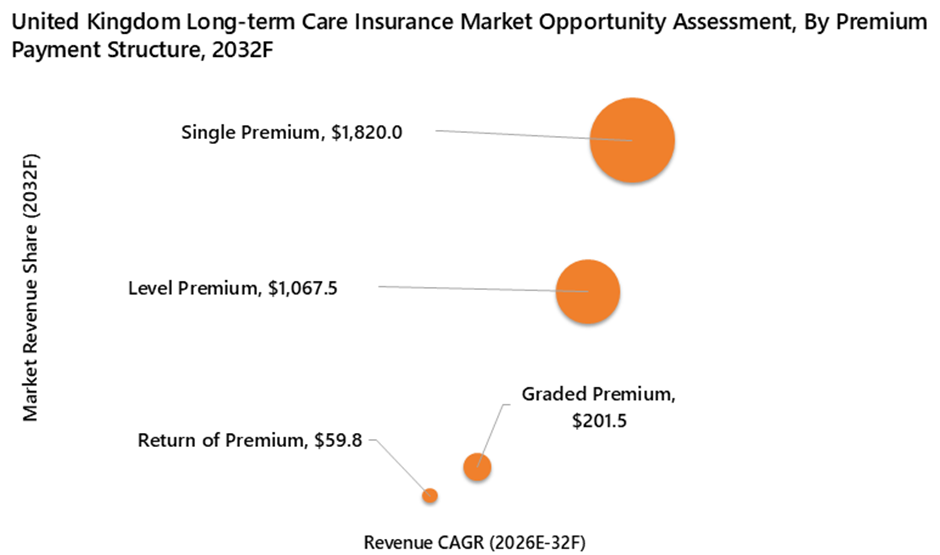
Market Segmentation By Premium Payment Structure
The Single Premium segment is expected to witness the fastest growth in the UK long-term care insurance market. This growth is driven by increasing preference among retirees for one-time payment plans that eliminate future premium obligations and simplify financial planning. Additionally, rising disposable savings among older populations and demand for guaranteed, hassle-free coverage are supporting adoption. Single premium policies also provide certainty in coverage without exposure to future premium hikes, making them highly attractive in an environment of economic uncertainty and rising healthcare costs.
Key Attractiveness of the Report
- 10 Years Market Numbers.
- Historical Data Starting from 2022 to 2025
- Base Year: 2025
- Forecast Data until 2032
- Key Performance Indicators Impacting the Market.
- Major Upcoming Developments and Projects.
Key Highlights of the Report:
- United Kingdom Long-term Care Insurance Market Overview
- United Kingdom Long-term Care Insurance Market Outlook
- United Kingdom Long-term Care Insurance Market Forecast
- Historical Data and Forecast of United Kingdom Long-term Care Insurance Market Revenue for the Period 2022-2032F
- Historical Data and Forecast of United Kingdom Long-term Care Insurance Market Revenue, By Risk Covered, for the Period 2022-2032F
- Historical Data and Forecast of United Kingdom Long-term Care Insurance Market Revenues, By Policy Type, for the Period 2022-2032F
- Historical Data and Forecast of United Kingdom Long-term Care Insurance Market Revenues, By Benefit Duration, for the Period 2022-2032F
- Historical Data and Forecast of United Kingdom Long-term Care Insurance Market Revenues, By Benefit Amount, for the Period 2022-2032F
- Historical Data and Forecast of United Kingdom Long-term Care Insurance Market Revenues, By Premium Payment Structure, for the Period 2022-2032F
- Industry Life Cycle
- Porter’s Five Force Analysis
- United Kingdom Long-term Care Insurance Market Drivers and Restraints
- United Kingdom Long-term Care Insurance Market Trends & Evolution
- Market Opportunity Assessment
- United Kingdom Long-term Care Insurance Market Revenue Ranking, By Top 3 Companies
- Competitive Benchmarking
- Company Profiles
- Key Strategic Recommendations
Market Scope and Segmentation
The report provides a detailed analysis of the following market segments:
By Risk Covered
- Medical and Nursing Care
- Home Health Care
- Assisted Living and Personal Care
- Skilled Nursing and Rehabilitation Care
By Policy Type
- Traditional LTCI (Long Term Care Insurance)
- Linked Benefit LTCI (Long Term Care Insurance)
- Hybrid LTCI (Long Term Care Insurance)
By Benefit Duration
- Indefinite (Lifetime)
- Limited Benefit Period (e.g., 2, 5, or 10 years)
- Combination of Indefinite and Limited Benefit Periods
By Benefit Amount
- Fixed Benefits (e.g., $2,000 per month)
- Indexed Benefits (e.g., benefits that increase with inflation)
By Premium Payment Structure
- Single Premium (one-time payment)
- Level Premium (fixed monthly payments over the life of the policy)
- Graded Premium (premiums that increase over time)
- Return of Premium (premiums paid back to the policyholder if no long-term care benefits are used)






































