Ukraine Artificial Intelligence in Retail Market Size & Growth Rate (2026-2032)
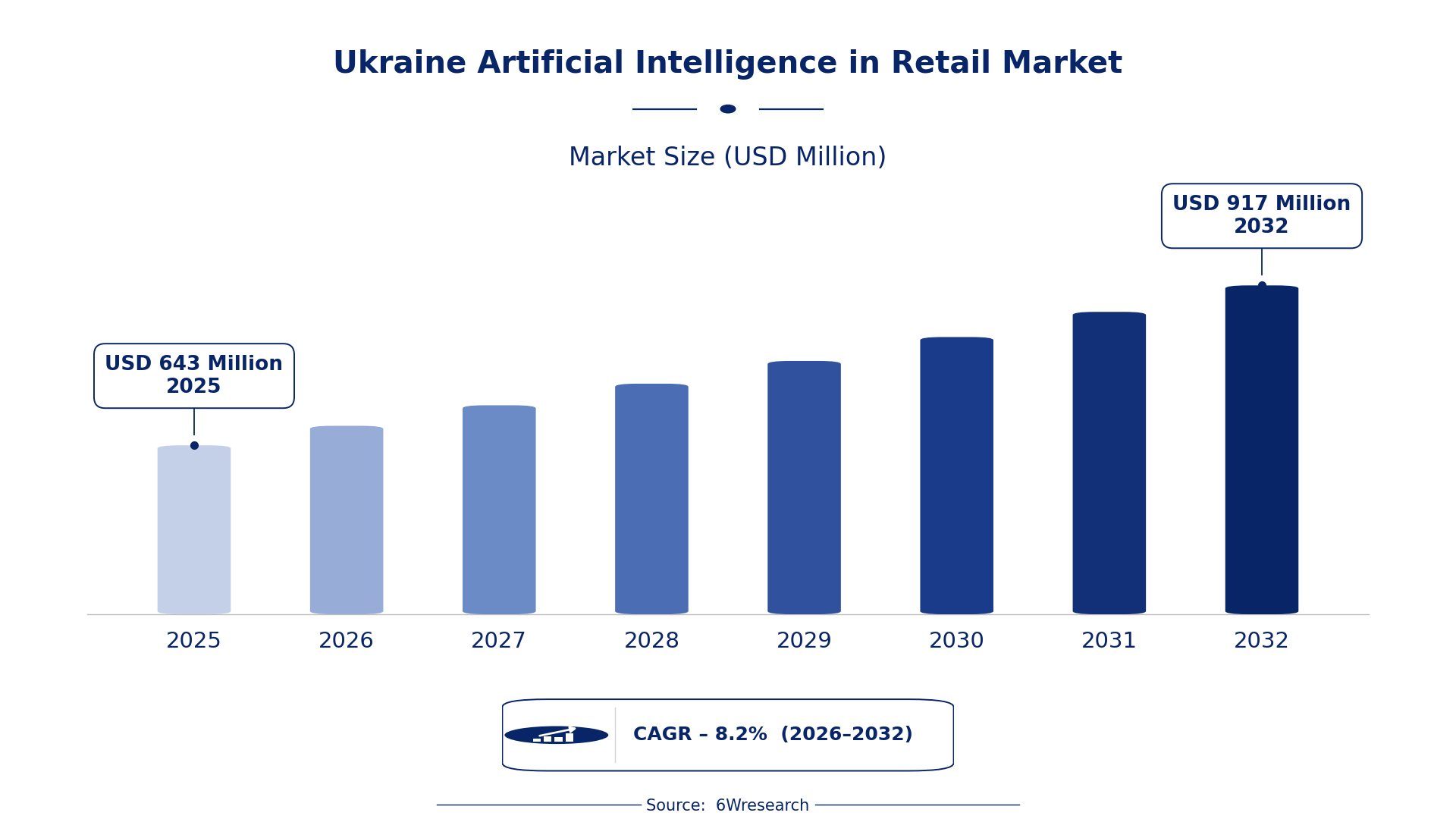
The Ukraine Artificial Intelligence in Retail Market was estimated at USD 643 Million in 2025 and is projected to reach USD 917 Million by 2032, growing at a CAGR of 8.2% from 2026 to 2032.
Ukraine Artificial Intelligence in Retail Market Synopsis
The driving force behind the Ukraine Artificial Intelligence in Retail Market is the rising adoption of AI technologies aimed at enhancing customer experiences. Retailers are increasingly leveraging AI for personalized marketing, inventory management, and demand forecasting, leading to improved operational efficiencies.
As digital transformation accelerates, retail businesses are integrating AI solutions to meet evolving consumer expectations. This trend is reflected in the growing market for AI-powered tools that assist retailers in making informed decisions, optimizing resources, and ultimately improving profitability.
Ukraine Artificial Intelligence in Retail Market Year-wise Growth Rate and Key Drivers
This graph illustrates the annual growth rates of the Ukraine Artificial Intelligence in Retail Market from 2021 to 2032, highlighting a steady upward trajectory and projected expansion over the forecast period.
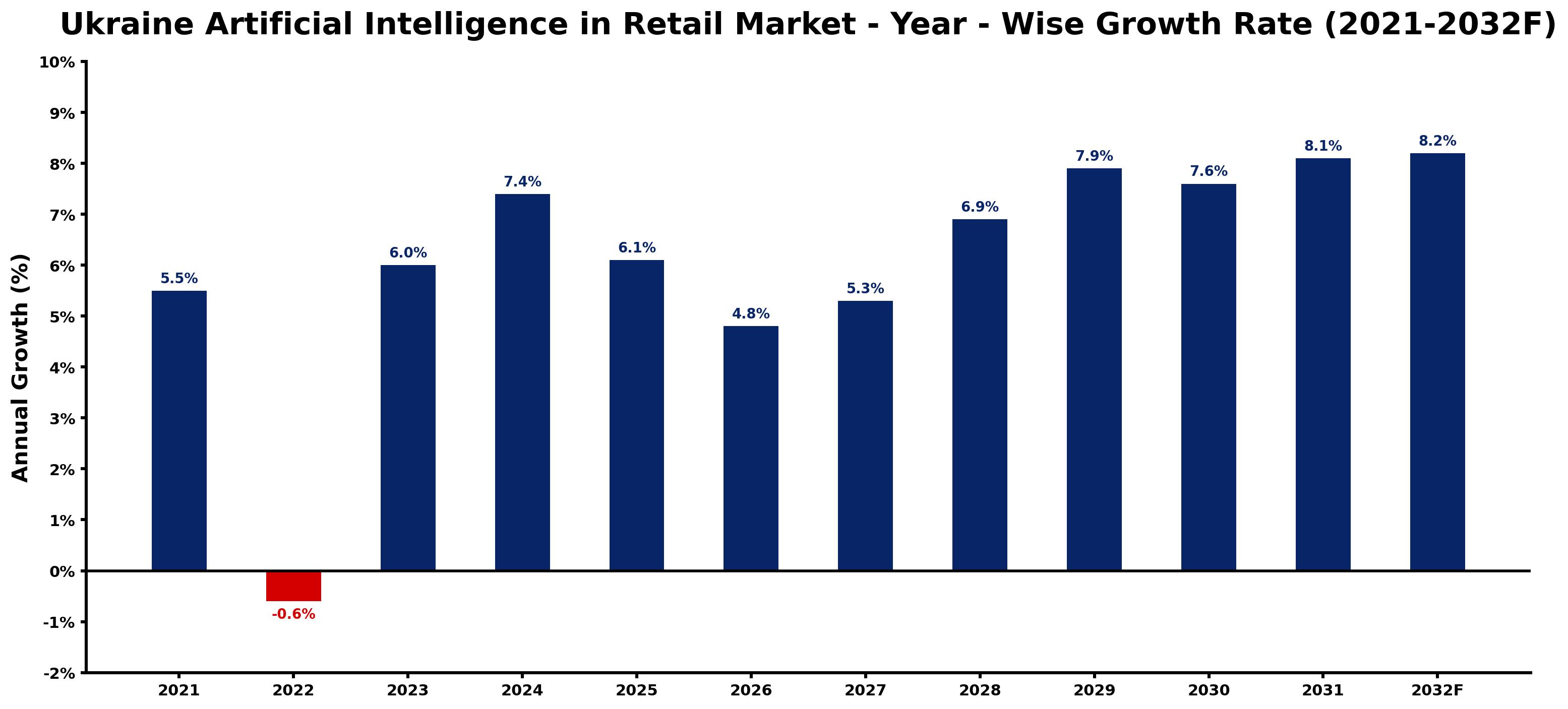
The table below presents the year‑wise growth rates along with the key drivers influencing the market
| Year | Growth Rate | Major Drivers |
| 2021 | 5.5% | Increased e-commerce growth amid pandemic-driven market shifts. |
| 2022 | -0.6% | Disrupted supply chains due to ongoing military conflict. |
| 2023 | 6.0% | Launch of Ukrainian AI research grants boosting innovation. |
| 2024 | 7.4% | Growing adoption of chatbots for enhanced customer interaction. |
| 2025 | 6.1% | Investment in Ukrainian tech startups focusing on retail analytics. |
| 2026 | 4.8% | Emergence of local AI developers enhancing retail solutions. |
| 2027 | 5.3% | Government incentives for AI integration in small businesses. |
| 2028 | 6.9% | Rise in mobile payments fueling demand for AI tools. |
| 2029 | 7.9% | Development of augmented reality applications in retail shopping. |
| 2030 | 7.6% | Consumer demand for data-driven marketing strategies increases. |
| 2031 | 8.1% | Collaboration between retailers and tech firms accelerates progress. |
| 2032 | 8.2% | Advanced machine learning algorithms improving sales forecasting. |
Note: Market size estimations and growth projections presented in this report are based on 6Wresearch's proprietary forecasting methodology, utilizing the latest available industry data, government publications, and primary research inputs.
Ukraine Artificial Intelligence in Retail Market Key Takeaways
Below are some of the specific key takeaways from the market, including:
- The market is witnessing a surge in AI-driven personalized marketing strategies.
- AI technologies are transforming inventory management and supply chain processes.
- Consumer demand for enhanced customer service is driving the adoption of AI-powered chatbots.
- Predictive analytics applications are becoming essential for understanding consumer behavior.
- Government initiatives are supporting the growth of AI technologies in retail.
Evaluation of Restraints in Ukraine Artificial Intelligence in Retail Market
Several restraints are limiting the expansion of the Ukraine Artificial Intelligence in Retail Market. A noticeable challenge is the lack of awareness among retailers regarding the potential benefits of AI technologies. Many businesses hesitate to invest due to perceived high initial costs and a scarcity of skilled professionals capable of implementing these advanced systems. on top of that, concerns around data privacy and the complexities involved in integrating AI into existing frameworks pose significant hurdles for retail operators. Addressing these issues is crucial for unlocking the full potential of AI in this sector.
Ukraine Artificial Intelligence in Retail Market Trends
The market is currently witnessing several key trends. AI-powered chatbots are increasingly being employed for customer service, providing instant support and personalized interactions. Retailers are also utilizing machine learning algorithms for data-driven inventory management, enabling them to optimize stock levels based on real-time demand forecasts. Another trend is the rise of computer vision technologies for smart checkout systems, enhancing the shopping experience while reducing operational costs.
Additionally, natural language processing is being harnessed for personalized marketing campaigns, allowing retailers to craft targeted messages that resonate with individual consumers. These trends highlight a broader shift towards data-centric approaches in retail, emphasizing the importance of AI technologies for competitive advantage.
Ukraine Artificial Intelligence in Retail Market Opportunities
Opportunities abound in the Ukraine Artificial Intelligence in Retail Market, particularly in predictive analytics. Retailers can harness AI to anticipate consumer behavior, allowing for better inventory management and tailored marketing strategies. The integration of AI in supply chain management and fraud detection presents additional avenues for growth. As e-commerce continues to flourish, leveraging AI technologies will be vital for retailers looking to enhance operational efficiency and customer satisfaction.
Government Initiatives in the Ukraine Artificial Intelligence in Retail Market
The Ukrainian government is actively fostering the development of Artificial Intelligence within the retail sector through a series of strategic initiatives. By implementing policies that encourage innovation, the government aims to create a conducive environment for AI adoption. These initiatives are crucial for addressing data protection concerns while promoting the ethical use of AI technologies.
- A recently launched National Strategy for the Development of Artificial Intelligence aims to bolster AI innovation across various sectors, including retail.
- A current initiative involves the establishment of the AI Innovation Hub, which supports AI startups with resources and guidance specific to the retail industry.
- Ongoing efforts are focused on enhancing data protection regulations to safeguard consumer information while encouraging AI integration.
- A planned public-private partnership seeks to improve digital infrastructure, facilitating the broader implementation of AI solutions in retail by 2028.
Future Insights of the Ukraine Artificial Intelligence in Retail Market
Looking ahead to 2026-2032, the Ukraine Artificial Intelligence in Retail Market is set for substantial growth. The increasing reliance on AI technologies will drive demand for solutions that enhance customer experience and operational efficiency. Retailers are expected to invest in advanced analytics and machine learning tools to gain deeper insights into consumer preferences. As online shopping becomes more prevalent, companies will prioritize AI integration to remain competitive in the digital marketplace.
Ukraine Artificial Intelligence in Retail Market Latest Developments
In the past year, the Ukraine Artificial Intelligence in Retail Market has seen notable developments that reflect its evolving nature. Retailers are actively adopting AI solutions to streamline operations and enhance customer engagement, resulting in increased investment in this technology.
- A major technology vendor announced the rollout of an AI-powered inventory management system in late 2025, aimed at optimizing stock levels for retailers.
- Currently, several retailers are implementing AI-driven chatbots to improve customer service, with initial deployments starting in Q1 2026.
- A planned initiative for 2027 aims to introduce machine learning algorithms in retail analytics, enhancing decision-making capabilities for businesses.
- An ongoing partnership between tech firms is focused on developing advanced predictive analytics tools, enhancing the market's capacity for understanding consumer trends.
Ukraine Artificial Intelligence in Retail Market - Key Attractiveness of the Report
- 10 Years of Market Numbers
- Historical Data Starting from 2022 to 2025
- Base Year: 2025
- Forecast Data until 2032
- Key Performance Indicators Impacting the Market
- Major Upcoming Developments and Projects
Key Highlights of the Report:
- Ukraine Artificial Intelligence in Retail Market Outlook
- Market Size of Ukraine Artificial Intelligence in Retail Market, 2025
- Forecast of Ukraine Artificial Intelligence in Retail Market, 2032
- Historical Data and Forecast of Ukraine Artificial Intelligence in Retail Revenues & Volume for the Period 2022-2032F
- Ukraine Artificial Intelligence in Retail Market Trend Evolution
- Ukraine Artificial Intelligence in Retail Market Drivers and Challenges
- Ukraine Artificial Intelligence in Retail Price Trends
- Ukraine Artificial Intelligence in Retail Porter's Five Forces
- Ukraine Artificial Intelligence in Retail Industry Life Cycle
- Historical Data and Forecast of Ukraine Artificial Intelligence in Retail Market Revenues & Volume By Type for the Period 2022-2032F
- Historical Data and Forecast of Ukraine Artificial Intelligence in Retail Market Revenues & Volume By Online for the Period 2022-2032F
- Historical Data and Forecast of Ukraine Artificial Intelligence in Retail Market Revenues & Volume By Offline for the Period 2022-2032F
- Historical Data and Forecast of Ukraine Artificial Intelligence in Retail Market Revenues & Volume By Service for the Period 2022-2032F
- Historical Data and Forecast of Ukraine Artificial Intelligence in Retail Market Revenues & Volume By Professional for the Period 2022-2032F
- Historical Data and Forecast of Ukraine Artificial Intelligence in Retail Market Revenues & Volume By Managed for the Period 2022-2032F
- Historical Data and Forecast of Ukraine Artificial Intelligence in Retail Market Revenues & Volume By Technology for the Period 2022-2032F
- Historical Data and Forecast of Ukraine Artificial Intelligence in Retail Market Revenues & Volume By Machine Learning for the Period 2022-2032F
- Historical Data and Forecast of Ukraine Artificial Intelligence in Retail Market Revenues & Volume By Deep Learning for the Period 2022-2032F
- Historical Data and Forecast of Ukraine Artificial Intelligence in Retail Market Revenues & Volume By NLP for the Period 2022-2032F
- Ukraine Artificial Intelligence in Retail Import Export Trade Statistics
- Market Opportunity Assessment By Type
- Market Opportunity Assessment By Service
- Market Opportunity Assessment By Technology
- Ukraine Artificial Intelligence in Retail Top Companies Market Share
- Ukraine Artificial Intelligence in Retail Competitive Benchmarking By Technical and Operational Parameters
- Ukraine Artificial Intelligence in Retail Company Profiles
- Ukraine Artificial Intelligence in Retail Key Strategic Recommendations






































