United Arab Emirates (UAE) Data Center Physical Security Market Size & Growth Rate (2026-2032)
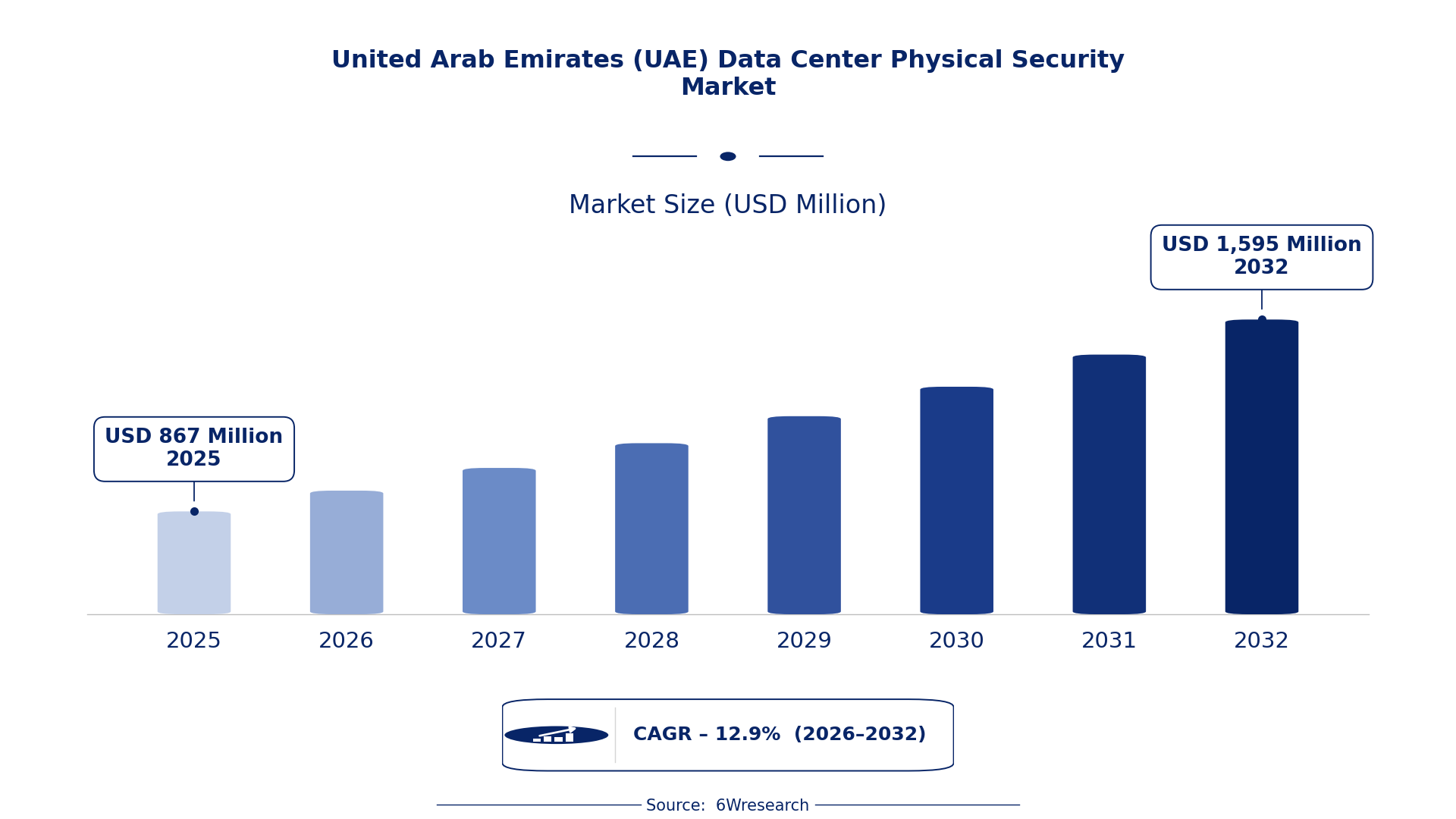
The United Arab Emirates (UAE) Data Center Physical Security Market was estimated at USD 867 Million in 2025 and is projected to reach USD 1595 Million by 2032, growing at a CAGR of 12.9% from 2026 to 2032.
United Arab Emirates (UAE) Data Center Physical Security Market Synopsis
The UAE's data center physical security market is becoming increasingly critical as the nation strengthens its position as a digital economy powerhouse. With a growing number of data centers supporting various sectors, ensuring their physical protection against potential threats has become a top priority for stakeholders.
The demand for advanced security solutions—encompassing access control systems, surveillance technologies, and monitoring capabilities—is surging. This growth reflects a commitment to safeguarding sensitive data against threats, such as theft, vandalism, and espionage, that could disrupt operations and compromise data integrity.
United Arab Emirates (UAE) Data Center Physical Security Market Year-wise Growth Rate and Key Drivers
This graph illustrates the annual growth rates of the United Arab Emirates (UAE) Data Center Physical Security Market from 2021 to 2032, highlighting a steady upward trajectory and projected expansion over the forecast period.
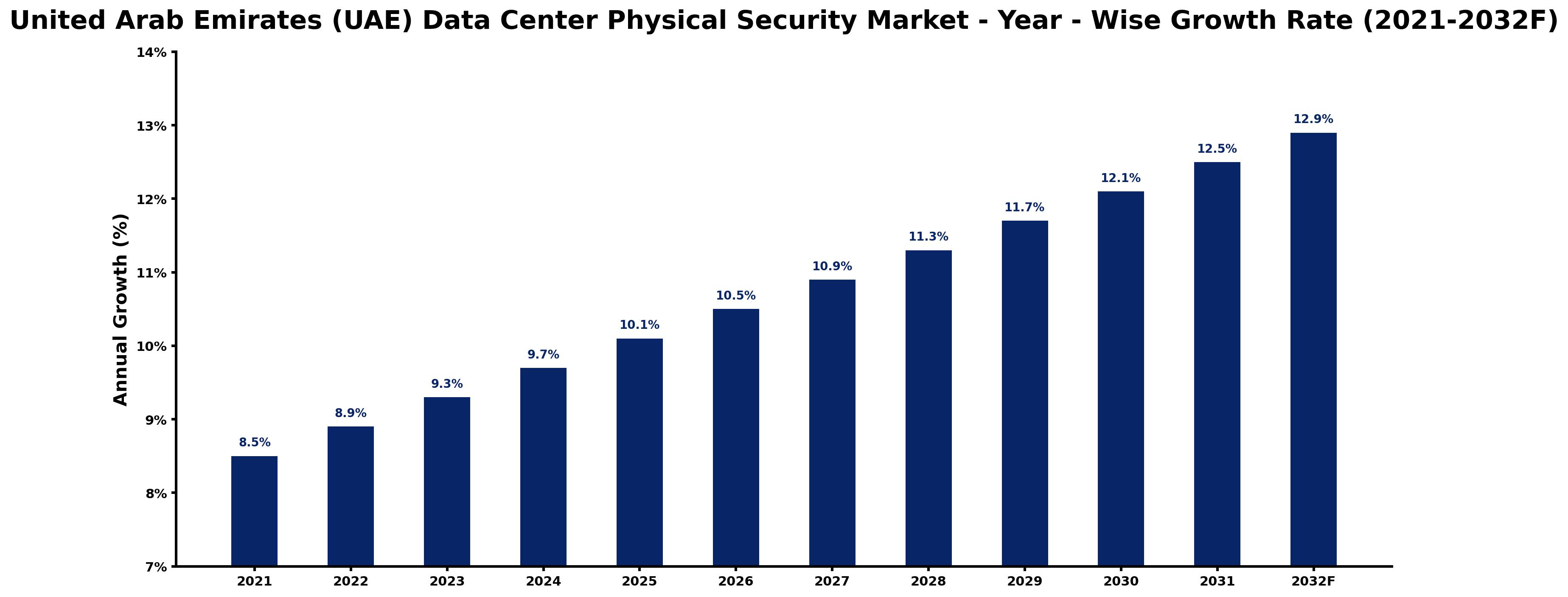
The table below presents the year‑wise growth rates along with the key drivers influencing the market
| Year | Growth Rate | Major Drivers |
| 2021 | 8.5% | Enhanced cybersecurity regulations from UAE Telecommunications Regulatory Authority. |
| 2022 | 8.9% | Increase in digital surveillance initiatives by Dubai Smart City. |
| 2023 | 9.3% | Government investment in secure infrastructure for Expo 2023. |
| 2024 | 9.7% | Boost in data center security from UAE Cybersecurity Strategy. |
| 2025 | 10.1% | Popularity of biometrics for access control in facilities. |
| 2026 | 10.5% | Rise in enterprise security budgets post-2020 pandemic. |
| 2027 | 10.9% | Local demand for compliance with Abu Dhabi Data Protection Law. |
| 2028 | 11.3% | Security upgrades driven by growing fintech sector needs. |
| 2029 | 11.7% | Increased foreign investment in UAE data center infrastructure. |
| 2030 | 12.1% | Emergence of hybrid work models increasing physical security needs. |
| 2031 | 12.5% | Focus on disaster recovery solutions following regional outages. |
| 2032 | 12.9% | Growth in e-commerce requiring enhanced customer data security. |
Note: Market size estimations and growth projections presented in this report are based on 6Wresearch's proprietary forecasting methodology, utilizing the latest available industry data, government publications, and primary research inputs.
United Arab Emirates (UAE) Data Center Physical Security Market Key Takeaways
Below are some of the specific key takeaways from the market, including:
- The market is experiencing a compound annual growth rate of 10.7% from 2026 to 2032.
- Investment in physical security solutions is driven by the increasing volume of sensitive data managed by local data centers.
- Compliance with government regulations is influencing security technology upgrades and innovations.
- Emerging threats are pushing organizations to adopt more sophisticated surveillance and access control systems.
- The integration of physical and digital security measures is becoming a focal point for data center operators.
Evaluation of Restraints in United Arab Emirates (UAE) Data Center Physical Security Market
While the UAE data center physical security market is on an upward trajectory, several factors pose challenges. Organizations must find a balance between stringent security protocols and operational efficiency. The rapid evolution of security threats requires continuous adaptation, which can strain resources. on top of that, compliance with varying regulatory frameworks adds complexity, compelling businesses to adopt flexible, responsive security measures that align with changing standards.
United Arab Emirates (UAE) Data Center Physical Security Market Trends
Several trends are shaping the UAE data center physical security market. The integration of AI and machine learning into security systems is gaining traction, enabling predictive monitoring and enhanced threat detection. Biometric authentication is becoming more prevalent as organizations seek to tighten access control. Additionally, there is a notable shift towards cloud-based security solutions that offer scalability and flexibility, catering to the growing number of data centers across the region.
United Arab Emirates (UAE) Data Center Physical Security Market Opportunities
The burgeoning UAE data center market presents significant growth opportunities, particularly in the deployment of innovative security solutions. Companies specializing in integrated physical security systems, including surveillance and access control technologies, have a lucrative market ahead. on top of that, partnerships between technology vendors and data center operators can lead to tailored solutions that enhance security measures while optimizing operational performance.
Government Initiatives in the United Arab Emirates (UAE) Data Center Physical Security Market
The UAE government recognizes the importance of securing data centers as essential components of national infrastructure. As digital transformation accelerates, public policy is increasingly focused on enhancing data protection and critical infrastructure resilience. Regulatory support and initiatives have been introduced to bolster physical security measures across the sector, influencing investments and operational practices.
- A recently completed national initiative aimed at reinforcing cybersecurity protocols within data centers to comply with international standards.
- A current program is underway that provides financial incentives for data center operators to upgrade their physical security systems.
- An upcoming regulatory framework set to launch by 2026 will mandate specific safety standards and protocols for data center physical security.
- A planned public-private partnership focusing on enhancing surveillance capabilities in data center facilities is expected to start in 2025.
Future Insights of the United Arab Emirates (UAE) Data Center Physical Security Market
Looking towards 2026-2032, the UAE data center physical security market will continue to evolve, driven by ongoing technological advancements and increasing demands for data integrity. The alignment of physical and cybersecurity measures will be a priority, as threats continue to grow more sophisticated. Companies that invest in cutting-edge solutions and adapt to regulatory changes will find themselves at a competitive advantage in this expanding marketplace.
United Arab Emirates (UAE) Data Center Physical Security Market Latest Developments
In the past year, the UAE data center physical security market has witnessed several notable developments. The push for enhanced security measures is evident as organizations invest in modernizing their facilities to counter rising threats effectively.
- A major technology vendor announced a new surveillance product line aimed at data centers, launched in Q2 2025.
- In early 2025, an initiative to deploy biometric access controls across major data centers began, improving physical security protocols.
- Partnerships between data center operators and security technology firms are currently ongoing, focusing on integrating AI solutions for real-time monitoring.
- A service upgrade expected in mid-2026 will introduce advanced analytics capabilities for security management systems, enhancing threat response efficiency.
United Arab Emirates (UAE) Data Center Physical Security Market - Key Attractiveness of the Report
- 10 Years of Market Numbers
- Historical Data Starting from 2022 to 2025
- Base Year: 2025
- Forecast Data until 2032
- Key Performance Indicators Impacting the Market
- Major Upcoming Developments and Projects
Key Highlights of the Report:
- United Arab Emirates (UAE) Data Center Physical Security Market Outlook
- Market Size of United Arab Emirates (UAE) Data Center Physical Security Market, 2025
- Forecast of United Arab Emirates (UAE) Data Center Physical Security Market, 2032
- Historical Data and Forecast of United Arab Emirates (UAE) Data Center Physical Security Revenues & Volume for the Period 2022-2032F
- United Arab Emirates (UAE) Data Center Physical Security Market Trend Evolution
- United Arab Emirates (UAE) Data Center Physical Security Market Drivers and Challenges
- United Arab Emirates (UAE) Data Center Physical Security Price Trends
- United Arab Emirates (UAE) Data Center Physical Security Porter's Five Forces
- United Arab Emirates (UAE) Data Center Physical Security Industry Life Cycle
- Historical Data and Forecast of United Arab Emirates (UAE) Data Center Physical Security Market Revenues & Volume By Solution Types for the Period 2022-2032F
- Historical Data and Forecast of United Arab Emirates (UAE) Data Center Physical Security Market Revenues & Volume By Video Surveillance for the Period 2022-2032F
- Historical Data and Forecast of United Arab Emirates (UAE) Data Center Physical Security Market Revenues & Volume By Monitoring for the Period 2022-2032F
- Historical Data and Forecast of United Arab Emirates (UAE) Data Center Physical Security Market Revenues & Volume By Access Control for the Period 2022-2032F
- Historical Data and Forecast of United Arab Emirates (UAE) Data Center Physical Security Market Revenues & Volume By Service Types for the Period 2022-2032F
- Historical Data and Forecast of United Arab Emirates (UAE) Data Center Physical Security Market Revenues & Volume By Consulting for the Period 2022-2032F
- Historical Data and Forecast of United Arab Emirates (UAE) Data Center Physical Security Market Revenues & Volume By System Integration for the Period 2022-2032F
- Historical Data and Forecast of United Arab Emirates (UAE) Data Center Physical Security Market Revenues & Volume By Professional Services for the Period 2022-2032F
- United Arab Emirates (UAE) Data Center Physical Security Import Export Trade Statistics
- Market Opportunity Assessment By Solution Types
- Market Opportunity Assessment By Service Types
- United Arab Emirates (UAE) Data Center Physical Security Top Companies Market Share
- United Arab Emirates (UAE) Data Center Physical Security Competitive Benchmarking By Technical and Operational Parameters
- United Arab Emirates (UAE) Data Center Physical Security Company Profiles
- United Arab Emirates (UAE) Data Center Physical Security Key Strategic Recommendations






































