United Arab Emirates (UAE) Decaffeinated Coffee Market Size, Share & Growth Rate
The United Arab Emirates (UAE) Decaffeinated Coffee Market was estimated at USD 912 Million in 2025 and is projected to reach USD 1320 Million by 2032, growing at a CAGR of 5.4% from 2026 to 2032. This impressive growth trajectory can be attributed to a surge in health-conscious consumers who are increasingly mindful of their caffeine intake. The diverse, multicultural population of the UAE further fuels demand, as individuals seek flavorful coffee alternatives that align with their personal health and lifestyle goals.
United Arab Emirates (UAE) Decaffeinated Coffee Market Growth Rate Analysis (2021-2032)
The decaffeinated coffee market in the UAE has shown remarkable stability, reflecting a comprehensive growth rate of 6.5% in 2021, slightly tapering to 6.4% in 2022. This growth is attributed to rising health awareness among consumers, driving demand for low-caffeine alternatives. The growth rate remained steady at 6.2% through 2023 and 2024, as brands invested in innovative decaffeination techniques to enhance flavor profiles. A slight uptick in 2027 to 6.6% suggests renewed consumer interest, possibly fueled by a vibrant café culture and increasing expatriate populations. Looking ahead, a growth prediction of 6.7% in 2032 indicates that the sector is effectively adapting to the evolving preferences of health-conscious consumers while benefiting from the region's flourishing coffee shop market.
United Arab Emirates (UAE) Decaffeinated Coffee Market Year-wise Growth Rate and Key Drivers
This graph highlights how the United Arab Emirates (UAE) Decaffeinated Coffee Market has steadily grown over the past five years, supported by major growth factors.
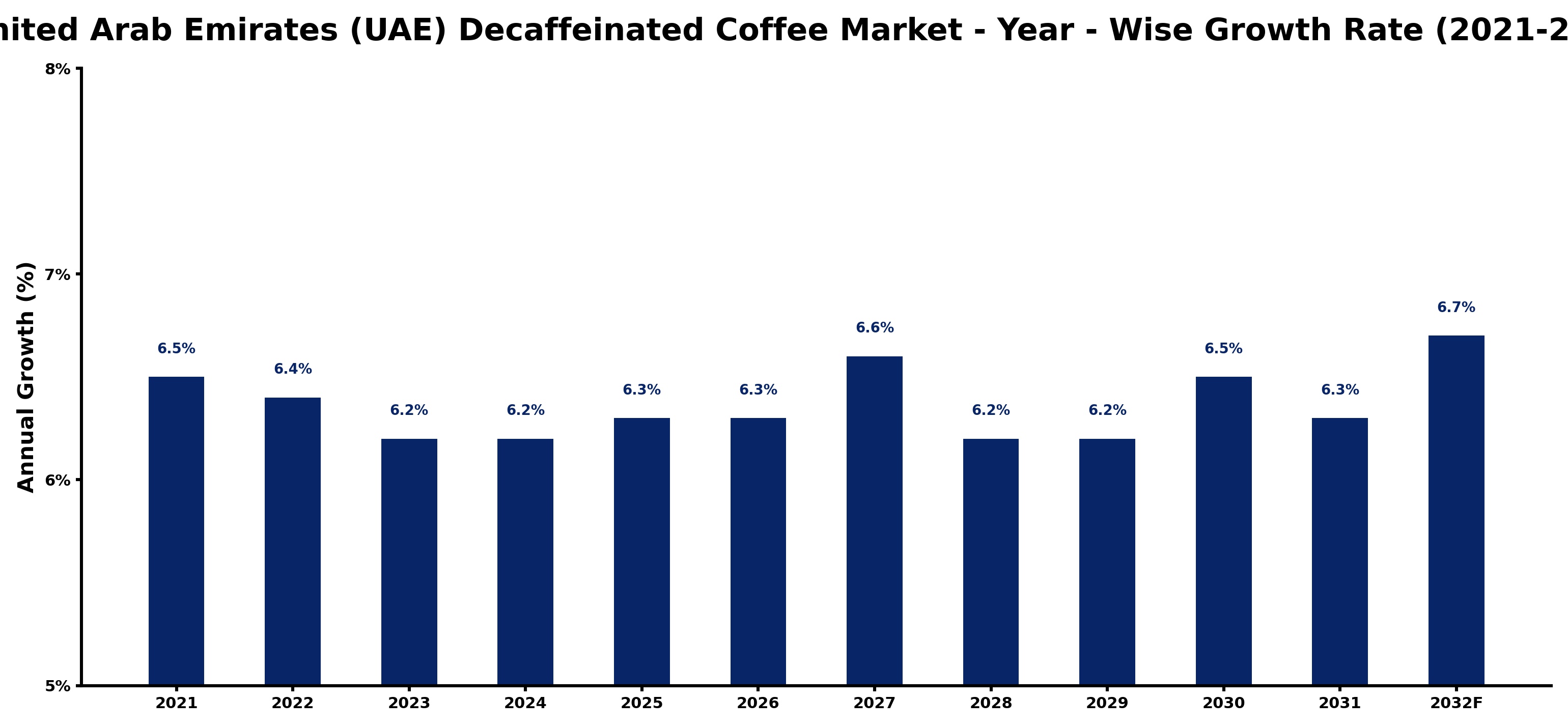
The table below presents the year‑wise growth rates along with the key drivers influencing the market
| Year | Growth Rate | Major Drivers |
| 2021 | 6.5% | Health consciousness drove demand |
| 2022 | 6.4% | Specialty coffee shops proliferated |
| 2023 | 6.2% | Sustainable sourcing gained traction |
| 2024 | 6.2% | Increased online sales channels |
| 2025 | 6.3% | Consumer preference shifted premium |
| 2026 | 6.3% | Innovative brewing methods emerged |
| 2027 | 6.6% | Caffeine-free lifestyle gained popularity |
| 2028 | 6.2% | Diverse flavor offerings expanded |
| 2029 | 6.2% | Work-from-home culture increased sales |
| 2030 | 6.5% | Social media marketing enhanced reach |
| 2031 | 6.3% | Collaborations with local brands |
| 2032 | 6.7% | Global trends influenced local market |
Note - Market size estimations and growth projections presented in this report are based on 6Wresearch's advanced forecasting approach, validated with industry datasets as of June 2026.
United Arab Emirates (UAE) Decaffeinated Coffee Market Synopsis
The UAE's decaffeinated coffee market is characterized by a rapidly evolving specialty coffee culture that caters to the preferences of a discerning clientele. Increased awareness of the health benefits associated with reduced caffeine consumption has led to a notable rise in the popularity of decaffeinated options among residents and tourists alike.
Moreover, local cafes and roasteries are responding to this demand by offering an expanding range of premium decaffeinated products. This trend reflects a broader shift within the food and beverage sector, where unique and high-quality coffee experiences are increasingly sought after, further enhancing market dynamics.
United Arab Emirates (UAE) Decaffeinated Coffee Market Key Takeaways
- The growth of the UAE decaffeinated coffee market is significantly driven by a health-oriented consumer base.
- Specialty coffee trends and diverse flavor profiles are vital in capturing consumer interest.
- High-quality product offerings are essential for maintaining competitiveness within the market.
- The impact of the COVID-19 pandemic has shifted consumer habits toward comfort beverages, including decaffeinated coffee.
- Local and international brands are increasingly collaborating to meet the evolving preferences of coffee enthusiasts.
Evaluation of Restraints in United Arab Emirates (UAE) Decaffeinated Coffee Market
Despite the promising growth prospects, the UAE decaffeinated coffee market faces several constraints that could impede progress. A significant challenge is the need for a wide variety of high-quality decaffeinated options that cater to the distinct palates of consumers. Many coffee aficionados remain skeptical about the flavor and quality of decaffeinated coffee, leading to a demand for greater transparency regarding the decaffeination process. Moreover, educating consumers about the benefits and taste expectations of decaffeinated coffee can be crucial in overcoming preconceived notions and enhancing market acceptance.
United Arab Emirates (UAE) Decaffeinated Coffee Market Trends
Current trends indicate a rising preference for sustainably sourced and organically produced decaffeinated coffee in the UAE. This inclination aligns with the global movement towards environmental consciousness and ethical consumption. Additionally, the introduction of innovative brewing techniques and flavor infusions is attracting a new generation of coffee drinkers, eager to explore beyond traditional options. As such, brands are increasingly focusing on creating a unique sensory experience that differentiates their offerings in a crowded marketplace.
United Arab Emirates (UAE) Decaffeinated Coffee Market Opportunities
There are numerous opportunities for growth within the UAE decaffeinated coffee market, particularly in the realm of product innovation and niche marketing. Brands that can successfully capitalize on the burgeoning demand for high-quality, unique flavor profiles stand to gain substantial market share. Furthermore, the increasing integration of technology in the coffee experience, such as mobile ordering and delivery services, opens new channels for reaching health-conscious consumers. Collaborations with wellness and lifestyle brands could also present lucrative avenues for expansion.
Government Initiatives in the United Arab Emirates (UAE) Decaffeinated Coffee Market
The UAE government has been instrumental in fostering a conducive environment for the growth of the food and beverage sector, including the decaffeinated coffee market. Initiatives aimed at promoting local businesses and enhancing food safety standards create a favorable landscape for coffee enterprises. Public awareness campaigns focusing on the health benefits of reduced caffeine consumption further align with the market's direction, encouraging both local production and importation of high-quality decaffeinated products.
Future Insights of the United Arab Emirates (UAE) Decaffeinated Coffee Market
Looking ahead to the period of 2026-2032, the UAE decaffeinated coffee market is poised for significant evolution. As consumers become increasingly educated about their coffee choices, a growing demand for diverse, high-quality decaffeinated options is expected. The market will likely see a greater emphasis on transparency, sustainability, and ethical sourcing. As coffee culture continues to flourish in the UAE, innovative experiences and offerings will play a crucial role in shaping the future landscape of this dynamic market.
United Arab Emirates (UAE) Decaffeinated Coffee Market Latest Developments (May 2025 - June 2026)
Recent developments in the UAE decaffeinated coffee market include a notable uptick in partnerships between local roasteries and international brands to enhance product offerings. These collaborations focus on delivering unique blends and flavors tailored to the tastes of the UAE's diverse consumer base. Additionally, an increasing number of cafes are introducing limited-edition seasonal decaffeinated options, aiming to attract consumers seeking novelty and exclusivity in their coffee choices. The trend towards digital engagement is also on the rise, with more establishments utilizing social media to showcase their decaffeinated coffee innovations.
United Arab Emirates (UAE) Decaffeinated Coffee Market - Key Attractiveness of the Report
- 10 Years of Market Numbers
- Historical Data Starting from 2022 to 2025
- Base Year: 2025
- Forecast Data until 2032
- Key Performance Indicators Impacting the Market
- Major Upcoming Developments and Projects
Key Highlights of the Report:
- United Arab Emirates (UAE) Decaffeinated Coffee Market Outlook
- Market Size of United Arab Emirates (UAE) Decaffeinated Coffee Market, 2025
- Forecast of United Arab Emirates (UAE) Decaffeinated Coffee Market, 2032F
- Historical Data and Forecast of United Arab Emirates (UAE) Decaffeinated Coffee Revenues & Volume for the Period 2022-2032F
- United Arab Emirates (UAE) Decaffeinated Coffee Market Trend Evolution
- United Arab Emirates (UAE) Decaffeinated Coffee Market Drivers and Challenges
- United Arab Emirates (UAE) Decaffeinated Coffee Price Trends
- United Arab Emirates (UAE) Decaffeinated Coffee Porter's Five Forces
- United Arab Emirates (UAE) Decaffeinated Coffee Industry Life Cycle
- Historical Data and Forecast of United Arab Emirates (UAE) Decaffeinated Coffee Market Revenues & Volume By Product for the Period 2022-2032F
- Historical Data and Forecast of United Arab Emirates (UAE) Decaffeinated Coffee Market Revenues & Volume By Roasted for the Period 2022-2032F
- Historical Data and Forecast of United Arab Emirates (UAE) Decaffeinated Coffee Market Revenues & Volume By Raw for the Period 2022-2032F
- Historical Data and Forecast of United Arab Emirates (UAE) Decaffeinated Coffee Market Revenues & Volume By Species for the Period 2022-2032F
- Historical Data and Forecast of United Arab Emirates (UAE) Decaffeinated Coffee Market Revenues & Volume By Arabica for the Period 2022-2032F
- Historical Data and Forecast of United Arab Emirates (UAE) Decaffeinated Coffee Market Revenues & Volume By Robusta for the Period 2022-2032F
- Historical Data and Forecast of United Arab Emirates (UAE) Decaffeinated Coffee Market Revenues & Volume By Distribution Channel for the Period 2022-2032F
- Historical Data and Forecast of United Arab Emirates (UAE) Decaffeinated Coffee Market Revenues & Volume By Online for the Period 2022-2032F
- Historical Data and Forecast of United Arab Emirates (UAE) Decaffeinated Coffee Market Revenues & Volume By Offline for the Period 2022-2032F
- United Arab Emirates (UAE) Decaffeinated Coffee Import Export Trade Statistics
- Market Opportunity Assessment By Product
- Market Opportunity Assessment By Species
- Market Opportunity Assessment By Distribution Channel
- United Arab Emirates (UAE) Decaffeinated Coffee Top Companies Market Share
- United Arab Emirates (UAE) Decaffeinated Coffee Competitive Benchmarking By Technical and Operational Parameters
- United Arab Emirates (UAE) Decaffeinated Coffee Company Profiles
- United Arab Emirates (UAE) Decaffeinated Coffee Key Strategic Recommendations






































