United Kingdom (UK) Data Classification Market Size & Growth Rate (2026-2032)
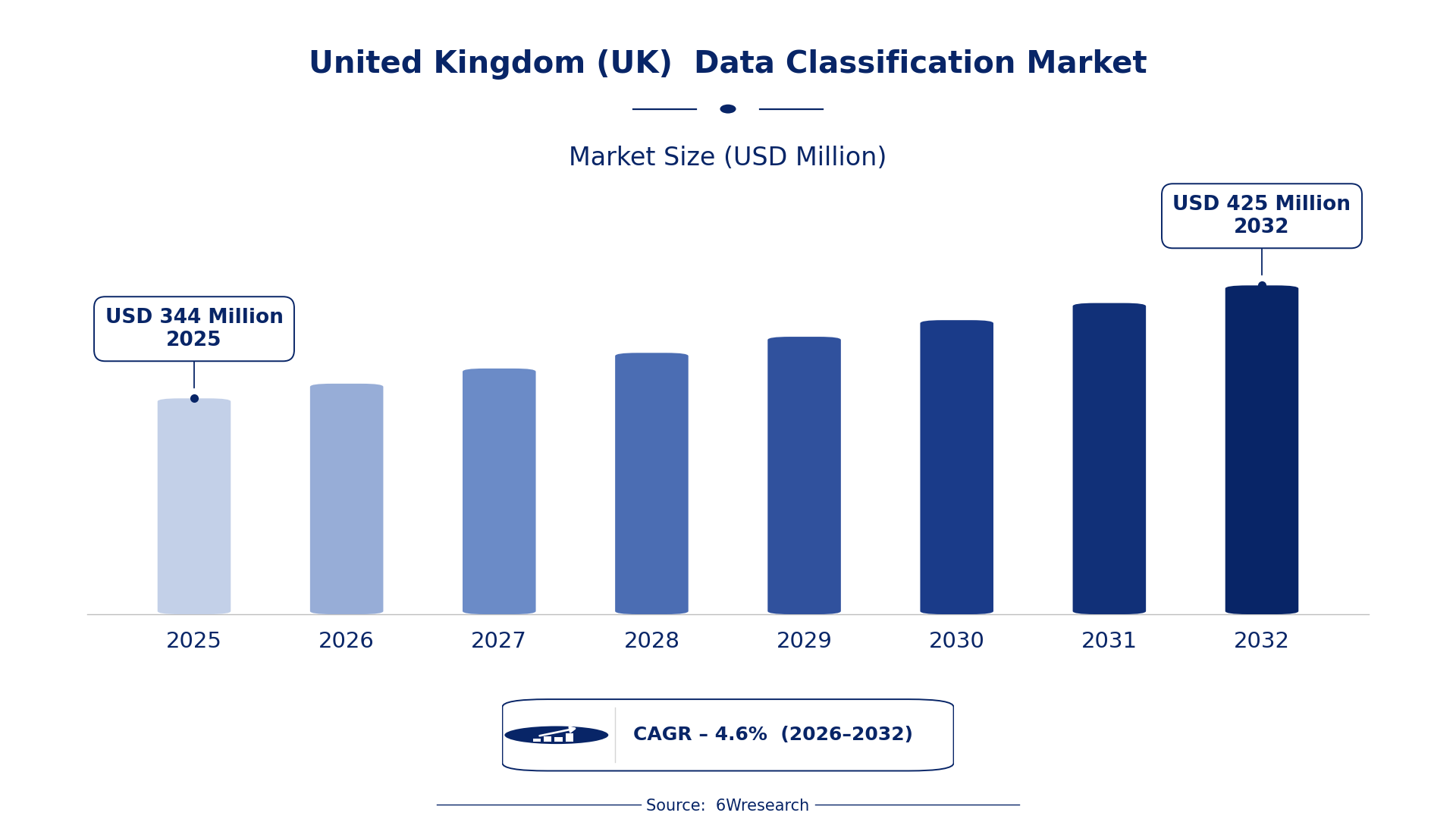
The United Kingdom (UK) Data Classification Market was estimated at USD 344 Million in 2025 and is projected to reach USD 425 Million by 2032, growing at a CAGR of 4.6% from 2026 to 2032.
United Kingdom (UK) Data Classification Market Synopsis
A notable demand for data classification solutions is emerging in the UK, largely driven by organizations seeking to safeguard sensitive information. As businesses grapple with increasing volumes of data, effective classification becomes crucial not only for compliance but also for operational efficiency.
on top of that, the urgency surrounding data security has been amplified by high-profile data breaches, pushing companies to adopt more stringent data governance measures. This momentum is evident in the rise of automated data classification technologies, which streamline processes and enhance accuracy in data handling.
United Kingdom (UK) Data Classification Market Year-wise Growth Rate and Key Drivers
This graph illustrates the annual growth rates of the United Kingdom (UK) Data Classification Market from 2021 to 2032, highlighting a steady upward trajectory and projected expansion over the forecast period.
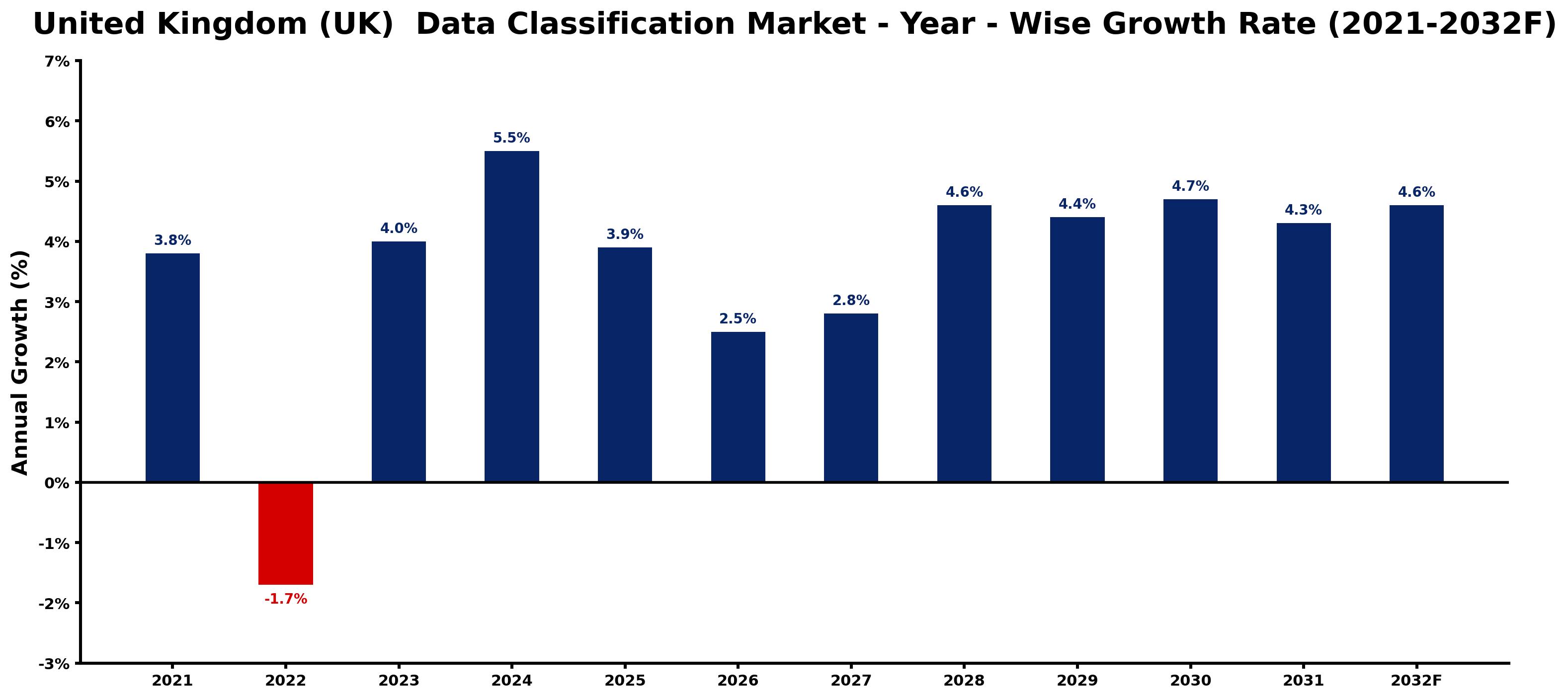
The table below presents the year‑wise growth rates along with the key drivers influencing the market
| Year | Growth Rate | Major Drivers |
| 2021 | 3.8% | UK GDPR enforcement drives data classification needs. |
| 2022 | -1.7% | ICO data regulation changes impacted compliance costs significantly. |
| 2023 | 4.0% | Increased remote work boosts demand for data security. |
| 2024 | 5.5% | Rising AI adoption necessitates advanced data classification tools. |
| 2025 | 3.9% | Financial services push for stricter data compliance regulations. |
| 2026 | 2.5% | Public sector data protection initiatives enhance industry growth. |
| 2027 | 2.8% | Healthcare data governance laws demand robust classification solutions. |
| 2028 | 4.6% | Emerging tech startups prioritize effective data management strategies. |
| 2029 | 4.4% | Ongoing cyber threats heighten importance of data classification. |
| 2030 | 4.7% | UK Digital Economy Act increases focus on data privacy. |
| 2031 | 4.3% | Surge in IoT devices drives classification and security solutions. |
| 2032 | 4.6% | Integration of machine learning enhances data classification accuracy. |
Note: Market size estimations and growth projections presented in this report are based on 6Wresearch's proprietary forecasting methodology, utilizing the latest available industry data, government publications, and primary research inputs.
United Kingdom (UK) Data Classification Market Key Takeaways
Below are some of the specific key takeaways from the market, including:
- The market is fueled by compliance requirements, particularly those set by GDPR.
- Organizations prioritize data protection, significantly impacting adoption rates for classification solutions.
- Automated data classification technologies are gaining traction, improving efficiency and accuracy.
- With increasing data volumes, effective classification systems are more critical than ever.
- Challenges related to integration and management persist as major concerns for organizations.
Evaluation of Restraints in United Kingdom (UK) Data Classification Market
Despite its growth potential, the UK data classification market is hindered by several constraints. Regulatory compliance, especially regarding GDPR, poses a complex challenge for organizations attempting to classify and manage data. The rapid rise in data types and volumes complicates the implementation of effective classification systems. Additionally, the integration of new tools with legacy IT infrastructure often results in significant operational hurdles, requiring ongoing updates to address evolving data threats and types.
United Kingdom (UK) Data Classification Market Trends
Several trends are currently shaping the UK data classification market. Automation technologies are increasingly popular, as they help organizations classify data with minimal human intervention. on top of that, the trend toward hybrid and multi-cloud environments necessitates more sophisticated data management strategies, further fueling the demand for advanced classification solutions. Additionally, there is a growing emphasis on data governance frameworks, reflecting heightened awareness about data privacy and protection.
United Kingdom (UK) Data Classification Market Opportunities
The UK presents several promising opportunities for growth in the data classification market. Organizations are investing in upgrading their data management capabilities, creating demand for innovative solutions. The rise of remote work has led to increased focus on secure data handling, positioning classification tools as essential. on top of that, partnerships between technology providers and organizations seeking tailored classification solutions could yield significant advancements, making this an attractive area for investment.
Government Initiatives in the United Kingdom (UK) Data Classification Market
The UK government's approach to data classification is marked by a commitment to enhancing data protection standards and ensuring compliance with established regulations. By focusing on stringent data protection initiatives, the government is playing an essential role in shaping the data classification market. Organizations are being urged to align their practices with regulations such as GDPR, emphasizing the importance of safeguarding sensitive information.
- A regulatory framework established in 2018 mandates strict compliance with data protection guidelines, ensuring robust classification practices.
- Current efforts include nationwide awareness campaigns educating businesses on the importance of effective data management and classification.
- Ongoing consultations aim to enhance the existing regulatory framework to keep pace with emerging data challenges and technologies.
- A public-private partnership initiative, expected to launch in late 2026, aims to bolster data security infrastructure across various sectors.
- Planned revisions to the GDPR are anticipated in 2027, which will further refine data classification practices and compliance requirements.
Future Insights of the United Kingdom (UK) Data Classification Market
As we look toward 2026-2032, the UK data classification market is set for dynamic changes. The increasing complexity of data environments will likely drive demand for more sophisticated and integrated classification solutions. Enhanced regulatory demands will push organizations to adopt innovative approaches to data governance. With technology evolving rapidly, businesses will need to stay ahead by investing in cutting-edge tools that not only classify but also provide insights into data usage and risk management.
United Kingdom (UK) Data Classification Market Latest Developments
Recent activity in the UK data classification market has been characterized by a surge of technological advancements and strategic partnerships. Organizations are increasingly focusing on automating classification processes, resulting in significant operational enhancements. Additionally, regulatory developments have continued to shape market dynamics, leading to heightened interest from businesses eager to comply with evolving standards.
- A major technology vendor introduced a new automated classification tool in early 2025 that has received positive feedback for its efficiency.
- A partnership between two leading data security companies began in mid-2025, aiming to develop integrated classification solutions tailored for SMEs.
- A pilot program to evaluate AI-driven classification technologies is currently ongoing, set to conclude by the end of 2026.
- An upcoming initiative announced in Q1 2026 plans to enhance data-sharing frameworks among public sector organizations, improving classification processes.
- A regulatory review focused on data protection standards is set to launch by mid-2027, aiming to address current market challenges.
United Kingdom (UK) Data Classification Market - Key Attractiveness of the Report
- 10 Years of Market Numbers
- Historical Data Starting from 2022 to 2025
- Base Year: 2025
- Forecast Data until 2032
- Key Performance Indicators Impacting the Market
- Major Upcoming Developments and Projects
Key Highlights of the Report:
- United Kingdom (UK) Data Classification Market Outlook
- Market Size of United Kingdom (UK) Data Classification Market, 2025
- Forecast of United Kingdom (UK) Data Classification Market, 2032
- Historical Data and Forecast of United Kingdom (UK) Data Classification Revenues & Volume for the Period 2022-2032F
- United Kingdom (UK) Data Classification Market Trend Evolution
- United Kingdom (UK) Data Classification Market Drivers and Challenges
- United Kingdom (UK) Data Classification Price Trends
- United Kingdom (UK) Data Classification Porter's Five Forces
- United Kingdom (UK) Data Classification Industry Life Cycle
- Historical Data and Forecast of United Kingdom (UK) Data Classification Market Revenues & Volume By Component for the Period 2022-2032F
- Historical Data and Forecast of United Kingdom (UK) Data Classification Market Revenues & Volume By Solutions (Standalone and Integrated) for the Period 2022-2032F
- Historical Data and Forecast of United Kingdom (UK) Data Classification Market Revenues & Volume By Services for the Period 2022-2032F
- Historical Data and Forecast of United Kingdom (UK) Data Classification Market Revenues & Volume By Application for the Period 2022-2032F
- Historical Data and Forecast of United Kingdom (UK) Data Classification Market Revenues & Volume By Access Control for the Period 2022-2032F
- Historical Data and Forecast of United Kingdom (UK) Data Classification Market Revenues & Volume By GRC for the Period 2022-2032F
- Historical Data and Forecast of United Kingdom (UK) Data Classification Market Revenues & Volume By Web for the Period 2022-2032F
- Historical Data and Forecast of United Kingdom (UK) Data Classification Market Revenues & Volume By Mobile & Email Protection for the Period 2022-2032F
- Historical Data and Forecast of United Kingdom (UK) Data Classification Market Revenues & Volume By Centralized Management for the Period 2022-2032F
- Historical Data and Forecast of United Kingdom (UK) Data Classification Market Revenues & Volume By Methodology for the Period 2022-2032F
- Historical Data and Forecast of United Kingdom (UK) Data Classification Market Revenues & Volume By Content-based Classification for the Period 2022-2032F
- Historical Data and Forecast of United Kingdom (UK) Data Classification Market Revenues & Volume By Context-based Classification for the Period 2022-2032F
- Historical Data and Forecast of United Kingdom (UK) Data Classification Market Revenues & Volume By User-based Classification for the Period 2022-2032F
- Historical Data and Forecast of United Kingdom (UK) Data Classification Market Revenues & Volume By Vertical for the Period 2022-2032F
- Historical Data and Forecast of United Kingdom (UK) Data Classification Market Revenues & Volume By BFSI for the Period 2022-2032F
- Historical Data and Forecast of United Kingdom (UK) Data Classification Market Revenues & Volume By Healthcare and Lifesciences for the Period 2022-2032F
- Historical Data and Forecast of United Kingdom (UK) Data Classification Market Revenues & Volume By Government and Defense for the Period 2022-2032F
- Historical Data and Forecast of United Kingdom (UK) Data Classification Market Revenues & Volume By Education for the Period 2022-2032F
- Historical Data and Forecast of United Kingdom (UK) Data Classification Market Revenues & Volume By Telecom for the Period 2022-2032F
- Historical Data and Forecast of United Kingdom (UK) Data Classification Market Revenues & Volume By Media and Entertainment for the Period 2022-2032F
- Historical Data and Forecast of United Kingdom (UK) Data Classification Market Revenues & Volume By Others (Retail and Ecommerce, Manufacturing, and Energy and Utilities) for the Period 2022-2032F
- United Kingdom (UK) Data Classification Import Export Trade Statistics
- Market Opportunity Assessment By Component
- Market Opportunity Assessment By Application
- Market Opportunity Assessment By Methodology
- Market Opportunity Assessment By Vertical
- United Kingdom (UK) Data Classification Top Companies Market Share
- United Kingdom (UK) Data Classification Competitive Benchmarking By Technical and Operational Parameters
- United Kingdom (UK) Data Classification Company Profiles
- United Kingdom (UK) Data Classification Key Strategic Recommendations






































