United Kingdom (UK) Enterprise Application Integration Market Size & Growth Rate (2026-2032)
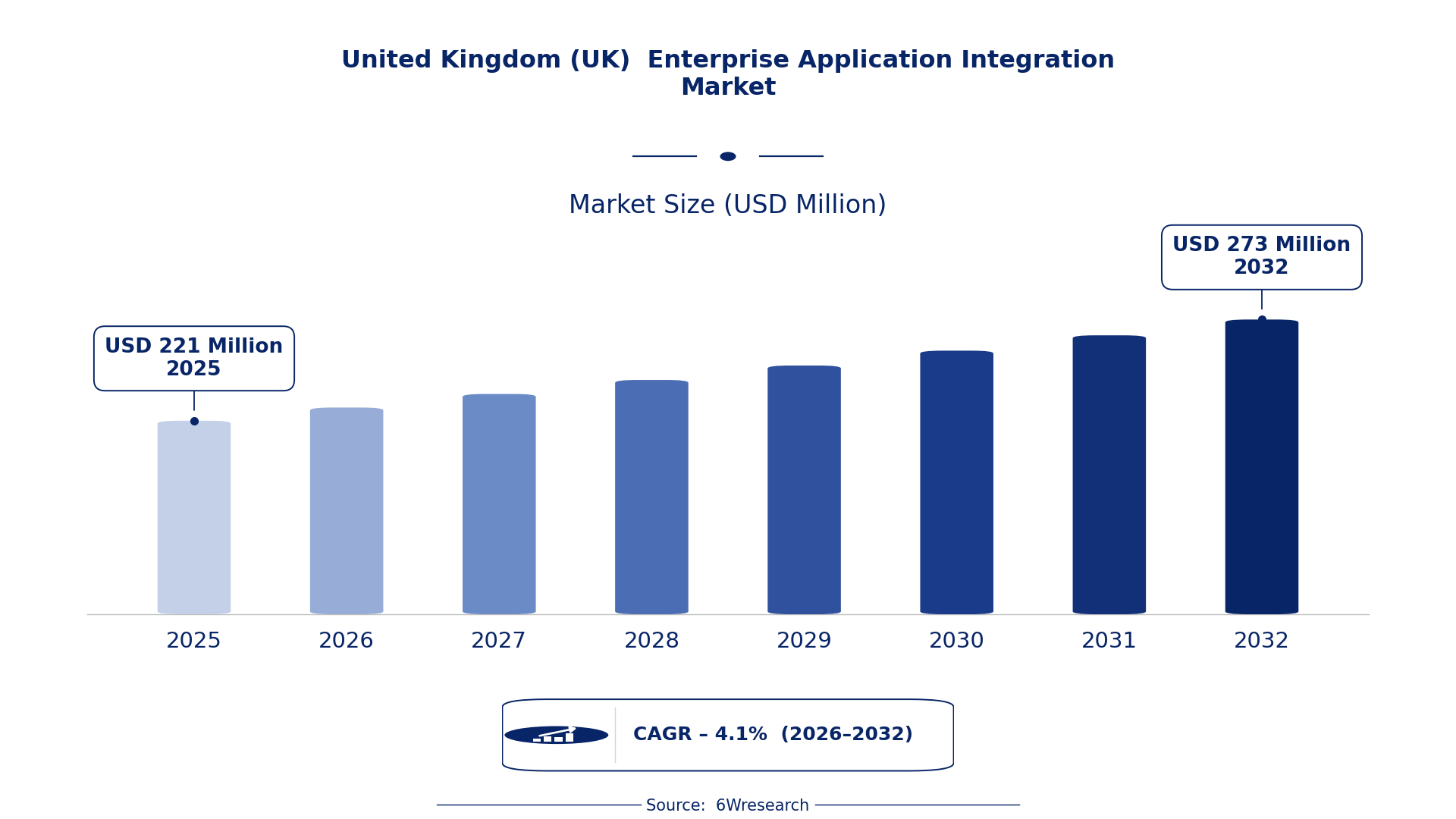
The United Kingdom (UK) Enterprise Application Integration Market was estimated at USD 221 Million in 2025 and is projected to reach USD 273 Million by 2032, growing at a CAGR of 4.1% from 2026 to 2032.
United Kingdom (UK) Enterprise Application Integration Market Synopsis
The UK Enterprise Application Integration Market is witnessing a transformative phase, driven largely by the integration of cloud solutions and the need for real-time data accessibility. As businesses increasingly prioritize digital transformation, the demand for effective integration solutions has surged, enabling organizations to streamline operations and enhance overall efficiency.
With key industries recognizing the value of interconnected systems, there’s a notable shift towards adopting advanced integration platforms. This change is not merely about technology; it reflects a broader strategic move to foster innovation and maintain competitive advantages in an ever-demanding market.
United Kingdom (UK) Enterprise Application Integration Market Year-wise Growth Rate and Key Drivers
This graph illustrates the annual growth rates of the United Kingdom (UK) Enterprise Application Integration Market from 2021 to 2032, highlighting a steady upward trajectory and projected expansion over the forecast period.
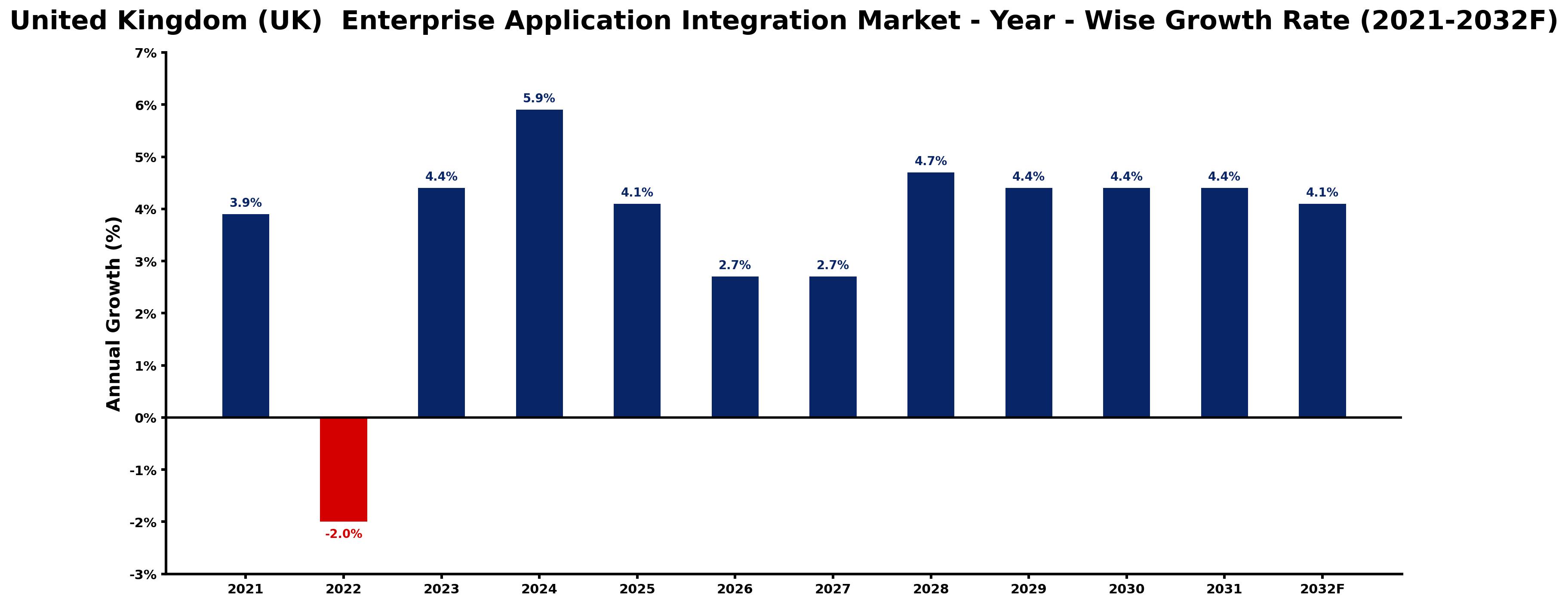
The table below presents the year‑wise growth rates along with the key drivers influencing the market
| Year | Growth Rate | Major Drivers |
| 2021 | 3.9% | Increased adoption of cloud platforms by UK businesses |
| 2022 | -2.0% | Brexit-related uncertainty impacted integration project investments. |
| 2023 | 4.4% | UK's push for data-driven decision making in enterprises |
| 2024 | 5.9% | Mandatory compliance with UK Data Protection regulations |
| 2025 | 4.1% | Growing need for seamless remote work integrations |
| 2026 | 2.7% | Emergence of local AI tools for enterprise automation |
| 2027 | 2.7% | Rise in UK startups needing integrated application solutions |
| 2028 | 4.7% | UK enterprises focusing on real-time data connectivity |
| 2029 | 4.4% | Advancements in cybersecurity frameworks driving integration needs |
| 2030 | 4.4% | Increased collaboration demands in remote project management |
| 2031 | 4.4% | Focus on improving operational efficiency in UK SMEs |
| 2032 | 4.1% | UK government support for digital financial services growth |
Note: Market size estimations and growth projections presented in this report are based on 6Wresearch's proprietary forecasting methodology, utilizing the latest available industry data, government publications, and primary research inputs.
United Kingdom (UK) Enterprise Application Integration Market Key Takeaways
Below are some of the specific key takeaways from the market, including:
- Cloud-based integration solutions are leading the growth trajectory of the market.
- Real-time data access has become a critical requirement for businesses aiming to enhance decision-making processes.
- Integration of AI and IoT technologies is becoming increasingly prevalent within enterprises.
- Organizations are seeking scalable integration solutions to adapt to their evolving needs.
- The market is benefiting from supportive government initiatives aimed at bolstering digital infrastructure.
Evaluation of Restraints in United Kingdom (UK) Enterprise Application Integration Market
Despite its promising growth, the UK Enterprise Application Integration Market faces several restraints. One major challenge is the complexity involved in integrating diverse systems and applications, which can hinder operational efficiency. Organizations often grapple with various technologies, protocols, and data formats that complicate integration efforts. on top of that, the rapid pace of technological advancements necessitates constant updates and adaptations, adding to the burden. Ensuring seamless connectivity between on-premises and cloud-based solutions, while adhering to stringent data security and compliance regulations, remains a pressing concern. Additionally, the shortage of skilled professionals proficient in enterprise application integration limits companies' ability to implement and sustain effective solutions.
United Kingdom (UK) Enterprise Application Integration Market Trends
The ongoing trend towards cloud-native integration platforms is reshaping the UK EAI market. Companies are increasingly adopting solutions that offer agility and scalability, essential for meeting dynamic business requirements. The integration of emerging technologies such as artificial intelligence and machine learning is gaining traction, as organizations seek to derive actionable insights from their data. Additionally, there is a growing emphasis on creating a connected ecosystem by integrating disparate applications and data sources. This focus on unified connectivity is driving demand for innovative EAI solutions that enhance customer experiences and operational efficiency.
United Kingdom (UK) Enterprise Application Integration Market Opportunities
The UK EAI market presents substantial investment opportunities, particularly as businesses embrace digital transformation initiatives. The increasing demand for efficient data integration and seamless connectivity among applications highlights the need for advanced EAI solutions. Investment in local technology providers that offer innovative integration capabilities can yield significant returns, as companies seek to optimize operations and leverage data effectively. The UK’s strong technological infrastructure and skilled workforce further enhance its attractiveness as a destination for EAI investments, signaling potential for growth and expansion.
Government Initiatives in the United Kingdom (UK) Enterprise Application Integration Market
Government policy plays a crucial role in shaping the dynamics of the UK Enterprise Application Integration Market. With initiatives aimed at enhancing digital infrastructure, the UK government is fostering an environment conducive to innovation. Regulatory frameworks are being established to ensure compliance and data security, which are essential for EAI implementations. This proactive approach not only supports existing businesses but also encourages new entrants into the market.
- A recently completed initiative was the Digital Economy Act, which aims to improve digital connectivity across the UK.
- A currently ongoing programme focuses on enhancing support for small and medium-sized enterprises (SMEs) through the Industrial Strategy Challenge Fund.
- Plans are in place for a public-private initiative expected to expand digital infrastructure access by 2028.
- The government is also enhancing its regulatory frameworks, including updates to the General Data Protection Regulation (GDPR) to ensure data security and privacy compliance.
- Upcoming initiatives are expected to promote research and development in emerging technologies relevant to enterprise application integration.
Future Insights of the United Kingdom (UK) Enterprise Application Integration Market
Looking ahead to 2026-2032, the UK Enterprise Application Integration Market is set for considerable growth. The ongoing adoption of digital technologies across industries will continue to drive demand for EAI solutions that facilitate seamless connectivity and data integration. As organizations strive for greater operational efficiency and improved decision-making capabilities, the emphasis on cloud-based integration solutions will intensify. on top of that, the proliferation of IoT devices and the growing importance of data analytics will further fuel market expansion, as businesses seek to harness the full potential of integrated technologies.
United Kingdom (UK) Enterprise Application Integration Market Latest Developments
Over the last 12-14 months, the UK Enterprise Application Integration Market has experienced a flurry of activity, highlighting the sector's dynamic nature. Companies are increasingly launching innovative solutions aimed at enhancing integration capabilities and addressing the challenges faced by organizations. This surge in activity is indicative of the market's potential and the pressing demand for advanced integration technologies.
- A major technology vendor launched an advanced cloud-based integration platform in early 2025, designed to improve operational efficiency for businesses.
- In mid-2025, a leading regional operator initiated a partnership with several SMEs to enhance their integration capabilities.
- A planned rollout of a new regulatory framework is expected to begin in Q3 2025, focusing on improving data compliance in EAI implementations.
- A recent collaboration between technology providers aims to develop AI-driven integration solutions, with the project currently underway and expected to be completed by late 2026.
- An initiative aimed at upgrading digital infrastructure across the UK is set to commence in early 2026, enhancing connectivity for EAI solutions.
United Kingdom (UK) Enterprise Application Integration Market - Key Attractiveness of the Report
- 10 Years of Market Numbers
- Historical Data Starting from 2022 to 2025
- Base Year: 2025
- Forecast Data until 2032
- Key Performance Indicators Impacting the Market
- Major Upcoming Developments and Projects
Key Highlights of the Report:
- United Kingdom (UK) Enterprise Application Integration Market Outlook
- Market Size of United Kingdom (UK) Enterprise Application Integration Market, 2025
- Forecast of United Kingdom (UK) Enterprise Application Integration Market, 2032
- Historical Data and Forecast of United Kingdom (UK) Enterprise Application Integration Revenues & Volume for the Period 2022-2032F
- United Kingdom (UK) Enterprise Application Integration Market Trend Evolution
- United Kingdom (UK) Enterprise Application Integration Market Drivers and Challenges
- United Kingdom (UK) Enterprise Application Integration Price Trends
- United Kingdom (UK) Enterprise Application Integration Porter's Five Forces
- United Kingdom (UK) Enterprise Application Integration Industry Life Cycle
- Historical Data and Forecast of United Kingdom (UK) Enterprise Application Integration Market Revenues & Volume By Deployment type for the Period 2022-2032F
- Historical Data and Forecast of United Kingdom (UK) Enterprise Application Integration Market Revenues & Volume By Hosted for the Period 2022-2032F
- Historical Data and Forecast of United Kingdom (UK) Enterprise Application Integration Market Revenues & Volume By On-Premise for the Period 2022-2032F
- Historical Data and Forecast of United Kingdom (UK) Enterprise Application Integration Market Revenues & Volume By Hybrid for the Period 2022-2032F
- Historical Data and Forecast of United Kingdom (UK) Enterprise Application Integration Market Revenues & Volume By Organization size for the Period 2022-2032F
- Historical Data and Forecast of United Kingdom (UK) Enterprise Application Integration Market Revenues & Volume By Small for the Period 2022-2032F
- Historical Data and Forecast of United Kingdom (UK) Enterprise Application Integration Market Revenues & Volume By Medium for the Period 2022-2032F
- Historical Data and Forecast of United Kingdom (UK) Enterprise Application Integration Market Revenues & Volume By Enterprises for the Period 2022-2032F
- Historical Data and Forecast of United Kingdom (UK) Enterprise Application Integration Market Revenues & Volume By Large Enterprises for the Period 2022-2032F
- Historical Data and Forecast of United Kingdom (UK) Enterprise Application Integration Market Revenues & Volume By Industry Vertical for the Period 2022-2032F
- Historical Data and Forecast of United Kingdom (UK) Enterprise Application Integration Market Revenues & Volume By Banking, financial services and insurance(BFSI) for the Period 2022-2032F
- Historical Data and Forecast of United Kingdom (UK) Enterprise Application Integration Market Revenues & Volume By Business services for the Period 2022-2032F
- Historical Data and Forecast of United Kingdom (UK) Enterprise Application Integration Market Revenues & Volume By IT and telecom for the Period 2022-2032F
- Historical Data and Forecast of United Kingdom (UK) Enterprise Application Integration Market Revenues & Volume By Manufacturing for the Period 2022-2032F
- Historical Data and Forecast of United Kingdom (UK) Enterprise Application Integration Market Revenues & Volume By Retail and wholesale for the Period 2022-2032F
- Historical Data and Forecast of United Kingdom (UK) Enterprise Application Integration Market Revenues & Volume By Healthcare for the Period 2022-2032F
- Historical Data and Forecast of United Kingdom (UK) Enterprise Application Integration Market Revenues & Volume By Government for the Period 2022-2032F
- Historical Data and Forecast of United Kingdom (UK) Enterprise Application Integration Market Revenues & Volume By Other verticals( education, entertainment and media, power and utilities) for the Period 2022-2032F
- United Kingdom (UK) Enterprise Application Integration Import Export Trade Statistics
- Market Opportunity Assessment By Deployment type
- Market Opportunity Assessment By Organization size
- Market Opportunity Assessment By Industry Vertical
- United Kingdom (UK) Enterprise Application Integration Top Companies Market Share
- United Kingdom (UK) Enterprise Application Integration Competitive Benchmarking By Technical and Operational Parameters
- United Kingdom (UK) Enterprise Application Integration Company Profiles
- United Kingdom (UK) Enterprise Application Integration Key Strategic Recommendations






































