United States (US) Database Security Market Size & Growth Rate (2026-2032)
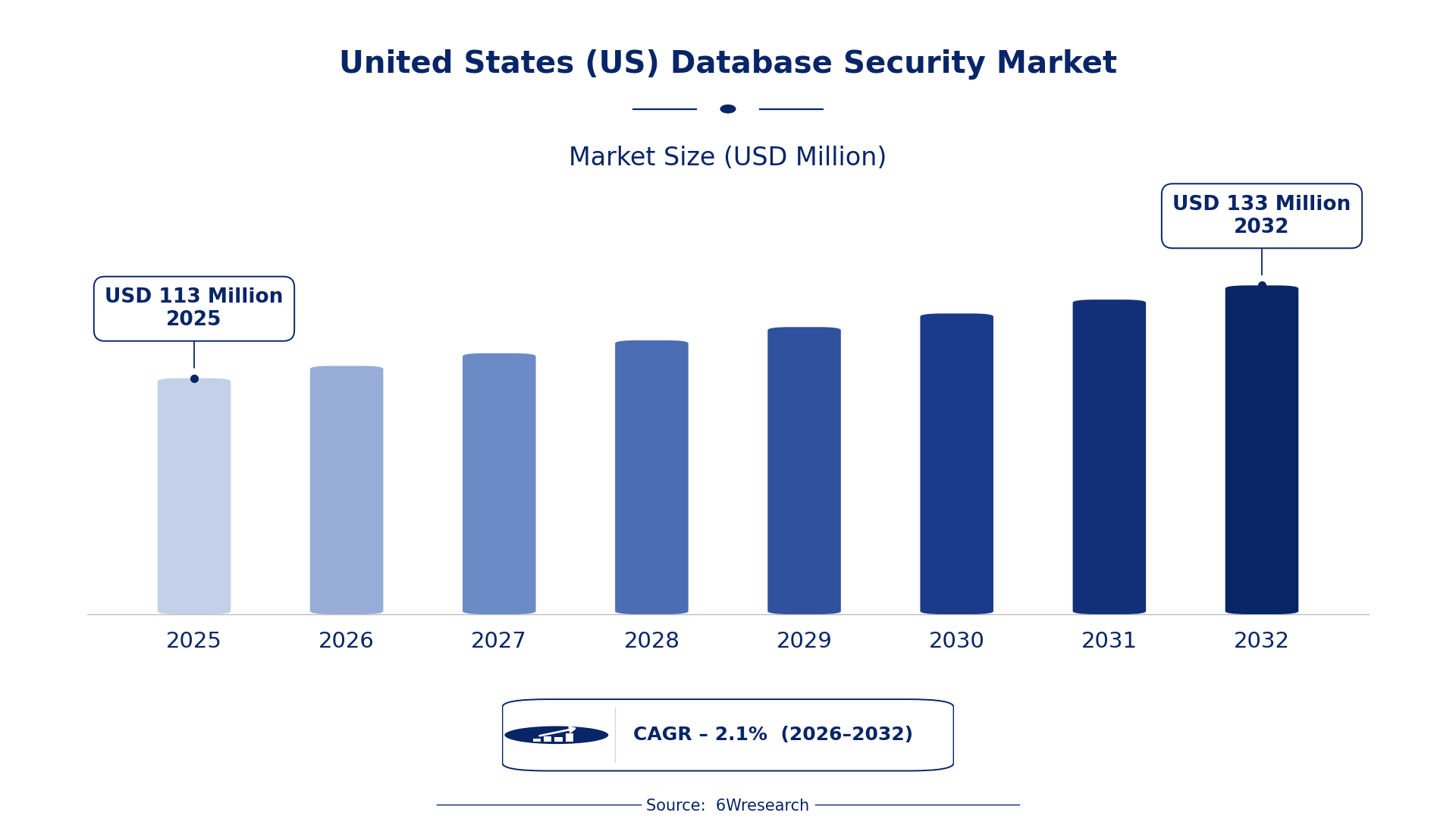
The United States (US) Database Security Market was estimated at USD 113 Million in 2025 and is projected to reach USD 133 Million by 2032, growing at a CAGR of 2.1% from 2026 to 2032.
United States (US) Database Security Market Synopsis
The primary force driving the United States Database Security Market is the escalating number of cyber threats and data breaches. Companies across multiple sectors are pouring resources into database security solutions to shield sensitive information while adhering to compliance requirements such as GDPR and CCPA.
As a result, solutions encompassing database encryption, access control, and activity monitoring have gained traction. The increasing shift toward cloud-based database security options reflects a demand for scalable solutions, propelling investment as organizations aim for cost-effective yet secure environments.
United States (US) Database Security Market Year-wise Growth Rate and Key Drivers
This graph illustrates the annual growth rates of the United States (US) Database Security Market from 2021 to 2032, highlighting a steady upward trajectory and projected expansion over the forecast period.
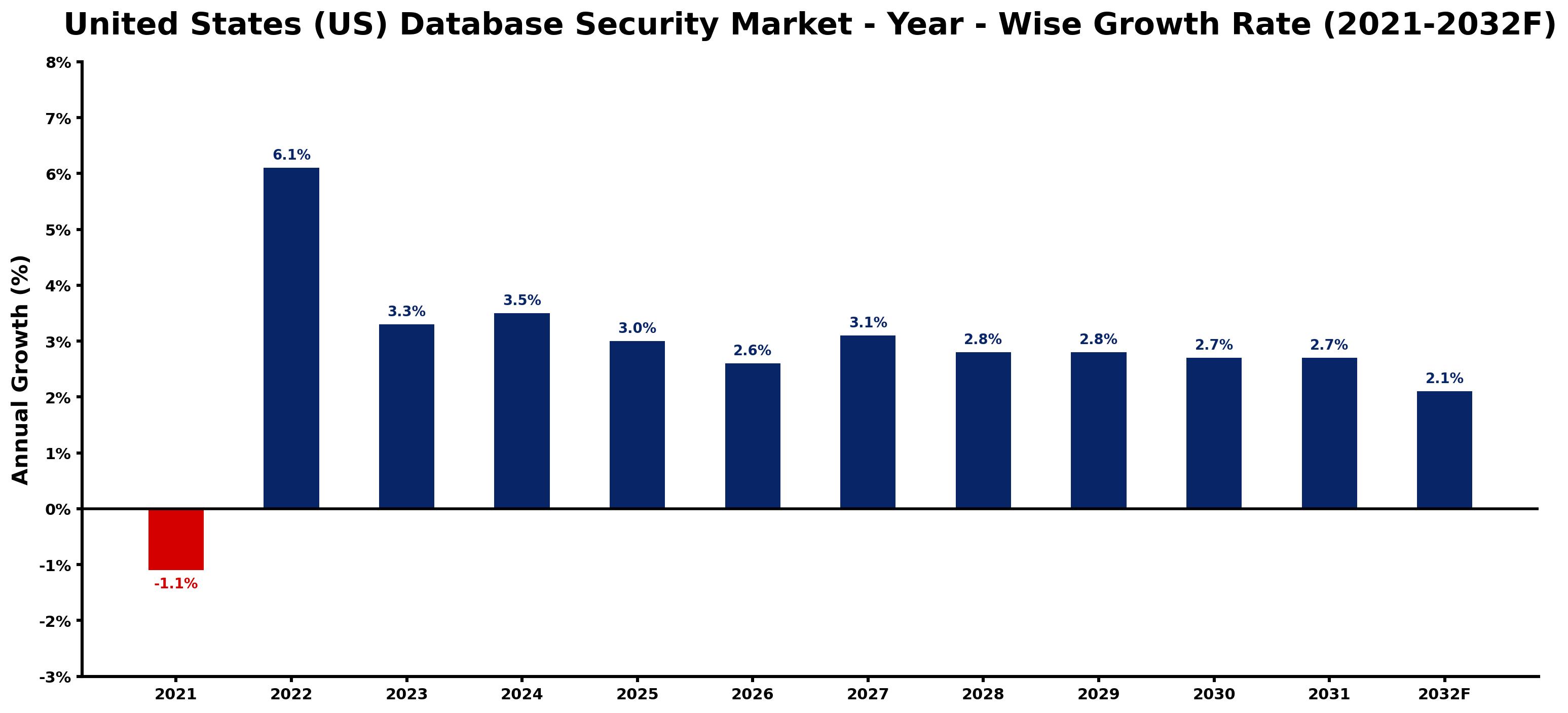
The table below presents the year‑wise growth rates along with the key drivers influencing the market
| Year | Growth Rate | Major Drivers |
| 2021 | -1.1% | Colonial Pipeline ransomware attack increased security compliance costs. |
| 2022 | 6.1% | Increased data breach penalties by GDPR enforcement. |
| 2023 | 3.3% | Rise in remote work driving cloud security investments. |
| 2024 | 3.5% | Regulatory compliance mandates for financial data protection. |
| 2025 | 3.0% | Growth in IoT devices necessitating enhanced database security. |
| 2026 | 2.6% | Emerging cybersecurity threats boosting security software adoption. |
| 2027 | 3.1% | Government incentives for cybersecurity workforce development initiatives. |
| 2028 | 2.8% | Increased awareness of ransomware attacks prompting solutions. |
| 2029 | 2.8% | Shift to zero-trust security frameworks in enterprises. |
| 2030 | 2.7% | Investments in AI-driven security analytics tools rising. |
| 2031 | 2.7% | Introduction of data localization laws increasing security needs. |
| 2032 | 2.1% | Focus on healthcare data protection due to HIPAA updates. |
Note: Market size estimations and growth projections presented in this report are based on 6Wresearch's proprietary forecasting methodology, utilizing the latest available industry data, government publications, and primary research inputs.
United States (US) Database Security Market Key Takeaways
Below are some of the specific key takeaways from the market, including:
- Organizations are prioritizing database security due to rising regulatory compliance requirements.
- Cloud adoption is driving the demand for advanced security solutions tailored for cloud databases.
- Integration of artificial intelligence into security solutions is enhancing threat detection capabilities.
- The shortage of skilled cybersecurity professionals presents a significant challenge for companies.
- Investment opportunities are concentrated in encryption technologies and comprehensive security platforms.
Evaluation of Restraints in United States (US) Database Security Market
A critical limitation facing the US Database Security Market is the increasing sophistication of cyber threats, which complicates protective measures. The growing complexity of IT environments adds layers of difficulty for organizations seeking effective security strategies. In tandem, the shortage of skilled professionals exacerbates the issue, making it challenging for companies to implement robust security frameworks. As the landscape evolves, organizations must continually innovate their approaches to data protection to effectively mitigate risks.
United States (US) Database Security Market Trends
Key trends shaping the United States Database Security Market include a heightened focus on sensitive data protection driven by stringent regulations and a surge in cyber threats. Advanced solutions such as encryption and monitoring tools are becoming standard as companies seek to enhance data integrity.
The rise of remote work has sparked an increased demand for secure database access from multiple locations. Additionally, integrated security platforms are gaining traction, providing organizations with comprehensive protection across databases and IT systems.
United States (US) Database Security Market Opportunities
The United States Database Security Market offers substantial investment opportunities, largely fueled by the growing importance of digital technologies and awareness around data privacy. Key areas for investment include advanced encryption solutions, threat detection tools, and compliance management systems. Organizations prioritizing data security are likely to continue fueling demand, as they seek to navigate the increasingly complex regulatory landscape.
Government Initiatives in the United States (US) Database Security Market
Government policies play a critical role in shaping the United States Database Security Market, establishing essential frameworks that drive compliance and security standards. These initiatives not only aim to protect sensitive information but also enhance the overall resilience of the data protection infrastructure across various sectors.
- A regulatory framework introduced in 2025 mandates enhanced security measures for financial institutions under the Gramm-Leach-Bliley Act (GLBA).
- Currently ongoing, the Federal Information Security Management Act (FISMA) mandates that federal agencies implement robust information security programs.
- A recently launched initiative focuses on cybersecurity best practices, promoted through the National Institute of Standards and Technology (NIST) framework.
- A planned public-private collaboration is set to begin in 2027, aimed at upgrading digital infrastructure to meet contemporary security challenges.
Future Insights of the United States (US) Database Security Market
Looking ahead, the United States Database Security Market is expected to maintain a positive trajectory as the volume of sensitive data continues to increase. The ongoing rise in cyber threats and evolving regulatory requirements are key drivers for demand. Companies increasingly adopting cloud-based solutions will further enhance market growth, as will technological advancements in artificial intelligence and machine learning, enabling more sophisticated security measures to counteract modern cyber threats.
United States (US) Database Security Market Latest Developments
Recent activity within the United States Database Security Market indicates a surge in innovation and investment. Companies are increasingly focused on upgrading their security measures in response to the rising threat of data breaches. The landscape is becoming increasingly competitive as businesses recognize the need for effective solutions to protect their valuable data assets.
- A major technology vendor launched an advanced database encryption solution in early 2025, designed to integrate seamlessly with existing infrastructures.
- An ongoing initiative began in Q4 2025 to enhance real-time monitoring capabilities across various industry sectors.
- A regional operator announced plans in mid-2026 to roll out a comprehensive training program addressing the cybersecurity skills gap.
- A product upgrade is expected to be introduced in late 2026, featuring integrated AI for improved anomaly detection.
United States (US) Database Security Market - Key Attractiveness of the Report
- 10 Years of Market Numbers
- Historical Data Starting from 2022 to 2025
- Base Year: 2025
- Forecast Data until 2032
- Key Performance Indicators Impacting the Market
- Major Upcoming Developments and Projects
Key Highlights of the Report:
- United States (US) Database Security Market Outlook
- Market Size of United States (US) Database Security Market, 2025
- Forecast of United States (US) Database Security Market, 2032
- Historical Data and Forecast of United States (US) Database Security Revenues & Volume for the Period 2022-2032F
- United States (US) Database Security Market Trend Evolution
- United States (US) Database Security Market Drivers and Challenges
- United States (US) Database Security Price Trends
- United States (US) Database Security Porter's Five Forces
- United States (US) Database Security Industry Life Cycle
- Historical Data and Forecast of United States (US) Database Security Market Revenues & Volume By Component for the Period 2022-2032F
- Historical Data and Forecast of United States (US) Database Security Market Revenues & Volume By Solution for the Period 2022-2032F
- Historical Data and Forecast of United States (US) Database Security Market Revenues & Volume By Services for the Period 2022-2032F
- Historical Data and Forecast of United States (US) Database Security Market Revenues & Volume By Business function for the Period 2022-2032F
- Historical Data and Forecast of United States (US) Database Security Market Revenues & Volume By Marketing for the Period 2022-2032F
- Historical Data and Forecast of United States (US) Database Security Market Revenues & Volume By sales for the Period 2022-2032F
- Historical Data and Forecast of United States (US) Database Security Market Revenues & Volume By finance for the Period 2022-2032F
- Historical Data and Forecast of United States (US) Database Security Market Revenues & Volume By operations for the Period 2022-2032F
- Historical Data and Forecast of United States (US) Database Security Market Revenues & Volume By Organization Size for the Period 2022-2032F
- Historical Data and Forecast of United States (US) Database Security Market Revenues & Volume By Large Enterprises for the Period 2022-2032F
- Historical Data and Forecast of United States (US) Database Security Market Revenues & Volume By SMEs for the Period 2022-2032F
- Historical Data and Forecast of United States (US) Database Security Market Revenues & Volume By Deployment Mode for the Period 2022-2032F
- Historical Data and Forecast of United States (US) Database Security Market Revenues & Volume By Cloud for the Period 2022-2032F
- Historical Data and Forecast of United States (US) Database Security Market Revenues & Volume By On-premises for the Period 2022-2032F
- Historical Data and Forecast of United States (US) Database Security Market Revenues & Volume By Vertical for the Period 2022-2032F
- Historical Data and Forecast of United States (US) Database Security Market Revenues & Volume By Banking, Financial Services, And Insurance for the Period 2022-2032F
- Historical Data and Forecast of United States (US) Database Security Market Revenues & Volume By Telecommunication and IT for the Period 2022-2032F
- Historical Data and Forecast of United States (US) Database Security Market Revenues & Volume By Government and Defense for the Period 2022-2032F
- Historical Data and Forecast of United States (US) Database Security Market Revenues & Volume By Manufacturing for the Period 2022-2032F
- Historical Data and Forecast of United States (US) Database Security Market Revenues & Volume By Healthcare and life sciences for the Period 2022-2032F
- Historical Data and Forecast of United States (US) Database Security Market Revenues & Volume By Retail and Ecommerce for the Period 2022-2032F
- Historical Data and Forecast of United States (US) Database Security Market Revenues & Volume By Energy and Utilities for the Period 2022-2032F
- United States (US) Database Security Import Export Trade Statistics
- Market Opportunity Assessment By Component
- Market Opportunity Assessment By Business function
- Market Opportunity Assessment By Organization Size
- Market Opportunity Assessment By Deployment Mode
- Market Opportunity Assessment By Vertical
- United States (US) Database Security Top Companies Market Share
- United States (US) Database Security Competitive Benchmarking By Technical and Operational Parameters
- United States (US) Database Security Company Profiles
- United States (US) Database Security Key Strategic Recommendations






































