US Malt Market (2025-2031) | Revenue, Trends, Share, Industry, Value, Analysis, Outlook, Size, Forecast, Companies & Growth
Market Forecast By Type (Malt, Malt Extract, Malt Extract Powder, Malt Flour, Barley malt, Wheat malt, Rye malt), By Application (Beer Industry, Whisky Distilleries, Food industry, Beverages, Pharmaceutical industry) And Competitive Landscape
| Product Code: ETC179060 | Publication Date: Jan 2022 | Updated Date: Nov 2025 | Product Type: Market Research Report | |
| Publisher: 6Wresearch | Author: Ravi Bhandari | No. of Pages: 70 | No. of Figures: 35 | No. of Tables: 5 |
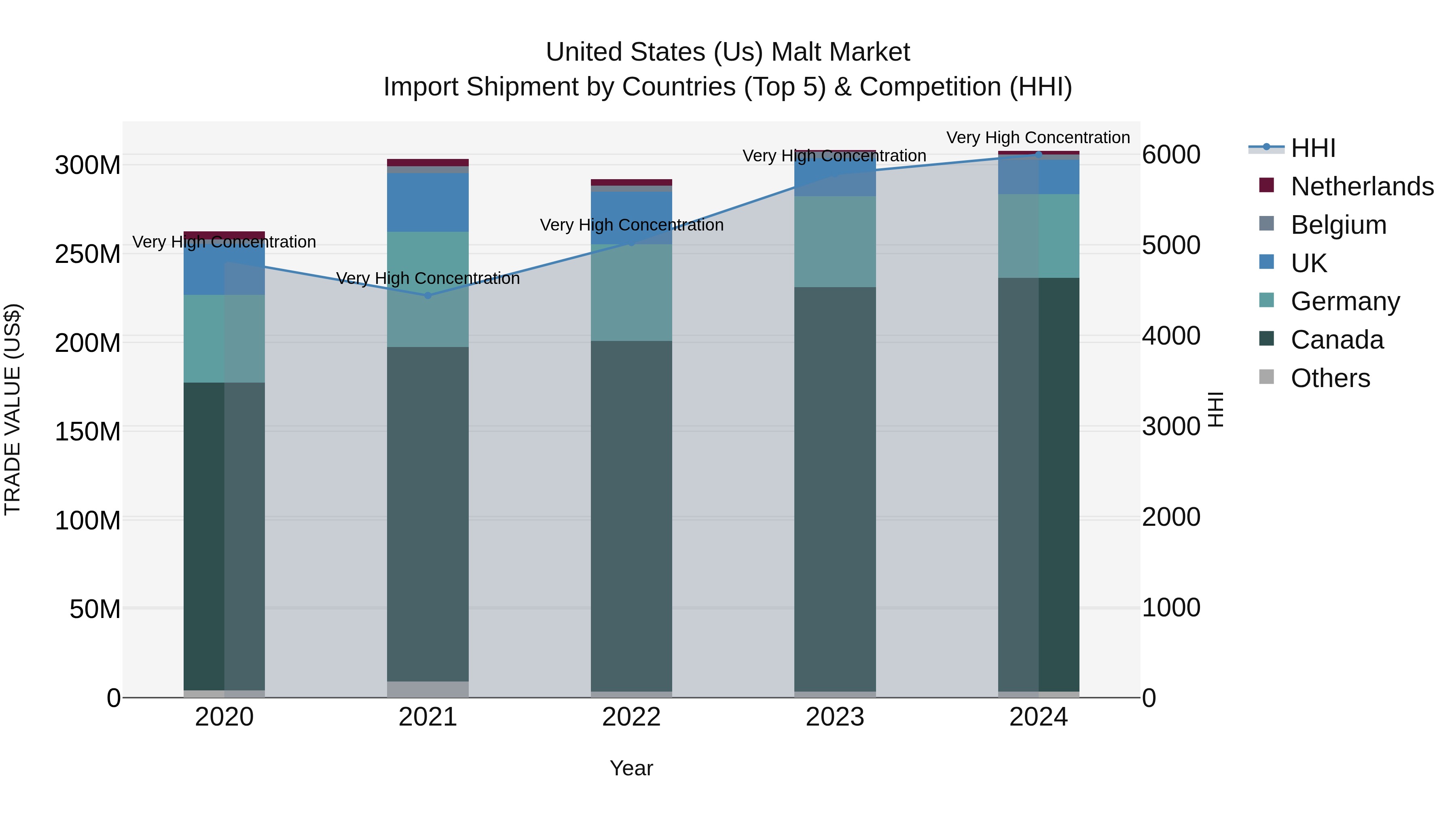
United States (US) Malt Market Top 5 Importing Countries and Market Competition (HHI) Analysis
In 2024, malt import shipments to the United States continued to be dominated by top exporting countries including Canada, Germany, UK, Belgium, and Netherlands. The high Herfindahl-Hirschman Index (HHI) indicates a concentrated market, with limited competition among suppliers. Despite a slight decline in growth rate from 2023 to 2024, the compound annual growth rate (CAGR) for the period 2020-2024 remained positive at 4.06%, reflecting a steady expansion in malt imports to meet demand in the US market.
US Malt Market Highlights
| Report Name | US Malt Market |
| Forecast period | 2025-2031 |
| CAGR | 9.4% |
| Growing Sector | Alcoholic Beverage |
Topics Covered in the US Malt Market Report
The US Malt market report thoroughly covers the market by type, by application and competitive Landscape. The report provides an unbiased and detailed analysis of the on-going market trends, opportunities/high growth areas, and market drivers which would help the stakeholders to devise and align their market strategies according to the current and future market dynamics.
US Malt Market Synopsis
The US malt market has witnessed significant growth in recent years, primarily driven by the rising popularity of craft beers and the burgeoning craft brewing industry. Malt, an essential ingredient in beer production, contributes to the beverage's flavor, color, and body. American maltsters are continually innovating, producing a variety of malt types to cater to the diverse pallets of craft beer enthusiasts. This surge in demand has not only impacted the malt industry but has also played a crucial role in cultivating a vibrant craft beer culture throughout the United States. Additionally, one of the most notable trends in the US malt market is the increasing emphasis on sustainability and organic production methods. With consumers becoming more environmentally conscious, there's been a significant uptick in demand for organic malts, which are produced without the use of synthetic fertilizers or pesticides. Additionally, there's a growing trend toward local sourcing, with craft breweries preferring to procure malt made from locally grown grains. This not only supports local farmers but also reduces the carbon footprint associated with transportation. Furthermore, the advent of novel malt varieties, tailored to enhance specific flavor profiles, indicates a shift towards more personalized and experimental brewing practices.
According to 6Wresearch, US Malt market size is projected to grow at a CAGR of 9.4% during 2025-2031. Several key factors have contributed to the robust growth of the US malt market. Firstly, the explosion of the craft beer sector has dramatically increased the demand for high-quality malt, with brewers seeking diverse malt varieties to create unique and complex beer flavors. Additionally, the rise in consumer preference for locally-sourced and sustainable products has propelled the demand for organic malt produced through eco-friendly practices. The adoption of innovative farming and malting techniques, aimed at enhancing the malt's flavor profile and yield, also plays a significant role. Lastly, the expanding interest in home brewing among hobbyists and enthusiasts has further fueled the growth of the malt market, as more individuals experiment with creating personalized beer blends at home.
Government Initiatives Introduced in the US Malt Market
Government initiatives have also been a significant driving force behind the growth of the sustainable malt industry. Various federal and state programs aim to support small-scale farmers and organic practices, providing grants, tax incentives, and research opportunities to promote eco-friendly agriculture. These initiatives not only encourage the adoption of sustainable farming methods but also foster collaborations between craft brewers and local farmers, creating a more resilient and environmentally responsible supply chain. Steadily, these efforts have enhanced the US Malt Market Share. Additionally, policies aimed at reducing the industry's carbon footprint align well with the craft brewing community's commitment to sustainability, further enhancing the appeal of locally sourced, organic malt.
Key Players in the US Malt Market
Several key companies have emerged as frontrunners in the US malt industry, significantly contributing to its development and sustainability. Among these, Malteurop North America and Great Western Malting stand out for their commitment to quality and innovation, supplying a wide range of malt products to craft brewers and distillers nationwide. Rahr Malting Co. is another major player, known for its advanced malting facilities and support for sustainable agriculture practices. Additionally, Briess Malt & Ingredients Co. has gained recognition for its artisanal approach to malting, offering organic and non-GMO malt varieties that cater to the growing demand for natural and sustainable brewing ingredients. Moreover, the companies’ clutch immense United States (US) Malt Market Revenues. Further, these companies, through their focus on sustainability, quality, and collaboration with local farmers, play pivotal roles in shaping the future of the US malt market.
Future Insights of the United States (US) Malt Market
Looking ahead, the future of the US malt industry appears to be on a trajectory toward even greater sustainability and innovation. With increasing consumer demand for organic and sustainably-produced beverages, the malt sector is expected to continue emphasizing environmentally responsible practices. We'll likely see more strategic partnerships between malt suppliers and organic farmers, aiming to enhance the sustainability of the supply chain while supporting local economies. Technological advancements in malting processes are also anticipated, which could further improve energy efficiency and reduce wastage. In response to a more informed and health-conscious consumer base, the industry might also expand its offerings of specialized malt varieties, such as gluten-free options, to cater to niche markets. Altogether, these trends suggest that the malt industry will remain at the forefront of the craft brewing movement, steering it towards a future that values both quality and environmental stewardship.
Market Analysis by Type
According to Ravi Bhandari, Research Head, 6Wresearch, the malt industry offers a variety of products tailored to meet the diverse needs of brewers, distillers, and food manufacturers. These include Malt, which is partially germinated cereal grains that have been dried in a process known as malting; Malt Extract, a concentrated syrup or powder made from malt and used to add flavor and color to beverages and foods; Malt Extract Powder, which is the dehydrated form of malt extract, offering a longer shelf-life and easier handling; Malt Flour, ground malted grains that can be used in baking and brewing to enhance flavor; Barley Malt, made specifically from barley, it's the most common type of malt in brewing, providing the sugars needed for fermentation; and Wheat Malt, which is malted wheat grains used primarily in the production of wheat beers, offering a lighter flavor and aiding in head retention. Each of these products contributes uniquely to the flavor profiles, textures, and nutritional values of a wide range of consumables.
Market Analysis by Application
The versatility of malt products extends beyond brewing, influencing various sectors such as the Beer Industry, where malt serves as the fundamental ingredient providing flavor, color, and the sugars necessary for fermentation. In the Whisky Distilleries, malted barley is crucial for creating the distinct flavors and aromas characteristic of fine spirits. The Food Industry benefits from malt's nutritional value and flavor-enhancing properties, utilizing it in products ranging from bread and confectionery to sauces and cereals. Malt extracts and powders are also widely used in the Beverage sector, contributing to the taste profiles of non-alcoholic drinks, smoothies, and nutritional supplements. Furthermore, the Pharmaceutical Industry employs malt extracts as nutritional supplements, due to their high content of vitamins, minerals, and amino acids, aiding in the development of health-focused products.
Key Attractiveness of the Report
- 10 Years Market Numbers.
- Historical Data Starting from 2021 to 2024.
- Base Year: 2024.
- Forecast Data until 2031.
- Key Performance Indicators Impacting the Market.
- Major Upcoming Developments and Projects.
Key Highlights of the Report:
- US Malt Market Overview
- US Malt Market Outlook
- US Malt Market Forecast
- Market Size of US Malt Market, 2024
- Forecast of United States (US) Malt Market, 2031
- Historical Data and Forecast of US Malt Revenues & Volume for the Period 2021-2031
- US Malt Market Trend Evolution
- US Malt Market Drivers and Challenges
- US Malt Price Trends
- US Malt Porter's Five Forces
- US Malt Industry Life Cycle
- Historical Data and Forecast of US Malt Market Revenues & Volume By Type for the Period 2021-2031
- Historical Data and Forecast of US Malt Market Revenues & Volume By Malt for the Period 2021-2031
- Historical Data and Forecast of US Malt Market Revenues & Volume By Malt Extract for the Period 2021-2031
- Historical Data and Forecast of US Malt Market Revenues & Volume By Malt Extract Powder for the Period 2021-2031
- Historical Data and Forecast of US Malt Market Revenues & Volume By Malt Flour for the Period 2021-2031
- Historical Data and Forecast of US Malt Market Revenues & Volume By Barley malt for the Period 2021-2031
- Historical Data and Forecast of US Malt Market Revenues & Volume By Wheat malt for the Period 2021-2031
- Historical Data and Forecast of US Malt Market Revenues & Volume By Rye malt for the Period 2021-2031
- Historical Data and Forecast of US Malt Market Revenues & Volume By Application for the Period 2021-2031
- Historical Data and Forecast of US Malt Market Revenues & Volume By Beer Industry for the Period 2021-2031
- Historical Data and Forecast of US Malt Market Revenues & Volume, By Whisky Distilleries for the Period 2021-2031
- Historical Data and Forecast of US Malt Market Revenues & Volume, By Food industry for the Period 2021-2031
- Historical Data and Forecast of US Malt Market Revenues & Volume, By Beverages for the Period 2021-2031
- Historical Data and Forecast of US Malt Market Revenues & Volume, By Pharmaceutical industry for the Period 2021-2031
- US Malt Import Export Trade Statistics
- Market Opportunity Assessment, By Type
- Market Opportunity Assessment, By Application
- US Malt Top Companies Market Share
- US Malt Competitive Benchmarking, By Technical and Operational Parameters
- US Malt Company Profiles
- US Malt Key Strategic Recommendations
Markets Covered
The US Malt market report provides a detailed analysis of the following market segments:
By Type
- Malt
- Malt Extract
- Malt Extract Powder
- Malt Flour
- Barley Malt
- Wheat Malt
- Rye Malt
By Application
- Beer Industry
- Whisky Distilleries
- Food Industry
- Beverages
- Pharmaceutical Industry
US Malt Market (2025-2031): FAQs
The market growth is driven by the explosion of the craft beer sector has dramatically increased the demand for high-quality malt, with brewers seeking diverse malt varieties to create unique and complex beer flavors.
The barley malt is expected to register enormous growth over the years.
The beer type grasps the highest market share.
Rahr Malting Co. and Briess Malt & Ingredients Co. are some of the prominent players in the United States (US) Malt market.
6Wresearch actively monitors the US Malt Market and publishes its comprehensive annual report, highlighting emerging trends, growth drivers, revenue analysis, and forecast outlook. Our insights help businesses to make data-backed strategic decisions with ongoing market dynamics. Our analysts track relevent industries related to the US Malt Market, allowing our clients with actionable intelligence and reliable forecasts tailored to emerging regional needs.
Yes, we provide customisation as per your requirements. To learn more, feel free to contact us on sales@6wresearch.com
| 1 Executive Summary |
| 2 Introduction |
| 2.1 Key Highlights of the Report |
| 2.2 Report Description |
| 2.3 Market Scope & Segmentation |
| 2.4 Research Methodology |
| 2.5 Assumptions |
| 3 US Malt Market Overview |
| 3.1 US Country Macro Economic Indicators |
| 3.2 US Malt Market Revenues & Volume, 2021 & 2031F |
| 3.3 US Malt Market - Industry Life Cycle |
| 3.4 US Malt Market - Porter's Five Forces |
| 3.5 US Malt Market Revenues & Volume Share, By Type, 2021 & 2031F |
| 3.6 US Malt Market Revenues & Volume Share, By Application, 2021 & 2031F |
| 4 US Malt Market Dynamics |
| 4.1 Impact Analysis |
| 4.2 Market Drivers |
| 4.2.1 Increasing consumer awareness about the health benefits of malt-based products |
| 4.2.2 Growing demand for craft beer and specialty malt products |
| 4.2.3 Expansion of the food and beverage industry in the United States |
| 4.3 Market Restraints |
| 4.3.1 Fluctuating prices of raw materials such as barley and wheat |
| 4.3.2 Stringent government regulations related to alcohol production and consumption |
| 4.3.3 Competition from substitute products like corn syrup and artificial sweeteners |
| 5 US Malt Market Trends |
| 6 US Malt Market, By Types |
| 6.1 US Malt Market, By Type |
| 6.1.1 Overview and Analysis |
| 6.1.2 US Malt Market Revenues & Volume, By Type, 2021-2031F |
| 6.1.3 US Malt Market Revenues & Volume, By Malt, 2021-2031F |
| 6.1.4 US Malt Market Revenues & Volume, By Malt Extract, 2021-2031F |
| 6.1.5 US Malt Market Revenues & Volume, By Malt Extract Powder, 2021-2031F |
| 6.1.6 US Malt Market Revenues & Volume, By Malt Flour, 2021-2031F |
| 6.1.7 US Malt Market Revenues & Volume, By Barley malt, 2021-2031F |
| 6.1.8 US Malt Market Revenues & Volume, By Wheat malt, 2021-2031F |
| 6.2 US Malt Market, By Application |
| 6.2.1 Overview and Analysis |
| 6.2.2 US Malt Market Revenues & Volume, By Beer Industry , 2021-2031F |
| 6.2.3 US Malt Market Revenues & Volume, By Whisky Distilleries, 2021-2031F |
| 6.2.4 US Malt Market Revenues & Volume, By Food industry , 2021-2031F |
| 6.2.5 US Malt Market Revenues & Volume, By Beverages , 2021-2031F |
| 6.2.6 US Malt Market Revenues & Volume, By Pharmaceutical industry, 2021-2031F |
| 7 US Malt Market Import-Export Trade Statistics |
| 7.1 US Malt Market Export to Major Countries |
| 7.2 US Malt Market Imports from Major Countries |
| 8 US Malt Market Key Performance Indicators |
| 8.1 Average selling price of malt products |
| 8.2 Percentage of market penetration in different regions of the United States |
| 8.3 Number of new product launches in the malt market |
| 8.4 Consumer sentiment and feedback regarding malt-based products |
| 8.5 Investment in research and development for innovative malt products |
| 9 US Malt Market - Opportunity Assessment |
| 9.1 US Malt Market Opportunity Assessment, By Type, 2021 & 2031F |
| 9.2 US Malt Market Opportunity Assessment, By Application, 2021 & 2031F |
| 10 US Malt Market - Competitive Landscape |
| 10.1 US Malt Market Revenue Share, By Companies, 2024 |
| 10.2 US Malt Market Competitive Benchmarking, By Operating and Technical Parameters |
| 11 Company Profiles |
| 12 Recommendations |
| 13 Disclaimer |
Global Go To Market Strategy - 2030
Export potential enables firms to identify high-growth global markets with greater confidence by combining advanced trade intelligence with a structured quantitative methodology. The framework analyzes emerging demand trends and country-level import patterns while integrating macroeconomic and trade datasets such as GDP and population forecasts, bilateral import–export flows, tariff structures, elasticity differentials between developed and developing economies, geographic distance, and import demand projections. Using weighted trade values from 2020–2024 as the base period to project country-to-country export potential for 2030, these inputs are operationalized through calculated drivers such as gravity model parameters, tariff impact factors, and projected GDP per-capita growth. Through an analysis of hidden potentials, demand hotspots, and market conditions that are most favorable to success, this method enables firms to focus on target countries, maximize returns, and global expansion with data, backed by accuracy.
By factoring in the projected importer demand gap that is currently unmet and could be potential opportunity, it identifies the potential for the Exporter (Country) among 190 countries, against the general trade analysis, which identifies the biggest importer or exporter.
To discover high-growth global markets and optimize your business strategy:
Click Here
Pricing
- Single User License$ 1,995
- Department License$ 2,400
- Site License$ 3,120
- Global License$ 3,795

Leadership Perspectives from Industry Events
Search
Thought Leadership and Analyst Meet





Our Clients








6WResearch In News
- India Export Attractiveness Tracker 2026
- India Air Conditioner Market Set for Strong Rebound in 2026 After Weather-Led Correction and GST-Driven Recovery: 6Wresearch
- ADAS in India: How Automatic Emergency Braking, Blind Spot Detection & Driver Monitoring are Transforming Road Safety
- Doha a strategic location for EV manufacturing hub: IPA Qatar
- Demand for luxury TVs surging in the GCC, says Samsung
- Empowering Growth: The Thriving Journey of Bangladesh’s Cable Industry
Latest Reports
- Nicaragua RPG Gaming Market (2026-2032)
- New Zealand RPG Gaming Market (2026-2032)
- Netherlands RPG Gaming Market (2026-2032)
- Nauru RPG Gaming Market (2026-2032)
- Namibia RPG Gaming Market (2026-2032)
- Mozambique RPG Gaming Market (2026-2032)
- Montenegro RPG Gaming Market (2026-2032)
- Mongolia RPG Gaming Market (2026-2032)
- Monaco RPG Gaming Market (2026-2032)
- Micronesia RPG Gaming Market (2026-2032)
Industry Events and Analyst Meet

EV India Expo 2026

HIMTEX 2026

India Refining Summit 2026

India EV Show 2026

EV tech India Expo 2026
Whitepaper
- Middle East & Africa Commercial Security Market Click here to view more.
- Middle East & Africa Fire Safety Systems & Equipment Market Click here to view more.
- GCC Drone Market Click here to view more.
- Middle East Lighting Fixture Market Click here to view more.
- GCC Physical & Perimeter Security Market Click here to view more.


