United States (US) Mobile Security Market Size & Growth Rate (2026-2032)
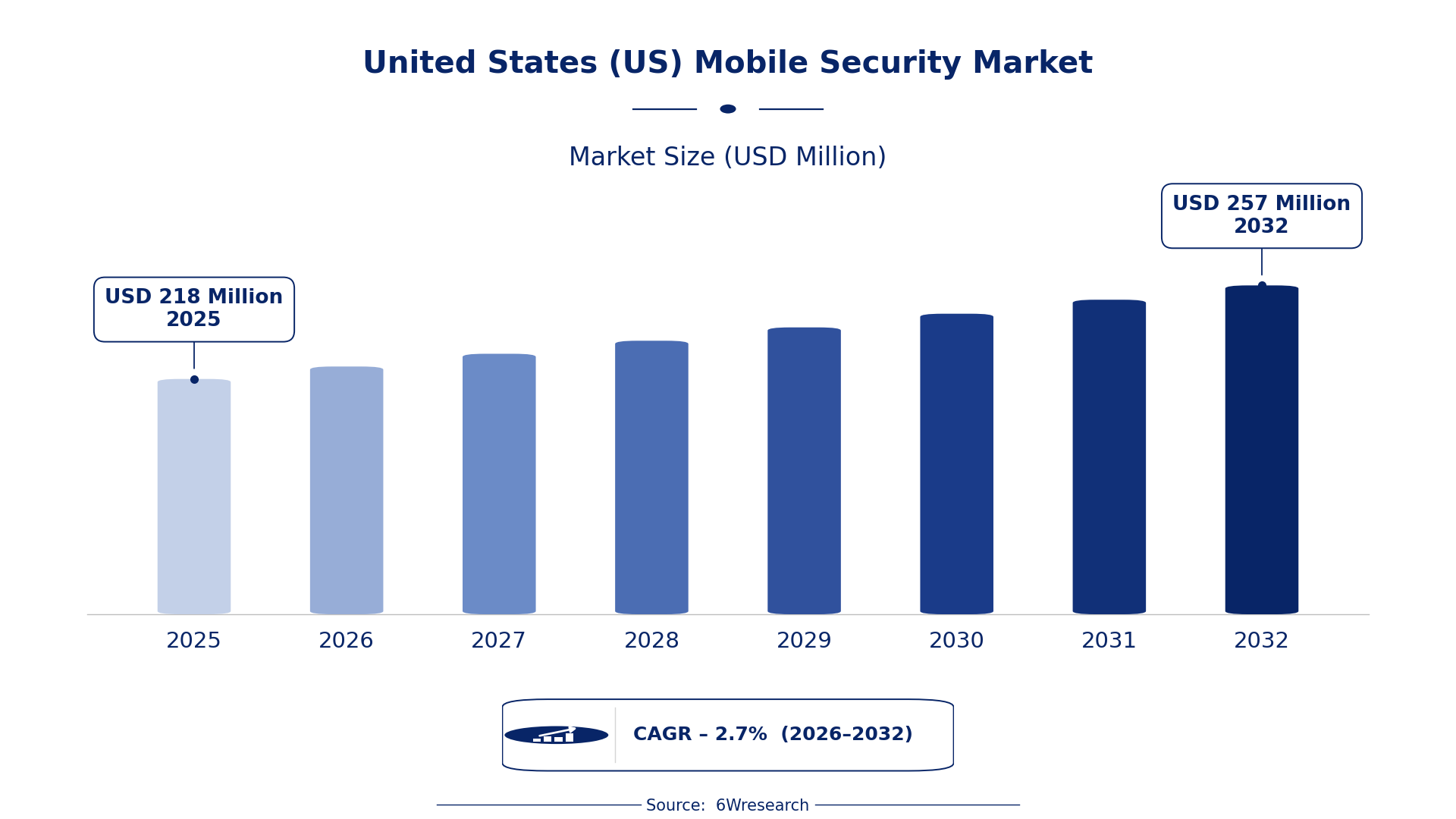
The United States (US) Mobile Security Market was estimated at USD 218 Million in 2025 and is projected to reach USD 257 Million by 2032, growing at a CAGR of 2.7% from 2026 to 2032.
United States (US) Mobile Security Market Synopsis
The surge in smartphone and tablet adoption has made mobile security a pressing concern for organizations across the United States. With every device representing a potential gateway for cyber threats, businesses are increasingly prioritizing mobile security solutions to safeguard sensitive information.
As regulatory frameworks like GDPR and HIPAA impose stricter compliance requirements, the demand for comprehensive security measures has escalated. Organizations are seeking solutions not only for compliance but also to protect their reputations and maintain customer trust in a digital age fraught with vulnerabilities.
United States (US) Mobile Security Market Year-wise Growth Rate and Key Drivers
This graph illustrates the annual growth rates of the United States (US) Mobile Security Market from 2021 to 2032, highlighting a steady upward trajectory and projected expansion over the forecast period.
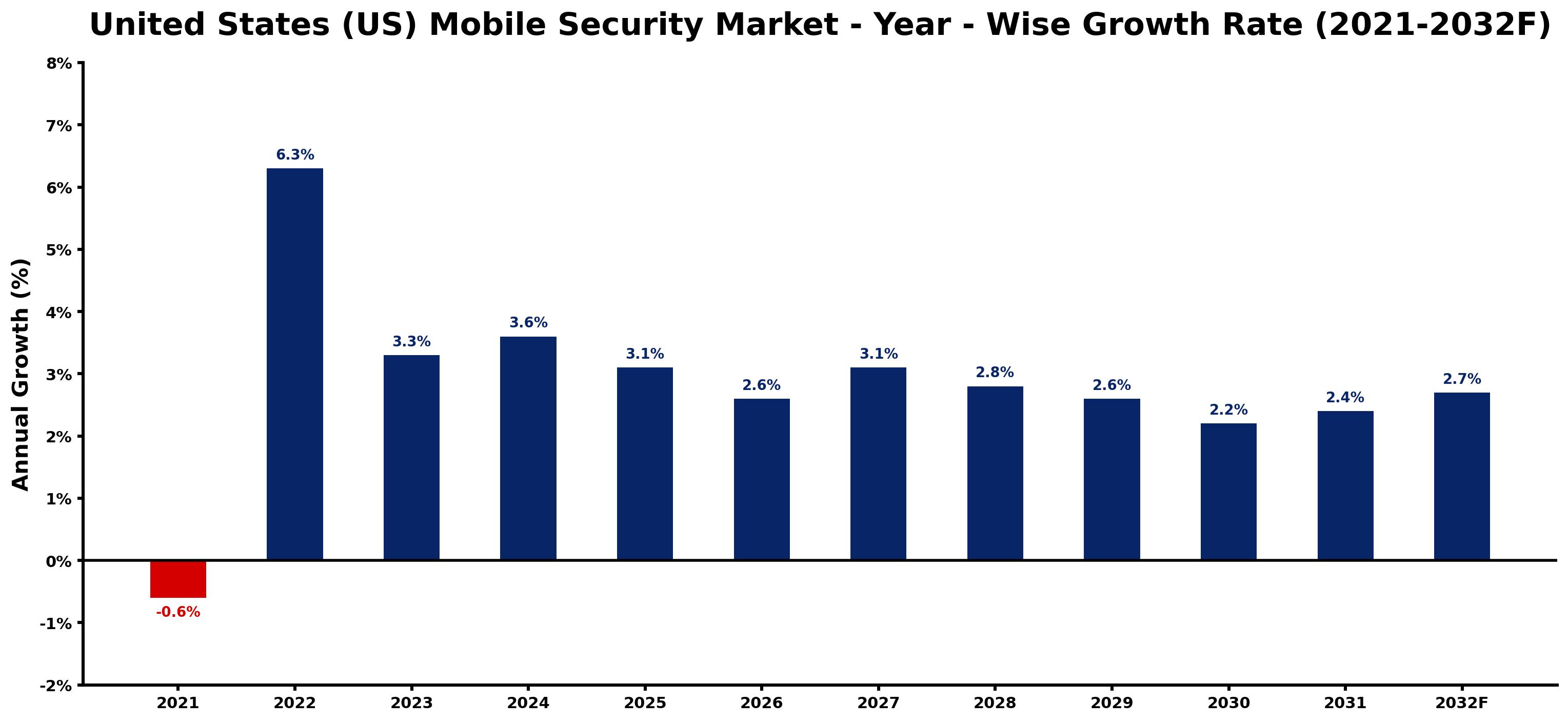
The table below presents the year‑wise growth rates along with the key drivers influencing the market
| Year | Growth Rate | Major Drivers |
| 2021 | -0.6% | Delay in implementation of CISA cybersecurity initiatives |
| 2022 | 6.3% | Rise in remote work amplifying mobile security concerns. |
| 2023 | 3.3% | Increased regulatory scrutiny on personal data protection laws. |
| 2024 | 3.6% | Adoption of mobile payments necessitating enhanced security measures. |
| 2025 | 3.1% | Cybersecurity insurance market growth drives demand for mobile security. |
| 2026 | 2.6% | Implementation of CISA guidelines enhances mobile device security. |
| 2027 | 3.1% | Surge in mobile malware threats prompts security upgrades. |
| 2028 | 2.8% | Public awareness campaigns on mobile fraud increase demand. |
| 2029 | 2.6% | Smartphone penetration among seniors drives demand for security features. |
| 2030 | 2.2% | Emergence of IoT devices requires advanced mobile security solutions. |
| 2031 | 2.4% | Regulatory mandates for KYC compliance accelerate mobile security services. |
| 2032 | 2.7% | Partnerships between telecoms and security firms foster innovation. |
Note: Market size estimations and growth projections presented in this report are based on 6Wresearch's proprietary forecasting methodology, utilizing the latest available industry data, government publications, and primary research inputs.
United States (US) Mobile Security Market Key Takeaways
Below are some of the specific key takeaways from the market, including:
- Mobile device management (MDM) solutions are becoming essential for organizations to secure and oversee their devices.
- There is a rising trend towards advanced authentication methods, such as biometrics and multi-factor authentication, to enhance mobile security.
- Integration of artificial intelligence and machine learning in mobile security solutions is gaining traction to proactively combat threats.
- Companies are increasingly adopting comprehensive mobile security platforms that include features like app security and data encryption.
- The ongoing shift towards remote work and BYOD policies is reshaping security strategies for organizations in the US.
Evaluation of Restraints in United States (US) Mobile Security Market
The US Mobile Security Market faces notable constraints that hinder its progress. One of the primary challenges is the rapid evolution of cyber threats, which constantly outpace the development of security solutions. This leads to a perpetual need for innovation and updates to existing security measures.
on top of that, the diverse range of operating systems and device types complicates comprehensive protection across all platforms. Organizations struggle to find solutions that adequately balance stringent security protocols with user experience, as overly restrictive measures can frustrate users and impede productivity.
United States (US) Mobile Security Market Trends
Key trends are shaping the US Mobile Security Market, reflecting an urgent need for enhanced protection. Companies are increasingly investing in mobile device management (MDM) solutions that enable secure access and device oversight. The rise in mobile malware threats has propelled demand for advanced detection and prevention technologies.
Additionally, organizations are shifting towards integrated platforms that provide multiple security capabilities, such as secure web browsing and application security. The incorporation of AI and machine learning is notable, as these technologies facilitate real-time threat analysis and rapid response capabilities.
United States (US) Mobile Security Market Opportunities
The potential for investment in the US Mobile Security Market is promising. As data security concerns escalate, companies that offer innovative mobile security software, authentication solutions, and threat detection technologies are well-positioned for growth.
Investors should focus on organizations developing cutting-edge encryption techniques and biometric authentication systems, as these areas are gaining momentum. With the expanding mobile workforce and the adoption of new technologies, the demand for effective mobile data protection solutions will continue to rise.
Government Initiatives in the United States (US) Mobile Security Market
Government policies play a crucial role in shaping the US Mobile Security Market. Regulatory bodies are taking actionable steps to address mobile security challenges through stringent compliance requirements. As a result, organizations are under pressure to enhance their security frameworks, ensuring consumer data protection.
- The Federal Trade Commission (FTC) has recently reinforced laws concerning consumer data protection, mandating companies to adopt stronger security measures.
- Current initiatives from the National Institute of Standards and Technology (NIST) focus on developing updated guidelines for cybersecurity best practices, including mobile-specific protocols.
- A public-private partnership is currently underway to enhance mobile infrastructure security through collaborative efforts between industry stakeholders and government agencies.
- A planned cybersecurity awareness campaign aims to educate businesses on the importance of mobile security, set to launch in early 2026.
- The Department of Homeland Security (DHS) is expected to initiate a mobile security grant program by mid-2026 to support technology upgrades for small businesses.
Future Insights of the United States (US) Mobile Security Market
Looking ahead, the US Mobile Security Market is on a trajectory of sustained growth through 2032. The increasing mobile workforce and the ongoing BYOD trend will necessitate more robust mobile security solutions. As more companies embrace e-commerce and mobile banking, the stakes for data protection will rise even higher.
The rise of 5G technology will expand the attack surface for mobile devices, emphasizing the need for comprehensive security measures. Investment in advanced mobile threat defense systems and secure access controls will be critical for organizations aiming to stay ahead of evolving cyber threats.
United States (US) Mobile Security Market Latest Developments
Recent months have seen a flurry of activity in the US Mobile Security Market, highlighting both innovation and investment in this critical area. Companies are actively rolling out new technologies to address growing security threats and meet the regulatory requirements imposed by the government.
- A major technology vendor launched a comprehensive mobile threat detection system in late 2025, significantly enhancing organizations' capabilities to identify and respond to cyber threats.
- A regional operator is currently implementing an enhanced mobile device management platform, which began in early 2025 and remains underway.
- An upcoming initiative, expected to launch in mid-2026, aims to integrate advanced biometric authentication features into existing mobile security frameworks.
- A collaborative project between leading cybersecurity firms and educational institutions kicked off in early 2025, focusing on developing training programs for IT professionals.
- A new service upgrade was introduced in late 2025, providing enhanced encryption protocols for mobile transactions in response to the rise of mobile banking threats.
United States (US) Mobile Security Market - Key Attractiveness of the Report
- 10 Years of Market Numbers
- Historical Data Starting from 2022 to 2025
- Base Year: 2025
- Forecast Data until 2032
- Key Performance Indicators Impacting the Market
- Major Upcoming Developments and Projects
Key Highlights of the Report:
- United States (US) Mobile Security Market Outlook
- Market Size of United States (US) Mobile Security Market, 2025
- Forecast of United States (US) Mobile Security Market, 2032
- Historical Data and Forecast of United States (US) Mobile Security Revenues & Volume for the Period 2022-2032F
- United States (US) Mobile Security Market Trend Evolution
- United States (US) Mobile Security Market Drivers and Challenges
- United States (US) Mobile Security Price Trends
- United States (US) Mobile Security Porter's Five Forces
- United States (US) Mobile Security Industry Life Cycle
- Historical Data and Forecast of United States (US) Mobile Security Market Revenues & Volume By End User for the Period 2022-2032F
- Historical Data and Forecast of United States (US) Mobile Security Market Revenues & Volume By Individual for the Period 2022-2032F
- Historical Data and Forecast of United States (US) Mobile Security Market Revenues & Volume By Enterprise (Solution (Authentication, Application Security, & Device Security), Service) for the Period 2022-2032F
- Historical Data and Forecast of United States (US) Mobile Security Market Revenues & Volume By Deployment Mode for the Period 2022-2032F
- Historical Data and Forecast of United States (US) Mobile Security Market Revenues & Volume By On-premises for the Period 2022-2032F
- Historical Data and Forecast of United States (US) Mobile Security Market Revenues & Volume By Cloud for the Period 2022-2032F
- Historical Data and Forecast of United States (US) Mobile Security Market Revenues & Volume By Organization Size for the Period 2022-2032F
- Historical Data and Forecast of United States (US) Mobile Security Market Revenues & Volume By Small and Medium-Sized Enterprises (SMEs) for the Period 2022-2032F
- Historical Data and Forecast of United States (US) Mobile Security Market Revenues & Volume By Large Enterprises for the Period 2022-2032F
- Historical Data and Forecast of United States (US) Mobile Security Market Revenues & Volume By Vertical for the Period 2022-2032F
- Historical Data and Forecast of United States (US) Mobile Security Market Revenues & Volume By BFSI for the Period 2022-2032F
- Historical Data and Forecast of United States (US) Mobile Security Market Revenues & Volume By Telecom & IT for the Period 2022-2032F
- Historical Data and Forecast of United States (US) Mobile Security Market Revenues & Volume By Retail for the Period 2022-2032F
- Historical Data and Forecast of United States (US) Mobile Security Market Revenues & Volume By Healthcare for the Period 2022-2032F
- Historical Data and Forecast of United States (US) Mobile Security Market Revenues & Volume By Government & Defense for the Period 2022-2032F
- Historical Data and Forecast of United States (US) Mobile Security Market Revenues & Volume By Manufacturing for the Period 2022-2032F
- Historical Data and Forecast of United States (US) Mobile Security Market Revenues & Volume By Others for the Period 2022-2032F
- Historical Data and Forecast of United States (US) Mobile Security Market Revenues & Volume By Operating System for the Period 2022-2032F
- Historical Data and Forecast of United States (US) Mobile Security Market Revenues & Volume By iOS for the Period 2022-2032F
- Historical Data and Forecast of United States (US) Mobile Security Market Revenues & Volume By Android for the Period 2022-2032F
- United States (US) Mobile Security Import Export Trade Statistics
- Market Opportunity Assessment By End User
- Market Opportunity Assessment By Deployment Mode
- Market Opportunity Assessment By Organization Size
- Market Opportunity Assessment By Vertical
- Market Opportunity Assessment By Operating System
- United States (US) Mobile Security Top Companies Market Share
- United States (US) Mobile Security Competitive Benchmarking By Technical and Operational Parameters
- United States (US) Mobile Security Company Profiles
- United States (US) Mobile Security Key Strategic Recommendations






































