United States (US) Phosphate Market Top 5 Importing Countries and Market Competition (HHI) Analysis
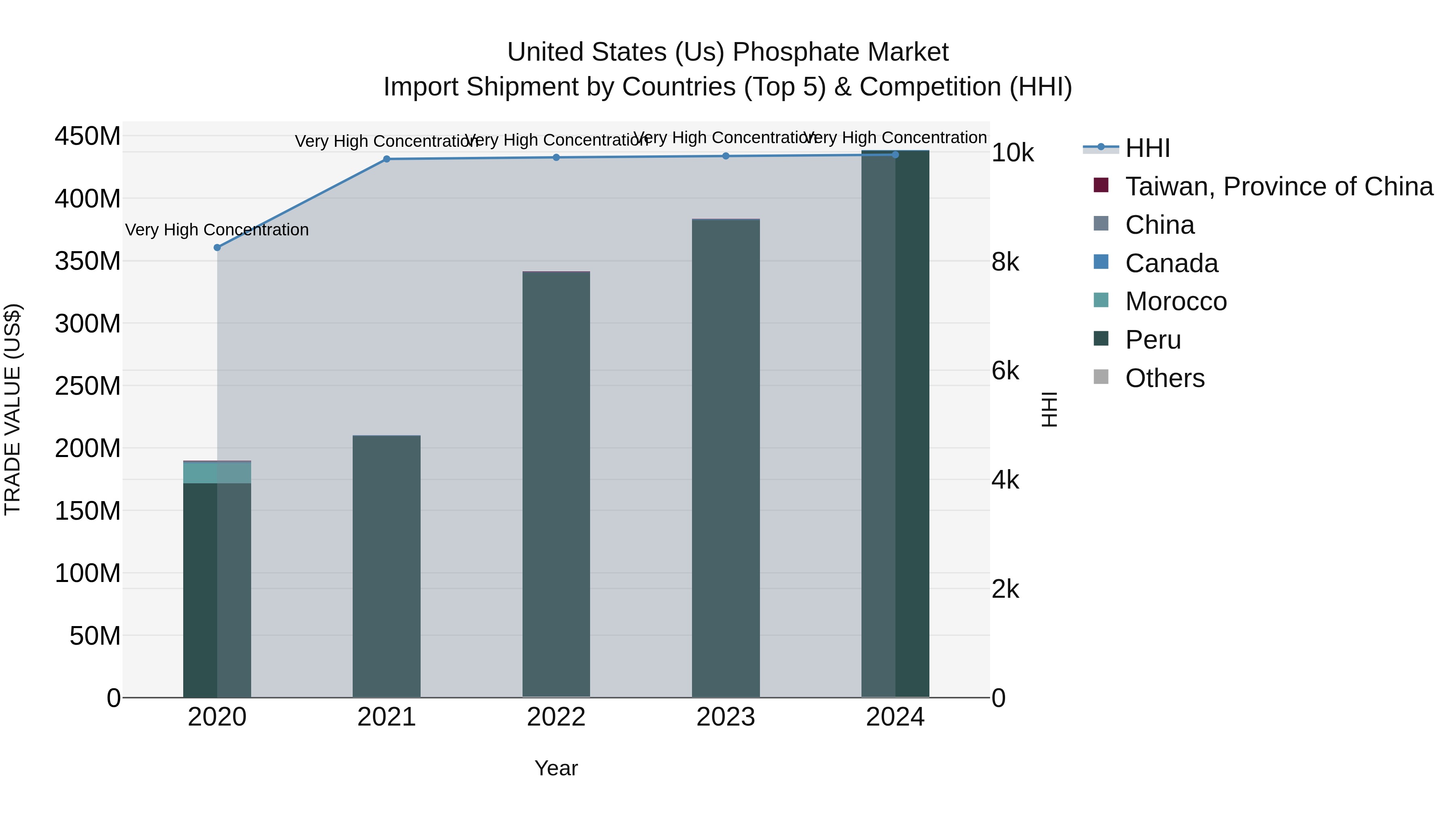
The United States saw a significant increase in phosphate import shipments in 2024, with top exporting countries being Peru, UK, Canada, Spain, and Mexico. The market remained highly concentrated, as indicated by the high Herfindahl-Hirschman Index (HHI). The compound annual growth rate (CAGR) from 2020 to 2024 was an impressive 23.29%, highlighting the growing demand for phosphate imports in the US. Moreover, the growth rate from 2023 to 2024 reached 14.31%, indicating a strong upward trend in the market. These trends suggest a favorable outlook for the phosphate import market in the US.
United States (US) Phosphate Market Overview
The United States Phosphate Market is a crucial segment of the global fertilizer industry, with the US being one of the largest producers and consumers of phosphate-based fertilizers. Phosphates are essential nutrients for plant growth, making them a key component in agriculture. The market is influenced by factors such as agricultural trends, weather patterns, and government policies. Key players in the US phosphate market include companies like Mosaic Company, Nutrien Ltd., and CF Industries. The market is also impacted by international trade dynamics, as the US imports and exports phosphate products. Sustainability and environmental concerns are growing priorities in the industry, leading to increased focus on eco-friendly phosphate solutions and efficient nutrient management practices. Overall, the US phosphate market continues to play a vital role in supporting agricultural productivity and food security.
United States (US) Phosphate Market Trends and Opportunities
The US Phosphate Market is experiencing steady growth due to increasing demand from agriculture, food processing, and chemical industries. The trend of sustainable agriculture practices and the rising popularity of organic farming are driving the demand for phosphate-based fertilizers. Additionally, the growing awareness of the importance of soil health and nutrient management is creating opportunities for innovative phosphate products that enhance crop yield and quality. The market is also witnessing a shift towards specialty phosphates in food processing applications, driven by the demand for clean-label and functional ingredients. Overall, the US Phosphate Market is poised for further expansion as companies focus on developing environmentally friendly and efficient phosphate products to meet the evolving needs of various industries.
United States (US) Phosphate Market Challenges
In the US Phosphate Market, some of the key challenges include environmental concerns surrounding phosphate mining and processing, regulatory pressures related to water pollution and ecosystem disruptions, fluctuating global demand and pricing, and competition from alternative fertilizers. Additionally, the industry is facing issues such as limited domestic phosphate reserves, reliance on imports to meet demand, and the need for technological advancements to improve efficiency and sustainability. Market players are also grappling with the impact of trade policies, changing consumer preferences towards organic and sustainable agriculture practices, and the need to innovate in order to stay competitive in a rapidly evolving market landscape. Overall, navigating these challenges requires strategic planning, investment in research and development, and a commitment to sustainable practices in the US Phosphate Market.
United States (US) Phosphate Market Drivers
The United States phosphate market is primarily driven by factors such as the growing demand for fertilizers in the agriculture sector, as phosphates are essential nutrients for plant growth. The increasing population and the need to enhance food production to meet this demand are fueling the use of phosphate-based fertilizers. Additionally, the expanding industrial applications of phosphates in sectors like food and beverage, water treatment, and pharmaceuticals are contributing to market growth. Technological advancements in phosphate mining and processing methods, as well as government initiatives to promote sustainable agriculture practices, are also driving the market. However, environmental concerns related to phosphate runoff and regulations regarding phosphate usage in some regions are challenges that could impact market growth in the future.
United States (US) Phosphate Market Government Policy
Government policies related to the US Phosphate Market primarily focus on environmental regulations, land use policies, and mining regulations. The US Environmental Protection Agency (EPA) and state agencies enforce regulations to mitigate the environmental impact of phosphate mining, processing, and waste disposal. Additionally, land use policies play a crucial role in determining where mining activities can take place, with a focus on protecting sensitive ecosystems and water resources. Mining regulations also govern the extraction and transportation of phosphate materials to ensure worker safety and environmental protection. Overall, the government aims to balance the economic benefits of the phosphate industry with the need to safeguard the environment and public health through a combination of stringent regulations and oversight.
United States (US) Phosphate Market Future Outlook
The future outlook for the United States Phosphate Market appears promising due to the increasing demand for fertilizers in the agriculture industry. Phosphates are essential nutrients for plant growth, and with the growing global population, the need for higher crop yields is driving the demand for phosphate-based fertilizers. Additionally, the expansion of the food industry and the rising trend of organic farming practices are expected to further boost the market for phosphates. However, environmental concerns and regulations regarding phosphate runoff and water pollution may pose challenges for the market in the future, leading to a shift towards sustainable and eco-friendly phosphate alternatives. Overall, the US Phosphate Market is anticipated to witness steady growth with a focus on innovation and sustainability in the coming years.
Key Highlights of the Report:
- United States (US) Phosphate Market Outlook
- Market Size of United States (US) Phosphate Market, 2022
- Forecast of United States (US) Phosphate Market, 2031
- Historical Data and Forecast of United States (US) Phosphate Revenues & Volume for the Period 2021 - 2031
- United States (US) Phosphate Market Trend Evolution
- United States (US) Phosphate Market Drivers and Challenges
- United States (US) Phosphate Price Trends
- United States (US) Phosphate Porter's Five Forces
- United States (US) Phosphate Industry Life Cycle
- Historical Data and Forecast of United States (US) Phosphate Market Revenues & Volume By Type/Derivative for the Period 2021 - 2031
- Historical Data and Forecast of United States (US) Phosphate Market Revenues & Volume By Ammonium Phosphate for the Period 2021 - 2031
- Historical Data and Forecast of United States (US) Phosphate Market Revenues & Volume By Calcium Phosphate for the Period 2021 - 2031
- Historical Data and Forecast of United States (US) Phosphate Market Revenues & Volume By Phosphoric Acid for the Period 2021 - 2031
- Historical Data and Forecast of United States (US) Phosphate Market Revenues & Volume By Application for the Period 2021 - 2031
- Historical Data and Forecast of United States (US) Phosphate Market Revenues & Volume By Fertilizers for the Period 2021 - 2031
- Historical Data and Forecast of United States (US) Phosphate Market Revenues & Volume By Foods & Beverages for the Period 2021 - 2031
- Historical Data and Forecast of United States (US) Phosphate Market Revenues & Volume By Detergents for the Period 2021 - 2031
- Historical Data and Forecast of United States (US) Phosphate Market Revenues & Volume By Type of Resource for the Period 2021 - 2031
- Historical Data and Forecast of United States (US) Phosphate Market Revenues & Volume By Sedimentary Marine Deposits for the Period 2021 - 2031
- Historical Data and Forecast of United States (US) Phosphate Market Revenues & Volume By Igneous & Weathered for the Period 2021 - 2031
- Historical Data and Forecast of United States (US) Phosphate Market Revenues & Volume By Biogenic for the Period 2021 - 2031
- United States (US) Phosphate Import Export Trade Statistics
- Market Opportunity Assessment By Type/Derivative
- Market Opportunity Assessment By Application
- Market Opportunity Assessment By Type of Resource
- United States (US) Phosphate Top Companies Market Share
- United States (US) Phosphate Competitive Benchmarking By Technical and Operational Parameters
- United States (US) Phosphate Company Profiles
- United States (US) Phosphate Key Strategic Recommendations






































